Concrete parking structures age on their own schedule, and it is rarely a convenient one. Chloride-induced corrosion, freeze-thaw cycling, and decades of deferred maintenance combine to create repair backlogs that operators face every budget season. For the facility manager who inherited an aging deck or the ownership group weighing a major rehabilitation against a sale or adaptive reuse, the decisions are consequential and the technical landscape is dense.
This guide cuts through that complexity. It covers how concrete parking structures deteriorate, how to organize a condition assessment, how to prioritize and sequence repairs, and what operators consistently get wrong when managing these projects.
Why Parking Structures Deteriorate Faster Than Other Concrete Buildings
Parking structures face a combination of stressors that most concrete buildings do not. Understanding the mechanisms matters because the repair strategy depends entirely on the root cause.
Chloride-Induced Corrosion
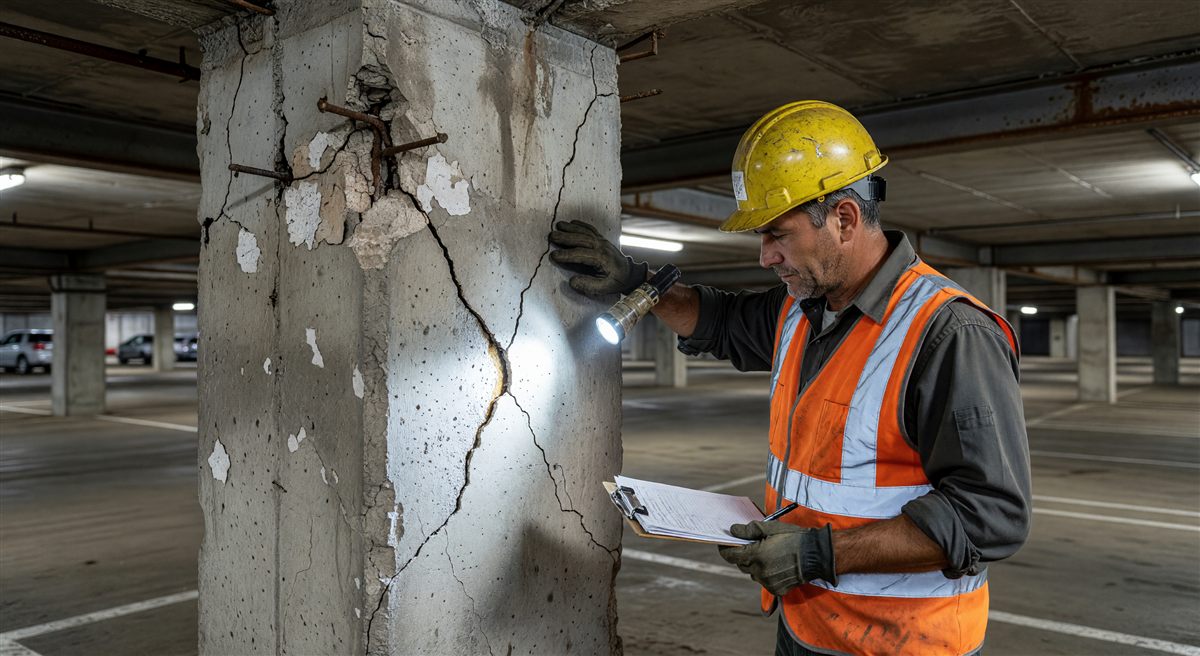
The dominant failure mode in cold climates is chloride attack. Deicing salts applied to roadways track into facilities on vehicle undercarriages and accumulate on deck surfaces. Chloride ions migrate through concrete, reach the reinforcing steel, and initiate electrochemical corrosion. As rebar corrodes, it expands — producing the delamination, cracking, and spalling that operators recognize as the visible face of the problem. By the time concrete begins falling from a soffit, corrosion of the steel beneath has often been progressing for a decade or more.
Carbonation
In mild climates where deicing salts are less common, carbonation drives deterioration. Atmospheric CO₂ reacts with calcium hydroxide in the concrete matrix, reducing pH and eventually destroying the passive layer that protects embedded steel. Carbonation advances slowly — typically a few millimeters per year in well-cured concrete — but in older structures built with lower-quality mix designs, it can penetrate deeply.
Freeze-Thaw Cycling
Water trapped in concrete pores expands upon freezing, generating internal pressure that progressively fractures the paste matrix. Structures in climates with frequent freeze-thaw cycles (typically defined as more than 20 cycles per year) require air-entraining admixtures in concrete mixes to resist this mechanism. Older structures built before this was standard practice are particularly vulnerable.
Design and Construction Deficiencies
Many structures built in the 1960s through the 1980s were designed with inadequate concrete cover over reinforcing steel, insufficient drainage slopes, or waterproofing details that were never installed or have long since failed. These design-era vulnerabilities accelerate all of the mechanisms above.
Organizing a Condition Assessment
Informed repair decisions require credible condition data. The industry standard for parking structure assessment involves several interrelated investigation methods.
Visual Survey
A systematic visual survey is the foundation. Trained inspectors walk every bay of every level — top deck, intermediate levels, and the underside of each deck (soffit) — cataloging and mapping:
- Cracks (width, length, pattern, and orientation)
- Delaminations (detected by sounding with a hammer or chain drag)
- Spalls (active and historic, with depth estimates)
- Efflorescence and staining
- Joint and sealant conditions
- Drain conditions and evidence of ponding
- Post-tensioning anchor pockets and exposed tendons (in PT structures)
The output is a condition map — ideally plotted on floor plan drawings — that allows quantitative area calculations for each defect category.
Chloride Content Testing
Core samples extracted from the deck and analyzed in a laboratory reveal the chloride concentration profile at various depths. This data, compared against the threshold level for corrosion initiation (~0.03% by weight of concrete for conventional steel), allows engineers to predict where corrosion has already started and to estimate how quickly it will spread to currently unaffected areas.
Carbonation Testing
Phenolphthalein indicator solution applied to a freshly broken core face turns pink in alkaline zones and remains colorless in carbonated zones. Simple and inexpensive, this test establishes the carbonation depth and its relationship to the depth of reinforcing steel cover.
Half-Cell Potential Mapping
For structures where chloride attack is suspected but spalling has not yet become widespread, half-cell potential mapping can detect areas of active corrosion before visible deterioration appears. Electrodes placed on the concrete surface measure the electrical potential of embedded steel; areas with strongly negative readings indicate a high probability of active corrosion. This technique is most useful for prioritizing repair areas and avoiding the reactive cycle of fixing what is visibly broken while ignoring the deterioration immediately adjacent.
Structural Review
A condition assessment is not the same as a structural assessment. If the investigation reveals significant section loss in reinforcing steel — which can occur in heavily corroded zones — a licensed structural engineer must evaluate load-carrying capacity. Operators sometimes discover during rehabilitation projects that a structure that appeared serviceable had experienced meaningful structural degradation in isolated areas.
Condition Rating Systems
Most condition assessments produce a rating for each bay or section, typically on a five-point scale:
| Rating | Condition | Typical Description |
|---|---|---|
| 1 | Excellent | No defects, new or like-new condition |
| 2 | Good | Minor surface defects, no structural concern |
| 3 | Fair | Moderate cracking or delamination, localized spalls, maintenance required |
| 4 | Poor | Widespread deterioration, active corrosion, significant repair needed |
| 5 | Critical | Structural concern, immediate action required |
These ratings drive capital planning. A structure rated predominantly 2-3 is a candidate for preventive maintenance and targeted repair. A structure with widespread 4-5 ratings requires a comprehensive rehabilitation program — and possibly a frank conversation about long-term viability.
Repair Strategies: Matching Method to Mechanism
The parking industry has a persistent problem with repair work that fixes the visible symptom without addressing the underlying cause. Understanding the appropriate repair strategy for each mechanism prevents this.
Concrete Removal and Patching
The most common repair activity: saw-cut or jackhammer deteriorated concrete, clean the exposed steel (remove rust, treat with corrosion inhibitor), apply bonding agent, and place a cementitious repair mortar. Patching is appropriate for localized spalls and delaminations but has a documented failure mode: the patch perimeter creates a galvanic cell that accelerates corrosion in the concrete immediately surrounding the repair — the “halo effect.” For structures with moderate to severe chloride contamination, patching alone as a repair strategy is a cycle that never ends.
Electrochemical Chloride Extraction
For structures where chloride contamination is pervasive but deterioration has not yet advanced to widespread spalling, electrochemical chloride extraction (ECE) can reduce chloride concentrations in the concrete matrix, extending the time before corrosion initiation occurs across the structure. The process involves applying an electrical current that drives chloride ions out of the concrete toward an external anode. ECE is expensive and requires temporary decommissioning of the structure, but can be cost-effective compared to repeated patching cycles over a multi-decade horizon.
Cathodic Protection
Cathodic protection (CP) systems suppress corrosion electrochemically rather than removing the chloride. A low-level electrical current is applied to the reinforcing steel, counteracting the corrosion cell. CP systems require an installed anode network (embedded in the concrete or surface-applied) and ongoing monitoring. They are particularly appropriate for structures in severe chloride environments where chloride extraction alone cannot keep pace with ongoing contamination.
Waterproofing and Traffic Coatings
Preventing chloride and water ingress is more cost-effective than repairing the damage they cause. Vehicular traffic-bearing membranes applied to deck surfaces provide a physical barrier. These systems require proper substrate preparation, appropriate product selection for the application (top deck, interior levels, or ramp surfaces have different requirements), and periodic maintenance or renewal. Traffic coating renewal cycles of 10-15 years are typical, though this varies significantly with traffic volumes and application quality.
Crack Injection
Structural and non-structural cracks are typically sealed by pressure injection of epoxy (for structural load-transfer) or polyurethane (for active water infiltration). Crack injection addresses water penetration rather than the corrosion directly, but limiting water and chloride ingress at the crack location slows progression.
Capital Planning: Prioritization and Sequencing
Operators rarely have the capital to address all identified deficiencies simultaneously. Prioritization requires balancing:
Life safety first. Spalled concrete falling from soffits or barrier faces represents a direct hazard. Areas with active falling material require immediate remediation — temporary shoring, netting, or closure of affected bays — regardless of budget timing.
Structural integrity second. Areas where engineering assessment has identified reduced load capacity must be addressed before cosmetic or non-structural work elsewhere.
Progression rate third. Not all deterioration advances at the same rate. Areas with high chloride concentrations and active corrosion will generate significantly more spalling in three years than areas with minor surface cracking. Chloride mapping data allows engineers to model progression and sequence repairs to prevent cheaper, earlier-stage repairs from becoming more expensive later.
Waterproofing before patching. One of the most common sequencing errors is performing concrete patching before renewing waterproofing. Water and chloride will continue to infiltrate through a deteriorated deck membrane, undermining patches within a few years. Waterproofing renewal should precede or accompany structural repairs.
Typical Rehabilitation Budget Components
For operators building a capital plan, the following line items typically appear in a comprehensive parking structure rehabilitation project:
- Engineering and testing (condition assessment, design, construction observation)
- Concrete removal and patching — typically priced per square foot of repair area
- Crack injection
- Traffic membrane removal and replacement
- Joint and sealant replacement
- Corrosion inhibitor application
- Drain replacement or modification
- Signage and striping renewal following membrane work
- Contractor mobilization and demobilization
Repair costs vary significantly by market, access conditions, and structure type (post-tensioned versus conventionally reinforced, cast-in-place versus precast). Operators should use local construction cost data and engineer estimates rather than national averages for budget development.
What Operators Consistently Get Wrong
Treating Rehabilitation as a One-Time Event
A parking structure does not achieve a stable state following rehabilitation. Without ongoing maintenance — joint sealant inspection and replacement, drainage maintenance, surface cleaning to remove salt accumulation, and periodic traffic coating renewal — deterioration resumes. The most effective operators manage their structures on maintenance cycles with defined inspection intervals and funded reserve accounts.
Selecting Lowest-Bid Contractors Without Technical Qualification Review
Concrete repair is a technically demanding specialty. Improper surface preparation, incorrect product selection, inadequate curing, or poor workmanship in traffic coating application will cause premature failures that cost more to re-do than the original work would have cost if executed correctly. Evaluate contractor qualifications, request references for comparable projects, and require construction observation by the design engineer of record.
Deferring Assessment Until Visible Distress Is Widespread
By the time soffits are actively spalling, the structure typically has years of repair costs baked in. Periodic condition assessments — commonly recommended every three to five years for structures in aggressive environments — allow operators to catch deterioration at earlier, less expensive stages and to plan capital expenditures before they become emergencies.
Ignoring Post-Tensioned Tendon Conditions
Post-tensioned parking structures require specialized inspection of tendon anchorage zones and grout/duct conditions. Tendon failures are rare but consequential, and they require different repair approaches than conventional reinforced concrete. Operators of PT structures should confirm that their assessment team has specific PT structure experience.
Working with Structural Engineers and Specialty Contractors
Successful rehabilitation projects involve clear roles. The structural or parking facility engineer leads condition assessment, develops repair documents, and provides construction observation. The specialty contractor executes work per those documents. The owner or operator’s role is to ensure the right professionals are engaged and that the project is not value-engineered in ways that compromise durability.
Request condition assessment reports that include quantified repair areas, not just narrative descriptions. Ask engineers to provide a phased repair plan with 5- and 10-year projections based on observed deterioration rates. This gives ownership groups the information they need to make capital allocation decisions and to evaluate whether rehabilitation investment is warranted compared to other disposition strategies.
The Long View
A concrete parking structure built to current standards, properly maintained, can serve 50 or more years. Many existing structures — built in the postwar parking construction boom and now reaching their fifth or sixth decade — are approaching the end of their economic life without having received adequate maintenance investment. For these assets, the question is not only how to repair them but whether to repair them, and that question requires honest condition data and a rigorous analysis of remaining useful life.
For operators managing structures that still have viable service life ahead, the framework is straightforward: assess regularly, plan capital expenditures on a maintenance cycle, address life safety and structural issues immediately, and sequence waterproofing before patching. The facilities that receive this treatment tend to age well. The ones that do not generate the emergency repair calls and liability concerns that define the reactive side of parking facility management.
Concrete repair is not glamorous. But for the operators and owners responsible for aging parking assets, it is among the most consequential technical disciplines they will engage with across a structure’s life.
Frequently Asked Questions
What is the primary cause of concrete deterioration in parking structures? Chloride-induced corrosion of reinforcing steel is the primary cause of concrete deterioration in parking structures in climates where de-icing salts are used. Chloride ions from road salt penetrate the concrete matrix, depassivate the protective oxide layer on reinforcing steel, and initiate corrosion. The expanding corrosion products exert pressure that cracks and spalls the concrete cover, exposing the corroded steel and accelerating further deterioration.
How does the ASCE 41 condition rating system apply to parking structures? ASCE 41 provides a five-level condition rating scale used by structural engineers to assess parking structure deterioration: Condition 1 is like-new with no visible deterioration; Condition 5 is severe deterioration with structural capacity concerns requiring immediate action. The rating scale guides rehabilitation investment decisions — structures at Condition 3 or above warrant engineering evaluation for structural implications, while Condition 1 to 2 structures require routine maintenance only.
What is cathodic protection and when is it used in parking structure rehabilitation? Cathodic protection (CP) is an electrochemical technique that applies a small electrical current to the reinforcing steel to counteract the corrosion reaction — making the steel cathode rather than anode in the electrochemical cell. CP systems are installed in parking structures where chloride contamination has reached reinforcing steel but corrosion has not yet caused structural damage. CP can halt active corrosion and extend structural service life by decades at lower cost than complete concrete removal and replacement.
What is electrochemical chloride extraction (ECE) and how does it differ from cathodic protection? Electrochemical chloride extraction (ECE) is a temporary treatment that applies a large electrical current through saturated concrete over a period of weeks to drive chloride ions out of the concrete matrix and toward an anode applied to the surface. Unlike cathodic protection, which is a permanent ongoing system, ECE is a one-time treatment that reduces chloride concentration in the concrete. ECE is appropriate for structures where chloride levels are elevated but corrosion is not yet active; it is not effective for structures where corrosion has already initiated.
Why must waterproofing be applied before concrete patching, not after? Concrete patching repairs deteriorated areas but does not address the ongoing water and chloride infiltration that caused the deterioration. If waterproofing is not applied before patching, water will continue to migrate through unpatched areas adjacent to the repair, initiating new corrosion at the patch boundaries — a phenomenon known as the ring anode or halo effect. Applying waterproofing membranes before patching ensures that repaired areas are protected from the source of deterioration rather than simply filling visible defects.
Further Reading from Authoritative Sources
- Transportation Research Board parking structure deterioration and rehabilitation research — The Transportation Research Board is a primary publisher of parking structure durability research, including chloride-induced corrosion, cathodic protection effectiveness, and rehabilitation cost-benefit analyses directly relevant to the article’s content.
- FHWA concrete bridge and parking structure corrosion protection guidance — FHWA’s infrastructure and materials research programs produce authoritative guidance on chloride corrosion mechanisms and protection technologies that apply directly to the parking structure concrete repair practices described in the article.