Parking facilities are large infrastructure investments with design lives of 40 to 60 years — a time horizon that encompasses significant projected changes in precipitation intensity, sea level, extreme heat frequency, and storm severity. Climate change is not an abstract future concern for parking facility owners and operators: flooding events are already damaging facilities, heat island effects are worsening surface lot thermal conditions, and coastal facilities face accelerating tidal intrusion risk. Incorporating climate resilience into parking facility management and capital planning is increasingly recognized as both good facility stewardship and financial risk management.
Flooding Risk for Parking Facilities
Flooding is the most significant near-term climate risk for parking facilities in many markets:
Below-grade facility vulnerability: Underground and below-grade parking garages are inherently vulnerable to flooding. Stormwater intrusion through vehicle ramps, stairwells, and elevator shafts can rapidly fill below-grade levels with water that damages structural elements, electrical systems, PARCS equipment, and any vehicles parked during a flood event. Several high-profile flooding events — Hurricane Sandy (2012) in New York, Hurricane Harvey (2017) in Houston — resulted in catastrophic damage to below-grade parking facilities.
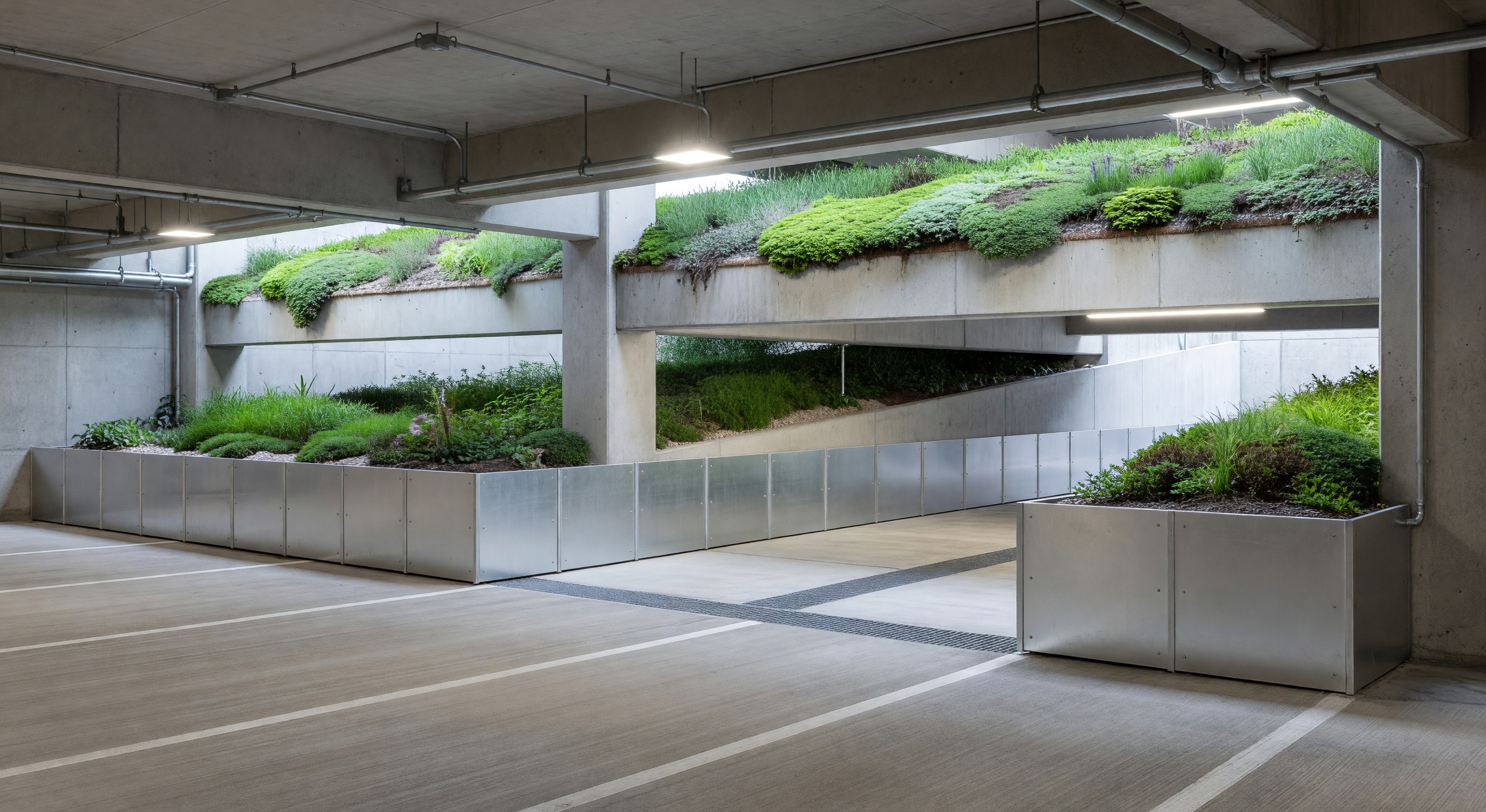
Surface lot drainage: Surface parking lots with impervious paving generate significant stormwater runoff that can overwhelm drainage systems and flood adjacent properties. Post-construction improvements — permeable paving, bioswales, detention basins — can reduce runoff volumes and slow peak flows, reducing downstream flooding impact and extending time before on-site flooding occurs.
Coastal and tidal flooding: Parking facilities near coastlines, rivers, and tidal waterways face increasing risk from king tides, storm surge, and progressive sea level rise. NOAA sea level rise projections (updated regularly) provide localized elevation data that facilities can use to assess long-term inundation risk for specific sites.
Flood hardening strategies: Interventions for below-grade facility flood protection include: deployable flood barriers at ramp entrances (removable panels or inflatable barriers rated for hydrostatic pressure), backflow prevention on storm drain connections, waterproof coatings on below-grade walls, elevated electrical panels and PARCS equipment placement above expected flood levels, and automatic closure systems that seal ramp access when flooding is detected.
Extreme Heat and Surface Lots
Surface parking lots are documented urban heat islands — large expanses of dark asphalt absorb solar radiation and release it as heat, raising ambient temperatures in and around the lot:
Heat island quantification: Research from Arizona State University and other institutions has documented surface parking lots running 20 to 30 degrees Fahrenheit hotter than adjacent vegetated areas during peak summer temperatures. This thermal loading affects vehicle interior temperatures (safety risk for occupants and pets), worker conditions for lot attendants, and the thermal comfort of adjacent pedestrian environments.
Mitigation strategies: Parking lot heat island mitigation includes: cool pavement coatings that reflect more solar radiation than conventional asphalt; shade trees and tree islands planted throughout the lot; shade structures (carports, canopies) that protect vehicles and provide surfaces for solar panel installation; permeable paving that allows evaporative cooling; and white or light-colored pavement materials in new construction.
EV charging and heat: Extreme heat reduces EV battery performance and increases charging times for parked vehicles. EV charging installations in hot climates benefit from shade structure coverage that reduces battery temperature, improving charging efficiency and battery longevity.
Worker safety: Parking lot attendants, enforcement officers, and maintenance staff working on unshaded asphalt surfaces face significant heat exposure risk in extreme temperature events. Shade structures, water access, heat management protocols, and real-time temperature monitoring (triggering work modifications when surface temperatures exceed thresholds) are occupational safety requirements in increasingly common extreme heat conditions.
Severe Storm Hardening
Wind events, hail, and severe storms pose distinct risks to parking structures:
Structural wind loads: Parking structures are open-sided by design, which reduces their vulnerability to wind pressure differential compared to enclosed buildings but exposes internal elements (vehicles, equipment) to wind-driven rain, debris, and direct wind loads. ASCE 7 wind load requirements for parking structures in high-wind zones (coastal Southeast, Gulf Coast, Great Plains) should be verified against current code requirements during any major renovation.
Roof and facade elements: Rooftop elements — solar panels, lighting fixtures, antenna mounts — must be secured to standards appropriate for the local wind environment. IBHS (Insurance Institute for Business & Home Safety) standards for commercial roof attachment provide relevant guidance for parking structure rooftop installations.
Hail damage management: Hail events damage vehicles parked in open lots and on open-decks of parking structures. Insurance coverage requirements for operators of open facilities and protocols for responding to hail damage claims (documentation, customer notification, insurance coordination) should be established before events occur.
Emergency operations planning: Severe weather operational protocols — early warning notification to facility staff, decision criteria for closing facilities ahead of storms, communication to parkers, post-storm assessment and reopening criteria — should be documented in facility emergency plans.
Wildfire Smoke Operations
In western states, wildfire smoke events create operational challenges for parking facilities:
Air quality monitoring and response: When Air Quality Index (AQI) reaches unhealthy levels (AQI 151+), parking facilities with outdoor worker assignments should implement reduced outdoor exposure protocols. PARCS systems that enable remote monitoring allow some staff roles to be conducted from enclosed control rooms rather than outdoor posts.
HVAC filtration for enclosed structures: Enclosed parking areas with mechanical ventilation — typically underground garages — should verify that ventilation system filtration is rated appropriately for particulate matter (PM2.5) during smoke events. MERV-13 or higher filtration in building HVAC systems is the CDC/EPA recommendation for smoke particulate control.
Communication to customers: When wildfire smoke creates hazardous air quality conditions, parking operators should communicate with monthly permit holders and transient customers about conditions, any operational modifications, and refund policies if the facility is temporarily closed.
Long-Term Capital Planning for Climate Risk
Site risk assessment: Parking facility owners should conduct or commission climate risk assessments for their specific sites — reviewing FEMA flood maps (and projected future FEMA maps), NOAA sea level rise projections, NOAA extreme precipitation projections, and local heat island analysis. Risk assessment results inform which climate adaptation investments are most urgent.
Insurance cost trajectory: Insurance costs for facilities in high-climate-risk locations are increasing. Properties with documented flood risk face flood insurance requirements (for federally backed financing) and are experiencing significant commercial property insurance premium increases. Capital investment in flood hardening can be justified partly on insurance cost reduction.
Phased adaptation investment: Not all climate adaptation investments are urgent at the same time. A phased capital plan that addresses the highest-probability near-term risks first (local flooding, extreme heat management) before longer-horizon risks (sea level, 50-year storm frequency changes) allows operators to allocate capital efficiently across planning horizons.
Frequently Asked Questions
Is FEMA flood map designation sufficient for assessing a parking facility’s flood risk? FEMA flood maps are an important reference but not sufficient for comprehensive flood risk assessment. Maps are based on historical data and may not reflect changing precipitation patterns; they are updated infrequently; and they may not capture nuanced local drainage conditions. First Street Foundation and FEMA’s own Risk Rating 2.0 methodology provide more current probabilistic flood risk assessments. For facilities in any flood-prone area, a site-specific drainage and flood risk analysis is worth commissioning before making hardening investments.
What is the ROI on parking lot shade structure installation? Shade structure ROI includes: EV charging revenue if solar panels are incorporated; parking rate premium if the facility markets shaded parking in a hot climate; reduced vehicle damage claims if hail or sun exposure is reduced; and worker safety improvement that reduces heat-related illness incidents. Full-coverage shade canopies for surface lots typically run $6,000 to $12,000 per space installed; the payback period depends heavily on whether solar generation revenue is captured.
How should operators communicate climate risk to investors and lenders? Commercial real estate investors and lenders are increasingly incorporating climate risk into underwriting decisions, particularly for coastal and flood-prone assets. Operators seeking financing should be prepared to disclose known climate risks, document mitigation investments already made, and present a climate resilience capital plan for future investments. Proactive disclosure of managed risk is better received than reactive disclosure of unmanaged risk.
What resources are available for parking facility climate resilience planning? IPMI (International Parking and Mobility Institute) has published guidance on sustainable and resilient parking facility design. The Urban Land Institute’s (ULI) Urban Resilience program provides resources for commercial real estate climate adaptation. NOAA’s Climate Adaptation Resources provide region-specific climate projection data. FEMA’s Building Resilient Infrastructure and Communities (BRIC) grant program funds climate adaptation projects including commercial infrastructure hardening in eligible communities.
Takeaway
Climate resilience is becoming a standard element of responsible parking facility management rather than an optional enhancement. Flooding risk for below-grade facilities, heat island effects on surface lots, severe storm exposure, and wildfire smoke operations are current operational realities in affected markets, not hypothetical future concerns. Operators who conduct site-specific risk assessments, implement cost-effective hardening measures, and incorporate climate risk into capital planning are protecting their assets against insurable and uninsurable losses while positioning their facilities to meet increasingly stringent investor, lender, and regulatory expectations around climate risk management.
Further Reading from Authoritative Sources
- FHWA climate resilience and infrastructure adaptation guidance for transportation facilities — FHWA publishes climate resilience guidance for transportation infrastructure, flood risk assessment frameworks for facilities, and climate adaptation planning resources that directly inform parking facility climate risk management.
- EPA urban heat island mitigation and stormwater management guidance for parking facilities — EPA publishes urban heat island mitigation guidance, stormwater management standards for impervious surfaces, and air quality recommendations for wildfire smoke conditions—all directly referenced in this article.