Parking structure cleanliness is both an operational priority and a revenue driver. A dirty, stained, or graffiti-marred garage signals neglect — to customers, to potential monthly parkers evaluating competing facilities, and to the owner’s long-term asset value. Conversely, a clean, well-maintained structure signals operational competence and justifies premium pricing in competitive markets. Cleaning is not glamorous, but it is consequential.
The Cleaning Hierarchy
Parking structure cleaning operates at three levels of intensity, each requiring different frequencies and equipment:
Daily or routine cleaning: Litter pickup, paper and debris removal from stairwells and elevator lobbies, spot cleaning of visible spills and staining, and inspection for graffiti or vandalism. This is the visual baseline that customers experience most directly.
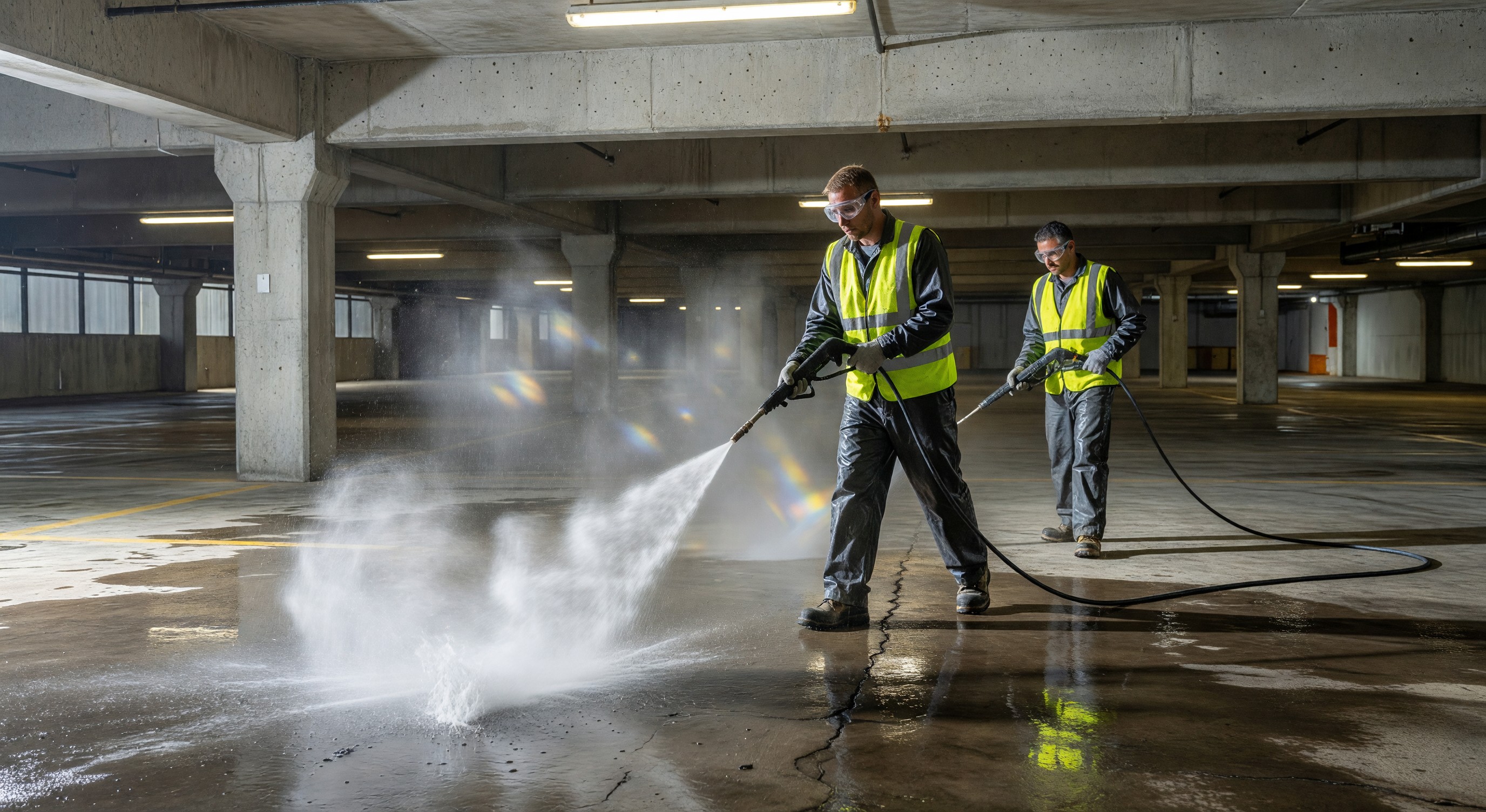
Periodic power washing: High-pressure washing of deck surfaces, stairwells, stairwells, and elevator lobbies on a scheduled frequency. This removes accumulated tire marks, oil stains, and the general soil load that routine cleaning cannot address.
Annual deep cleaning: Full structural cleaning including soffit washing, column cleaning to full height, drain cleaning, and any specialty cleaning for biological growth (mold, mildew) or severe staining.
Deck Washing Schedules and Equipment
Parking deck surfaces accumulate tire rubber, oil drips, and general grime that becomes embedded in concrete and traffic coating surfaces over time. Regular washing extends the life of traffic coatings and maintains the surface condition that reflects well on facility management.
Frequency: High-volume enclosed structures: quarterly power washing. Open structures with outdoor exposure: bi-annually (spring and fall). Lower-volume facilities: annually.
Equipment: Hot water pressure washers at 2,500 to 4,000 PSI with appropriate nozzle selection for the surface type. Cold water is less effective for oil and grease removal. Floor scrubber machines (ride-on or walk-behind) are more efficient for large open areas than manual power washing.
Drainage management: Deck washing generates significant water runoff containing petroleum hydrocarbons, suspended solids, and cleaning agents. Environmental regulations in many jurisdictions prohibit discharge of untreated parking structure wash water to storm drains. Berming, vacuum recovery, or dedicated wash water collection systems allow proper treatment or disposal. Verify applicable stormwater discharge requirements before specifying a cleaning program.
Traffic coating protection: Some pressure washing chemicals and high PSI settings can damage traffic coatings or marking paint. Use pressure washing detergents specified compatible with the deck coating system; avoid high-alkaline cleaners on painted surfaces.
Stairwell and Elevator Lobby Cleaning
Stairwells and elevator lobbies require more intensive and frequent cleaning than deck surfaces because they accumulate waste from pedestrian traffic, are enclosed (limiting natural ventilation of odors), and are the spaces where safety and crime risk are highest — cleanliness directly affects user comfort and willingness to use these spaces.
Daily: Visual inspection and litter removal. Any graffiti or spills receive same-day response.
Weekly: Wet mopping or scrubbing of stairwell treads and landings; elevator cab floor mopping and interior surface wipe-down; lobby floor mopping.
Monthly: Full stairwell wall washing; elevator cab wall and ceiling cleaning; door hardware and rail cleaning.
Quarterly: High-pressure washing of stairwell wall and floor surfaces; elevator cab deep clean.
Lighting inspection: Stairwell and lobby lighting should be checked weekly — burned-out lights create both safety and perception problems. Facilities with LED lighting (much longer lamp life than fluorescent or incandescent) can extend inspection frequency, but visual checks remain important.
Graffiti Response Protocol
Graffiti must be addressed quickly — response time is the key variable in graffiti management. Research on graffiti behavior consistently shows that graffiti removed within 24 to 48 hours is significantly less likely to be repeated than graffiti allowed to remain for weeks. The facility that responds quickly signals active management; the facility that allows graffiti to persist signals neglect that invites further vandalism.
Response time standard: Graffiti visible to facility users (entry/exit areas, elevator lobbies, stairwells, ground level) should be removed or covered within 24 hours of discovery. Graffiti in less visible internal locations (upper deck columns, remote parking bays) within 72 hours.
Removal methods by surface:
- Unpainted concrete: Graffiti remover chemicals (sodium hydroxide or citrus-based formulations) followed by pressure washing. Test on inconspicuous area first to confirm no surface etching.
- Painted surfaces and traffic coatings: Graffiti removal gel applied carefully to avoid lifting the base coating; repaint if removal is not complete.
- Anti-graffiti coatings: Sacrificial anti-graffiti coatings applied to high-risk surfaces (stairwells, elevator lobbies, ground-floor columns) allow graffiti removal with low-pressure washing, protecting the underlying surface. Anti-graffiti coating reapplication is required after removal.
Documentation: Photograph graffiti before removal for evidence collection. Report to law enforcement if the tag is associated with known criminal activity or if the same tag appears repeatedly (potential escalation indicator).
Frequently Asked Questions
How often should a parking structure be power washed? High-volume enclosed structures should receive quarterly power washing of deck surfaces. Open structures with natural drainage benefit from bi-annual washing (spring and fall). All structures should include stairwell power washing quarterly regardless of deck washing frequency.
What drainage regulations apply to parking garage wash water? Many jurisdictions prohibit discharge of parking structure wash water (which contains petroleum hydrocarbons and other pollutants) to storm drains without treatment. Verify applicable stormwater discharge requirements with local environmental authorities before specifying a cleaning program. Vacuum recovery systems allow proper disposal.
How quickly should graffiti be removed from a parking facility? Within 24 hours for graffiti visible to users (entry areas, lobbies, stairwells, ground level); within 72 hours for interior locations. Rapid response is the most effective graffiti deterrent — graffiti removed quickly is significantly less likely to be repeated than graffiti allowed to remain.
What anti-graffiti measures can be applied to parking structure surfaces? Sacrificial anti-graffiti coatings (polyurethane or wax-based) applied to high-risk surfaces allow graffiti removal with low-pressure washing, protecting the underlying surface. These coatings require periodic reapplication but significantly reduce the labor and chemical cost of graffiti removal compared to treating unpainted concrete directly.
Takeaway
Parking structure cleaning is an investment in customer perception, asset value, and crime deterrence — not merely a housekeeping function. Facilities with documented cleaning schedules, prompt graffiti response protocols, and properly equipped cleaning crews consistently outperform those with informal cleaning practices on customer satisfaction scores, monthly parker retention, and the perception signals that premium pricing requires. The cost of a structured cleaning program is modest relative to the revenue impact of a facility that users describe as “dirty” or “unsafe” — the two descriptors that most reliably drive customers to competing facilities.
Further Reading from Authoritative Sources
- US EPA stormwater discharge requirements for parking facility cleaning operations — The EPA’s NPDES stormwater program for industrial activities governs the wash water discharge restrictions directly cited in this article.
- IPMI parking facility maintenance and cleaning program standards — IPMI provides parking facility management resources and benchmarks that establish the professional standards for cleaning frequency and quality described in this article, giving readers access to the industry authority on parking facility maintenance practice.