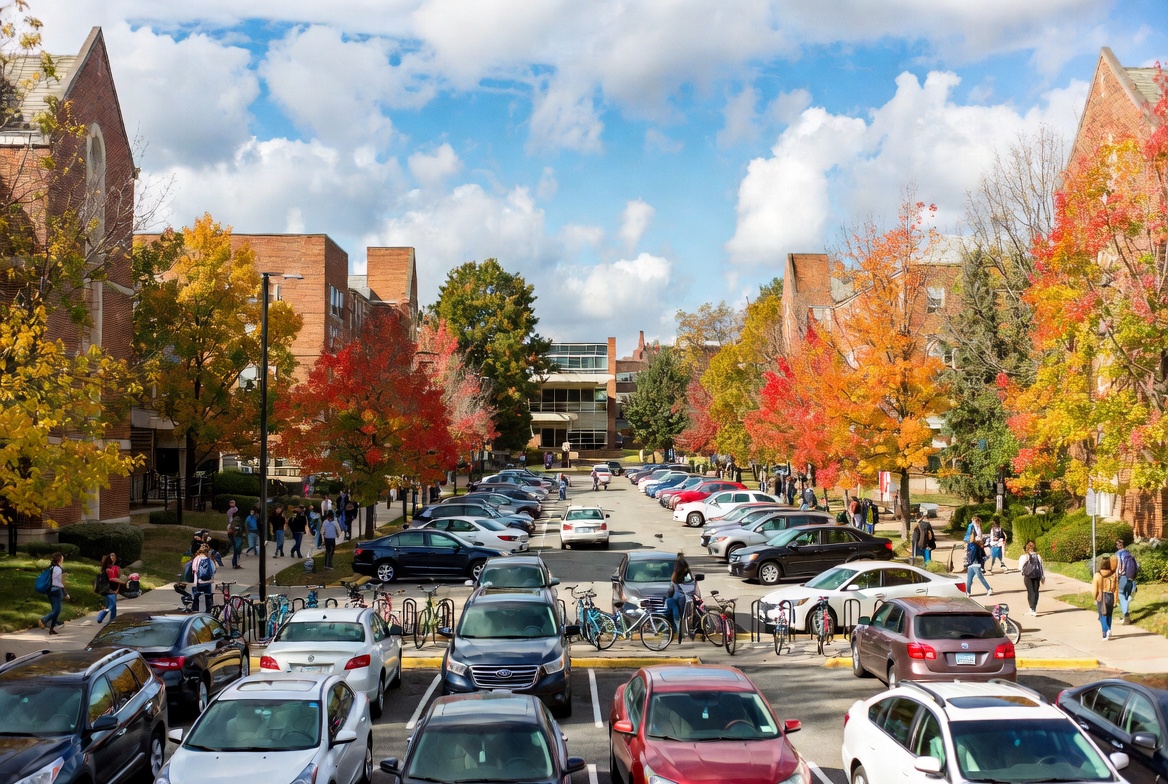
Few parking environments carry the complexity of a university campus. On any given weekday, a mid-sized institution juggles thousands of permit holders across multiple classification tiers, a fluctuating visitor population, faculty and staff with competing lot preferences, service and delivery vehicles, and — depending on the season — athletic event crowds that can double the vehicle count in a matter of hours.
The stakes are real. Parking is frequently cited in campus satisfaction surveys as a top-three frustration for students and employees, a finding echoed by the National Association of College and University Business Officers. It generates meaningful revenue for university transportation departments. And it intersects with broader institutional priorities including sustainability, accessibility, campus safety, and town-gown relations.
This article examines the core challenges of university campus parking and the strategies institutions are deploying to address them — from traditional permit systems to technology-driven approaches that are redefining how campuses manage vehicle access.
The Unique Nature of Campus Parking Demand
University parking demand behaves differently from commercial or municipal parking in several important ways.
Demand is cyclical at multiple scales. There are semester-over-semester fluctuations (fall is typically the heaviest period), day-of-week patterns (Tuesday through Thursday peak on most campuses), and time-of-day surges tied to class schedules. Summer sessions bring reduced volume but also construction crews, orientation visitors, and conference attendees.
The user population is segmented and hierarchical. Faculty expect reserved or premium lot access. Staff need consistent availability near their buildings. Graduate students lobby for proximity to labs. Commuter undergraduates often accept peripheral lots with shuttle service. Residential students may not need daily parking at all but insist on overnight security. Each group has different willingness to pay, different tolerance for walking distance, and different political leverage within the institution.
Turnover is built into the model. Unlike a corporate garage where the same employees park in the same spots year after year, a university replaces roughly a quarter of its student population annually. Every fall brings a cohort of new parkers who do not know the system, cannot find their assigned lot, and overwhelm the transportation office with questions during the first two weeks of classes.
Permit Systems: The Foundation of Campus Parking
The annual parking permit remains the backbone of university parking management. While the format has evolved — from windshield hang tags to dashboard placards to virtual permits tied to license plates — the underlying concept is unchanged: parkers purchase the right to use a designated lot or zone for a defined period.
Tiered Permit Structures
Most institutions operate a tiered system that reflects the campus hierarchy. A typical structure might include:
- Faculty/Staff Premium — Reserved or gated lots closest to academic buildings
- Faculty/Staff General — Open lots within reasonable walking distance
- Commuter Student — Peripheral lots, often served by campus shuttle
- Residential Student — Overnight lots near dormitories, sometimes restricted during class hours
- Graduate/Research — Designated areas near research facilities, sometimes with extended-hour access
Pricing varies enormously. Community colleges might charge $50 per semester for student parking. Major research universities in urban settings routinely charge $800 to $1,200 per year for staff permits, with premium faculty spots reaching $2,000 or more.
Virtual Permits and LPR Enforcement
The shift from physical to virtual permits has been one of the more significant operational changes in campus parking over the past decade. Under a virtual permit model, parkers register their license plate number when purchasing a permit. Enforcement officers — or fixed LPR cameras — verify compliance by reading plates rather than looking for a hang tag.
The benefits are substantial. Virtual permits eliminate the cost of manufacturing, distributing, and replacing physical tags. They allow parkers to switch vehicles without visiting the transportation office. And they provide a digital foundation for data-driven management — every plate read becomes a data point that reveals utilization patterns, peak-hour demand, and lot-specific turnover rates.
The transition is not without friction. Some campuses have encountered pushback from parkers who want the visual reassurance of a physical permit. Others have struggled with LPR accuracy in conditions where plates are obscured by snow, bike racks, or trailer hitches. But the overall trajectory is clear: virtual permits are becoming the standard.
Visitor Management: The Persistent Challenge
If permits are the foundation, visitor management is the perpetual headache. Universities host a constant stream of visitors — prospective students and their families, guest lecturers, vendors, alumni, patients at campus health facilities, and members of the public attending cultural events.
Common Approaches
Metered visitor lots. Dedicated lots or zones with pay-and-display meters or pay-by-plate kiosks. Simple to operate but limited in capacity and often inconveniently located.
Daily permits. Visitors purchase a day pass online, at a campus gateway, or from a pay station. This model works well when tied to LPR-based access control, allowing visitors to enter gated lots without stopping for a ticket.
Host-sponsored access. Faculty or department administrators pre-register visitor plates through an online portal. The visitor arrives, and the system recognizes their plate automatically. This approach provides a premium experience but requires campus-wide adoption of the registration tool.
Validation programs. Departments or admissions offices validate visitor parking after the visit, either electronically or through physical stamps. This distributes the cost to the hosting department rather than the visitor.
The most effective campus visitor programs combine several of these approaches, offering different options based on the visit type and the host’s willingness to manage logistics.
Event Parking: When Normal Rules Suspend
College athletics — particularly football, basketball, and hockey at Division I schools — create parking demand spikes that dwarf everyday operations. A Saturday football game at a Power Five institution can draw 40,000 to 100,000 fans, many of whom arrive hours early for tailgating.
Event parking management is essentially a separate operation that happens to share infrastructure with daily campus parking. It involves:
Lot reassignment. Lots that serve commuter students during the week become premium game-day parking. Permit holders must be notified of restrictions, and signage must be changed or supplemented.
Dynamic pricing. Many institutions have adopted tiered event pricing based on proximity to the venue. Lots adjacent to the stadium command $40 to $80 per vehicle, while peripheral lots with shuttle service might charge $10 to $20.
Pre-sale and reservation systems. Online pre-sale reduces congestion at entry points and gives the transportation office better demand forecasting. Season parking passes for athletic events are common at major programs and represent a significant revenue stream.
Traffic management. Ingress and egress plans, temporary lane reversals, coordination with local law enforcement, and pedestrian safety measures all fall within the event parking portfolio.
The operational complexity of event parking has driven many institutions to invest in automated access control equipment that can be reconfigured between daily and event modes. Systems from several manufacturers allow operators to switch rate schedules and access rules remotely, eliminating the need to physically reprogram equipment before each event.
Enforcement: Balancing Compliance and Goodwill
Parking enforcement on a university campus is a delicate act. Too lenient, and the permit system loses its value — why pay for a permit if violations are never cited? Too aggressive, and the transportation office becomes a lightning rod for student government complaints, faculty senate resolutions, and negative press coverage.
Citation Strategies
Most campuses follow a graduated enforcement model:
- Warning period at the start of each semester (typically the first one to two weeks)
- Standard citations for violations such as parking without a permit, parking in a restricted zone, or exceeding a time limit
- Escalating fines for repeat offenders
- Immobilization or towing for chronic violators or safety-related violations (blocking fire lanes, accessible spaces)
Fine amounts vary widely. First offenses typically range from $25 to $75, with escalation to $100 or more for repeat violations. Some institutions have adopted a points-based system where accumulation of points over a semester triggers permit revocation.
Technology-Assisted Enforcement
Mobile LPR units — cameras mounted on enforcement vehicles that scan plates as the officer drives through a lot — have dramatically increased enforcement efficiency. A single officer with an LPR-equipped vehicle can cover the same ground that previously required three or four officers on foot checking hang tags.
Fixed LPR cameras at gated lot entries provide real-time enforcement for virtual permit zones. Unauthorized vehicles are simply denied access, eliminating the citation-and-appeal cycle entirely for those facilities.
The Appeal Process
A fair and transparent appeal process is essential for institutional credibility. Most campuses operate a parking appeals board that includes student and staff representatives. Common grounds for appeal include medical emergencies, permit display errors, and first-time-visitor exceptions.
The appeals process is also a data source. Patterns in successful appeals can reveal systemic issues — confusing signage, inadequate visitor parking supply, or lot designations that do not align with actual building usage.
Sustainability and Alternative Transportation
Parking management at universities increasingly intersects with sustainability commitments. Many institutions have adopted climate action plans — supported by EPA sustainability frameworks — that include transportation demand management (TDM) strategies aimed at reducing single-occupancy vehicle trips.
Common TDM Strategies
Transit partnerships. Universities subsidize or fully fund local transit passes for students and employees, making bus or rail travel free at the point of use. The “universal transit pass” model has proven effective at institutions near robust transit networks.
Bike infrastructure. Expanded bike lanes, covered bike parking, bike-share programs, and end-of-trip facilities (showers, lockers) support cycling as a commute option. Some campuses have repurposed underutilized surface parking to create protected bike corrals.
Carpool and vanpool incentives. Preferred parking spaces, reduced permit costs, and guaranteed ride-home programs encourage shared commuting.
Remote and flexible work. The pandemic demonstrated that many campus employees can work effectively from home at least part of the week. Reduced on-campus presence translates directly to reduced parking demand.
Parking pricing as a lever. When parking is free or heavily subsidized, demand is artificially inflated. Progressive pricing — where permits cost more for solo drivers and less for carpoolers — uses market signals to shift behavior.
The Parking-Sustainability Tension
There is an inherent tension between generating parking revenue and reducing parking demand. Transportation departments that depend on permit sales to fund operations can find themselves in conflict with sustainability offices pushing to reduce driving. Resolving this tension requires institutional willingness to fund transportation services from general revenue rather than solely from parking fees — a shift that some universities have made and others are still debating.
Technology Integration and Data
The modern campus parking operation generates enormous volumes of data. LPR reads, pay station transactions, gate activations, citation records, permit sales, appeal outcomes, shuttle ridership, and occupancy counts all feed into a picture of how the campus parking ecosystem functions.
Real-Time Occupancy
Knowing how many spaces are available in each lot — in real time — is the single most requested feature among campus parkers. Occupancy data, displayed on digital signs at lot entrances, on mobile apps, and on campus websites, reduces cruising, lowers frustration, and helps distribute demand across underutilized lots.
Occupancy sensing technologies range from in-ground magnetic sensors (accurate but expensive to install and maintain) to overhead cameras with computer vision (increasingly cost-effective) to inference models based on gate counts (simple but less precise for lots with multiple ungated access points).
Integration with Campus Systems
Parking data becomes more valuable when connected to other campus systems. Integration with student information systems allows automatic permit eligibility verification. Connection to the campus event calendar enables proactive lot management. Links to the facilities work order system ensure that maintenance issues — potholes, broken lights, faded striping — are tracked and resolved.
For institutions evaluating how modern software platforms address these integration challenges, Parking BOXX has published a detailed overview of modern campus parking software management systems covering the core capabilities operators should expect from a current-generation PARCS platform.
Looking Forward
University campus parking is in a period of transition. The fundamentals have not changed — institutions still need to provide access for people who drive — but the tools, expectations, and strategic context are all evolving.
The institutions that manage this transition most effectively will be those that treat parking not as an isolated operational function but as a component of a broader campus mobility strategy. The Institute of Transportation Engineers has published guidelines on integrating parking with campus mobility planning. That means investing in technology that provides flexibility and data, designing policies that balance access with sustainability, and recognizing that the parking experience — for better or worse — shapes how students, employees, and visitors perceive the institution as a whole.
The parking lot may never be glamorous. But on a university campus, it is almost always consequential.