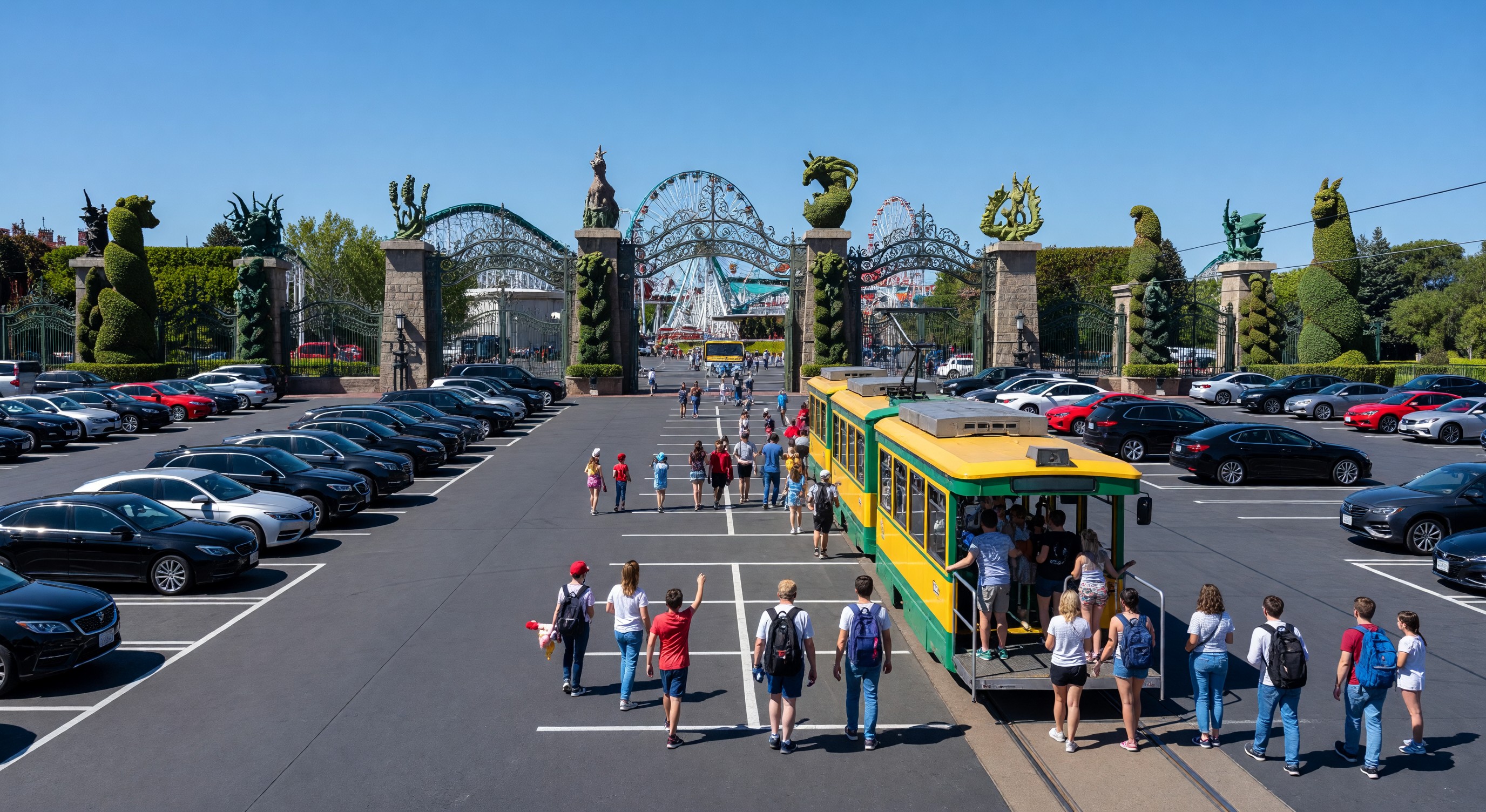
Theme park and amusement park parking represents one of the highest-volume single-site parking management contexts in the entertainment industry. Major theme parks regularly receive 30,000 to 50,000 daily visitors during peak periods, generating 8,000 to 15,000 vehicles that must be parked in organized fields, shuttled to the park entrance, managed throughout a 10 to 12 hour visit, and released at the end of the operating day. The operational scale, premium product differentiation, and gate revenue significance of theme park parking make it a specialized vertical with distinct operational requirements and revenue management opportunities.
Theme Park Parking Scale and Operations
Volume and land requirements: A major regional theme park with 20,000 parking spaces on 250 acres of parking fields illustrates the scale of this vertical. Parking operations at this scale require systematic lot organization, tram or shuttle transit from remote parking areas, traffic control at multiple ingress and egress points, and a central operations function coordinating the entire system.
Systematic lot naming and organization: Theme park parking fields are organized into named sections (characters, colors, animals, numbers) with clear signs that allow guests to find their vehicles at the end of a long day when exhaustion and crowd conditions make navigation difficult. Section naming that is memorable and unambiguous is an operational design requirement — a guest who cannot find their car after 10 hours in a park creates a serious customer service failure.
All-day parking model: Theme park parking is almost entirely all-day parking — guests arrive in the morning, park for the duration, and leave in the evening. There is no transient turnover during the day (guests do not typically leave and return mid-day). This means parking revenue must be captured at entry; no opportunity for exit-based revenue exists in most traditional gate operations.
Peak season demand concentration: Theme park demand is concentrated in peak seasons — summer, school breaks, and holiday periods. A park that receives 30,000 visitors on a peak August Saturday might receive 8,000 on a January weekday. Staffing and operational systems must accommodate this demand range.
Tram and Shuttle Operations
Remote lot shuttle necessity: Major theme parks locate most parking in remote fields that are a 10 to 20 minute walk from the main gate — a distance impractical for families with young children, guests with disabilities, and visitors carrying food and gear. Tram systems (open-air vehicles towed by a tractor in a train formation) or shuttle buses close this gap.
Tram capacity and frequency: Tram systems at major parks move thousands of guests per hour during peak morning arrival and evening departure. Capacity is calculated from guest flow rates — a 10-car tram carrying 10 guests per car running a 5-minute round trip circuit moves 120 guests per hour. Peak arrival demand of 5,000 guests per hour requires significant tram fleet capacity.
Tram deployment strategy: Trams are deployed to specific parking sections as they fill, running between the active section and the gate. As a section fills and a new section opens further away, trams extend their route or redeploy. Real-time coordination between the parking lot operator (who directs guests to sections) and tram dispatch is essential.
Accessibility considerations: Guests using wheelchairs, scooters, and other mobility devices need accessible tram or shuttle access. ADA requires accessible shuttles or equivalent service — most major parks operate dedicated accessible shuttles or include accessible accommodations in main tram design. Accessible drop-off and pickup locations near the gate reduce walking distance for mobility-impaired guests.
Premium Parking Products
Preferred parking: A designated premium parking area located closer to the main gate than the general parking fields — guests pay a significant premium for proximity. Preferred parking at major theme parks typically costs $30 to $50 more than standard parking and fills quickly on peak days. Guests with young children or mobility limitations are the core preferred parking customer.
Preferred parking pricing strategy: Premium pricing that approaches the limit of willingness to pay for proximity maximizes revenue from guests who value convenience highly. Pre-sale preferred parking (purchased online before arrival) at a premium to gate price captures revenue from planners and provides demand data.
Valet parking: Some parks offer valet service at the main entrance — attendants park the guest’s vehicle in a designated area and retrieve it at departure, eliminating the need for the guest to navigate the parking field at all. Valet at $75 to $100 per day appeals to the premium guest seeking a white-glove experience from park arrival to departure.
Annual pass holder parking: Theme parks with strong annual pass programs offer parking benefits as part of pass packages — free standard parking, discounted preferred parking, or reserved annual pass holder parking sections. Parking benefits are a meaningful component of annual pass value and renewal motivation.
Gate Revenue and Pricing
Gate pricing vs. pre-sale pricing: Many major theme parks charge lower pre-sale prices for parking purchased in advance online (encouraging pre-purchase behavior that aids demand forecasting and reduces gate transaction time) and higher gate prices for same-day purchase. Pre-sale discounts of 15 to 25 percent are typical.
Parking as a profit center: Theme park parking is a significant profit center — a 20,000-space park charging $35 standard parking with 70% occupancy on 300 operating days generates $147 million annually in gross parking revenue. Even accounting for tram operating costs, staff, and facility maintenance, parking is a major EBITDA contributor for park operators.
Bundle pricing with park admission: Some parks bundle parking with admission in pre-sold packages — “park + parking” bundles that capture the convenience-seeking customer and increase per-capita revenue. Bundle pricing requires careful optimization to avoid over-discounting parking revenue relative to the parking component’s value.
Seasonal and day-of-week pricing: Dynamic parking pricing that adjusts rates for peak periods (summer weekends, holiday periods) and lower-demand periods (January weekdays) captures appropriate revenue from high-demand days without over-pricing low-demand periods that benefit from parking price accessibility.
End-of-Day Operations
Exit surge management: All theme parks experience a large vehicle egress surge within 60 to 90 minutes of park close. Traffic control at exit lanes, external roadway intersection management, and tram coordination (high-frequency service from parking to the gate during the arrival crush, reversed for departure) are essential for guest safety and satisfaction.
Vehicle location assistance: Guests who cannot find their car — a common occurrence after an exhausting day in a large parking field — require assistance. A dedicated car finder service, staffed by employees with radios who can check where a vehicle was parked based on the guest’s arrival time and vehicle description, resolves this problem. Tram audio recordings of section placements during the morning can provide reference data.
Lost and found parking: Occasionally guests misplace their parking ticket or receipt that records their section. Parking operations should have a process for helping guests identify their parking section — using arrival time records, vehicle description, or license plate lookup in PARCS records.
Frequently Asked Questions
How do theme parks forecast daily parking demand to staff appropriately? Theme parks use a combination of historical attendance data (attendance on the same day in prior years, adjusted for current reservation data), advance ticket sales (electronic admission reservations provide real-time demand data), and weather forecasting to predict daily attendance and corresponding parking demand. Staffing is then scaled to the forecast — with predetermined staffing levels for “low,” “medium,” “high,” and “peak” attendance tiers that can be operationalized from the forecast.
What is the appropriate premium for preferred parking at a major theme park? Industry practice suggests that preferred parking premiums of $25 to $60 above standard parking rates are achievable at major destination parks where guests are spending $150 to $300+ per day on admission and in-park purchases. The premium should be calibrated so that preferred parking fills to near-capacity on peak days, indicating the price is at or near the market-clearing level.
How do theme parks handle parking for guests with disabilities? ADA-accessible parking spaces are required near the park entrance (not in remote general parking fields) at ratios set by ADA standards. Additionally, drop-off/pick-up areas for guests using accessible vehicles are required near accessible entrances. Many parks go beyond ADA minimums given the high proportion of guests with mobility needs visiting family-oriented destinations. Accessible parking areas should be on a paved accessible route to the main entrance with adequate space for van-accessible deployment.
How is parking revenue typically accounted for in theme park financial reporting? Theme park operators typically report parking revenue as a component of “out-of-park spending” or “ancillary revenue” — distinct from admission revenue. Some operators include parking in their per-capita spending metrics as evidence of in-park and adjacent revenue per guest. Parking revenue is a key component of theme park EBITDA and is typically reported separately or as a line item in ancillary revenue in investor communications.
Takeaway
Theme park parking management combines scale operations, premium product design, tram logistics, and gate revenue management at a level of complexity and volume that exceeds most other parking verticals. The parks that excel — with systematic lot organization and naming, reliable tram operations, clearly differentiated premium products, pre-sale pricing that incentivizes advance purchase, and end-of-day operations that safely and efficiently process tens of thousands of departing vehicles — deliver parking as an integrated part of the guest experience rather than a logistical afterthought. For major theme park operators, parking is both a significant profit center and a critical determinant of first and last impressions for guests whose experience begins and ends in the parking facility.
Further Reading from Authoritative Sources
- IPMI entertainment venue and theme park parking operations guidance — The International Parking and Mobility Institute publishes vertical-specific parking management guidance for entertainment venues that is directly relevant to the theme park operations, premium products, and revenue management described in the article.
- U.S. Access Board accessible parking standards for entertainment facilities — The U.S.