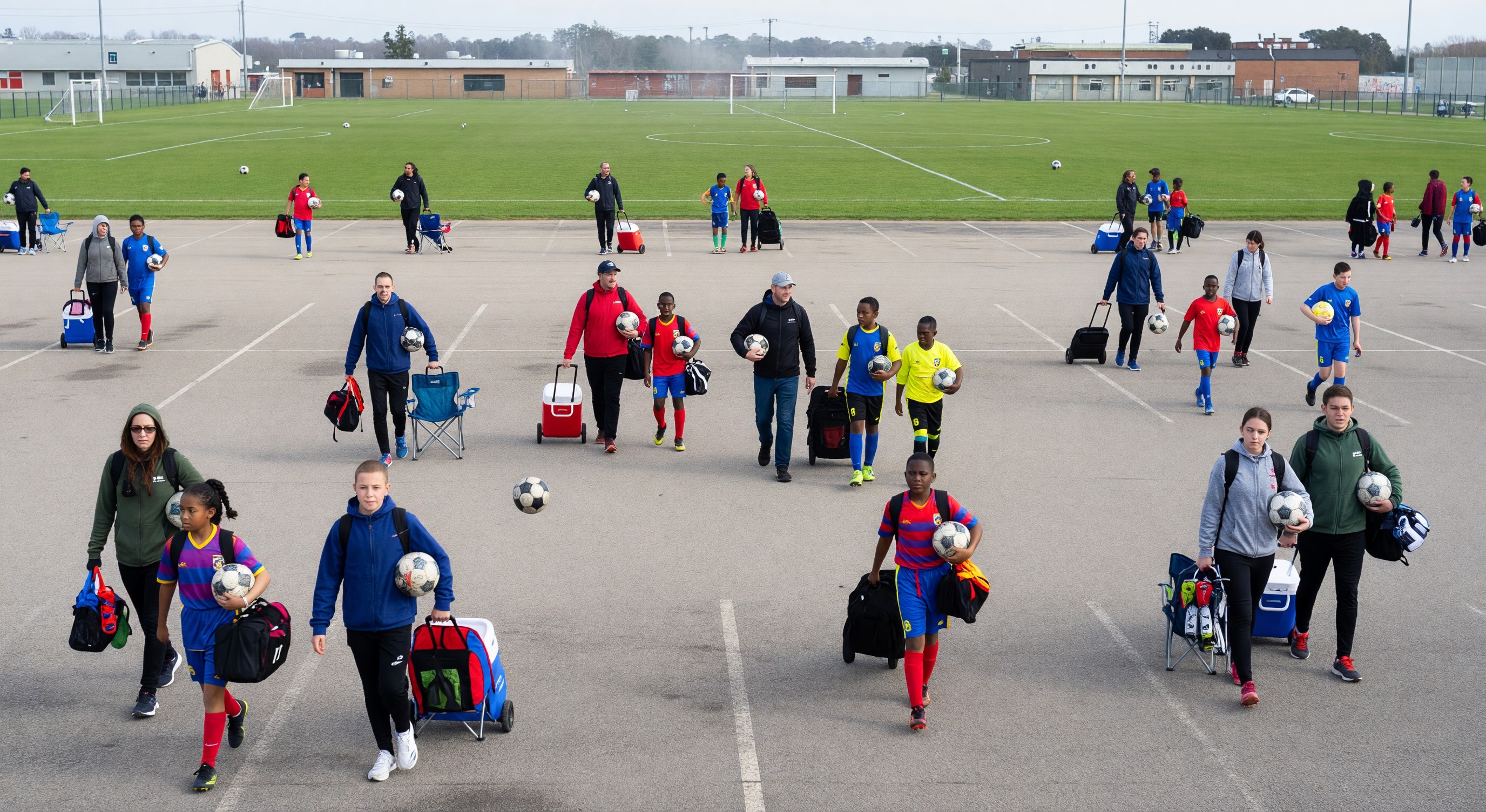
Multi-field sports complexes — youth soccer and baseball complexes, multi-sport recreational facilities, and community athletic parks — generate parking demand that differs fundamentally from professional sports venues. Instead of one massive event with concentrated demand, a youth sports complex may have 15 simultaneous games on a Saturday morning, with families arriving and departing in staggered waves throughout the day. Tournament weekends bring out-of-town teams, parents, coaches, and spectators who may not know the facility. And the customer base is families — often with young children, sports equipment, and multiple members — who need convenient, organized access to reach the right field at the right time. Understanding sports complex and recreation facility parking management helps operators and recreation managers design and operate effective parking for community athletic programming.
Sports Complex Parking Demand Characteristics
Simultaneous multi-game demand: A complex with 15 soccer fields hosting simultaneous Saturday morning games may generate 500 to 800 vehicles from all teams, families, and officials combined. Unlike a professional stadium where all fans attend the same event, multi-field complexes have fragmented demand distributed across fields — but the simultaneous timing still creates concentrated arrival peaks.
Staggered wave patterns: If games are scheduled in multiple waves (8 AM, 10 AM, 12 PM), arrival and departure demand creates multiple peaks separated by 2-hour intervals rather than a single surge. The 8 AM arrivals are departing as the 10 AM arrivals arrive — creating simultaneous inbound and outbound traffic that must be managed.
Tournament weekend intensity: Regional and national youth sports tournaments held at multi-field complexes generate the most intense parking demand of any operating week. Tournaments may bring 30 to 50 teams from multiple states, with families staying in nearby hotels and driving to the complex for multiple games over a 2 to 3 day period. Tournament weekend parking is substantially more demanding than a typical league programming weekend.
Seasonal programming concentration: Youth sports programming is concentrated in spring (baseball, lacrosse, soccer), fall (football, soccer), and to a lesser extent summer. Winter programming (indoor sports, off-season training) generates lower parking demand. Parking infrastructure sized for peak weekend tournament demand sits partially underutilized during programming shoulder seasons and off-season.
Parking Lot Organization and Field Access
Field proximity wayfinding: Families arriving for a youth soccer game are looking for a specific field — Field 7, the “Blue fields,” the east complex. If they don’t know which field and where it is, they may park in the wrong section and walk long distances with equipment, chairs, and young children. Clear field numbering, signage at the parking lot entrance identifying which parking areas serve which fields, and pre-event communication (tournament brackets that include field assignments and parking guidance) reduce this confusion.
Section designation and assignment: Designating parking sections by field cluster — section A serves fields 1-5, section B serves fields 6-10, etc. — and directing arriving vehicles to the appropriate section reduces the time families spend locating their field from wherever they happen to park.
Equipment and gear unloading: Youth sports families often arrive with significant equipment — bags, coolers, folding chairs, shade canopies. Designated drop-off areas near field access points where passengers can unload before the driver parks are a significant convenience that reduces lot congestion (drivers idling while passengers unload in the middle of the parking aisle).
Emergency vehicle access: Large sports complexes must maintain emergency vehicle access lanes throughout the facility, including during full tournament operation. Parking designs should identify and mark emergency access routes; parking control should prevent these routes from being blocked by parked vehicles or drop-off congestion.
Tournament Operations
Visitor and travel team orientation: Out-of-town teams and families attending tournaments are unfamiliar with the facility. Tournament packet information — mailed or emailed before the event — should include parking instructions, maps showing field locations and parking sections, and any special parking arrangements for teams (team bus parking areas, early entry for setup crews).
Overflow lot activation: Tournaments that exceed primary parking capacity require overflow lots — often grass fields or adjacent parking areas — with signage and staff direction. Pre-established overflow lots that have been analyzed for drainage (no flooding during rain) and access (adequate driving surface for regular vehicles) are preferable to improvised overflow activation on the morning of a full tournament.
Food vendor and sponsor vehicle management: Major tournaments often include food vendors, sponsor tents, and equipment vendors. These vehicles need specific designated areas — not mixed with family parking — and arrival/setup windows before event start. Coordinating vendor vehicle access with tournament operations prevents conflicts with family arrival traffic.
Referee and official parking: Game officials (referees, umpires, scorekeepers) need designated parking that allows them to arrive, park, and walk to their assigned field without navigating family parking areas. Designated official parking near field access points, clearly marked and enforced against unauthorized use, is standard at well-organized tournament facilities.
Staff and Volunteer Coordination
Operations staff parking: Maintenance, concession, security, and administrative staff who work at the complex during events need designated staff parking that doesn’t consume family parking spaces. Staff lots may be service-road accessible or designated in areas farther from the fields that staff can access on arrival before family parking demand peaks.
Volunteer parking team coordination: Multi-field complexes often rely on volunteer traffic directors — league volunteers, tournament committee members, or recruited community volunteers — to manage parking during high-demand events. Volunteer parking teams need: reflective safety vests, radio communication with a parking coordinator, knowledge of the lot layout and overflow protocol, and clear direction about when to activate overflow.
Shift coordination: A tournament day may run 8 AM to 6 PM with peak demand waves through the day. Parking staff/volunteers need shift coordination — staggering breaks, maintaining coverage during peak periods, and coordinating handoffs for multi-wave events.
Revenue and Fee Structures
Event parking fees: Many sports complexes charge parking fees for tournament events — $5 to $15 per vehicle per day for major tournaments. Revenue from parking fees helps offset facility maintenance costs. Clear advance communication of parking fees (in tournament registration materials) reduces arrival friction and complaints from families who didn’t expect to pay.
Season parking passes: Families whose children participate in multiple seasons of programming at the same complex may benefit from seasonal parking passes — a flat fee for the season that eliminates per-event payment. Season pass revenue is predictable upfront; per-event revenue is variable but captures families who only attend occasionally.
Reserved parking for team staff: Premium reserved parking spaces — designated for head coaches or team managers who arrive for pre-event setup and need reliable access — can be sold at a premium to team administrative staff who value guaranteed access over general family parking.
Free parking for community programming: Many public recreation complexes provide free parking as a community service — particularly for regular league programming serving local residents. Tournament events, which generate revenue from registration fees, may have parking fees even when regular programming parking is free. Clear communication about when parking is free vs. charged prevents confusion.
Frequently Asked Questions
What parking ratio is appropriate for a multi-field sports complex? Youth soccer complexes are commonly planned at 2 to 3 parking spaces per field for standard league games, assuming 2 to 3 vehicles per team side (coaches, officials) plus family vehicles. For tournament operations with larger spectator bases and multiple teams, 5 to 8 spaces per field may be needed for peak periods. The appropriate ratio depends heavily on the programming type, typical team size, and spectator attendance patterns at the specific facility.
How should sports complexes handle parking during rain and wet weather events? Rain creates additional challenges: soft grass overflow areas may not support vehicle traffic when saturated; families with young children are more likely to drop off and pick up rather than walk from distant lots; and safety concerns about wet pavement and visibility increase the importance of staff direction. Rain event protocols — identifying hard-surface overflow areas, activating additional drop-off management, and communicating with teams about parking changes — should be pre-planned rather than improvised.
What lighting standards apply to sports complex parking for evening games? Evening youth sports programming — common in spring and fall seasons — requires adequate parking lot lighting for family safety. IESNA RP-20 provides guidance on minimum illumination levels for parking facilities. Sports complex parking that serves evening events should meet commercial parking illumination standards for the entire time that programming creates pedestrian activity in the lot.
How should sports complexes coordinate with neighboring residential areas on high-demand weekends? Overflow onto residential streets is a common conflict point for sports complexes adjacent to residential neighborhoods. Proactive communication with neighbors about high-demand tournament weekends — notification of expected traffic and any traffic management measures — and prompt response to complaints about overflow or damage reduces conflict. Some complexes maintain a neighborhood liaison who is reachable on tournament weekends to address concerns in real time.
Takeaway
Sports complex and multi-field recreation parking management serves families with young children, sports equipment, and specific field destinations — a demanding customer base in a context where clear wayfinding, efficient organization, and adequate capacity are essential to the community recreation experience. The complexes that manage parking effectively — with clear field-to-parking section assignment, designated drop-off areas for equipment-laden families, volunteer traffic management during peak demand, pre-planned overflow protocols for tournaments, and advance communication to out-of-town visitors — provide an arrival experience that sets the stage for positive youth sports memories rather than parking frustration. For recreation administrators and sports park managers, parking management is part of the community service quality that distinguishes a well-run athletic complex from an adequate one.
Further Reading from Authoritative Sources
- IPMI recreational and event parking management guidance for sports complex operators — IPMI publishes event parking management standards, recreational facility parking guidance, and operations resources for parking operators at sports complexes and community recreation facilities.
- ITE parking generation data and traffic management guidelines for recreational sports facilities — ITE publishes parking generation studies for recreational sports facility land uses, traffic engineering guidelines for multi-field event management, and peak demand analysis frameworks that inform the space-per-field ratios and traffic management approaches described in this article.