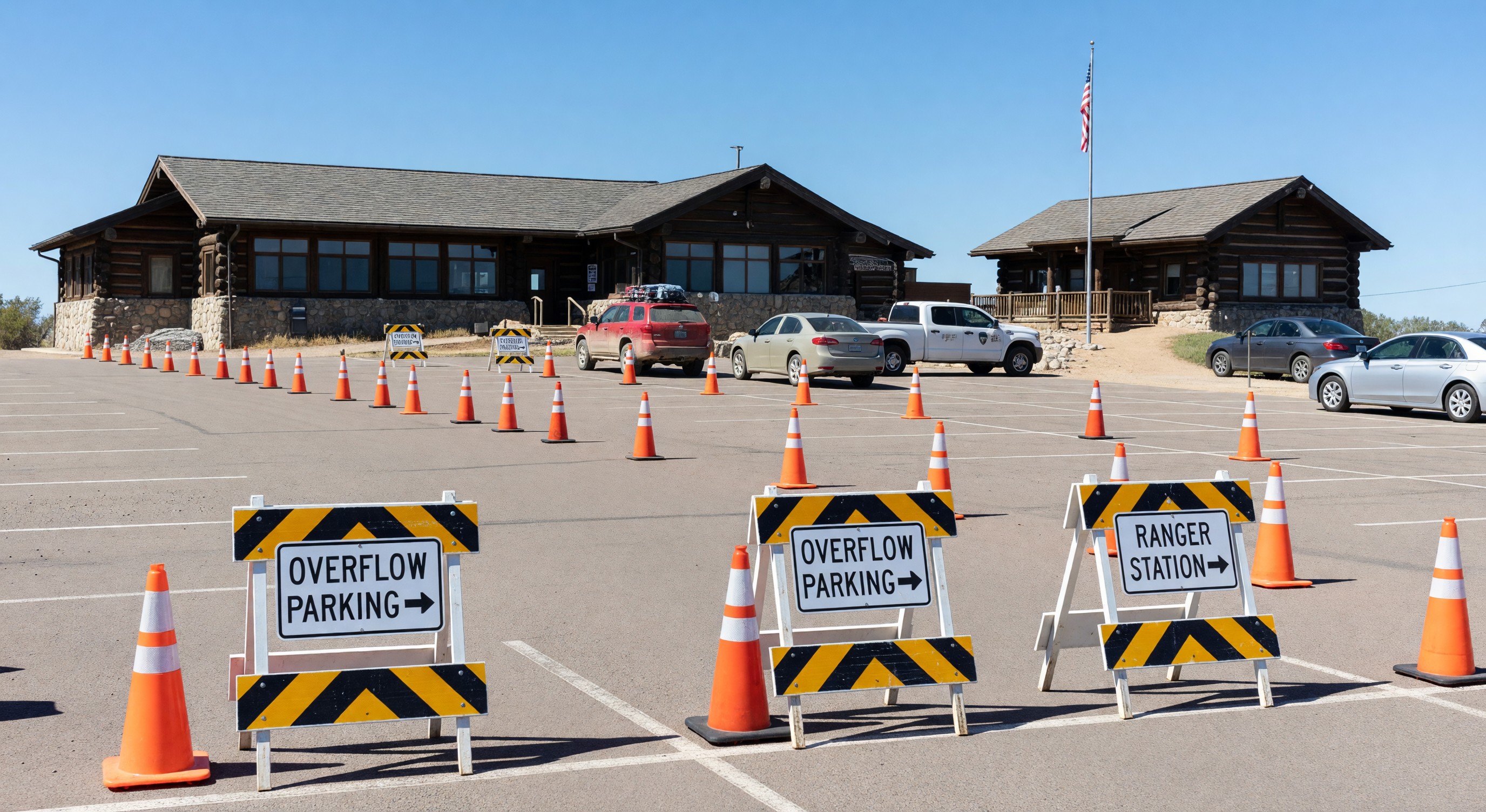
National parks, state parks, and public recreation areas face a parking management challenge that is unique in its stakes: the very popularity that fills parking lots may damage the natural resources the parks exist to protect. Yellowstone, Arches, Yosemite, and dozens of other crown jewel parks receive millions of visitors annually — more than their infrastructure was designed to accommodate. Parking lots overflow onto roadsides, visitors idle in traffic waiting for spaces, and the concentration of visitor activity damages vegetation, wildlife habitat, and visitor experience simultaneously. Managing recreation area parking requires balancing the public’s right of access with the resource protection mission, using reservation systems, shuttle operations, and visitor flow management tools that have no parallel in commercial parking management.
The Recreation Parking Challenge
Overcrowding and resource damage: The National Park Service recorded over 300 million visits to park units in 2023. Popular parks like Zion, Arches, and Acadia have experienced summer days where visitor volumes overwhelm all available infrastructure — parking lots, trails, and visitor centers. The resulting crowding reduces visitor experience quality and can damage resources directly (informal parking on vegetation, off-trail trampling caused by trail crowding that pushes visitors into undisturbed areas).
Mismatch between infrastructure and demand: Most national parks were designed in the mid-20th century with parking capacities calibrated for lower visitation. Modern vehicle ownership rates and the growth of outdoor recreation have produced demand that exceeds physical capacity at many popular parks without major infrastructure expansion — which itself would damage park resources.
Seasonal and weekend concentration: Recreation area parking demand is extremely seasonal and weekend-concentrated. Yosemite Valley may receive 20,000 visitors on a summer Saturday and 3,000 on a February weekday. Parking and visitor management infrastructure must handle the peak rather than the average, creating excess capacity most of the time.
Fee structure complexity: National park entrance fees, parking fees, camping fees, and reservation fees must be managed within the framework of the Federal Lands Recreation Enhancement Act (FLREA) and NPS fee policies. Fee revenue is retained by the park unit and must be used for visitor services and resource protection — creating a direct link between parking revenue and park management capacity.
Timed Entry Reservation Systems
Recreation.gov integration: The NPS has implemented timed entry reservation systems at numerous high-demand parks — requiring visitors to reserve a timed entry permit in advance to access the park or specific park areas during peak periods. Recreation.gov is the primary reservation platform for federal recreation facilities, including timed entry permits.
Arches National Park model: Arches National Park’s timed entry system (implemented starting in 2022) requires visitors arriving between 7 AM and 4 PM from peak season (typically April through October) to have a timed entry permit. Permits are available weeks in advance for a modest fee. The system limits daily arrivals to a level that avoids infrastructure overflow while allowing genuine visitor access with planning.
Zion National Park shuttle-only approach: Zion Canyon Scenic Drive has been shuttle-only (no private vehicles) since 2000 during peak season — private vehicles are required to park at the Zion Canyon Visitor Center and use the free park shuttle to access canyon attractions. This approach eliminates canyon parking demand entirely while maintaining visitor access through public transit.
Advance permit equity considerations: Timed entry permit systems that require advance booking favor visitors who can plan weeks ahead, have internet access, and can secure permits during competitive release windows. Equity implications — that the parks become effectively inaccessible to spontaneous visitors, lower-income families without flexible schedules, and visitors with limited digital access — are an active policy debate within the NPS and recreation planning community.
Shuttle Systems as Demand Management
Park shuttle operations: The most successful large-scale visitor flow management at crowded parks involves free or low-cost shuttle systems that remove private vehicles from sensitive areas. Zion, Acadia, Grand Canyon South Rim, and numerous other parks operate park shuttles that serve as the primary access mode for the most popular areas.
Off-site parking with shuttle: Parks that receive more vehicles than can park within the park boundary direct overflow to off-site parking areas with shuttle service to the park entrance. Gateway community parking — in nearby towns with shuttle connections — extends the park’s effective parking capacity without constructing impactful infrastructure within the park.
Shuttle frequency and capacity: Park shuttle systems must be designed for peak demand capacity. A shuttle route serving 2,000 visitors per hour requires substantial vehicle capacity and frequency — vehicles running every 10 minutes with 40-passenger capacity can move 240 passengers per hour per route; serving 2,000 per hour requires multiple simultaneous routes. Undersized shuttle systems create wait times that negate their benefit.
Seasonal and weekend service: Shuttle operations scaled for peak summer weekend demand require staffing and vehicle capacity that is fully utilized for 30 to 60 days per year and underutilized for the rest. Seasonal contracts, concession operators, and interagency agreements with other transportation providers allow flexible capacity scaling.
Parking Fee Structures in Recreation Areas
Federal fee authorities: Under FLREA, designated recreation fee areas can charge entrance fees, parking fees, camping fees, and special recreation permit fees. Federal lands operated by the NPS, USFS, BLM, and USFWS have different fee authorities under the same legislation. Revenue must be used for visitor services and resource protection.
America the Beautiful Pass: The interagency pass (America the Beautiful Pass) provides access to most fee-charging federal recreation areas for an annual fee — $80 for the standard pass (2024), with free passes for seniors over 62, military, and 4th-grade students through the Every Kid Outdoors program. Pass holders are exempt from entrance and standard amenity fees, including most parking fees.
State park fee structures: State parks set their own fee structures independently from federal standards. State park parking fees range from free (some states provide free state park access as a public benefit) to significant daily fees at premium destination parks. Annual state park passes (which typically include parking) are commonly offered at prices that provide value for residents who visit state parks frequently.
Revenue allocation: FLREA requires that at least 80% of recreation fee revenue be retained at the collecting unit and used for visitor services and resource protection. This retention creates a direct incentive for parks to maintain effective fee collection programs.
Environmental Impact Management
Parking footprint minimization: Recreation area parking design should minimize impervious surface footprint — each square foot of pavement has water quality, habitat fragmentation, and visual impact costs. Gravel parking areas, permeable paving, and efficient space layout reduce impervious surface per space.
Wildlife habituation concerns: Parking areas concentrate human activity that can habituate wildlife to human presence — a conservation concern for predator species and other wildlife that benefits from maintaining natural wariness of humans. Parking area location and design that minimizes wildlife-human contact in sensitive areas is a management consideration.
Vegetation and soils: Informal parking (vehicles parked on roadsides or in informal areas outside designated parking) compacts soils and destroys vegetation in ways that take decades to recover. Clear designation of parking areas, physical barriers (boulders, logs, fencing) that prevent informal parking, and enforcement that deters roadside parking protect park resources from one of the most common visitor impacts.
Light pollution: Parking lot lighting in park settings can affect nocturnal wildlife, astronomical observation in dark-sky parks, and the natural nighttime experience. Full-cutoff LED fixtures that minimize upward and lateral light spill, motion-activated lighting that reduces light during low-use periods, and warm-spectrum LEDs that have less impact on circadian rhythms of wildlife are best practices for recreation area parking lighting.
Frequently Asked Questions
How should parks communicate timed entry and reservation requirements to visitors? Communication before arrival is essential — visitors who arrive at a park expecting access and are turned away for lacking a required permit experience significant frustration and may leave negative reviews that discourage future visitation. Clear communication on the park website, Recreation.gov entry, and social media platforms about permit requirements, how to obtain them, and alternatives for unreserved visitors is the minimum standard.
What alternatives exist for visitors who can’t access timed entry reservations? Well-designed timed entry systems reserve some access for walk-up visitors (first-come, first-served early morning access before the reservation window), allow access outside peak hours (before 7 AM or after 4 PM at many parks), and direct visitors to nearby alternative parks or less-visited areas of the same park. Communication of these alternatives reduces the experience of total exclusion for visitors who didn’t secure advance permits.
How do parks manage parking for visitors with disabilities? ADA requirements apply to federal recreation areas under Section 504 of the Rehabilitation Act and the Architectural Barriers Act. Accessible parking spaces are required at all developed recreation areas; accessible routes from parking to visitor facilities must meet ADA standards. The Access Pass (free to persons with permanent disabilities) waives entrance and standard amenity fees. Timed entry permit systems typically include dedicated accessible reservation allotments that allow visitors with disabilities to secure access more easily than general permit competition.
What is the long-term trajectory for recreation area parking management? The long-term trend is toward more active visitor flow management — reservation systems, shuttle integration, dynamic pricing, and visitor experience monitoring that treats parking as one element of holistic visitor capacity management rather than a standalone infrastructure service. The NPS and other land management agencies view parking capacity expansion as a last resort; demand management through reservations, shuttles, and user fee pricing is the preferred tool for addressing overcrowding at popular recreation areas.
Takeaway
National park and recreation area parking management is fundamentally different from commercial parking in its mission — protecting resources and managing access for public benefit rather than maximizing revenue from a private asset. The tools of effective recreation parking management — timed entry reservations, shuttle systems, environmental impact minimization, and fee structures authorized by federal recreation law — have evolved substantially as park visitation has grown beyond historical infrastructure capacity. Land managers who implement thoughtful visitor flow management systems, communicate access requirements clearly to the public, and integrate parking into comprehensive visitor capacity planning are protecting the resources that make the parks valuable while ensuring that genuine public access is maintained for the millions of Americans who depend on public lands for outdoor recreation.
Further Reading from Authoritative Sources
- Federal Lands Recreation Enhancement Act and federal recreation fee authority — The U.S.
- Transportation Research Board national park access and visitor management research — The Transportation Research Board publishes research on recreation area visitor management, including timed entry effectiveness and shuttle system design, that provides the evidence base for the management strategies described in the article.