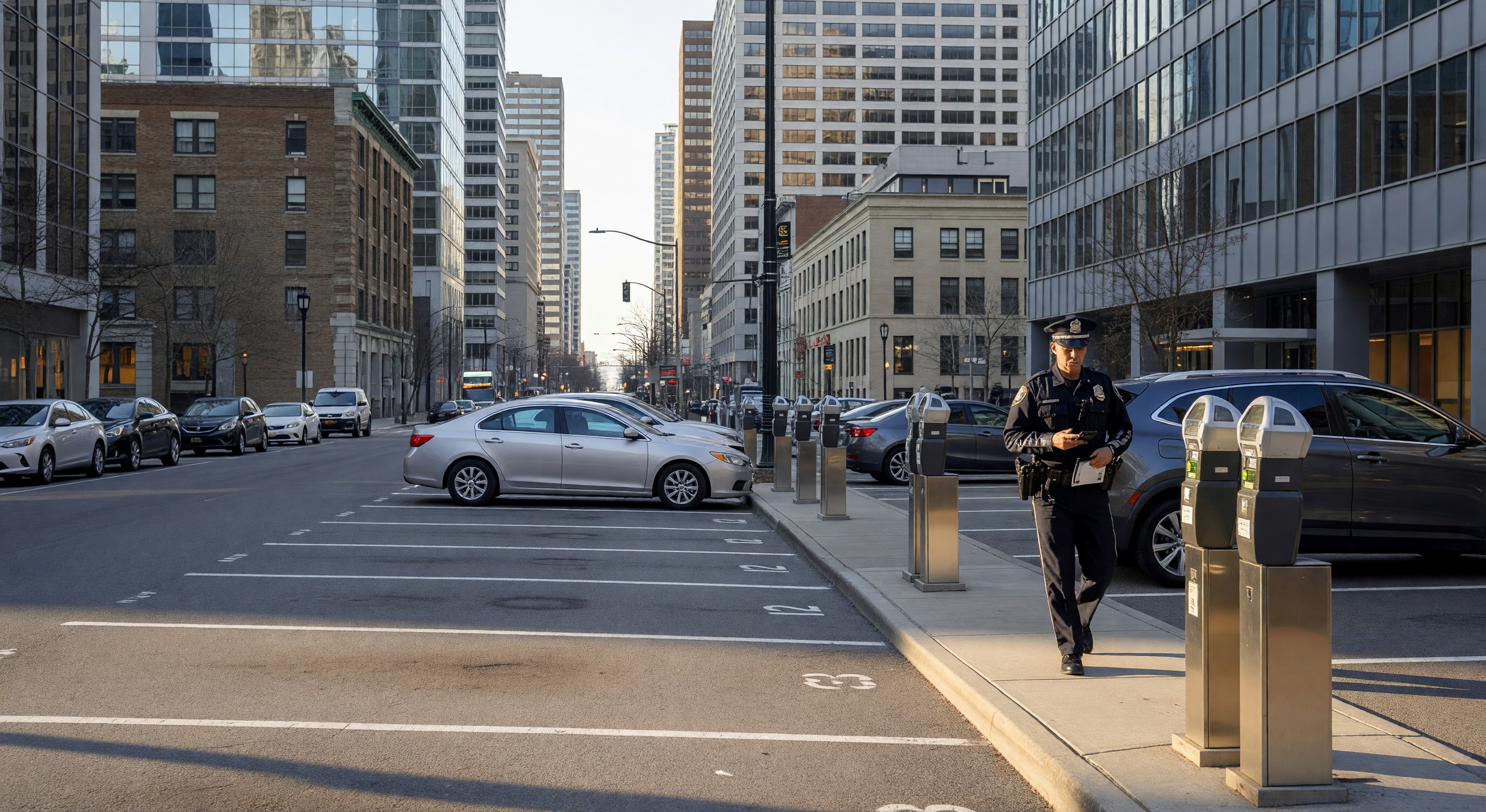
Municipal parking management encompasses the broadest range of parking types and policy objectives of any parking vertical. City governments operate on-street metered parking, publicly owned parking garages, residential permit programs, and parking enforcement — all within a policy framework that must balance revenue generation, transportation demand management, access for residents and visitors, and equity considerations. Unlike commercial parking, where revenue optimization is the primary objective, municipal parking must serve multiple, often competing public purposes simultaneously. Understanding how effective municipal parking management balances these objectives is essential for parking professionals working in or with city governments.
The Structure of Municipal Parking Authority
Municipal parking programs are organized in one of several governance structures:
City department operation: Many smaller and medium-sized cities manage parking directly through a transportation or public works department. City employees operate meters, manage enforcement, and administer permit programs. Revenue flows to the general fund or a dedicated transportation fund.
Parking authority: Some cities establish semi-independent parking authorities — boards with appointed members, separate budgetary authority, and staff dedicated to parking management. Parking authorities may have bonding authority (issuing revenue bonds backed by parking income) that enables capital investment in parking infrastructure independent of city budget cycles.
Private management with city oversight: Cities may contract the management of city-owned parking garages to private operators (management fee contracts or lease agreements) while retaining ownership and policy authority. The operator provides expertise and labor; the city retains revenue and policy control.
Regional parking authorities: Some metropolitan areas establish regional parking authorities that manage parking across multiple municipalities, enabling coordinated pricing, shared enforcement systems, and economies of scale in procurement and operations.
On-Street Meter Programs
On-street parking meter programs are the most visible element of municipal parking management:
Meter technology evolution: The traditional single-space parking meter (one meter per space) has largely been replaced by multi-space pay stations that serve 6 to 20 spaces from a single kiosk. Pay stations accept credit cards, mobile payment, and in some systems coin — and enable time-of-day rate variation, time limit enforcement, and remote monitoring that single-space meters did not.
License plate pay-by-space systems: Many municipal meter programs use license plate entry at pay stations — the parker enters their license plate number, pays for time, and the system records the plate and paid duration for enforcement matching. This eliminates the requirement to display a receipt and enables LPR-based enforcement to match plate records against payment records.
Dynamic meter pricing: San Francisco’s SFpark program demonstrated that demand-responsive meter pricing — adjusting rates up when blocks are full, down when blocks have excess vacancy — maintains target occupancy (85-90%, or roughly one vacant space per block face) while generating revenue. The model has been adopted in Seattle, San Diego, Washington DC, and other cities.
Enforcement technology: Parking enforcement for meter violations has shifted from manual chalk-and-officer methods toward LPR (license plate recognition) mobile units that photograph plates, check against payment databases, and automatically generate citations. LPR enforcement significantly increases the number of spaces an officer can check per shift and removes the time-constrained nature of chalk-based enforcement.
City-Owned Parking Garages
Municipal parking structures have different management challenges than private commercial facilities:
Public access obligations: City-owned garages typically have public access obligations that commercial facilities do not — they may be required to remain open 24/7, price below market for certain user groups, or accept all legal payment forms. These obligations can constrain revenue optimization.
Revenue bond financing: Many city-owned garages were financed with revenue bonds — bonds whose debt service is paid from parking garage revenue rather than general tax revenue. Revenue bond covenants typically require maintaining coverage ratios (revenue to debt service), which constrains pricing and operational decisions.
Capital maintenance funding: Aging municipal parking structures face deferred maintenance that has accumulated as parking revenue was diverted to general fund uses rather than facility maintenance. Capital needs assessments and dedicated capital maintenance funds are best practices that many municipal programs have not implemented consistently.
Private operator comparisons: Cities should periodically benchmark their city-owned garage performance (revenue per space, operating cost per space, customer satisfaction) against comparable privately operated facilities to evaluate whether city operation or private management is achieving market efficiency.
Residential Permit Programs
Residential parking permit (RPP) programs designate street parking for neighborhood residents in areas where demand from non-residents would otherwise crowd out residents:
Program design variation: RPP programs vary significantly in design — some provide unlimited overnight parking for permit holders; others allow time-limited daytime parking for residents; some distinguish between household vehicles and visitor permits. Program design should reflect the specific parking demand pressures the program addresses.
Fee structures: Most cities charge nominal fees for residential permits — $20 to $100 annually — that do not reflect market value. Increasing residential permit fees to levels that reflect the value of dedicated curb space access has been advocated by parking reform economists but is politically sensitive in most markets.
Equity considerations: RPP programs benefit residents with vehicles and curb access (predominantly homeowners) while providing limited benefit to households without vehicles or in dense housing without curb frontage. Designing RPP programs that do not create neighborhood barriers to visitors and service workers requires attention to program scope and exemptions.
Program administration: Permit issuance, verification of residency, visitor permit distribution, and enforcement coordination require administrative infrastructure that varies from paper-based systems at small cities to online portals with real-time permit verification at larger programs.
Enforcement and Revenue Collection
Citation management: Municipal parking citation systems track issuance, payment, appeals, and escalation to collection or DMV hold. Modern systems are digital — handheld devices for officers, web portals for payment and appeals, direct data transfer to collection agencies for delinquent accounts.
DMV registration holds: Most states allow municipalities to place holds on vehicle registration renewals for scofflaw vehicles with unpaid citation balances above a threshold. Registration holds are a powerful collection tool — drivers who need to renew their registration must clear parking debt to do so.
Parking revenue allocation: The appropriate destination for parking revenue — general fund, transportation fund, neighborhood parking fund, transit subsidy — is a policy decision that affects program design and political support. Programs that dedicate parking revenue to neighborhood improvements or transit benefit generate more community support than programs that funnel revenue to the general fund.
Frequently Asked Questions
How should cities price public parking to achieve transportation demand management goals? Pricing should reflect the scarcity of parking in specific locations and times — higher prices during peak periods when demand exceeds supply, lower prices off-peak when supply is abundant. The goal is 85 to 90 percent occupancy on metered blocks, achieved by adjusting rates dynamically. Pricing should also include cost-recovery for parking facility capital and operations, with any surplus available for transportation investment.
What is the appropriate relationship between transit investment and parking revenue? Several cities (San Francisco, Seattle, Portland) have dedicated a portion of on-street parking revenue to transit operations or capital — on the logic that parking demand and transit use are related, and that transportation system pricing should internalize the relationship. The specific allocation depends on local fiscal conditions and transportation policy priorities.
How should cities approach privatization or long-term lease of municipal parking assets? Long-term concession agreements (like Chicago’s 2008 parking meter lease) have generally been evaluated critically in retrospect — the 75-year term and limitations on rate adjustment created political and operational problems. Shorter-term management contracts that maintain city policy authority while accessing private operator expertise are typically preferable to full asset privatization for core municipal parking infrastructure.
What performance metrics matter most in municipal parking programs? Meter occupancy (achieving target 85% peak occupancy as evidence of appropriate pricing), citation collection rate (percentage of issued citations ultimately collected), garage utilization versus capacity, and public satisfaction with parking availability and pricing. Revenue per space is important but should be evaluated in context of the public access and TDM objectives that distinguish municipal from commercial parking.
Takeaway
Municipal parking management requires balancing revenue generation, public access, transportation demand management, and equity considerations in ways that purely commercial parking operations do not. The municipalities that manage parking most effectively treat it as an integrated transportation policy tool — setting prices that reflect demand, investing revenue in transportation infrastructure, maintaining public assets to modern standards, and measuring performance against multiple objectives simultaneously. The operational sophistication available from PARCS technology, LPR enforcement, and real-time data systems provides municipal parking programs with the tools to achieve these objectives — if the policy framework and political will to use them effectively are in place.
Further Reading from Authoritative Sources
- NACTO urban street design guide for on-street parking and curb management — NACTO’s urban street design guide provides the transportation planning and curb management context for on-street municipal parking programs, including the relationship between parking pricing, curb space allocation, and urban mobility goals described in this article.
- US DOT performance management framework for municipal transportation and parking programs — The US DOT transportation performance management framework provides the multi-objective performance measurement methodology applicable to municipal parking programs that must serve public access, TDM, revenue, and equity goals simultaneously, as described in this article.