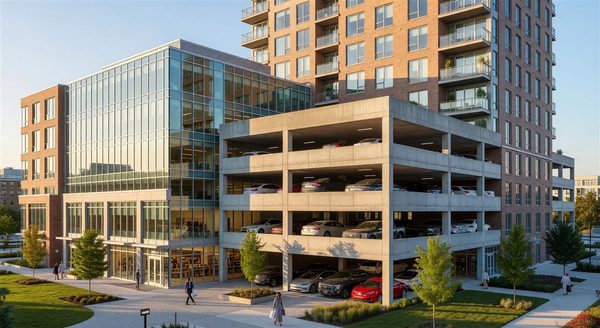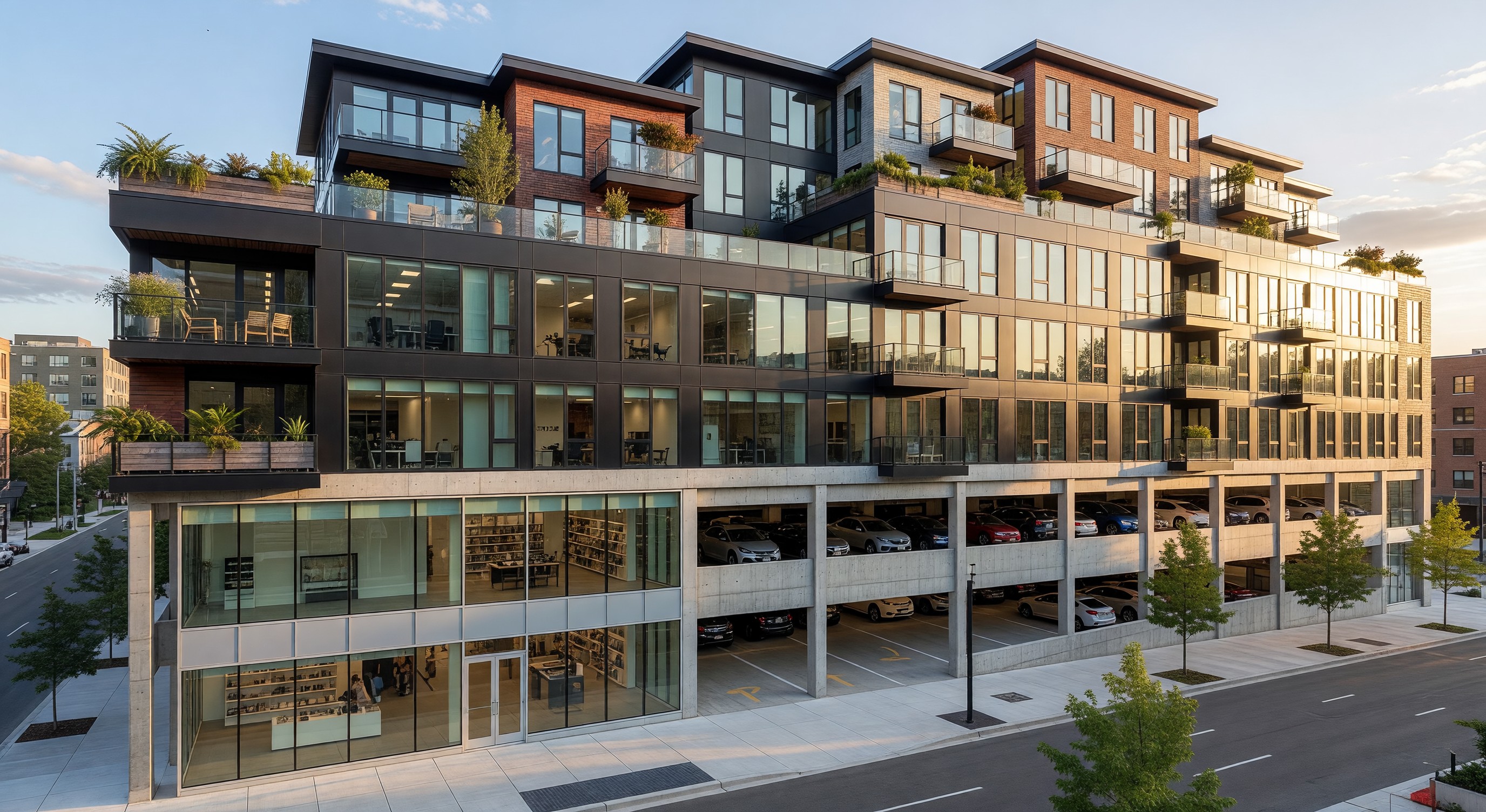
Mixed-use developments — projects that combine residential, retail, office, hotel, or other uses within a single building or campus — represent one of the most complex parking management environments. Multiple user populations with different parking demand patterns share a common facility; retail validation creates transaction complexity; residential tenants have overnight needs that conflict with retail turnover requirements; and the interplay between uses must be managed to prevent parking shortfall for any user group while maximizing overall facility utilization. Understanding the principles and practices of mixed-use parking management is essential for developers, property managers, and parking operators serving this growing development type.
The Mixed-Use Parking Opportunity
Mixed-use development’s fundamental parking advantage is temporal complementarity: different land uses generate peak parking demand at different times of day, allowing a shared parking supply to serve total demand that exceeds the capacity of any one user’s peak.
Office-retail-residential complementarity: Office use generates peak parking demand on weekday business hours; retail peaks on weekend afternoons; residential has peak overnight demand and lower daytime occupancy. The Urban Land Institute’s shared parking methodology (documented in ULI’s “Shared Parking” publication) quantifies these temporal demand profiles and calculates the reduced total supply needed to serve all users compared to building separate facilities for each use at their individual peak.
Actual vs. theoretical complementarity: The benefits of shared parking are real but require careful analysis. Uses that peak at the same time (a restaurant and a cinema, both peaking Saturday evening) cannot be double-counted in shared parking calculations. Accurate demand profiles for each use type — using ULI shared parking matrices adjusted for local conditions — are essential for determining actual supply requirements.
Practical constraints on sharing: True sharing requires that all users can access all spaces without restrictions — assigned resident spaces cannot be shared with retail customers. Practical mixed-use parking typically requires some permanent allocation (resident spaces, 24-hour reserved spaces) plus shared transient inventory that serves retail, office, and visitor demand throughout the day.
Multi-Tenant Access Management
Tenant segmentation: Mixed-use parking access management must distinguish between user types: residents with monthly residential permits (24-hour access, typically dedicated sections or levels); office tenants with weekday monthly permits (restricted to business hours or with after-hours access); retail customers with validated parking (time-limited); hotel guests with hotel-validated parking; and transient visitors paying hourly rates.
PARCS configuration complexity: A mixed-use facility’s PARCS must be configured to manage multiple access credential types simultaneously — residential RFID transponders that open without payment; monthly office permits with time restrictions; validation processes for retail and hotel; and pay-on-foot or pay-at-exit for transient users. PARCS systems that can be configured for complex multi-tenant access management are essential — simpler systems designed for single-use facilities may not accommodate the credential variety required.
Resident parking protection: Residential tenants in mixed-use buildings have expectations of access reliability that they will enforce through lease renewal decisions. Reserved or designated residential parking sections that are protected from retail or office encroachment — with access control that admits only residential credential holders — are necessary to meet residential tenant expectations.
After-hours access: Retail parking that is available to all users during business hours may transition to residential-only access overnight. PARCS access programming that changes permission levels by time of day supports this transition without requiring physical separation of uses.
Validation Programs in Mixed-Use Settings
Retail validation: Ground-floor retail tenants in mixed-use buildings typically offer parking validation to their customers — validating parking for the duration of the retail visit. In a shared parking facility, retail validation reduces parking revenue (the validated amount is borne by the retailer, not the customer) while encouraging retail utilization. Validation program design — how much is validated, for how long, with what maximum — must balance retail tenant service with parking facility revenue.
Restaurant validation: Restaurant tenants typically validate for two to three hours to cover a full dining experience. In a mixed-use facility with demand competition between restaurant, retail, and residential parking, restaurant validation that extends into residential peak periods (evening) can create capacity conflicts.
Hotel guest parking: Hotel components in mixed-use developments typically validate parking for hotel guests — in-hotel parking included in room rate or offered at a flat daily rate that is significantly below the facility’s transient rate. Hotel validation reconciliation (tracking how many hotel guest nights generate how many parking validations) requires clear accounting between the hotel’s parking cost and the parking facility’s revenue.
Multi-tenant validation reconciliation: When multiple tenants offer validation from a common parking facility, the parking operator must reconcile validation costs against tenant accounts — charging each tenant for the validation it issued. Digital validation systems (app-based, QR code-based) with tenant-specific validation codes provide clean audit trails for multi-tenant reconciliation.
Pricing Structure and Revenue Management
Blended rate management: Mixed-use parking facilities price different user segments differently — monthly residential permits at market residential rates, monthly office permits at commercial rates, hourly transient at a rate that reflects market demand, and validation rates by tenant agreement. The blended rate across all users produces the facility’s effective revenue per space.
Revenue allocation in mixed ownership: When a mixed-use development has multiple owners (residential condo association, retail owner, office owner), parking revenue allocation by user segment is essential for equitable contribution. Revenue from residential permit holders flows to the residential component; retail validation costs are charged to retail tenants; transient revenue is allocated by agreement. Clear revenue allocation agreements among ownership groups should be established at development time.
Dynamic pricing for transient users: The transient parking component of a mixed-use facility can use demand-responsive pricing — charging higher rates when the facility is in high demand and lower rates during low-demand periods. This pricing optimization applies to the portion of inventory available for transient use, not to the reserved or permitted components.
Operational Design for Mixed-Use
Physical separation: The most effective mixed-use parking design provides physical separation between user types — a residential section accessible only with residential credentials on specific levels, with transient and commercial users accessing other levels. Physical separation reduces access conflicts and simplifies credential management.
Signage clarity: Mixed-use parking facilities must communicate clearly which areas serve which users — residents to level P1, retail customers to P2 and P3, hotel guests to P4. Confusing signage that causes residential tenants to park in the wrong area or retail customers to occupy residential spaces creates ongoing conflict.
Hours of operation alignment: The parking facility’s hours of operation must align with all uses — residential tenants need 24/7 access even if retail closes at 10 PM. Operating requirements for each use must be established and operational hours set to serve the most demanding user type.
Frequently Asked Questions
How should shared parking inventory be allocated among tenants in a multi-tenant development? Allocation should follow a tiered approach: first, permanent allocations for users who have guaranteed access rights (residential tenants with leased spaces, hourly access commitments in tenant leases); second, the remaining “shared” inventory serves all other users on a first-come basis. The shared inventory must be sized so that it can serve peak demand from all eligible user types without shortfall — requiring accurate demand profiling and ULI shared parking analysis.
What happens when a mixed-use parking facility reaches full capacity during a peak period? When shared inventory is full, users without permanent reserved access must be turned away or directed to overflow facilities. Preventing this situation requires accurate demand forecasting and parking reservation systems (for retail events or planned high-demand periods) that allow management to anticipate and respond to peak demand. Clear policy about priority access when capacity is constrained — residents and monthly permit holders have priority over transient users — must be communicated and implemented.
How should mixed-use parking management agreements be structured? Management agreements for mixed-use parking should specify: the allocation of spaces by user type; the responsibilities of the parking operator versus individual tenants; the validation program terms for each tenant; revenue allocation and accounting requirements; liability allocation; and operational requirements including hours of operation and maintenance standards. Agreements should be reviewed by legal counsel familiar with multi-tenant commercial real estate arrangements.
Is mixed-use parking more or less expensive to operate than single-use parking? Mixed-use parking typically has higher operating cost per space than single-use parking due to greater access management complexity, multi-tenant validation reconciliation, longer operating hours (serving both residential and commercial uses), and more sophisticated PARCS requirements. These costs are offset by the higher space utilization achievable through temporal demand complementarity — spaces that are occupied more hours per day generate more revenue per space than single-use facilities where some periods are structurally low-demand.
Takeaway
Mixed-use development parking management is more complex than single-use parking, but the complexity is justified by the genuine advantage of temporal demand complementarity — the ability to serve more total demand from a smaller shared supply than would be needed for separate dedicated facilities. Achieving this advantage requires accurate demand profiling for each use type, carefully designed access management that prevents user conflicts, clear validation program structures with clean revenue accounting, and PARCS systems capable of managing the credential and pricing complexity of a multi-tenant operation. Developers and property managers who invest in thoughtful mixed-use parking program design capture the economic efficiency of shared parking while delivering reliable access to each user group.
Further Reading from Authoritative Sources
- IPMI shared parking and mixed-use development parking management guidance — The International Parking and Mobility Institute publishes operational guidance for parking management in mixed-use settings, including shared parking methodology and access management standards directly relevant to the article.
- Transportation Research Board shared parking and mixed-use development research — The Transportation Research Board publishes research on shared parking effectiveness and mixed-use development parking that provides the evidence base for the temporal complementarity and demand modeling approaches described in the article.