Medical office buildings (MOBs) — the physician practice offices, outpatient diagnostic centers, and specialty clinics that house outpatient medical care — occupy a distinct parking niche between general commercial office parking and hospital campus parking. MOBs serve patient populations who may have mobility limitations, are often in pain or experiencing health anxiety, and are navigating unfamiliar facilities while managing their health conditions. At the same time, MOBs have the commercial parking structure of general office buildings — physician tenant leases, staff parking programs, and validation practices tied to commercial practice economics rather than hospital operations. Understanding MOB parking’s hybrid character is essential for managing it effectively.
The MOB Parking Context
Medical office buildings are typically classified by their relationship to hospital campuses:
On-campus MOBs: Located on or adjacent to hospital campuses, sharing campus infrastructure and often integrated with campus parking management. On-campus MOBs may share campus PARCS, validation programs, and enforcement with the hospital while maintaining separate physician and staff permit arrangements.
Off-campus MOBs: Located in commercial areas removed from hospital campuses — physician offices in professional parks, standalone specialty clinics, surgical centers in commercial corridors. Off-campus MOBs manage parking independently with their own PARCS and validation programs.
Health system portfolio MOBs: Large health systems own or manage portfolios of MOBs across multiple locations, often with standardized parking programs applied across the portfolio through centralized management.
Patient Population Characteristics
MOB patient populations have distinct characteristics that affect parking management:
Higher-than-average mobility limitation: Patients attending specialist physician offices, oncology clinics, pain management practices, and orthopedic surgeons often have mobility conditions that make walking distances and uneven surfaces more challenging. ADA-accessible parking must be provided at adequate levels and maintained rigorously.
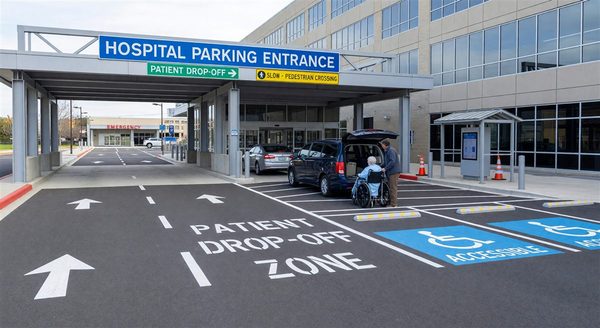
Post-procedure limitations: Patients who receive outpatient procedures — injections, biopsies, minor surgery under sedation — may be unable to drive post-procedure and need accessible pickup areas. Patient drop-off and pickup zones near the main entrance serve patients who arrive independently but need driver pickup after procedures.
Recurring visitor patterns: Many MOB patients are recurring visitors — patients in physical therapy, oncology follow-up, or ongoing specialist care visit the same MOB weekly or monthly. These recurring visitors benefit from validation programs that cover recurring visit parking costs, reducing the financial burden of ongoing medical care.
Appointment-based arrival: Unlike hospital emergency or inpatient admission, most MOB visits are appointment-based with predictable arrival windows. Parking demand follows appointment scheduling patterns — morning peaks, afternoon peaks, and predictable slow periods between them.
Physician and Staff Permit Programs
Physician parking tiers: Physician tenants of MOBs typically negotiate parking provisions in their lease agreements. Common provisions include: a number of reserved parking spaces allocated to the practice (for physicians and key staff); any validation allocation for patient parking; and reserved space location (near elevator or entrance for physician convenience). Premium reserved physician parking near the building entrance is a standard lease incentive.
Staff parking in secondary areas: Non-physician medical staff (nurses, medical assistants, front desk staff) typically receive parking permits in non-reserved secondary areas — often farther from the main entrance or in lower-priority sections. Staff permit pricing may be subsidized as a benefit or charged at market rates depending on the health system’s or MOB manager’s benefits philosophy.
Physician practice parking allocation: A medical practice with three physicians and five clinical staff may negotiate for four reserved physician spaces and five staff permits in the permit program. Managing these allocations across multiple physician tenants requires clear documentation of lease commitments and active monitoring to prevent lease violations.
Substitute and locum physician access: Physician practices with locum tenens (substitute) physicians, residents, or medical students need temporary parking access protocols — digital credentials or validation processes for individuals who need occasional access outside the regular permit program.
Patient Validation Programs
Standard visit validation: Most MOBs validate patient parking for the standard duration of a clinical visit — 90 minutes to 2 hours is typical for a specialist outpatient visit. Validation is often unlimited (no cap beyond the time limit) for visits that stay within the standard window.
Extended visit procedures: Patients receiving infusion therapy, physical therapy sessions, or outpatient procedures with observation periods may need validation beyond the standard window. Validation systems that allow clinical staff to extend validation for specific patients — tied to the clinical encounter duration rather than a fixed time — serve these extended-visit patients without exposing the practice to unlimited validation cost.
Practice-specific validation budgets: In MOBs with multiple physician tenants, each practice manages its own validation program — issuing validation on behalf of its patients and receiving a monthly invoice from the parking operator for the validation volume. Validation cost is typically allocated to the practice’s operating expenses rather than charged to individual patients.
Patient hardship accommodations: MOBs affiliated with non-profit health systems may have patient hardship parking programs — fee waivers or significant discounts for patients who demonstrate financial need. These programs are typically administered through the health system’s financial counseling function rather than the parking operator directly.
ADA Compliance Priorities
Accessible space quantity: MOBs should exceed ADA minimum accessible space counts given their patient population profile. The ADA minimum (1 in 25 spaces) may be adequate for general commercial parking but is often insufficient for medical office parking serving patient populations with higher-than-average mobility limitation rates.
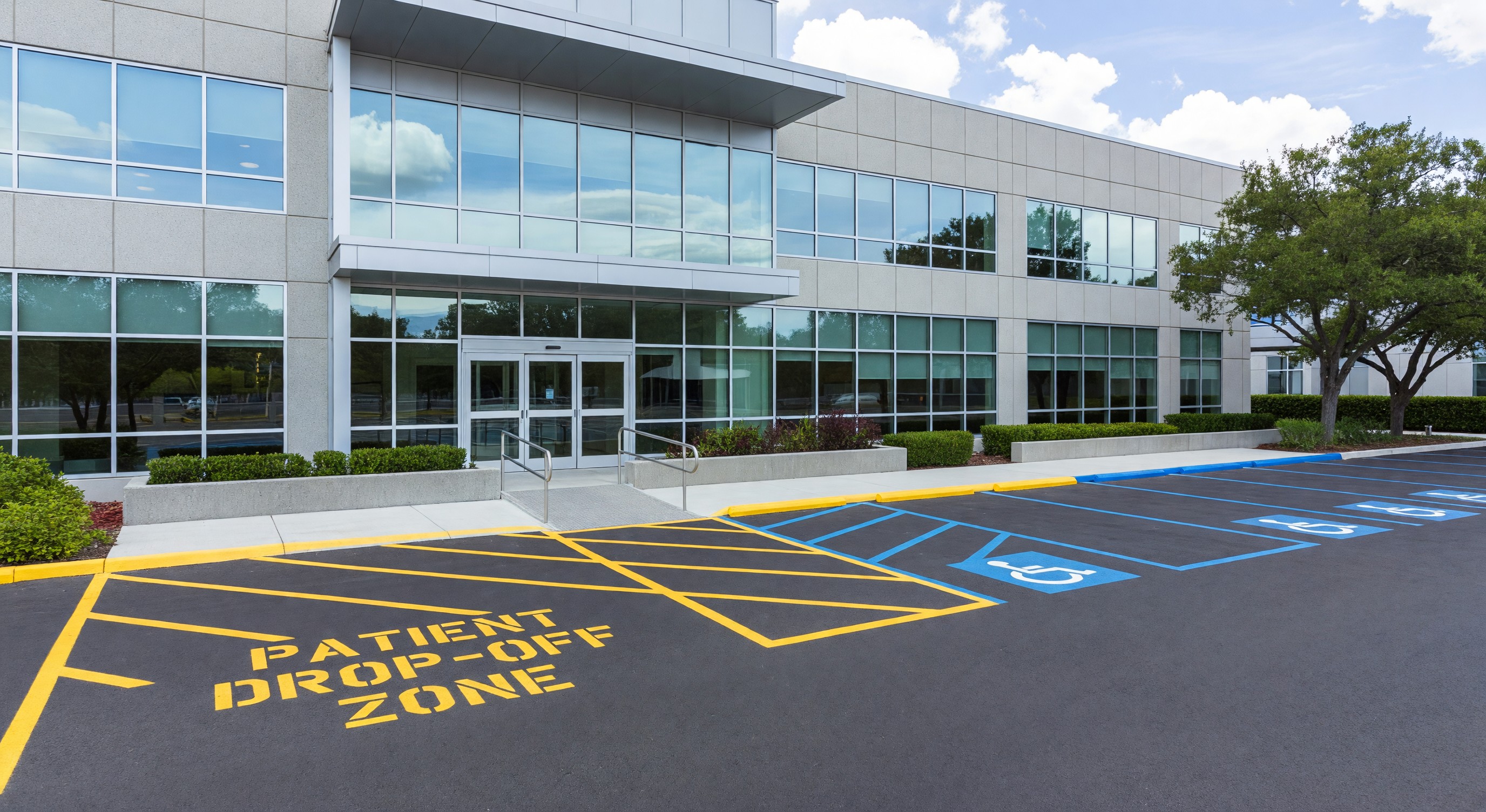
Van-accessible space emphasis: MOBs should have a higher proportion of van-accessible spaces (8-foot access aisles) than the ADA minimum (one in six accessible spaces). Patients who use power wheelchairs or scooters are disproportionately represented in medical facility patient populations.
Route quality from accessible spaces: The accessible route from accessible parking to the MOB entrance must be compliant in surface quality, width, cross-slope, and protruding object clearance. Routes through parking lots can be challenging to maintain (asphalt surface degradation, snow and ice accumulation in winter) and require higher maintenance priority than general parking surfaces.
Accessible drop-off zone: A designated accessible vehicle drop-off zone near the main entrance — separate from general traffic circulation — enables patients who cannot walk from parking to be dropped off at the entrance by a driver who then parks elsewhere.
Frequently Asked Questions
How should MOB parking validation programs handle HIPAA considerations? HIPAA privacy requirements apply to protected health information — medical records, diagnoses, treatment information. Standard parking validation (confirming that a vehicle is validated for a visit) does not inherently involve protected health information. However, if validation records link patient identity to visit type or treating physician in identifiable ways, HIPAA analysis by legal counsel is warranted. Validation systems that simply record a license plate, a validation time, and a generic “patient visit” category are generally not PHI-generating.
What is the appropriate parking ratio for a medical office building? MOB parking ratios are typically higher than general office parking ratios because medical staff-to-patient ratios are higher than typical office employee-to-visitor ratios, and because patients may arrive by vehicle at higher rates than office building visitors. A common planning standard for MOBs is 4 to 6 spaces per 1,000 square feet of gross leasable area, compared to 3 to 4 for general office. The appropriate ratio depends on the specific specialty mix — a primary care building sees shorter visits and higher turnover than a multi-day rehabilitation center.
How should MOB parking managers handle patients who park for extended periods beyond visit duration? Patients who remain parked significantly longer than their visit duration — a patient whose appointment is over but who has walked to a nearby appointment or is waiting for a family member — create capacity issues that affect other arriving patients. Clear time limit policies (enforced with reasonable grace periods and warning-first protocols), communicated through signage and validation materials, address this without creating the negative patient experience of punitive enforcement.
Should MOBs charge patients for parking? Patient parking pricing in MOBs is a balance between operational cost recovery and patient experience. Fully validated (free to the patient) parking is common in healthcare systems where patient experience is prioritized and parking cost is absorbed as a healthcare service cost. Partial validation (a defined number of free hours with charges for extended stays) and full patient charges (with hardship programs for low-income patients) are alternatives that reflect different institutional philosophies about parking as a healthcare service component.
Takeaway
Medical office building parking management combines the commercial parking structure of office building management with the patient access and experience priorities of healthcare facility management. The most effective MOB parking programs provide reliable, accessible patient parking with appropriate validation programs that reflect visit duration realities, clear physician and staff permit arrangements that honor lease commitments, ADA-compliant accessible spaces in excess of minimums given the patient population profile, and patient drop-off infrastructure for post-procedure pickup. The operational standard for MOB parking should reflect the healthcare context — parking is part of the patient’s care experience, and a parking failure that adds stress to an already anxiety-producing medical visit is a healthcare quality failure, not just a parking inconvenience.
Further Reading from Authoritative Sources
- US Access Board ADA parking guide for medical office building accessible space requirements — The US Access Board ADA parking guide provides the authoritative accessible space count, van-accessible space, and accessible route standards applicable to medical office building parking described in this article, supporting the recommendation to exceed ADA minimums for medical facility populations.
- ADA.gov parking resources for healthcare facility compliance and enforcement — ADA.gov provides the federal guidance on ADA parking compliance, enforcement, and maintenance requirements applicable to medical office building operators managing accessible parking for patient populations with mobility limitations described in this article.