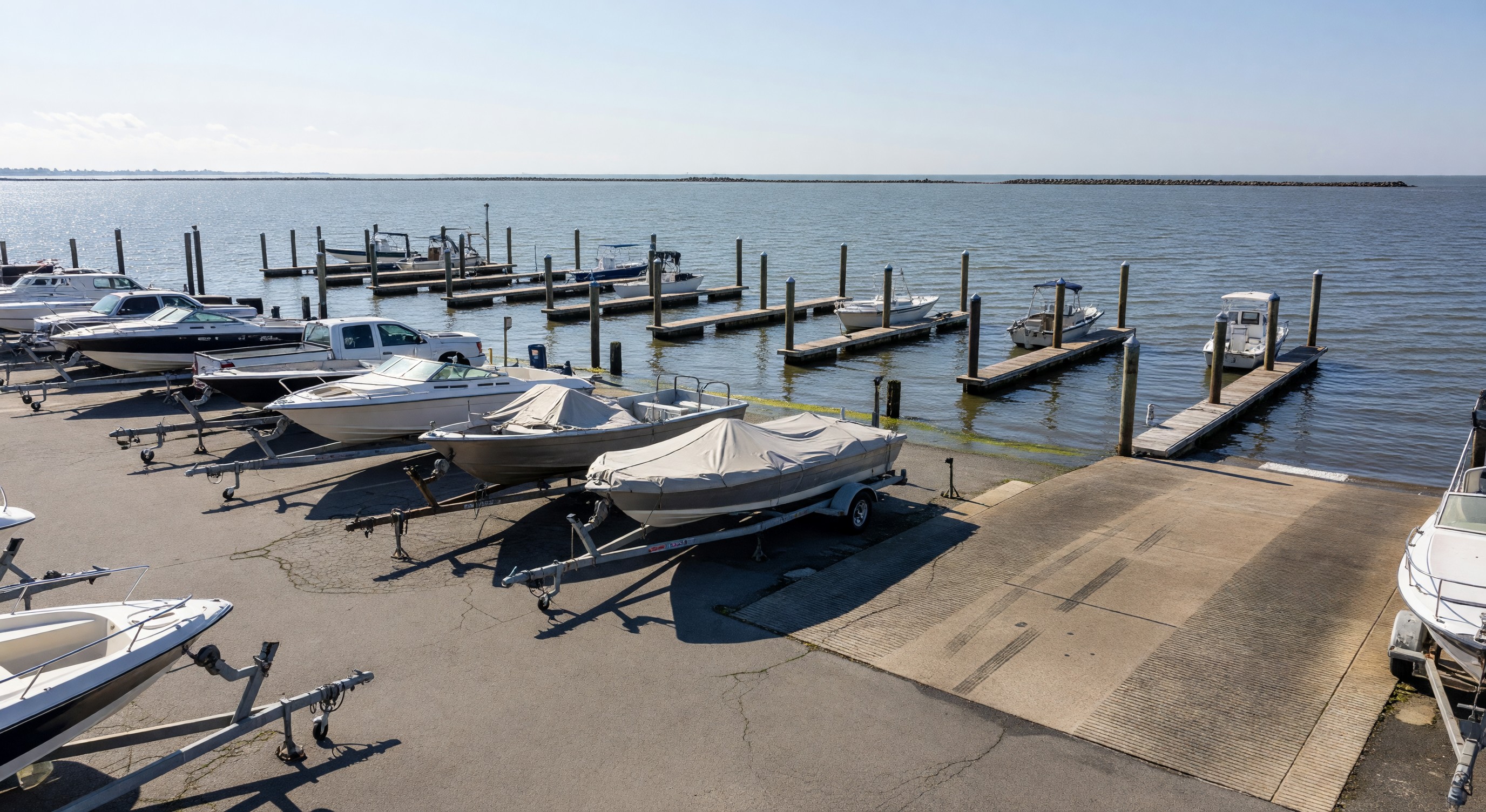
Marina and waterfront recreational facility parking occupies a specialized niche defined by trailer vehicles, seasonal demand concentration, boat launch logistics, and environmental considerations near water. The parking needs of recreational boaters — arriving with boat and trailer, launching into the water, parking the trailer and tow vehicle for the day, and returning to retrieve the boat — differ fundamentally from passenger vehicle parking in design, capacity, and management requirements. Understanding marina and waterfront parking management helps facility managers at marinas, state parks, county water access points, and yacht clubs provide appropriate access while managing limited waterfront parking resources effectively.
Marina Parking Demand Characteristics
Seasonal concentration: Recreational boating is intensely seasonal in most of North America — summer weekends generate orders of magnitude more demand than winter weekdays. A marina that serves 50 vehicles on a December weekday may see 500 on a July Saturday. Parking infrastructure and staffing must accommodate peak seasonal demand while the capital cost is amortized over year-round or full-season operations.
Weekend vs. weekday: Even within the boating season, weekend demand dramatically exceeds weekday demand. Saturday and Sunday arrivals from 7 to 10 AM for a full day on the water create a concentrated arrival surge that fills launch ramps and parking areas quickly.
Full-day duration: Boaters who launch for a full day of recreational use park their trailers for 8 to 12 hours. Unlike commercial parking where space turnover occurs throughout the day, marina trailer parking has very low midday turnover — most spaces occupied in the morning remain occupied until the afternoon or evening.
Special event peaks: Fishing tournaments, sailing regattas, and waterfront festivals generate above-normal demand that may overwhelm standard parking capacity. Pre-event capacity planning and overflow protocols are necessary for facilities that host regular events.
Trailer Parking Requirements
Space dimensions: Standard passenger vehicle parking spaces (8.5 feet wide, 18 feet long) are completely inadequate for vehicle-and-trailer combinations that may be 40 to 60 feet long. Trailer parking spaces require 12 to 15 feet of width and 40 to 65 feet of length. A standard parking lot designed for passenger vehicles has approximately one-third the trailer parking capacity of the same area redesigned for trailer parking.
Maneuvering space: Backing a boat trailer into a parking space — particularly for recreational boaters who may not be expert reverse-trailer drivers — requires significantly more maneuvering space than passenger vehicle parking. End-of-row and pull-through configurations that allow forward entry or minimize backing requirements reduce conflicts and damage.
Circulation design: Drive aisles for trailer parking must accommodate turning radii for common trailer configurations — typically 30 to 40 feet radius for a 22-foot boat trailer. Circulation patterns that minimize the need for tight turns reduce driver frustration and collision damage.
Separated trailer lot areas: Marinas with both slip holder parking (monthly tenants who need passenger vehicle parking) and launch area trailer parking benefit from physically separated areas — slip holder cars in a standard passenger vehicle lot, trailered boats in a larger-space trailer lot near the launch ramp. Separation prevents trailer vehicles from blocking passenger vehicle lots and vice versa.
Launch Ramp Queue Management
Ramp capacity and bottlenecks: Boat launch ramps are the primary bottleneck at busy marina facilities. A single ramp lane can typically launch or retrieve one boat every 5 to 10 minutes. At a facility with 100 boats launching on a Saturday morning, a single-lane ramp requires 8 to 17 hours of launch time — obviously inadequate for a concentrated morning arrival. Multi-lane ramps, ramp reservations, and launch assistance from dock staff reduce bottlenecks.
Staging area management: A staging area where boats wait before launching (rigged and ready but not blocking the ramp) maintains ramp throughput by ensuring each vehicle is fully prepared when the ramp is available. Staging area management — directing vehicles in queue order, preventing staging area blocking by unprepared vehicles — requires active staff management during peak periods.
Launch reservations: Online or app-based launch ramp reservations — particularly for peak summer weekends — distribute demand and allow boaters to plan their arrival for a specific window. Reservation systems that charge a fee for launch reservations (often $10 to $20 beyond the parking fee) generate revenue and reduce no-shows. Some state park and municipal marina systems have implemented reservation-required launch programs for peak periods.
Retrieval timing: The afternoon boat retrieval surge — all boaters returning from a day on the water within a similar time window — creates ramp congestion that mirrors the morning launch surge. Staging areas for boats waiting for ramp access, ramp attendants who manage retrieval sequences, and clear communication about retrieval procedures reduce the afternoon congestion that often exceeds the morning launch peak.
Slip Holder Permit Programs
Monthly parking for slip tenants: Boat slip tenants — who pay monthly slip rental for their boats — typically receive designated parking as part of their slip agreement. Slip holder parking may be passenger vehicle-only (for slips where boats remain in the water permanently) or include trailer space (for dry storage facilities where trailers need regular access).
Permit documentation and access control: Slip holder parking credentials — RFID transponders, license plate registration in LPR systems, or physical hang tags — provide access to designated parking areas. Access control that limits slip holder areas to valid credential holders prevents day-launch parkers from filling slip holder spaces.
Boat storage and parking integration: Dry stack storage facilities — where boats are stored in multi-story rack structures and launched by forklift on demand — have different parking requirements from wet slip marinas. Dry stack customers arrive to request their boat from storage staff, wait in a staging area, and depart with their boat. The vehicle traffic pattern (arrival without trailer, departure with boat and trailer) requires specific parking design that accommodates both states.
Seasonal slip permit changes: Marinas with seasonal slip holders (who rent for the warm water season only) have parking permit programs that activate and deactivate with the season. Digital permit management that handles seasonal activation reduces administrative burden compared to issuing and collecting physical permits.
Environmental Considerations
Impervious surface stormwater: Marina parking lots that drain to waterbodies create stormwater runoff concerns — oil, grease, and other contaminants from vehicle parking can wash directly into the water. Stormwater management features — oil-water separators, bioswales, permeable paving where engineering allows — may be required by environmental permits or best management practices.
Sensitive habitat adjacency: Waterfront parking facilities are often adjacent to sensitive wetlands, tidal flats, or riparian buffers. Construction or expansion of parking near water may require environmental permits (Section 404 wetlands permits, state coastal zone permits) that constrain parking footprint.
Light pollution management: Waterfront facilities near dark-sky or aquatic habitat areas may face restrictions on parking lot lighting — light that affects sea turtle nesting beaches, migratory bird flyways, or fish spawning areas. Shielded fixtures that minimize upward and lateral light spill, and seasonal lighting adjustments, address these concerns while maintaining safety illumination.
Frequently Asked Questions
How should marina facilities price trailer parking vs. passenger vehicle parking? Trailer parking should be priced higher than passenger vehicle parking — reflecting the larger space consumed, higher infrastructure cost per space, and typically longer dwell time. A common practice is to charge 1.5 to 2 times the passenger vehicle rate for trailer combinations. Flat daily rates (regardless of size) simplify administration but effectively subsidize trailer parkers with revenues from passenger vehicle parkers.
What is the appropriate ratio of trailer spaces to launch lanes? A rough planning standard is 10 to 15 trailer parking spaces per launch ramp lane, reflecting a typical daily turnover of 1 to 1.5 launch cycles per space per day and maintaining capacity for peak demand. This ratio depends heavily on the average daily visit duration, launch cycle time, and the seasonal demand profile.
How should marinas handle parking during fishing tournaments? Fishing tournaments generate concentrated early-morning launches (pre-dawn in many tournaments) followed by midday lulls and late-afternoon weigh-in-related activity. Pre-tournament communication with participants about parking areas, designated tournament staging areas, and expected launch times helps coordinate the surge. Tournament permit programs that include parking in the entry fee simplify the parking transaction for participants and revenue collection for the facility.
Are waterfront parking facilities at higher risk from sea level rise and coastal flooding? Yes — waterfront parking facilities are often among the lowest-elevation sites in coastal locations, making them vulnerable to tidal flooding, storm surge, and long-term sea level rise. Operators of waterfront parking should assess site elevation against NOAA sea level rise projections and current flood maps, develop operational protocols for closing the facility ahead of storm surge events, and consider the long-term capital investment implications of facilities that may face increasing flood frequency over their remaining useful life.
Takeaway
Marina and waterfront parking management requires specialized knowledge of trailer vehicle requirements, launch ramp logistics, seasonal demand concentration, and the environmental considerations that are inherent to operations near water. The facilities that manage this vertical effectively — with appropriately sized trailer parking, active launch ramp queue management, reliable slip holder permit programs, and environmental compliance — provide critical recreational access to America’s waterways while managing the complex logistics that trailer parking and boat launch operations require. For park managers, marina operators, and recreation facility planners, understanding the specific operational demands of waterfront parking is the foundation for providing a positive experience for boaters who depend on efficient, accessible water access.
Further Reading from Authoritative Sources
- EPA stormwater management and environmental permits for waterfront parking facilities — EPA administers the NPDES stormwater permit program and Section 404 wetlands permits that directly govern waterfront marina parking facility stormwater management and construction near water.
- IPMI recreational and specialty parking operations guidance for marina facilities — IPMI publishes specialty parking operations guidance, recreational facility parking standards, and permit management resources for parking operators in marina and waterfront recreational facility contexts.