Libraries and museums occupy a unique position in the parking management landscape — they are public or quasi-public institutions with access missions that extend to all community members regardless of income or transportation mode, while simultaneously facing real parking management challenges from events, exhibitions, and programs that generate concentrated demand. The parking policies and practices of libraries and museums reflect their institutional values about community access, equity, and the role of the institution in serving diverse publics. Understanding library and museum parking management helps facility managers, trustees, and directors align parking operations with institutional missions while managing practical parking logistics effectively.
Libraries and Museums as Public Institutions
Access mission: Public libraries are government-funded institutions with an explicit mission to provide free access to information and resources to all community members. This mission extends to physical access — parking, transit connections, and walking routes that allow all community members to reach the library regardless of income or mobility. Museums vary in their public vs. private status, but most have community access and public benefit as core institutional values that affect parking policy.
Fee policy philosophy: The question of whether to charge for parking at libraries and museums is a values question as much as a financial one. Free parking at a public library is consistent with the institution’s free access mission — charging for parking creates a financial barrier to library use for low-income community members. Many public library systems maintain free parking as a matter of policy. Museums may charge for parking as a revenue-generating amenity while providing transit subsidies for lower-income visitors.
Public trust accountability: Library and museum parking operations are accountable to public trustees, boards, and in the case of public libraries, to the local government. Parking policies must be justifiable to these stakeholders in terms of both institutional mission alignment and fiscal responsibility.
Cultural equity considerations: Libraries and museums increasingly examine who they serve and who faces barriers to access. Parking policy that is inaccessible to low-income, car-free, or mobility-impaired community members is inconsistent with equity-focused institutional missions. Parking is one element of an access audit that may also examine transit connections, bicycle parking, wayfinding for non-English speakers, and physical accessibility.
Demand Patterns at Cultural Institutions
Daily programming demand: Public libraries receive steady daily visitation from patrons accessing collections, computer resources, meeting rooms, and programs. Museum demand depends on exhibitions and programming — a blockbuster exhibition generates much higher demand than a typical week.
Special event peaks: Libraries and museums host programs that generate above-normal parking demand — lecture series, author events, family programming, exhibition openings. Events may attract audiences who do not regularly visit the institution and who need clear parking guidance.
School group visits: Museums receive significant school group traffic that arrives by bus rather than private vehicle. Bus parking — designated areas for school and charter buses, separate from private vehicle parking — is a regular operational requirement. Coordinating bus arrival and departure windows to prevent simultaneous bus traffic conflicts is standard museum operations practice.
Holiday and weekend patterns: Museums with blockbuster exhibitions see peak demand on weekends and holidays. Some science and children’s museums are primary family destination activities during school breaks. Understanding specific demand peaks by institution type helps calibrate staffing and overflow planning.
ADA Compliance as Mission Alignment
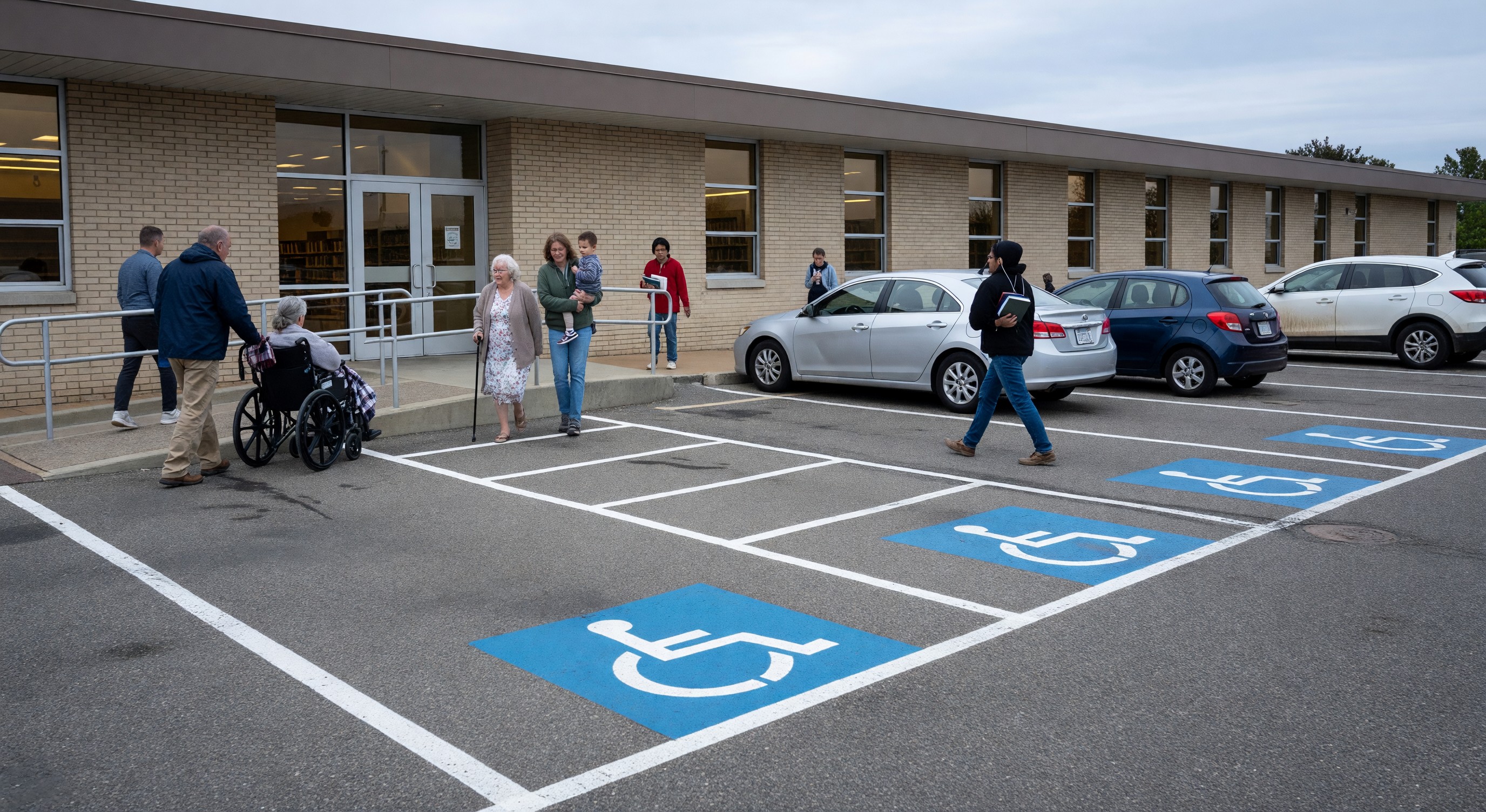
Accessible parking as inclusion: For libraries and museums with equity and access missions, ADA-compliant accessible parking is not merely legal compliance — it is mission alignment. Institutions whose values include serving community members with disabilities should ensure that accessible parking meets or exceeds legal minimums and is well-maintained.
Exceeding minimums: Libraries and museums should consider whether ADA minimum accessible space counts are adequate for their specific visitor population. Institutions that serve significant populations of older adults, people with chronic conditions, or community members with disabilities should exceed ADA minimums.
Language-accessible signage: Accessible parking signage in the primary languages of the surrounding community (in addition to standard ISA symbol signage) supports access for community members who may not be fluent in English — consistent with the multilingual and multicultural access missions of many public libraries.
Mobility device accommodation: Museums with wide exhibition spaces and libraries with accessible stacks can accommodate wheelchair and scooter users throughout the facility — but only if accessible parking, accessible entrance routes, and interior accessibility are all maintained. Parking accessibility is the first link in the accessibility chain.
Free vs. Paid Parking Policy
Public library free parking: Most public library systems in North America provide free patron parking — consistent with the free access model for all library services. Paid parking at a public library would create a financial barrier to access inconsistent with the institution’s mission. Time limits (2 to 4 hours) may be appropriate to prevent all-day commuter use of library parking in urban locations.
Museum parking fee models: Museums vary significantly. Major urban art museums often charge for parking ($15 to $25 at major institutions) as a revenue source; some provide free parking; some validate for members and charge non-members. The pricing model should reflect the institution’s access mission and revenue needs, with equity programs (free parking validation for EBT cardholders, discounted parking for school groups) addressing financial barriers for lower-income visitors.
Validation for program participants: Libraries and museums can provide parking validation for program participants — library cardholders, museum members, participants in specific programs — while charging transient visitors. Validation creates a cost-free access path for regular community participants while generating revenue from occasional transient visitors who are less likely to be deterred by parking costs.
Shared revenue with municipality: Public library parking lots that are managed by the municipality may have revenue shared with the general fund rather than retained by the library. Libraries seeking to improve parking through new equipment, lighting, or accessible amenities should understand the revenue flow and budget allocation process for any capital investment decisions.
Event and Exhibition Planning
Opening night events: Museum exhibition openings generate demand peaks from members, press, and invited guests. Event-specific parking management — reserved areas for VIP guests, shuttle service from remote lots, valet for premium guests — matches the event’s scale and character.
Lecture and program events: Evening lectures and programs at libraries and museums generate parking demand at times when nearby commercial parking may be available at favorable rates. Partnerships with nearby parking operators for event evening validation provide attendees with parking options that don’t compete with daytime patron parking.
Capacity communication: Communicating parking availability and alternatives to event attendees before arrival — in ticket confirmation emails, on the event information page, via pre-event reminder emails — reduces arrival confusion and improves the event experience. Clear communication of alternative transit options (bus routes, bike parking, rideshare drop-off) serves attendees who arrive without vehicles.
Frequently Asked Questions
How should public libraries balance free patron parking with commuter use prevention? Time limits (2 to 4 hours, enforced by LPR or periodic checking) prevent all-day commuter use while preserving free patron access for typical library visits. Warning-first enforcement (notices before towing) protects patron relationships. Some libraries use permit exemptions for extended research visits (reference librarians can issue day passes for legitimate research users who need longer stays).
What transit information should libraries and museums provide to visitors? Transit information displayed prominently — in the parking area, at building entrances, on the institution’s website — serves both current users and potential future users who might visit by transit if they knew the options. Transit maps, bus schedules, and bike route information presented as part of an overall access menu (parking AND transit AND biking) reflect the institution’s inclusive access values better than parking-only access information.
How should museums address parking equity in their access programs? Parking equity in museum access programs includes: free or reduced-fee parking for low-income visitors (paralleling reduced admission programs); transit subsidy programs (validated transit passes for visitors who take public transit); waiver of parking fees for community groups, school groups, and social service organizations that bring underserved populations; and communication about free parking alternatives in languages reflecting the surrounding community’s demographics.
What sustainability commitments should libraries and museums make regarding parking? Sustainability commitments appropriate for libraries and museums include: EV charging infrastructure that supports staff and visitor EV adoption; bicycle parking that meets APBP standards for quantity and security; stormwater management improvements that reduce runoff from paved parking areas; reduced lighting during low-use hours through motion controls; and advocacy for transit improvements that reduce visitor drive-alone rates. Institutions with public sustainability commitments should apply those commitments to their parking operations.
Takeaway
Library and museum parking management is shaped by the public access and equity missions of these institutions — missions that influence whether parking is free or paid, how accessible parking standards are applied, and how parking is integrated into the institution’s overall strategy for serving diverse communities. The institutions that manage parking most effectively align their parking policies with their core values — free access at public libraries, equity programs at museums, ADA compliance as mission rather than mere compliance — while managing practical logistics of event demand peaks, bus group coordination, and community member accessibility. Parking is part of the institution’s first impression and a component of the barrier or access question that every community member faces in deciding whether to visit.
Further Reading from Authoritative Sources
- ADA accessible parking requirements for cultural and public institutions — ADA.gov is the official DOJ resource for ADA compliance requirements, including the accessible parking standards for public libraries and museums discussed in the article’s ADA compliance as mission alignment section.
- NACTO bicycle parking and multimodal access guidance for institutions — NACTO publishes bicycle parking standards (in partnership with APBP) and multimodal access guidance that is directly relevant to the bicycle infrastructure and alternative transportation recommendations in the article’s sustainability section.