Industrial and warehouse facility parking encompasses a fundamentally different set of operational requirements than commercial or institutional parking. The primary vehicles are often commercial trucks and freight carriers, not passenger cars. Employee populations work in shift patterns — three shifts, seven days a week — rather than standard business hours. Security and access control for carriers and vendors is operationally critical in ways that commercial building access is not. And the integration of EV fleet charging with warehouse operations is an emerging requirement as last-mile delivery fleets electrify. Understanding industrial facility parking management as a distinct vertical helps facility managers and parking professionals serve this sector effectively.
Industrial Parking Population Types
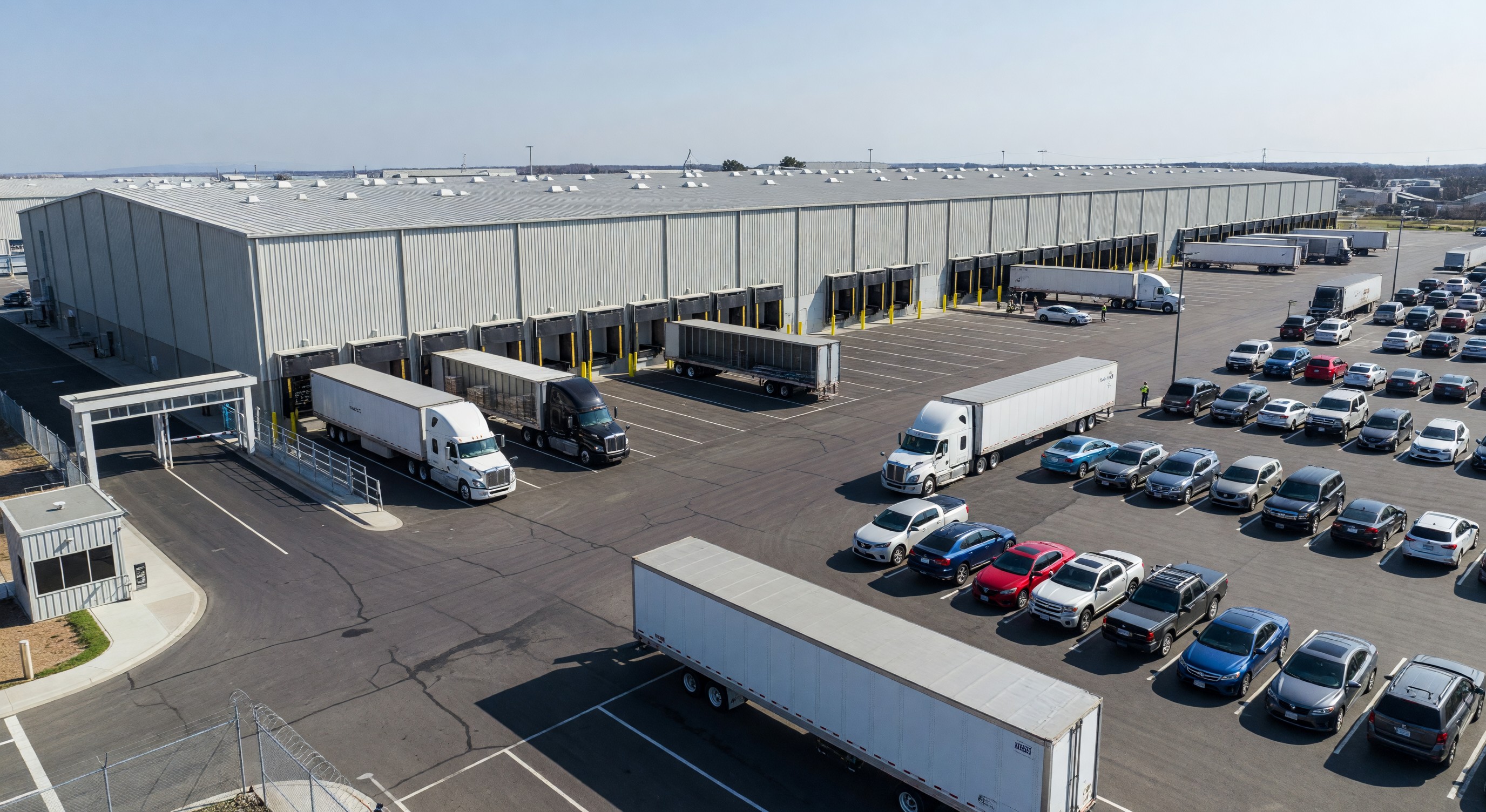
Industrial and warehouse facilities manage multiple distinct vehicle populations simultaneously:
Employee vehicles: Warehouse workers, distribution center associates, and facility staff drive personal vehicles to work in shift patterns. Employee parking lots must accommodate full-shift parking (8 to 12 hours) with shift-change peaks when one shift arrives while another is departing.
Commercial carriers and delivery trucks: Semi-trucks, LTL carriers, and parcel delivery vehicles arrive to load and unload freight. These vehicles have specific staging, maneuvering, and dock requirements that are operationally distinct from passenger vehicle parking.
Employee rideshare and carpool vehicles: High-density warehouse employment often generates carpool and shuttle demand — workers who don’t own vehicles or who commute long distances may use shuttle services or carpools that need designated drop-off and pickup areas.
Visitor and vendor vehicles: Vendor deliveries, service contractors, compliance inspectors, and business visitors arrive in passenger vehicles that need designated visitor parking separate from employee lots.
Fleet vehicles: Distribution centers that operate their own delivery fleets (the vehicles that leave the facility loaded with outbound freight) need overnight fleet storage and, increasingly, charging infrastructure for electric fleet vehicles.
Truck Staging and Dock Management
Staging area capacity: Distribution centers that receive significant inbound freight must manage truck staging — the area where arriving trucks wait for a dock appointment. Insufficient staging capacity causes trucks to stage on public roads, creating hazards and regulatory violations. Staging area planning should accommodate the peak number of simultaneously waiting trucks, typically based on appointment schedule density and historical unload times.
Appointment scheduling integration: Dock appointment scheduling systems that assign specific arrival windows to carriers reduce uncontrolled truck arrivals. When drivers know their appointment time, they can plan arrival accordingly rather than arriving early and waiting. Appointment scheduling reduces peak staging demand by distributing arrivals over the operating day.
Drop yard management: Some facilities maintain separate drop yards — areas where trailers are dropped (without the tractor) for later dock access. Drop yard management requires trailer identification, access control, and position tracking systems that locate specific trailers when they are needed for dock access.
Maneuvering space requirements: Semi-truck maneuvering requires significantly more space than passenger vehicle circulation. Truck turn radii (commonly 45 feet for standard trailers) must be accommodated in staging area and dock approach design. Inadequate maneuvering space causes damage to trailers, dock equipment, and adjacent vehicles.
Employee Shift Parking Management
Three-shift overlap peaks: 24/7 warehouse operations with 8-hour shifts create parking demand peaks at 6 AM, 2 PM, and 10 PM — when the incoming shift arrives as the departing shift leaves. The parking lot must accommodate both shifts’ vehicles simultaneously during the 15 to 30 minute overlap window.
Lot capacity for multi-shift operations: Unlike single-shift operations where lot capacity equals peak simultaneous demand, 24/7 operations typically have vehicles parked from all three shifts present during the overlap window. Lot capacity planning must account for the highest simultaneous vehicle count, which is the sum of the two largest shifts’ vehicles during their overlap period.
Shuttle service from remote parking: When on-site employee parking is insufficient (common in dense industrial parks or urban distribution facilities), remote parking with shuttle service to the facility entrance is standard. Shuttle schedules must align with shift-change times, including overnight shift changes at 10 PM and 6 AM when public transit options may be limited.
Security perimeter management: Employee vehicles parked near the facility create a security perimeter consideration — vehicles near dock access areas could facilitate cargo theft. Employee parking lots should be located away from dock access, and the route from employee parking to building entrances should not pass through the secured freight area.
Access Control for Carriers and Vendors
Carrier credentialing: Freight carriers with regular dock access may receive transponders, PIN codes, or LPR recognition that allows controlled access without guard intervention for each visit. The credentialing system must verify that the carrier has a valid appointment before granting access.
Visitor management: Vendor and visitor vehicles need access that is controlled without creating a bottleneck. A visitor management system that pre-registers expected visitors (with a confirmation code or arrival notification) reduces guard booth processing time.
Gate technology: Industrial facility access control gates must accommodate commercial vehicle heights and widths while providing security functionality. Overhead clearance for trucks, lane width for standard trailers, and gate arm height are design parameters that differ from passenger vehicle access control.
After-hours carrier access: Facilities that receive 24/7 deliveries must manage carrier access overnight when security staffing may be reduced. Intercom systems that connect to a remote security monitoring center, or self-service check-in kiosks that verify carrier credentials before gate access, maintain security without requiring full overnight gate staffing.
EV Fleet Charging Integration
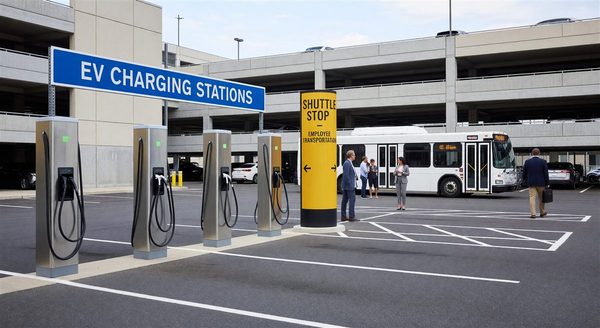
Last-mile delivery fleet electrification: E-commerce distribution centers are increasingly operating electric last-mile delivery fleets — delivery vans and electric cargo vehicles that need overnight charging between delivery shifts. The charging infrastructure required for 50 to 200 delivery vehicles represents a significant electrical infrastructure investment.
Charging schedule optimization: Electric fleet vehicles should charge during off-peak utility hours (overnight) when possible to minimize demand charges. Smart charging management systems that stagger charge initiation across the fleet — ensuring vehicles are fully charged by departure time without all charging simultaneously — reduce peak electrical demand.
Electrical service capacity: Distribution centers planning fleet electrification should conduct electrical service capacity assessments early in the process. A 100-vehicle electric delivery fleet requiring 50 kW per vehicle would need 5 MW at simultaneous full-power charging — likely exceeding available service capacity at most facilities. Smart charging management and utility coordination are prerequisites to successful large-fleet electrification.
Employee EV charging: As more warehouse workers own EVs, employee charging during shift hours — 8 to 12 hour dwell times — is an employee amenity that Level 2 charging can support without the electrical infrastructure demands of commercial fleet charging.
Frequently Asked Questions
What is the appropriate parking ratio for warehouse and distribution center facilities? Parking ratios for warehouse and distribution facilities are typically lower than office or retail — warehouse employment density is lower per square foot, and some workers (truck drivers, off-site delivery staff) don’t need on-site parking. A common planning standard is 0.5 to 1.0 spaces per 1,000 square feet of warehouse space for employee parking, with additional staging area for trucks. The specific ratio depends on the facility’s employment intensity, shift structure, and transit access.
How should industrial facilities manage truck idling in staging areas? Truck engine idling in staging areas creates air quality impacts (diesel exhaust) that may be regulated by state environmental agencies (California’s CARB Anti-Idling regulations are the most stringent example, but many states have similar rules). Idling time limits (typically 5 minutes), shore power connections in staging areas (allowing trucks to power accessories without running the engine), and clear anti-idling policy communication to carriers are best practices for idling management.
What security measures are standard for distribution center parking areas? Video surveillance of all parking areas — employee lots, truck staging, dock access — is standard. Perimeter fencing with controlled access points, lighting at IESNA commercial standards, and security patrol (manned or camera-based remote monitoring) are common. High-value cargo distribution centers may require additional measures including access credential verification at lot entry, not just at the building entry.
How do industrial facility parking requirements differ for cold storage operations? Cold storage warehouses (refrigeration or freezer facilities) have additional considerations: the temperature difference between cold storage and outdoor environments creates condensation challenges in covered parking adjacent to the facility; refrigeration equipment trucks (reefer units) that run while staged may have idling regulations; and employee facilities (changing rooms, break rooms) that allow workers to transition between cold storage environments and parking are located near employee lot exits. The operational environment also affects equipment reliability — extreme cold affects battery-operated access control and LPR cameras.
Takeaway
Industrial and warehouse facility parking management is shaped by the operational demands of logistics and manufacturing — commercial truck staging requirements, multi-shift employee parking dynamics, carrier access control, and EV fleet charging infrastructure that differs fundamentally from commercial or institutional parking contexts. The facilities that manage industrial parking effectively coordinate truck appointment scheduling with staging capacity, align employee lot capacity with shift-change demand peaks, maintain secure access control appropriate to cargo value, and plan ahead for the EV fleet charging infrastructure that supply chain electrification will require over the coming decade. As industrial real estate becomes increasingly sophisticated in its operational requirements, parking management has become a supply chain efficiency factor rather than a passive facility service.
Further Reading from Authoritative Sources
- EPA anti-idling regulations for commercial trucks in staging and loading areas — The EPA anti-idling regulatory framework provides the federal context for state anti-idling regulations applicable to commercial truck staging at distribution centers described in this article, making it the appropriate authority reference for diesel emissions compliance at industrial parking facilities.
- US DOE EV fleet charging infrastructure planning for distribution center and logistics facilities — The US DOE Alternative Fuels Data Center provides EV fleet charging infrastructure planning resources directly applicable to the distribution center electrification, electrical service capacity assessment, and smart charging management topics described in this article.