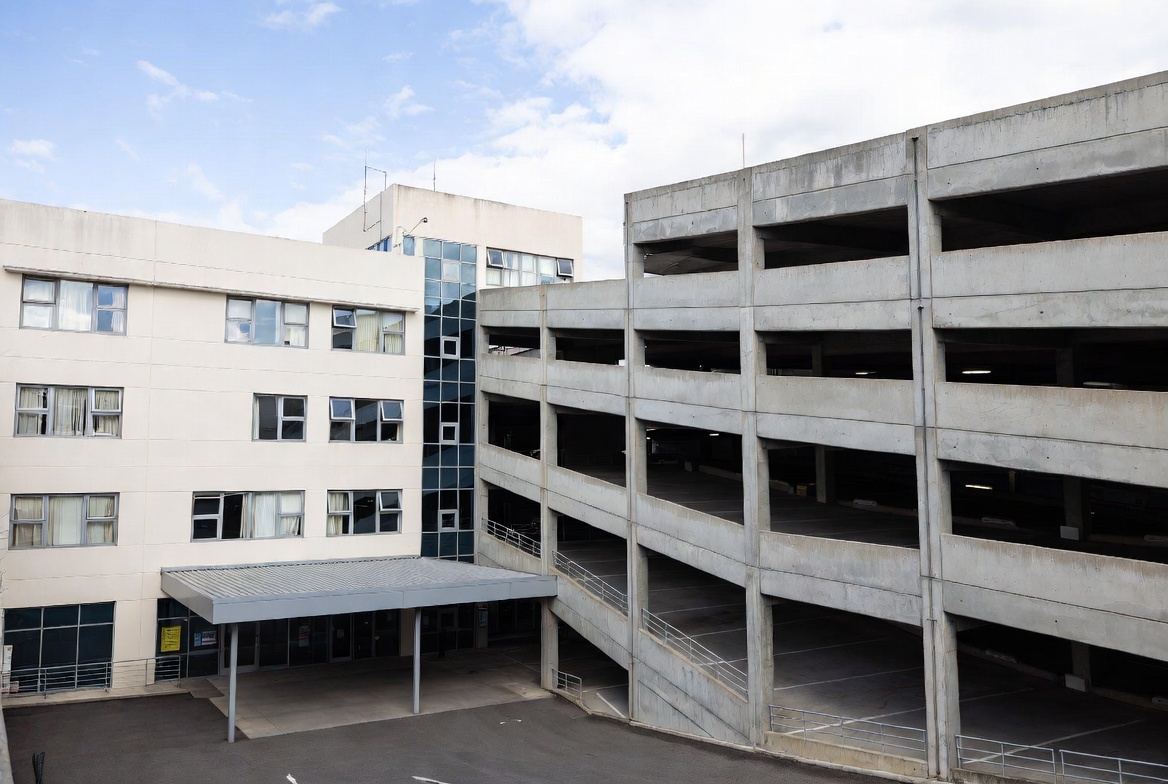
For most patients, the parking lot is their first and last interaction with a healthcare facility. It sets the tone for the entire visit. A confusing, crowded, or poorly maintained parking area creates stress before the patient even walks through the door — exactly the opposite of what a healthcare environment should do.
Yet parking is one of the most overlooked aspects of healthcare facility planning. Hospitals spend millions on interior design, patient rooms, and clinical technology while treating parking as an afterthought. That’s starting to change.
The Patient Experience Starts in the Parking Lot
Healthcare facilities are increasingly measured on patient experience metrics. Press Ganey surveys and HCAHPS (Hospital Consumer Assessment of Healthcare Providers and Systems) scores directly affect hospital reimbursement rates. The American Hospital Association has emphasized the importance of the total patient experience, including arrival and parking under value-based purchasing programs.
While these surveys focus primarily on clinical care, the overall patient experience — including arrival and departure — influences how patients perceive their entire visit. A patient who spent 20 minutes circling a parking structure looking for a space arrives at their appointment frustrated, anxious, and late. That emotional state colors every subsequent interaction.
Unique Challenges in Hospital Parking
Healthcare parking presents challenges that don’t exist in commercial or municipal parking:
Diverse User Populations
Hospital parking serves simultaneously:
- Patients — Often elderly, mobility-impaired, or in pain. May arrive by ambulance transfer or medical transport
- Visitors — Emotionally stressed, unfamiliar with the facility, visiting during non-standard hours
- Staff — Daily parkers who need guaranteed spaces for shift reliability
- Outpatient clinic users — Short visits requiring quick turnover
- Emergency department users — Arriving in crisis, need immediate proximity
Each group has different needs, different wayfinding capabilities, and different payment expectations. A single parking system must accommodate all of them.
Accessibility Requirements
Healthcare facilities typically need more accessible parking than the ADA minimum requires. Patient populations include higher percentages of wheelchair users, walker users, and people with temporary mobility impairments. Many hospitals voluntarily exceed ADA requirements by 50-100%.
24/7 Operations
Unlike office buildings or retail centers with predictable peak hours, hospitals operate continuously. Parking systems must handle shift changes (often the busiest parking periods), emergency surges, and overnight visitors without interruption.
Wayfinding Complexity
Large medical campuses may have multiple buildings, clinics, and entrances spread across a sprawling campus. Patients need to park not just “at the hospital” but near their specific clinic or department. Poor wayfinding means patients parking at the wrong building, walking long distances, or arriving late to appointments.
Technology Solutions for Healthcare Parking
Modern parking technology addresses many of these challenges:
Parking Guidance Systems
Real-time occupancy sensors connected to dynamic signage direct drivers to available spaces. For hospitals, this means:
- Patients spend less time circling and more time at their appointments
- Staff can be directed to designated areas automatically
- Emergency department proximity spaces can be monitored and managed
Tiered Access Control
Healthcare parking access control systems need to manage multiple credential types:
- Staff badges for daily parking
- Patient validation from clinic check-in
- Visitor passes (often with time limits)
- Emergency vehicle priority access
- Physician reserved spaces
Validation Integration
Outpatient clinics and imaging centers often validate parking as part of the patient visit. Modern systems integrate with hospital scheduling software to automatically validate parking when a patient checks in for an appointment.
Payment Flexibility
Hospital visitors shouldn’t have to scramble for parking payment during a stressful visit. Modern facilities offer:
- Validation that covers the full visit
- Mobile payment options
- Pay-on-exit (not pay-and-display, which adds stress)
- Grace periods for emergency visitors
The Seniors Factor
A 2014 case study by parking manufacturer Parking BOXX examined how senior citizens interact with hospital parking systems. The findings were revealing: interface complexity, small text, confusing payment sequences, and poor lighting at payment terminals created significant barriers for elderly patients.
These usability findings have implications beyond seniors. Any parking system that’s difficult for a 75-year-old to use is probably more difficult than it needs to be for everyone. Designing for the least technically comfortable user improves the experience for all users.
Key recommendations from the research included:
- Larger fonts and high-contrast displays on payment terminals
- Simplified payment sequences with fewer steps
- Better lighting at all interaction points
- Clear, consistent wayfinding from parking to building entrance
- Audio assistance options for visually impaired users
Revenue vs. Service
Hospital parking sits at an uncomfortable intersection of revenue generation and patient service. Many hospitals charge for parking (some charging significant daily rates), while patients and advocates argue that paying for parking adds financial stress to an already costly healthcare experience.
The best hospital parking operations find a balance:
- Validate patient parking whenever possible (absorb the cost into facility operations)
- Charge for non-patient parking (commercial office tenants, nearby businesses)
- Offer discounted long-term rates for patients with extended treatment plans (chemotherapy, dialysis)
- Provide free parking for emergency department visitors (at least for the first few hours)
- Use revenue from premium/convenient spaces to subsidize general patient parking
Planning a Hospital Parking System
For healthcare facilities planning new parking or upgrading existing systems, the priority order should be:
- Patient experience first — Technology decisions should reduce stress, not add it
- Accessibility beyond compliance — Exceed ADA minimums to serve your patient population
- Staff reliability — Guaranteed staff parking ensures clinical operations aren’t disrupted
- Operational efficiency — Automation reduces staffing costs and inconsistency
- Revenue optimization — Important but never at the expense of patient experience
Key Takeaways
- Hospital parking directly affects patient satisfaction scores and facility reputation
- Healthcare parking serves diverse populations with vastly different needs simultaneously
- Technology like parking guidance, tiered access control, and validation integration addresses key challenges
- Usability for elderly and mobility-impaired users should drive design decisions
- Revenue generation must be balanced against patient service obligations
- Accessibility requirements in healthcare settings should exceed standard ADA minimums
For operational guidance on hospital parking systems, the Parking BOXX blog covers hospital parking management including permit systems, patient-focused automation, and access control design for healthcare campuses.