Hospital and healthcare campus parking is among the most operationally demanding parking management contexts. Patients arriving for surgery may be anxious, in pain, or managing complex medical equipment. Family members visiting critically ill relatives are under severe emotional stress. The parking experience — which begins before the clinical encounter — directly affects patient satisfaction scores, Press Ganey survey results, and the facility’s reputation. Understanding how healthcare parking differs from commercial parking and how to manage it appropriately requires attention to empathy, accessibility, and operational reliability in ways that are distinct from revenue optimization.
The Healthcare Parking Priority Framework
Healthcare parking management operates under a different priority hierarchy than commercial parking:
Patient experience first: In commercial parking, revenue optimization and operational efficiency are primary. In healthcare parking, the patient experience is the overriding priority. A patient who is confused about parking, cannot find an accessible space, or faces a malfunctioning pay station during a cancer treatment appointment has a worse experience that affects their perception of the entire healthcare encounter.
Clinical staff access second: Clinical staff — physicians, nurses, technicians — must be able to reliably access the campus for scheduled shifts. Staff permit programs must be designed to guarantee clinical staff access without requiring circuitous routes or excessive walk time that would affect patient care.
Operational revenue third: Healthcare parking generates significant revenue (large hospitals routinely earn $5 to $15 million annually from parking), but revenue maximization is appropriately subordinated to patient experience and staff access in the operational priority framework.
Patient Validation and Hardship Programs
Healthcare parking validation programs serve the dual function of customer service and financial assistance:
Clinical validation: Outpatient clinical departments (oncology, cardiology, dialysis) validate parking for patients receiving treatment. Validation is typically unlimited or capped at a daily maximum — a cancer patient attending daily radiation therapy should not face full parking costs at every visit.
Hardship discount programs: Hospitals with robust community benefit programs offer hardship-based parking fee reduction or waiver for low-income patients. These programs require an application process but are an important element of healthcare equity and community benefit compliance for nonprofit hospitals.
Inpatient visitor validation: Families visiting hospitalized patients for extended periods (ICU family, pediatric families staying near a child’s bedside) often receive validation or discounted rates. The specific program design reflects the institution’s patient experience values.
Physician office visitor policy: Medical office buildings on healthcare campuses may have different validation policies than the hospital itself — commercial physician practices that validate for standard visit periods versus hospital outpatient departments that validate based on clinical encounter duration.
Program administration: Validation programs require systems for tracking validation issuance, controlling fraud (validating for non-patients, over-validating), and reconciling validation cost against the clinical department budget. PARCS systems with digital validation capabilities reduce fraud risk compared to physical stamp systems.
Valet Operations for High-Acuity Patients
Valet parking at hospital emergency departments and cancer centers serves a genuine medical need:
ED valet: Emergency department patients often arrive acutely ill and unable to walk extended distances or navigate a parking structure independently. ED valet allows caregivers to drop a patient at the ED entrance and hand off the vehicle without leaving the patient unattended.
Cancer center valet: Chemotherapy patients experiencing treatment side effects (fatigue, nausea, weakness) benefit significantly from door-to-door valet service. Many comprehensive cancer centers provide complimentary or subsidized valet as a standard patient amenity.
Valet staffing and training: Healthcare valet staff require training beyond standard valet driver competencies — they interact regularly with patients in distress, must communicate with empathy, may need to assist with mobility devices, and should be aware of HIPAA privacy considerations (patients have confidentiality rights regarding their medical conditions).
Mobility device handling: Valet staff at healthcare facilities regularly handle wheelchairs, walkers, power scooters, and motorized wheelchairs. Staff must be trained on how to secure, store, and return mobility devices safely and respectfully.
Vehicle damage protocols: Healthcare valet operations should have documented vehicle damage discovery, documentation, and customer notification protocols. Hospital patients who discover vehicle damage during an already stressful medical situation require particularly careful customer service management.
Staff Permit Programs
Healthcare campus staff permit programs must balance access equity with practical constraints:
Clinical priority tiers: Emergency physicians, nurses, and other clinical staff who work variable shifts (including overnight and weekend) typically receive the highest parking priority — parking in locations that provide the shortest, most reliable access route to their clinical area. Administrative and non-clinical staff may be assigned to more remote lots or structured parking.
Shift coordination: Nursing shift change — typically 7 AM and 7 PM at 12-hour shift hospitals — creates significant parking demand concentration. Permit programs and physical layout must accommodate the simultaneous arrival of the incoming shift while the departing shift exits.
On-call parking: Physicians and clinical staff on call may arrive at any hour. On-call parking designation near hospital access points ensures that on-call staff can reach their clinical area quickly at any time.
Remote parking with shuttle: Large hospitals with constrained campus parking often locate some staff parking at remote lots served by shuttle service. Shuttle frequency (every 10 to 15 minutes) and shuttle hours (covering all shift change times) are critical to staff acceptance of remote parking arrangements.
Carpool incentives: Parking-constrained campuses benefit from carpooling incentives for staff — reserved spaces near the building for verified carpool groups of 2 or more employees.
ADA Compliance in Healthcare Parking
Healthcare facilities serve a higher-than-average proportion of patients and visitors with mobility disabilities. ADA-compliant accessible parking is more important in healthcare than in most other parking contexts:
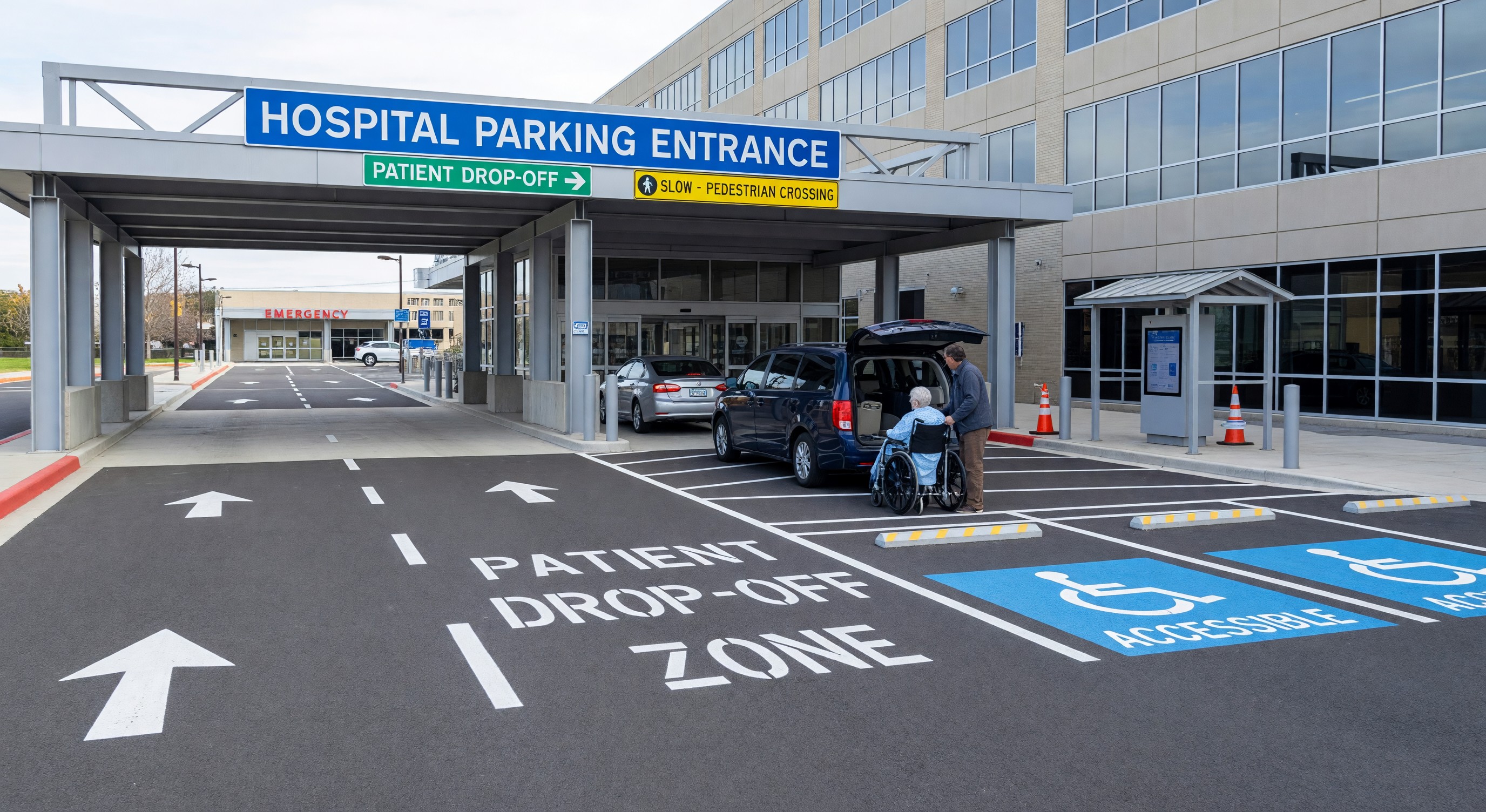
Above-minimum accessible space count: While ADA minimums specify a percentage of spaces, healthcare facilities should consider exceeding the minimum given the patient population’s mobility profile. The accessible space ratio that works adequately for a retail parking lot may be insufficient for a major medical center.
Van-accessible spaces: ADA requires one in six accessible spaces to be van-accessible (with 8-foot access aisle). Healthcare facilities should have a higher proportion of van-accessible spaces, as patients with power wheelchairs and mobility vans are disproportionately represented.
Weather protection: Accessible routes in northern climates require snow removal priority to maintain usability. Patients with mobility limitations are disproportionately vulnerable to slip-and-fall risks on icy accessible routes.
Parking near specific departments: High-demand accessible parking near oncology, dialysis, and other departments serving patients with mobility challenges should be specifically allocated, with accessible route design that minimizes distance and grade change.
Frequently Asked Questions
How should hospital parking fees be structured? Healthcare parking fee structures should balance: accessibility for all income levels (through validation and hardship programs), revenue adequacy for the parking operation, and behavioral influence (making public transit and carpooling attractive alternatives where available). Daily maximum caps (so that a long-stay family visitor doesn’t face an unlimited accumulating fee) are an important patient experience element. Monthly staff permit rates should be competitive with equivalent commercial parking nearby to avoid staff parking in surrounding neighborhoods.
What is the typical staffing model for a healthcare parking operation? Large hospital campuses typically require a combination of: valet staff (at ED and specialty department entrances), lot attendants or shuttle drivers (for remote lots), a parking administration office (for permit issuance, validation management, and customer service), and PARCS-supported self-service operations for structured parking areas. Remote monitoring can supplement or replace some on-site staff in lower-traffic periods.
How do hospital parking operations handle HIPAA in their day-to-day operations? Healthcare parking staff do not typically access protected health information in the course of normal parking operations. However, they must exercise discretion in conversations with patients — not asking about medical conditions, not discussing patient interactions in public areas, and maintaining a professional demeanor that respects patient privacy. Business associate agreements with PARCS vendors who access patient data (if validation records include clinical identifiers) should be reviewed with legal counsel.
What performance metrics matter most in healthcare parking? Customer satisfaction survey scores (often integrated with HCAHPS or Press Ganey surveys), accessible space availability rate (percentage of accessible spaces available during peak hours), valet wait time (average time from vehicle handoff to valet return), and permit holder access reliability (percentage of permit holders who are able to access a permit space within a defined time of arrival). These metrics reflect the patient experience and staff access priorities that distinguish healthcare parking from commercial parking.
Takeaway
Hospital and healthcare campus parking management requires a fundamentally different operational orientation than commercial parking — one centered on patient experience, staff access, and clinical support rather than revenue maximization. The facilities that execute well on this orientation — with appropriate validation programs, valet services for high-acuity patients, accessible parking prioritized above minimum requirements, and staff permit programs designed for clinical shift patterns — deliver parking as part of the healthcare encounter quality, not just as a revenue-generating ancillary service. The revenue will follow when the patient experience and staff access are managed well; prioritizing revenue over experience in healthcare parking inverts the appropriate priority structure.
Further Reading from Authoritative Sources
- US Access Board ADA parking design guide for healthcare facility accessible space requirements — The US Access Board ADA parking guide provides the authoritative accessible space count, van-accessible space, and accessible route requirements that apply to hospital and healthcare facility parking described in this article, supporting the recommendation to exceed ADA minimums for medical facility populations.
- IPMI healthcare parking management resources and patient experience standards — IPMI provides healthcare parking management guidance that addresses the patient experience, validation program, and ADA compliance priorities described in this article from the professional parking operations perspective applicable to hospital and medical campus parking managers.