Hospital parking has a uniquely difficult design problem. The facility serves patients under stress, elderly visitors with mobility constraints, staff working long shifts, and emergency arrivals with no tolerance for delay — often all through the same physical infrastructure. And it has to do this while meeting capital-cost targets, regulatory requirements, and increasingly, patient-experience benchmarks that directly affect reimbursement.
The tradeoffs are rarely addressed as explicitly as they deserve. The result is facilities that work adequately for the average user and poorly for the patient populations they most need to serve well.
Patient Experience as a Reimbursement Input
Patient experience scores, particularly the HCAHPS survey used by CMS, have had direct reimbursement implications since the introduction of value-based purchasing. Parking does not have a dedicated HCAHPS question, but several questions — overall hospital rating, recommendation likelihood — are measurably correlated with the pre-clinical experience, of which parking is a substantial component.
Research published in healthcare administration journals and summarized in American Hospital Association materials has repeatedly found that parking-access difficulty is among the most frequently cited sources of patient frustration in open-ended HCAHPS comments. The financial consequence — a difference of a few percentage points in satisfaction scores — translates to meaningful reimbursement dollars at a large health system.
This reframes the parking cost conversation. A parking design decision that trades capital cost against patient-access friction is not just an operations decision; it is a revenue decision.
The Design Decisions That Matter Most to Patients
Observational research and patient survey data consistently surface a small set of design variables that disproportionately affect patient experience.
Distance from parking to clinical destination. Elderly and mobility-impaired patients experience distance nonlinearly. A 400-foot walk is not twice as hard as a 200-foot walk; it is dramatically harder for a patient in pain, on supplemental oxygen, or recovering from surgery.
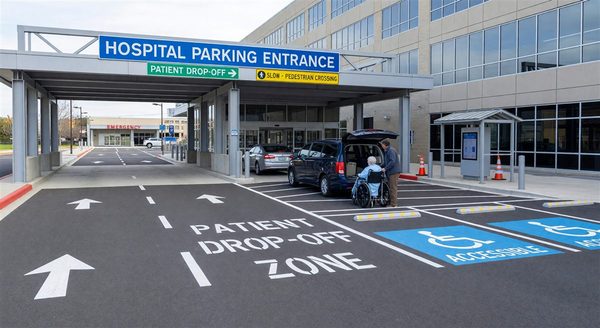
Legibility of the route. Hospitals are confusing buildings. Parking facilities that land patients at unmarked service entrances, long corridors, or remote elevators produce outsized frustration relative to the actual distance involved.
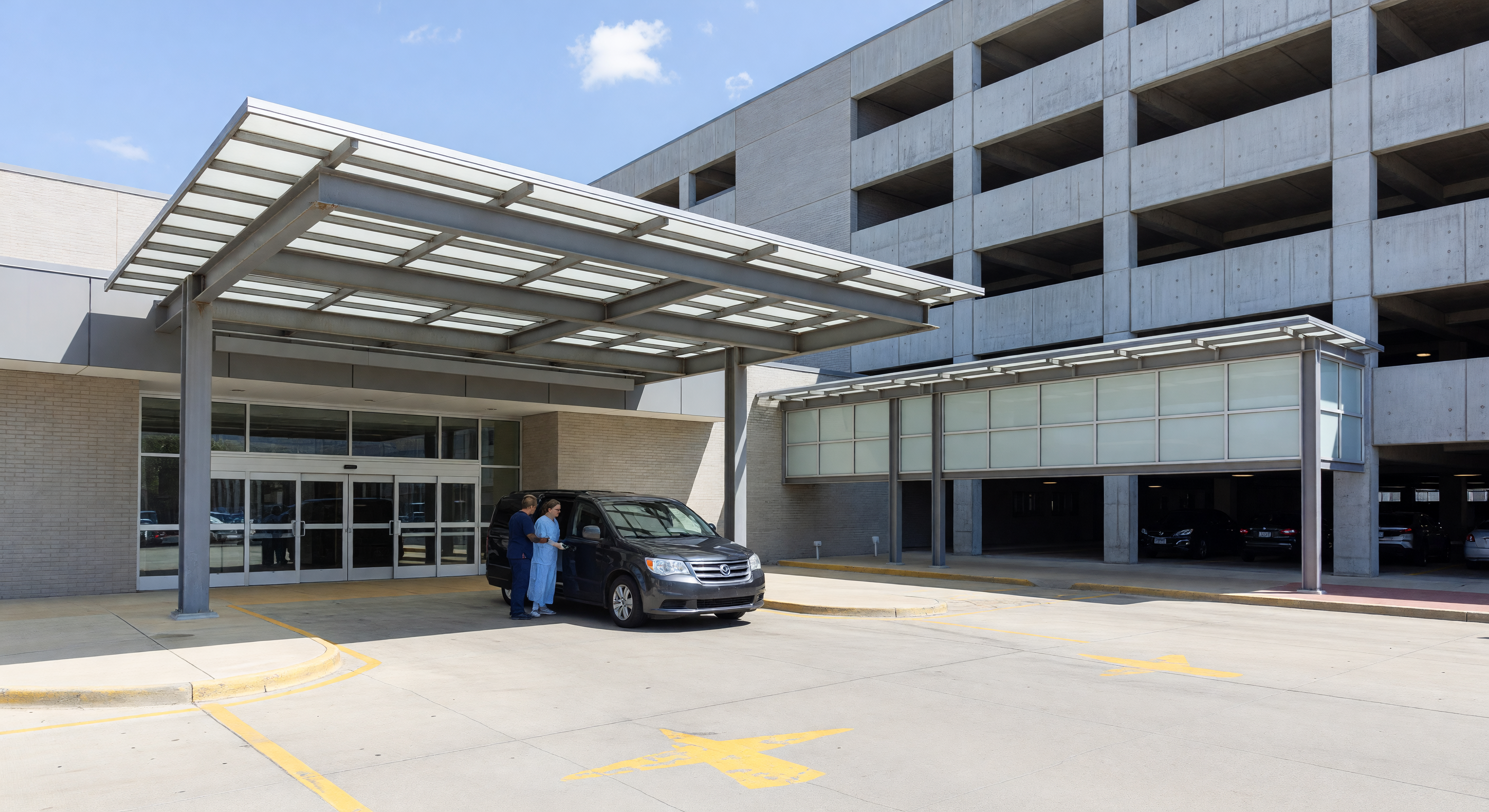
Weather exposure. Covered walkways, covered drop-off, and protected elevator access have substantially larger effects on patient satisfaction than capital planners often estimate. The value is highest exactly where weather is harshest — which is also where covered infrastructure costs the most.
Wayfinding and signage. Consistent, internally rational signage — not just from parking to the building, but from parking to specific clinical destinations — is a low-cost intervention with disproportionate return.
Valet availability. At facilities serving substantial oncology, cardiac, or geriatric populations, valet is less an amenity than an accessibility accommodation. It is expensive to operate but delivers measurable satisfaction improvement.
The Capacity Calculation That Hospitals Commonly Miss
Hospital parking capacity calculations frequently undercount the diurnal and weekly demand variability that matters for patient experience. Average-day parking sufficiency does not guarantee patient satisfaction; a hospital operating above capacity for 30 percent of weekday mornings will produce disproportionate patient complaints even if annual utilization averages 80 percent.
Demand characterization that separately accounts for:
- Staff shift change peaks
- Clinic day patterns (many hospitals have specific high-volume clinic days)
- Visitor patterns (weekends differ substantially from weekdays)
- Seasonal variation (flu season, summer trauma)
generally produces better capacity decisions than simple peak-day counts. The Transportation Research Board and healthcare-specific planning literature both support this disaggregated approach.
The Separation of Patient, Visitor, and Staff Parking
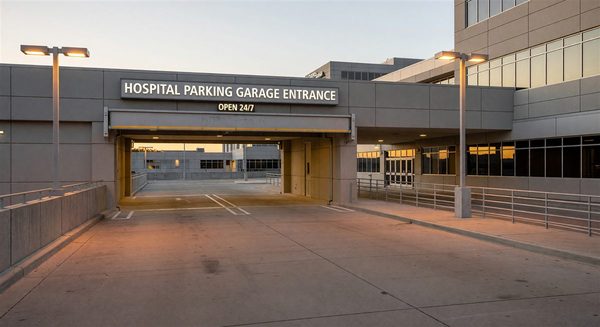
Well-performing hospital parking operations separate these three populations materially earlier in the patient’s experience than underperforming operations. Patient and close-family parking located closest to the primary entrance; visitor parking one tier back; staff parking on perimeter or in dedicated garages with shuttle or covered walkway access.
The separation is a policy decision, not just a physical one. It requires permit systems, validation structures, and wayfinding that reinforce the separation rather than treating parking as undifferentiated.
EV and Accessibility Requirements
EV charging at hospitals serves both patient and staff populations, with different usage patterns. Patient and visitor EV stalls see short, intermittent use; staff EV stalls see long, predictable use during shifts. The optimal stall mix and charging speed differ by population.
ADA parking requirements are mandatory. Exceeding them, particularly with van-accessible stalls and direct covered routes to entrances, has outsized impact on patient experience for the populations most likely to complete HCAHPS surveys.
FAQ
Does parking affect HCAHPS scores enough to matter financially?
Yes, indirectly. No HCAHPS question asks specifically about parking, but parking frustration is among the most commonly mentioned issues in open-ended comments, and it correlates with scores on the overall-rating and recommendation questions that directly drive value-based reimbursement.
How should hospital parking be segmented?
Patient and close-family parking closest to the primary entrance, with visitor and staff parking progressively further out, is the structure that has performed best in patient satisfaction measurement. The segmentation requires active permit and validation management, not just signage.
What design features have the largest patient-experience impact?
Short, legible, weather-protected routes from parking to clinical destinations. The underlying construct is access friction — the cumulative effort required for a patient in discomfort to reach the clinical service. Interventions that reduce friction disproportionately on the worst days produce the largest satisfaction gains.
How should EV charging be allocated between patient and staff populations?
Shorter-session patient and visitor stalls (Level 2 with session-length limits) near primary entrances; longer-session staff stalls in staff areas. Aggregating the two populations into a single EV stall pool generally produces poor utilization and patient frustration.