Grocery and supermarket parking is among the most operationally distinct retail parking contexts. Unlike general retail or shopping center parking, supermarket parking is characterized by extremely high turnover (average visit durations of 20 to 40 minutes), heavy cart traffic between the store and vehicles, curbside pickup demand that has grown dramatically since 2020, and a customer base that visits frequently — often multiple times per week — making parking convenience a direct factor in store selection and customer loyalty. Managing grocery parking effectively requires attention to operational details that affect daily operations profoundly.
Grocery Parking Demand Characteristics
High turnover and short duration: Grocery shoppers visit for shorter durations than most other retail categories — 20 to 40 minutes for a standard shopping trip. This high turnover means that a well-managed grocery lot can serve significantly more customers per space per day than a retail mall parking lot. The challenge is maintaining sufficient throughput — entry and exit efficiency — to accommodate this turnover without creating congestion during peak periods.
Peak demand concentration: Grocery stores see strong peak demand on Saturday morning (traditionally the highest-volume grocery shopping period), weekday evenings (5 to 7 PM after-work shopping), and specific seasonal peaks (pre-holiday weeks). Lot size must be adequate for these peaks even though average daily demand is lower.
Repeat customer familiarity: Grocery shoppers visit the same store frequently — many customers shop the same store two to three times per week. Repeat customers are familiar with the lot layout, know where to find carts, and have preferences about specific parking locations (close to entrance, away from cart corrals). This familiarity creates stronger reactions to operational changes than at one-time or infrequent shopping destinations.
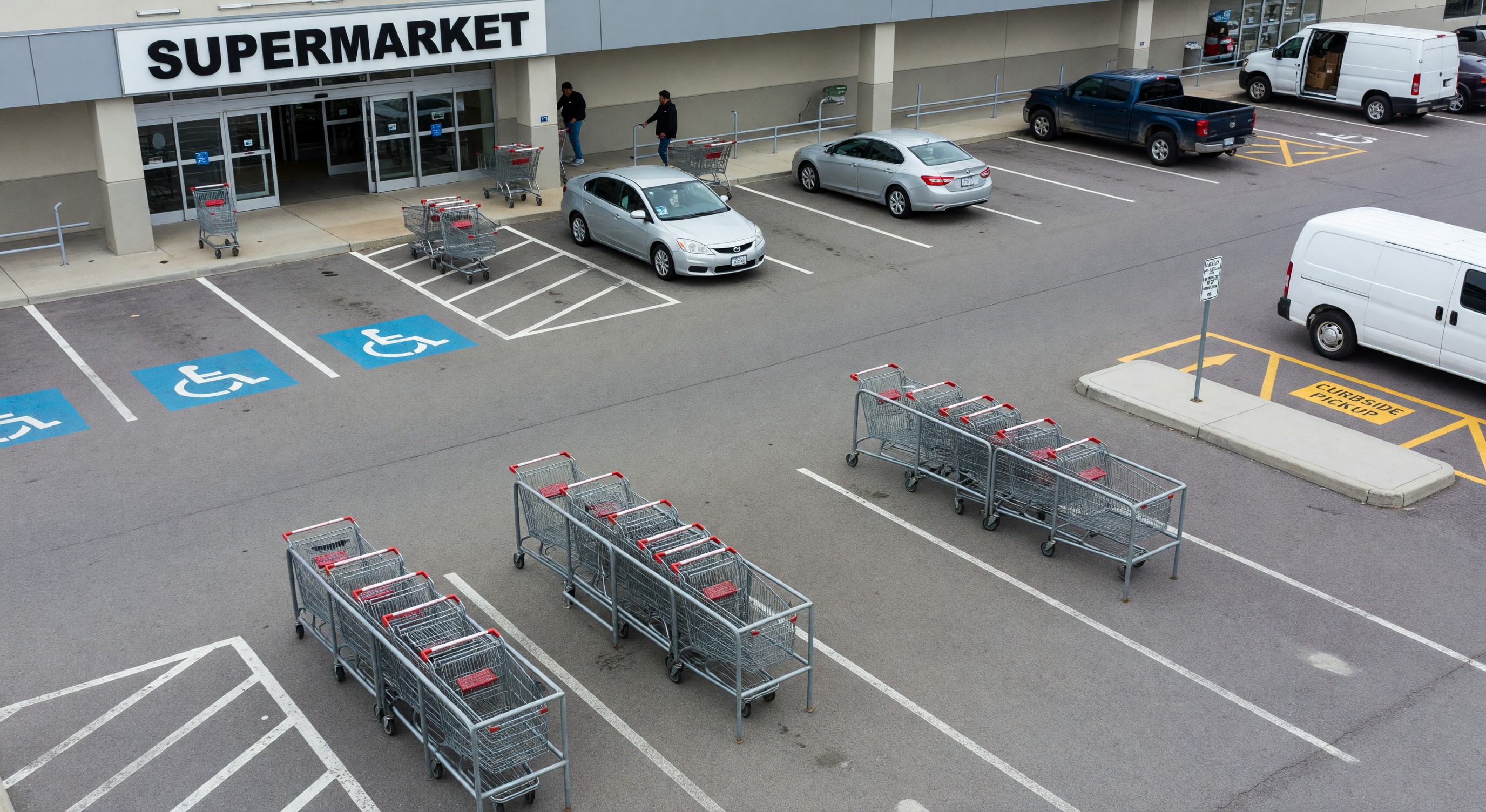
Cart logistics: Unlike most retail categories, grocery customers use shopping carts that travel between the store interior, the parking lot, and the customer’s vehicle. Cart management — providing adequate carts inside, retrieving carts from lot corrals and customer vehicles, preventing carts from escaping the lot — is a significant operational component of grocery parking management.
Cart Management and Corrals
Cart corral placement: Cart corrals (the return areas where customers leave carts after unloading their vehicles) must be placed at intervals throughout the lot — close enough to accessible spaces to be usable by customers with limited mobility, dense enough that no customer is more than one to two parking rows from a corral. APBP and shopping center design guidance suggests one corral per 25 to 30 spaces in high-turnover grocery lots.
Cart retrieval frequency: Corrals fill quickly during peak periods — a corral that holds 12 carts may fill within 30 minutes of a busy Saturday morning. Cart retrieval staff must run corral circuits frequently enough to prevent corrals from filling and carts from being left in drive aisles. Peak-period cart retrieval staffing is a grocery operations challenge that directly affects parking lot safety.
Cart containment: Carts that escape the lot — rolling into public streets, neighboring lots, or being used by non-customers — create safety hazards and loss of cart inventory. Cart wheel locks (systems that immobilize cart wheels if they exit the lot perimeter) or deposit systems (coin/token return systems that incentivize cart return to the store entrance) reduce cart escape rates.
Cart sanitization: Post-2020, cart sanitization infrastructure — wipes dispensers at store entrances, UV sanitization systems — became standard in grocery retail. These systems require space near the store entrance that parking layout must accommodate.
Curbside Pickup Parking
Curbside pickup growth: Online grocery ordering with curbside pickup has grown substantially, now representing 10 to 25 percent of grocery sales at stores with strong curbside programs. The parking demand from curbside pickup is fundamentally different from in-store shoppers — customers pull into a designated pickup space, stay for 2 to 5 minutes while their order is loaded by store staff, and depart.
Designated pickup space allocation: Grocery stores must balance converting parking spaces to curbside pickup from in-store shopping demand. Underallocating curbside spaces creates queues of pickup customers circling the lot; overallocating reduces available spaces for in-store shoppers. Space count should be based on peak curbside order volume, divided by average pickup dwell time, with a buffer.
Location and design: Curbside pickup spaces should be near the store’s curbside order station, on a convenient circulation route, and designed to prevent cross-traffic conflicts with in-store customer parking. Many grocers use painted curbs, specific signage, and sometimes physical barriers to designate and enforce curbside pickup areas.
Overflow management: When curbside pickup demand exceeds designated space capacity, queuing in the drive aisle creates safety hazards. Apps that notify pickup customers when their order is ready (so they arrive only when the order is packed and staff is ready) reduce dwell time and improve throughput.
Time Limit Enforcement
Time limit rationale: Grocery stores in urban or constrained markets may implement time limits (1 to 2 hours) to prevent the lot from being used for non-grocery purposes — employees of neighboring businesses parking all day, commuters using the lot as free long-term parking. In suburban locations with adequate capacity, time limits may not be warranted.
Enforcement technology: LPR-based time limit enforcement — cameras record entry time per plate, alert enforcement staff when vehicles exceed the limit — is more effective than chalk-and-return methods and requires less labor. For a grocery lot with no paid parking, LPR-based time enforcement may need to be operated by a third-party enforcement service that issues warnings or tow authorizations.
Customer grace periods: Grocery shopping duration legitimately varies — a large holiday shopping trip may take 60 minutes; an elderly customer who shops slowly may exceed a 60-minute limit while making a legitimate grocery purchase. Grace period policy (warning before towing, reasonable time limit thresholds) avoids penalizing legitimate customers.
ADA Compliance in Grocery Parking
Accessible space count: ADA Title III requirements for grocery stores set minimum accessible space counts based on total lot size. Given that grocery stores serve a high proportion of customers with mobility limitations (elderly shoppers, customers with chronic conditions who need grocery delivery or accessible parking), exceeding the minimum accessible space count is advisable.
Accessible van spaces: Van-accessible spaces (with 8-foot access aisle rather than 5-foot) are required at a ratio of one per six accessible spaces under ADA. Grocery lots should verify van-accessible space count and marking — a common deficiency in older lots.
Route maintenance: Accessible routes from accessible parking to the store entrance must be maintained — snow removal, ice treatment, pothole repair in the accessible route — as a legal requirement and customer service standard. Neglect of accessible routes is a common ADA complaint source at grocery stores.
Cart corral access: Standard cart corrals are not designed for customers using wheelchairs or mobility scooters who may need assistance loading groceries. Cart retrieval staff trained to assist customers with disabilities loading groceries into their vehicles is a service standard that exceeds ADA minimum requirements but is good practice at grocery stores serving elderly and disability-impacted populations.
Frequently Asked Questions
How should grocery stores manage employee parking? Employee parking in grocery lots typically consumes a significant number of spaces — a store with 100 employees on a single shift may occupy 50 to 80 parking spaces if employees drive to work. Designating employee parking in the most remote areas of the lot (farthest from the entrance) preserves convenient spaces for customers. Some stores offer transit incentives or carpool programs to reduce employee vehicle demand.
What lot size is appropriate for a grocery store? Grocery store parking ratio standards vary by market and store size, but a common planning standard is 4 to 6 spaces per 1,000 square feet of gross leasable area for standalone supermarkets. A 50,000 square foot supermarket would plan 200 to 300 spaces. Urban grocery stores with transit access may use lower ratios; suburban stores with no transit alternatives may use higher ratios. Curbside pickup demand has created pressure to add more spaces in some markets.
How do grocery stores handle parking lot safety and security? Grocery parking lot safety concerns include cart-related vehicle damage, theft from vehicles, and personal safety incidents. Cart retrieval staff provide a form of passive lot monitoring. Lighting standards (minimum maintained footcandles per IESNA RP-20) affect safety in evening and overnight hours. Security camera coverage of the lot — increasingly standard at major chains — deters theft and provides evidence for incident investigation.
What role does parking play in grocery store site selection? Parking adequacy is a primary consideration in grocery store site selection. Insufficient parking constrains sales volume — customers who cannot park conveniently go elsewhere. Zoning parking requirements, site layout constraints, and competition with co-tenants for parking in shopping center locations are all factors in grocery parking adequacy analysis. Grocery chains have their own parking standards that typically set higher requirements than municipal minimums.
Takeaway
Grocery and supermarket parking management requires attention to operational details — cart management, curbside pickup space allocation, accessible route maintenance, high-turnover throughput — that are specific to this retail category and differ materially from general commercial parking. The lots that operate well provide a seamless customer experience from arrival through loading and departure, support the store’s customer loyalty through consistently available and convenient parking, and manage the operational logistics of cart retrieval, curbside pickup, and accessibility compliance at a level of detail that reflects the high-frequency, convenience-sensitive nature of grocery shopping. For grocery retailers, parking management quality directly affects store-level competitive performance.
Further Reading from Authoritative Sources
- ADA Title III accessible parking requirements for retail grocery facilities — ADA.gov is the authoritative source for the ADA Title III accessible parking requirements, van-accessible space specifications, and accessible route maintenance obligations directly referenced in this article for grocery store parking compliance.
- ITE parking generation data and retail parking design standards for grocery stores — ITE publishes parking generation studies, retail parking demand data, and design standards for grocery and supermarket land uses that inform the space-per-square-foot planning ratios and peak demand management described in this article.