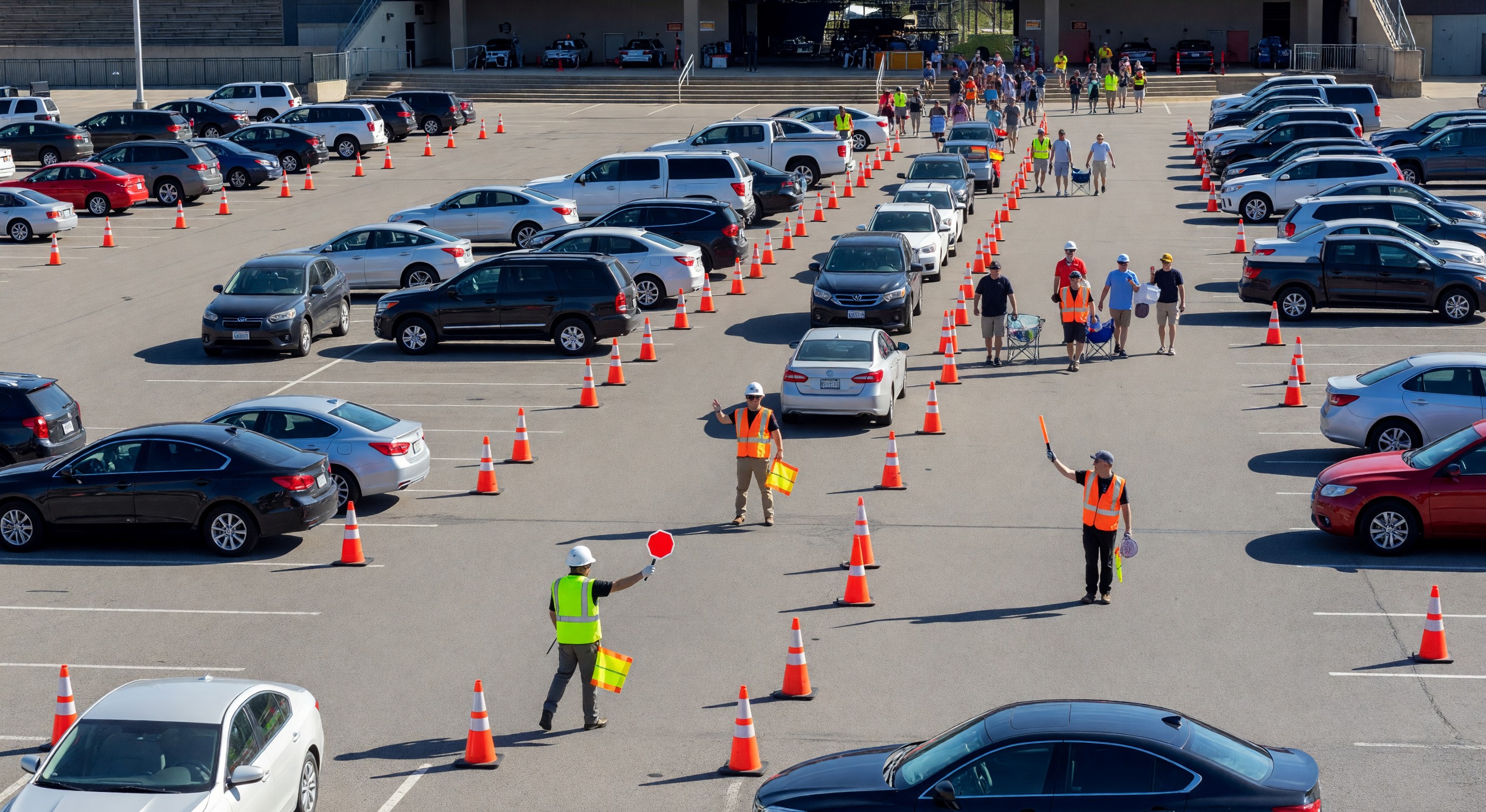
Event venue parking is among the most operationally challenging parking environments — characterized by massive simultaneous arrival waves, constrained egress, attendees unfamiliar with the facility, alcohol and other factors affecting judgment, and the requirement to process thousands of vehicles efficiently within a narrow operational window. Unlike daily parking where demand is distributed through the day, event parking compresses comparable or greater volume into 30 to 90 minute arrival and departure windows that strain every element of the parking and traffic system. Managing this extreme demand concentration effectively requires planning, technology, staffing, and communication strategies that differ substantially from standard parking operations.
Understanding Event Parking Demand Patterns
Event parking demand characteristics that distinguish it from daily parking:
Arrival compression: Concert and sports event attendees typically arrive within 90 minutes before event start, with 60 to 70 percent of arrivals concentrated in the 45 minutes before showtime. For a 15,000-seat venue, that’s 4,000 to 5,000 vehicles arriving in under an hour — a demand rate far exceeding the processing capacity of any normal parking facility.
Pre-sale and known demand: Unlike transient commercial parking where demand is estimated, sold-out events have known attendance that enables precise capacity planning. Event planners can calculate parking demand from ticket count, vehicle occupancy assumptions, and estimated transit share.
Departure concentration: Event egress is even more concentrated than arrival — all attendees leave within 30 to 60 minutes of event end. Managing departure safely requires coordinated exit sequencing, traffic control at intersection chokepoints, and clear directional guidance that parkers can follow when exiting.
Attendee unfamiliarity: Many event attendees visit the venue infrequently and are unfamiliar with parking locations, pricing, and routing. Signage, parking apps, pre-event communication, and on-site staff guidance are more important than at daily facilities where regular users develop familiarity.
Pre-Event Planning
Capacity analysis: The first planning step is calculating parking demand and comparing it against available supply. A 15,000-person event with 30% transit/rideshare share and 2.3 vehicle occupancy generates approximately 4,565 vehicles. Parking lots with that total capacity must be identified and allocated — including overflow locations if primary lots fill.
Lot assignment strategy: Assigning specific parking lots to specific attendee segments — VIP, accessible, general admission, overflow — requires clear pre-sale communication (which lot is assigned to which ticket type) and on-site wayfinding that guides each driver to the correct lot without confusion.
Traffic control plan: Working with the local municipality and traffic engineering department to develop an event traffic control plan — including temporary signal timing changes, lane configurations, flaggers at key intersections, and police support for major events — is essential for venues with significant external traffic impact.
Staffing plan: Event parking requires more staff per vehicle than standard operations — flaggers at lot entrances, traffic directors at key intersections, payment collection staff at pay stations, ADA assistance staff, and supervisors monitoring lot fill levels and communicating with operations. Staffing ratios depend on lot configuration and technology, but 1 staff per 50 to 100 vehicles is a common planning assumption.
Surge Arrival Management
Multiple entry points: Single-entry lots become severe bottlenecks during surge arrival. Multiple entry points with separate payment processing distribute the inbound traffic load. Venues with single-entry constraints should evaluate whether temporary additional entries can be created for event operations.
Pre-paid parking: Pre-sold event parking passes — purchased at ticket checkout or through a parking app — allow parkers to arrive with payment already processed. A pre-paid parker can enter without stopping for payment (with LPR scan or QR code confirmation), significantly increasing entry throughput. Converting 50% of event parkers to pre-paid can dramatically reduce entry queue lengths.
Signage and advance routing: Dynamic message signs on approach routes, supported by event app navigation guidance, can direct parkers to specific lots before they reach the facility — reducing circulation within the facility as drivers search for the correct lot. Pre-event email and app push notifications with parking directions reduce on-site confusion.
Overflow management: When primary lots fill, overflow lots must be clearly designated and actively managed. Staff at primary lot entrances who redirect overflow traffic must communicate with overflow lot staff to ensure receiving capacity. GPS coordinates and app navigation for overflow lots allow parkers to route directly without following physical signs through crowded areas.
Revenue Management
Event pricing premium: Event parking commands a premium over daily parking rates — attendees are willing to pay for the convenience of on-site parking for an activity they are excited about. Standard pricing practice is to charge three to five times the daily parking rate for event parking, with VIP parking priced at a further premium.
Pre-sale revenue capture: Event parking pre-sales capture revenue before the event and reduce on-site payment processing requirements. Ticketmaster, AXS, and event-specific parking apps facilitate pre-sale integration with ticket checkout — converting parking from an ancillary to a bundled or closely associated purchase.
Dynamic event pricing: For events with varying demand (major headliner concerts vs. smaller events at the same venue), dynamic pricing that adjusts event parking rates based on ticket sales velocity and anticipated attendance captures full revenue potential without leaving money on the table for high-demand events.
Third-party competition: For events at standalone venues without controlled access, private surface lots nearby may offer lower-priced parking competition. Venue parking operators should monitor competitive options and price at a premium justified by proximity and convenience rather than assuming a captive audience.
Departure Operations
Staggered release: For major events, coordinating with venue operations to stagger the departure of different sections or zones can reduce the simultaneous exit surge. VIP lots release first; lots farthest from the main exit release with a slight delay. Announcement coordination with the venue’s PA system supports staggered release.
Exit lane capacity: All available exit lanes should be operational at event end. Pre-positioned staff at exit lanes reduce processing time. Cash lanes should be minimized (directing cash-paying parkers to consolidation points before reaching exit lanes) to avoid cash-handling bottlenecks.
Traffic signal coordination: Working with traffic operations to implement green extension on primary exit routes — holding green lights on departure routes longer during peak egress — reduces external traffic interference with departing event vehicles.
Attendee communication: Post-event communication reminding parkers of lot locations (via app notification or parking receipt) reduces lost-car incidents. A dedicated staff resource or kiosk for lost vehicle assistance handles the inevitable cases where attendees cannot locate their vehicles in large lots.
Frequently Asked Questions
How should event venues handle accessible parking for large events? ADA-compliant accessible parking must be provided at a minimum percentage of event parking (per ADA Title III standards), located closest to accessible venue entrances. Event parking planning should identify and reserve accessible spaces in excess of the minimum given that accessibility needs are higher at public entertainment events than minimum standards anticipate. Clearly marked and lighted accessible routes from accessible parking to the venue entrance are required regardless of event conditions.
What technology systems are most impactful for event parking operations? Pre-sale parking pass platforms (integrated with ticket checkout), mobile payment apps, LPR-based entry for pre-paid passes, and real-time lot occupancy monitoring for operations staff are highest-impact. Dynamic message signs on approach routes for directional guidance are valuable at venues with complex traffic environments. The most important technology investment is whatever reduces entry lane processing time — the primary bottleneck in surge arrival management.
How should event parking operators manage relationships with the venue? Event parking at venue-affiliated lots typically requires a commercial agreement specifying parking lot capacity allocation, revenue sharing between the parking operator and venue, operational coordination (signage, pre-sale integration, staffing coordination), and liability allocation. Clear agreement terms avoid disputes when events generate unexpected challenges.
What staffing certifications or training are important for event parking? Flagger safety certification (ANSI/ATSSA standards for traffic control flaggers) is required for staff directing vehicle traffic at event entrances and on roadways. Staff should be trained in customer service for high-pressure, time-constrained situations, and in ADA assistance protocols. For large events with alcohol, de-escalation and impaired driver intervention training is valuable.
Takeaway
Event venue parking management is fundamentally different from standard commercial parking in its demand characteristics — massive simultaneous arrival, concentrated departure, attendees unfamiliar with the facility — and requires specialized planning, technology, staffing, and communication strategies calibrated to these conditions. The operations that manage event parking well — with pre-sold passes reducing payment bottlenecks, coordinated traffic control plans, clear wayfinding, adequate staffing for surge conditions, and staggered departure protocols — provide safe, efficient parking that supports the overall event experience. Revenue optimization follows from operational excellence: event parking at a well-managed venue commands premium prices because the experience supports them.
Further Reading from Authoritative Sources
- US Access Board ADA parking design guide for event venue accessible space requirements — The US Access Board ADA parking guide provides the federal accessible space count, dimensional, and route requirements that apply to event venue parking described in this article, making it the primary regulatory reference for accessible event parking compliance.
- ITE event venue traffic management and parking technical resources — ITE provides traffic engineering and event venue parking technical resources that address the traffic management plan development, signal coordination, and traffic control standards applicable to the large-scale event parking operations described in this article.