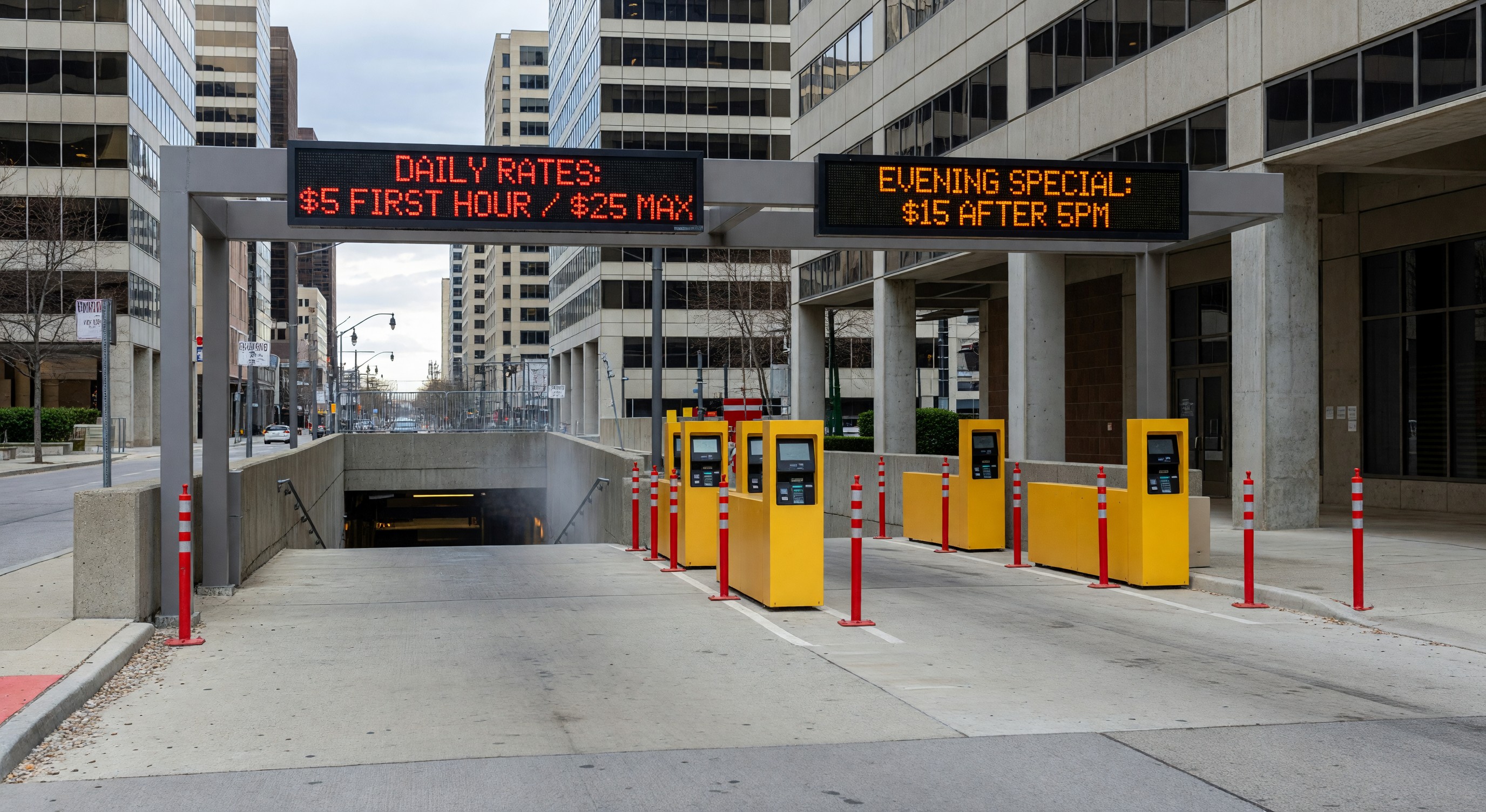
Downtown commercial parking — the structured garages and surface lots serving urban office workers, retail visitors, and city center destinations — represents the largest revenue segment in the parking management industry and the sector most directly affected by the structural changes of the 2020s. Hybrid work has reduced the daily commuter base that historically anchored monthly permit revenue. Urban retail patterns have shifted. Competition from street parking, ride-hail, and transit alternatives is more intense than in suburban contexts. Understanding the current operational realities and revenue management strategies for downtown commercial parking is essential for operators in this sector.
The Downtown Commercial Parking Revenue Model
Downtown parking facilities typically generate revenue from two primary sources:
Monthly permit revenue: Monthly parkers — primarily office workers who commute downtown on a defined schedule — provide predictable, recurring revenue. A 500-space downtown garage with 70% monthly occupancy at $250/month generates $87,500 monthly in base permit revenue before variable income. Monthly revenue is the foundation of the operating model: it covers fixed costs and provides cash flow stability.
Transient revenue: Daily and hourly parkers — retail visitors, restaurant guests, event attendees, doctor’s office patients — provide variable, demand-responsive revenue. Transient rates are typically higher per hour than the equivalent hourly rate of a monthly permit, but transient volume is less predictable and more sensitive to competition and economic conditions.
Revenue mix optimization: The optimal monthly-to-transient revenue mix depends on the facility’s competitive position and demand profile. Facilities near office concentrations may target 60 to 70 percent monthly revenue. Facilities near retail, entertainment, or mixed-use destinations may target higher transient percentages where daily demand is strong and monthly demand is limited.
Hybrid Work Impact on Monthly Demand
The post-2020 normalization of hybrid work schedules among knowledge workers has directly impacted monthly permit programs in downtown office-centric parking:
Demand reduction and permit attrition: Monthly permit holders who now commute three days per week rather than five may cancel their monthly permit in favor of daily transient parking — or in favor of transit or ride-hail on commuting days. The economics of a monthly permit become less attractive when the commuter only uses it 12 to 15 days per month rather than 20 to 22.
Flexible product development: Operators have responded with partial-week and day-bundle products (covered in the Parking Subscription Models article) that capture commuters with irregular schedules who can’t justify a full monthly permit. These flexible products retain some recurring revenue from the hybrid work population that would otherwise convert entirely to transient.
Market differentiation: In markets where hybrid work has been most severe (San Francisco, downtown Seattle, certain Washington DC corridors), the most competitively positioned downtown garages are those that have diversified beyond office commuter demand — serving mixed-use destinations, hotels, and event venues that generate transient demand less affected by hybrid work patterns.
Transient Pricing and Revenue Management
Dynamic pricing for transient: Downtown commercial parking can and should use demand-responsive transient pricing — raising rates when demand is high (Thursday evenings, event days, high-occupancy periods) and reducing rates when demand is low (early mornings, rainy Monday middays). PARCS systems that support rate scheduling enable time-of-day pricing without manual intervention.
Competition monitoring: Downtown operators compete directly with other garages, surface lots, and street parking on price. Rate monitoring — tracking competitor pricing in real time through parking apps and direct observation — enables competitive pricing decisions. Being systematically 10 to 15 percent above the market average without a service quality differential that justifies the premium is a common self-inflicted competitive problem.
Event and convention pricing: Downtown facilities near convention centers, sports arenas, and major venues should have event pricing programs that increase transient rates when events drive above-normal demand. Pre-event rate increases communicated through parking apps and the facility’s online presence capture event premium revenue.
Pre-reservation systems: Platforms like SpotHero, ParkWhiz, and the facility’s own booking system allow transient parkers to reserve and pre-pay for parking before arriving — capturing demand from planners who want certainty about parking availability and cost. Pre-reservation volume is an indicator of demand strength and provides revenue before the customer arrives.
Competition Management
Street parking relationship: Downtown on-street parking — metered spaces — directly competes with structured parking for short-duration visits. Facilities that are priced at or below the all-in cost of street parking for 60 to 90 minute visits capture retail and restaurant visit parking that would otherwise use street parking. Understanding the metered parking rate and enforcement environment in the surrounding blocks is essential competitive context.
Ride-hail competition: Ride-hail is a real alternative to parking for downtown destinations. Operators who understand which customer segments are most substitutable (infrequent downtown visitors with no vehicle storage need) and which are less substitutable (monthly commuters who prefer to have their vehicle available for midday errands) can tailor marketing and pricing to the less-substitutable segment.
Transit differentiation: Facilities near major transit stations compete with transit for commuter mode share. The value proposition of parking — guaranteed access, vehicle availability for midday trips, convenience for multi-stop commuters — must be communicated to commuters who are evaluating transit alternatives.
Operational Excellence in Downtown Parking
Transaction throughput: Urban parking customers value speed. Long queues at entry or exit lanes during peak periods create frustration that affects return visit decisions. Optimizing entry and exit lane capacity — pre-paid lanes for monthly holders, mobile payment for transient, LPR-based rapid processing — is a competitive differentiator.
Cleanliness and facility condition: Downtown parking facility cleanliness — well-lit levels, maintained surfaces, clean stairwells, functional lighting — directly affects customer perception of quality. Facilities that neglect maintenance trade short-term cost savings for long-term customer and tenant attrition.
Customer service quality: Monthly permit holders who have issues (access credential failures, invoice disputes, special requests) expect responsive customer service. Remote monitoring platforms that enable real-time response to customer calls and efficient online account management for monthly holders are increasingly standard expectations.
Safety and security: Urban parking facility security — camera coverage, lighting, emergency call stations, regular patrol — affects customer willingness to use the facility. Facilities in locations with crime concerns must invest in visible security measures that address customer anxiety, not just meet minimum legal standards.
Frequently Asked Questions
How much has hybrid work affected downtown commercial parking revenue? Effects vary by market. Downtown office parking in San Francisco, Seattle, and some New York submarkets saw 25 to 40 percent monthly permit revenue declines from pre-2020 peaks. Downtown markets with strong office absorption (Sunbelt markets like Austin, Nashville, Charlotte) saw less impact or even growth. By 2024, most markets had experienced partial recovery, with the most office-dependent facilities recovering to 75 to 90 percent of pre-2020 monthly permit levels in recovering markets.
What technology investments have the highest ROI in downtown commercial garages? Revenue management software that enables demand-responsive transient pricing typically delivers 8 to 15 percent transient revenue improvement at facilities with meaningful demand variability — among the highest ROI parking technology investments. LPR-based entry and exit (reducing gate transaction time and lane bottlenecks) has high operational ROI in high-volume downtown facilities. Mobile payment and pre-reservation integration with major platforms captures pre-committed transient demand.
How should downtown parking facilities manage their online reputation? Google Reviews, Yelp, and app store ratings for parking apps significantly affect transient customer acquisition. Facilities should actively monitor reviews, respond professionally to negative feedback, and encourage satisfied customers to leave reviews. The most common negative reviews in downtown commercial parking are about price surprises, access failures, and unresponsive customer service — all addressable through operational improvements and proactive communication.
What is the impact of EV charging availability on downtown commercial parking demand? EV penetration is growing fastest among the demographic most likely to use downtown commercial parking — professional workers, higher-income urban residents. EV charging availability in downtown garages is increasingly a decision factor for EV-owning monthly permit holders who value workplace-adjacent charging. Facilities in markets with high EV adoption (California, Pacific Northwest, Northeast) that provide meaningful charging capacity are commanding modest rate premiums and retaining EV-owning monthly tenants who might otherwise seek charging-equipped facilities.
Takeaway
Downtown commercial parking is navigating a structural transition driven by hybrid work, ride-hail competition, and evolving urban transportation patterns — while maintaining the largest share of parking industry revenue in most markets. The operators who succeed in this environment are those who respond actively to demand changes: developing flexible permit products for hybrid commuters, implementing dynamic transient pricing to capture variable demand, maintaining competitive rate positions, investing in facility quality that justifies premium positioning, and adding EV charging infrastructure that retains and attracts the growing EV-owning customer segment. Downtown commercial parking remains a significant business, but it increasingly requires active revenue management and market responsiveness rather than the passive management that sufficed in the pre-2020 era of reliable office commuter demand.
Further Reading from Authoritative Sources
- IPMI downtown commercial parking revenue management and urban operations guidance — IPMI publishes downtown commercial parking revenue management guidance, competitive pricing frameworks, and urban operations standards for parking operators.
- ITE urban parking demand and downtown transportation planning resources — ITE publishes urban parking demand research, downtown transportation planning guidelines, and transit-parking competition analysis that provide the technical context for downtown commercial parking demand management.