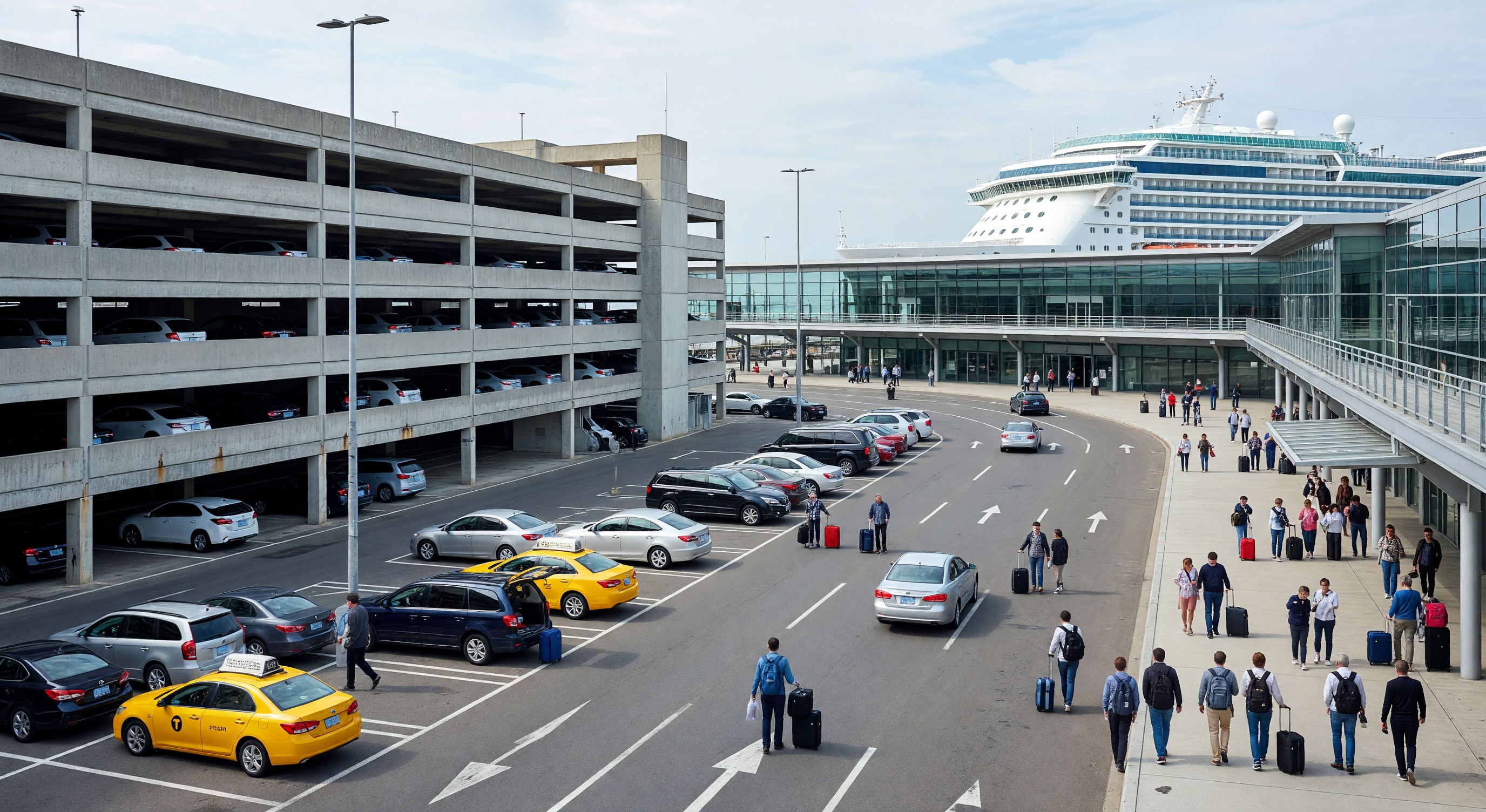
Cruise terminal parking is a specialized parking vertical characterized by multi-day vehicle storage, massive simultaneous passenger processing during embarkation and disembarkation, coordination with cruise line schedules that are fixed months in advance, and security requirements specific to port environments. A major cruise terminal may process 3,000 to 6,000 vehicles arriving for an embarkation in a four-hour window — all parked for 7 to 14 days — and an equivalent number departing from a previous cruise in the same window. Understanding the operational complexity and revenue management of cruise terminal parking helps port authorities, parking operators, and cruise terminal facility managers deliver effective service in one of the highest-intensity parking environments.
Cruise Terminal Parking Demand Characteristics
Multi-day vehicle storage: Unlike most parking contexts where vehicles stay for hours, cruise terminal parkers leave their vehicles for the duration of the cruise — 7 nights, 10 nights, 14 nights. The average vehicle dwell time of 7 to 10 days means that spaces generate revenue for extended periods per transaction. A 2,000-space facility at $25/day with 90% occupancy generates $45,000/day — revenue levels achievable because each vehicle parks for many consecutive days.
Concentrated embarkation arrivals: Cruise ship departure typically begins passenger boarding 3 to 5 hours before sailing. Within that window, thousands of vehicles arrive, passengers and luggage are unloaded, vehicles are directed to the parking facility, and parking is processed. A single embarkation for a 3,000-passenger ship with 1,200 vehicles arriving over 4 hours requires processing 300 vehicles per hour — a moderate pace manageable with adequate staffing and entry lanes.
Simultaneous embarkation and disembarkation: Cruise schedules are calibrated so that one cruise disembarks (passengers departing, picking up vehicles) in the morning while the next cruise embarks in the afternoon. Managing both flows simultaneously — departing passengers retrieving vehicles while arriving passengers are parking theirs — requires operational separation and clear wayfinding.
Turnover between cruises: The multi-day storage model means that most spaces turn over once per cruise cycle (every 7 to 14 days) rather than daily or hourly. Pricing per day times dwell days per vehicle determines revenue per space per cycle — the key revenue metric in this context.
Embarkation Day Operations
Traffic and access management: Embarkation day creates major traffic volume on the routes approaching the cruise terminal. Working with local traffic authorities to implement temporary traffic management — additional signal timing, police traffic control at critical intersections, designated approach routes for cruise vehicles — reduces congestion on the surrounding road network.
Drop-off and parking separation: Cruise terminal operations distinguish between drop-off vehicles (passengers dropped at the terminal by a driver who does not park) and parking vehicles (passengers who will leave their car for the cruise duration). Separate lanes and facilities for each function prevent mixing of through traffic with parked vehicles.
Porter and luggage handling coordination: Passengers typically hand off their luggage at curbside porters before proceeding to the parking facility. Coordinating the parking entry flow with the luggage handling operation — ensuring that passengers can locate porters, hand off luggage, and then proceed to park — requires physical layout and wayfinding that supports this two-step process.
Security screening: Port of Entry regulations require vehicle and passenger screening at cruise terminals under U.S. Customs and Border Protection protocols. Vehicle screening (which may include visual inspection, document check, or imaging) must be integrated into the parking entry process without creating delays that back vehicles up onto public roads.
Disembarkation Day Operations
Batch vehicle retrieval: Unlike standard parking where vehicles are retrieved individually on demand, cruise terminal disembarkation involves hundreds of passengers retrieving their vehicles within a 2 to 3 hour window. PARCS systems must be capable of processing high exit volumes (potentially 400 to 600 vehicles per hour) without creating exit lane bottlenecks.
Payment collection at disembarkation: Most cruise terminal parking facilities collect payment at exit rather than on entry. The exit transaction — verifying the vehicle, calculating the multi-day charge, processing payment — must be efficient at high volume. Pre-paid options (purchasing parking online at reservation) and mobile payment reduce exit transaction time.
Shuttle from parking to terminal: Large cruise terminal parking facilities that are not adjacent to the passenger terminal (a common situation at major ports where parking facilities may be 500 to 1,000 feet from the ship) operate shuttle buses between parking and the terminal. Shuttle frequency during embarkation and disembarkation windows is a critical service quality factor.
Abandoned vehicle management: A small number of vehicles are left at cruise terminal parking beyond the cruise return date — passengers who have a medical emergency, miss the ship, or have other complications may not return on schedule. Protocols for identifying, holding, and ultimately addressing long-duration vehicles beyond the expected cruise duration are necessary.
Revenue Management
Advance purchase and pre-reservation: Cruise passengers who plan their travel months in advance have the motivation to pre-purchase parking with their cruise booking. Integration with cruise line booking platforms (or third-party travel booking sites) allows parking to be sold at the time of cruise reservation — capturing motivated buyers who will not comparison shop at the time of parking entry.
Rate structures by cruise duration: Pricing may be structured with per-day rates, or with flat rates by cruise duration (7-night cruise rate, 10-night cruise rate, 14-night cruise rate). Flat rates by duration are simpler for passengers to understand and compare; per-day rates with daily maximums may be more appropriate for irregular cruise lengths.
Premium parking tiers: Covered parking, indoor parking within the parking structure, or reserved spaces closest to the terminal entry may be offered at a premium over standard surface or open-deck parking. Premium differentiation is particularly valuable in markets where temperature extremes (hot summer climates, cold winter climates) make covered parking highly desirable.
Competitive positioning: Major cruise ports have multiple parking options — port authority facilities, private lots, and off-site lots with shuttle service. Pricing must be competitive within the port parking market while reflecting the advantages of on-site facilities (proximity, security, convenience). Off-site lots typically undercut port pricing by 20 to 40 percent in exchange for a shuttle, and some passengers will accept that tradeoff.
Port Security and Access Control
CBP compliance: Cruise terminal parking facilities operate within U.S. Customs and Border Protection port security zones. Access control requirements, prohibited items, and security protocols are more extensive than commercial parking. Operators must comply with CBP requirements and maintain current knowledge of port security regulations.
TWIC card requirements: Maritime facilities where workers access controlled port areas may require Transportation Worker Identification Credential (TWIC) cards for parking operations staff who access the port security zone. Parking facility staff training and credentialing requirements under port security protocols differ from standard commercial parking staffing.
Video surveillance requirements: Port security protocols typically require comprehensive video surveillance of parking facilities, with retention periods and access provisions that may exceed commercial parking standards. Surveillance systems must comply with port security requirements while meeting operational video management needs.
Frequently Asked Questions
How should cruise terminal parking operators handle extremely long dwell times (cancellations, medical emergencies)? Operators should have documented protocols for vehicles held beyond expected departure date — attempted contact with the registered vehicle owner or emergency contact, coordination with the cruise line’s passenger services, and defined hold periods before considering the vehicle abandoned under applicable state law. Clear communication of these policies to parkers at entry reduces misunderstanding and legal exposure.
What is the revenue impact of pre-selling cruise parking vs. gate sales? Pre-sold parking provides earlier revenue recognition, reduces processing time at arrival (pre-paid parkers enter more quickly), and improves demand forecasting for operations staffing. The trade-off is reduced flexibility — a pre-sold parker who cancels their cruise may request a refund that represents foregone revenue. Cancellation and refund policies for pre-sold cruise parking should be clearly communicated and aligned with cruise line cancellation practices.
How should port parking facilities price relative to off-site competitors? The premium for on-site convenience — no shuttle, secured port facility, adjacency to terminal — is worth approximately $3 to $8 per day to many cruise passengers. On-site pricing that exceeds off-site options by more than this range risks losing price-sensitive customers to off-site competitors. On-site pricing that is at or below off-site options forgoes available revenue. Monitoring competitive pricing and adjusting rates to maintain a reasonable premium above the off-site option is the appropriate pricing strategy.
What payment technologies are appropriate for cruise terminal parking? Multi-day parking with exit-payment collection benefits from mobile payment options (passengers can pay on their phone before returning to the vehicle), pre-purchase integration with cruise booking platforms, and standard credit card acceptance at exit lanes. The high transaction value (7 days × $25/day = $175 per transaction) makes payment method reliability and fraud prevention more important than in standard short-term parking.
Takeaway
Cruise terminal parking management combines the multi-day vehicle storage economics of airport parking with the massive simultaneous passenger processing demands of event parking — in a port security environment that adds regulatory complexity to an already operationally demanding context. The facilities that manage cruise parking effectively coordinate their operations with cruise line schedules and embarkation/disembarkation sequencing, invest in PARCS systems capable of processing high exit volumes during disembarkation, offer pre-purchase options integrated with cruise booking, and maintain security compliance appropriate to the port environment. Revenue management that differentiates on proximity, covered parking availability, and security premium — while remaining competitive with off-site alternatives — captures the revenue potential of this high-value, recurring-customer parking vertical.
Further Reading from Authoritative Sources
- U.S. Department of Transportation port security and maritime facility access standards — The U.S.
- IPMI cruise terminal and port parking operations guidance — The International Parking and Mobility Institute publishes parking vertical guidance including cruise terminal and port operations that is directly relevant to the article’s operational and revenue management content.