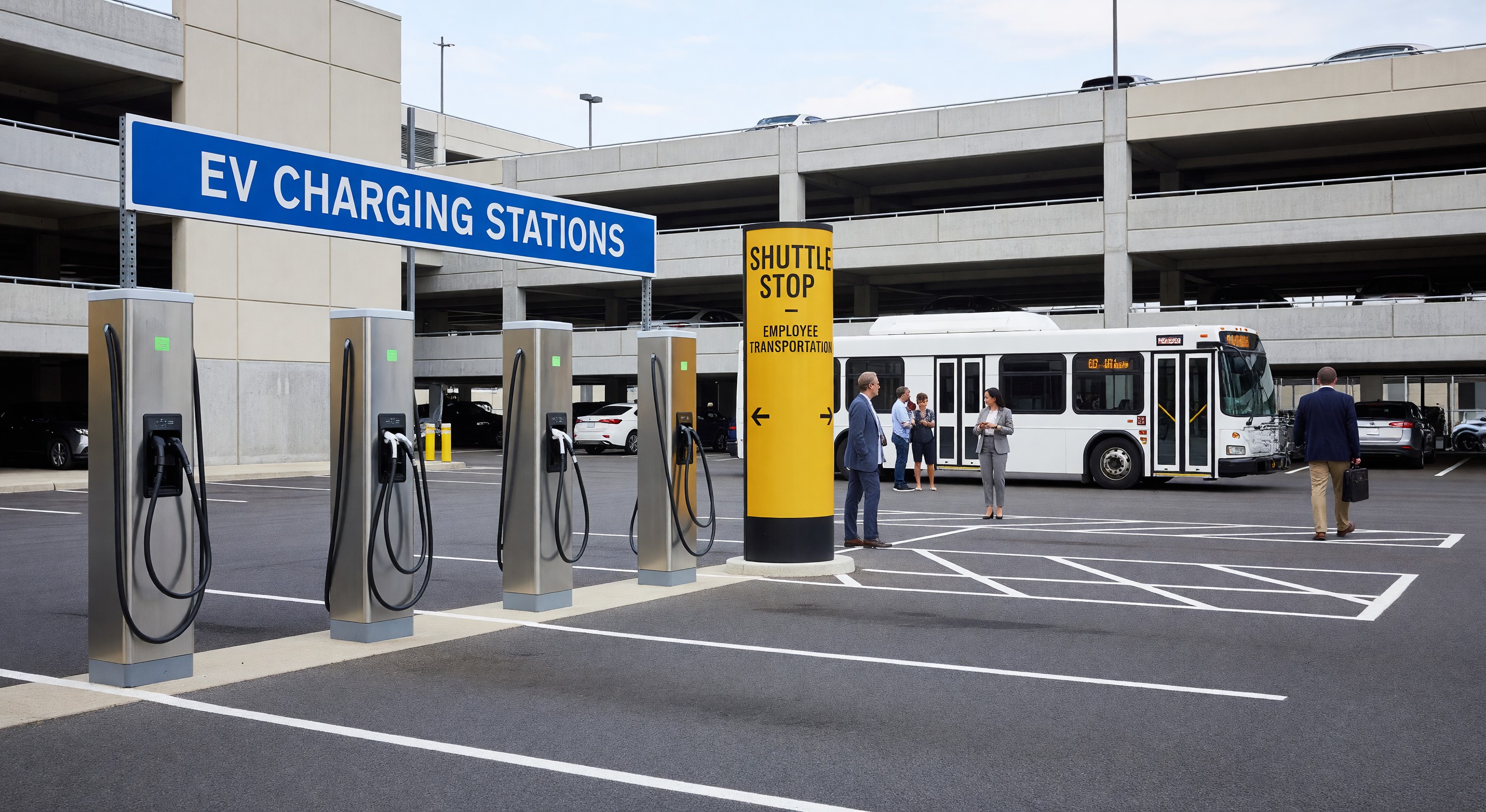
Large corporate campuses — technology companies, pharmaceutical facilities, financial institutions, and other major employers with concentrated workforces — present distinct parking management challenges driven by high employee density, geographic constraint, and the employer’s interest in transportation demand management as part of sustainability and commuter benefit programs. Corporate campus parking is less about revenue maximization and more about efficiently managing access for a known population with structured work schedules and transportation benefit options that differ from general commercial parking. Understanding corporate campus parking management helps facility managers, HR professionals, and transportation coordinators optimize a system that significantly affects employee experience and operational productivity.
Corporate Campus Parking Demand Characteristics
Corporate campuses differ from commercial parking in key ways:
Known demand base: Employee headcount and on-site work schedules define parking demand with much higher predictability than transient commercial parking. A campus with 5,000 employees and a parking ratio of 0.6 spaces per employee needs 3,000 spaces for a fully on-site workforce — a calculation that changes with hybrid work schedules.
Shift and schedule concentration: All-day knowledge worker campuses see concentrated morning arrival (typically 7 to 9:30 AM) and evening departure (5 to 7 PM). Campus parking systems must handle these arrival and departure surges without bottlenecks that create productivity-affecting delays.
Employer subsidy considerations: Many large employers subsidize employee parking — providing free or heavily discounted parking as part of the compensation and benefits package. The IRS allows up to $315/month (2024) in pre-tax parking benefit. Employers who provide free parking subsidize a significant benefit that is tax-free to employees but creates parking demand that could be reduced through transportation alternatives.
Competitive talent context: In competitive labor markets, transportation and parking benefits affect talent recruitment and retention. Reducing or eliminating free parking — even as part of a transportation demand management program — requires careful management to avoid negative employee relations impacts.
Permit Programs for Corporate Campuses
Permit tiers: Large corporate campuses typically have multiple permit tiers — reserved executive parking, premium spaces with covered or proximate locations, standard employee permits for general lots, and remote parking with shuttle service. Permit tier assignment may be based on seniority, position level, compensation, or lottery.
Wait list management: Campuses with more employees than parking spaces manage wait lists for permit assignments. Digital permit management systems track wait list position, automate permit offers when spaces become available, and manage permit transfers when employees change assignments or locations.
Hybrid work permit programs: Post-2020, many corporate campuses implemented partial or flexible permit programs that match permit allocation to actual attendance patterns. A hybrid employee who is on-site three days per week doesn’t need a five-day permit — and a flexible daily pass or three-day permit at reduced cost may be preferable to the employer (fewer permits, lower parking subsidy cost) and the employee (pays only for days they use).
Contractor and visitor management: Corporate campuses must manage parking for contractors, vendors, and visitors who are distinct from the employee permit population. Designated visitor parking with time limits, visitor validation programs for specific meetings, and contractor permit systems prevent visitor and contractor vehicles from occupying employee spaces.
Transportation Demand Management
TDM programs are a standard component of large corporate campus transportation management:
Transit subsidies: Pre-tax transit benefit (IRS Section 132, up to $315/month in 2024) allows employees who commute by transit to purchase their transit pass with pre-tax dollars — a tax savings of 25 to 35 percent relative to after-tax spending. Employers who fund transit subsidies beyond the employee’s own pre-tax contribution further reduce transit cost and incentivize transit use.
Vanpool and carpool programs: Employer-sponsored vanpool programs provide passenger vans that employees use for group commutes. Vanpool drivers receive benefits (free parking, van personal use) in exchange for managing the vehicle. Carpool programs that provide reserved or premium parking for verified carpools incentivize vehicle sharing.
Bike amenities: Secure bicycle parking, shower facilities, and sometimes bicycle purchase loans (or on-site bicycle lending programs) support cycling commuters. LEED certification credits and green building standards encourage these amenities.
Guaranteed ride home: A common barrier to transit and carpool commuting is the concern that irregular schedules will leave the commuter stranded. Guaranteed ride home programs — employer-funded taxi or TNC rides for employees who need to leave unexpectedly — address this concern and increase willingness to use alternative commute modes.
Shuttle Operations
Corporate campuses with remote parking locations or significant commuter rail access points typically operate shuttle systems:
Campus circulators: On-campus shuttle routes connecting parking structures, buildings, and transit stops provide transportation within large campus footprints. Shuttle frequency (every 10 to 15 minutes) and coverage of all major campus destinations determine employee acceptance of the shuttle as a genuine transportation option rather than a slow inconvenience.
Rail and transit station shuttles: Shuttle routes connecting major transit stations to the campus expand the effective transit catchment area. Employees who live near transit lines can ride to the station and shuttle to campus — eliminating the car trip that would otherwise be required by the transit-to-campus gap.
Remote parking shuttles: Large campuses that extend parking to remote surface lots provide shuttle service from those lots to the main campus. Shuttle frequency, covered waiting areas, and real-time shuttle tracking (via app) determine whether remote parking feels like a reasonable commute option or a punishment for lower permit tiers.
Shuttle technology: GPS vehicle tracking with real-time arrival displays at stops, mobile app schedule and arrival information, and automated ridership counting support shuttle system planning and employee adoption. Scheduling optimization software that adjusts service frequency based on ridership patterns reduces operating cost while maintaining service quality.
Hybrid Work Impact and Parking Right-Sizing
Demand reduction from hybrid work: Corporate campuses where employees are on-site three to four days per week rather than five experience meaningful parking demand reduction — often 20 to 40 percent fewer vehicles on any given day. This creates opportunities to reduce parking supply (redeveloping lots for other uses), sublease excess parking capacity, or right-size permit programs to actual demand.
Reservation systems: Day-specific desk reservation systems (hot-desking, hoteling) that coordinate when employees come on-site create data on expected daily attendance that can feed parking reservation systems — allowing employees to pre-reserve parking for the days they plan to attend and alerting operations to days when parking demand will be high or low.
Subleasing excess capacity: Campuses with more parking than current hybrid work demand requires can sublease excess parking to neighboring businesses, creating revenue from underutilized assets. Multi-year subleases with neighboring employers have been arranged in several technology campus markets.
Frequently Asked Questions
Should large employers charge employees for parking? The parking cash-out economics are compelling: an employee who values a parking space at $200/month (its market value) and is offered $200/month in cash in lieu of a parking space will often prefer cash and find alternative commute options. California’s parking cash-out law requires employers with 50+ employees in leased parking situations to offer the cash option. Employers who implement parking cash-out programs typically see 10 to 30 percent reduction in solo driver commuting without reducing employee satisfaction.
How should corporate campuses plan for EV charging? Corporate campus EV charging should be planned as infrastructure that grows with the employee EV fleet rather than installed at full scale upfront. Electrical infrastructure (panel capacity, conduit) can be installed during initial development or renovation at relatively low cost; charger equipment can be added as demand grows. Level 2 charging (19.2 kW) is appropriate for all-day workplace parking where 8-hour dwell times make fast charging unnecessary. Fleet data on employee EV ownership rates guides rollout planning.
What are the benefits of a TDM coordinator role at large corporate campuses? A dedicated transportation demand management coordinator manages all alternative commute programs — transit subsidies, vanpool, carpool, shuttle coordination, cycling amenities, guaranteed ride home — and tracks mode share and program participation. TDM coordinators at large campuses often achieve 20 to 40 percent reduction in drive-alone commuting compared to campuses without TDM programs, reducing parking demand and supporting sustainability commitments.
How do corporate campuses handle parking demand for large all-hands events or recruiting events? Special events that bring more employees or visitors to campus than regular permit capacity supports require pre-planned overflow protocols — temporary additional lots (with shuttle service), designated visitor overflow areas, and communication to regular permit holders about overflow options. Major quarterly or annual events should have standing event parking plans that can be activated with defined lead times.
Takeaway
Corporate campus parking management requires coordinating permit programs, transportation demand management, shuttle operations, and EV charging infrastructure to serve a known employee population with defined access requirements and increasingly flexible work schedules. The most effective corporate campus parking programs treat parking as one element of a comprehensive transportation benefit — not the default option that employees receive regardless of how they actually commute, but one option among several that is priced or structured to encourage the commute modes that best serve the employee and the employer’s sustainability goals. As hybrid work becomes permanently embedded in corporate culture, the right-sizing of parking supply and permit programs to actual demand is a significant operational and financial opportunity for campus transportation managers.
Further Reading from Authoritative Sources
- US DOT transportation performance management for corporate campus TDM program evaluation — The US DOT transportation performance management framework provides the methodological basis for measuring TDM program effectiveness and mode shift outcomes that corporate campus transportation managers need to evaluate their parking demand management investments.
- US DOE EV charging infrastructure planning for corporate campus workplace charging — The US DOE Alternative Fuels Data Center provides workplace EV charging infrastructure planning guidance directly applicable to corporate campus EV charging deployment, supporting the phased installation approach and Level 2 charging recommendations described in this article.