Campground and RV park operators face access control challenges that the parking industry’s standard playbook does not address. The vehicles are larger. The access points are wider. The demand swings are more extreme — from near-empty on a January weekday to overflowing on a July Fourth weekend. The guests expect around-the-clock entry and exit. And the operating environment is outdoors, exposed to weather, wildlife, and conditions that would destroy equipment designed for urban parking garages.
Despite these differences, the fundamental access control needs are the same as any managed parking operation: know who is on your property, control when and how they enter and leave, collect revenue accurately, and maintain security. Research from Grand View Research shows the outdoor recreation access control market is growing steadily. The solutions just need to be adapted to an environment where a 40-foot motorhome is the standard customer vehicle and the nearest technician may be an hour away.
This article covers the unique access control requirements of campgrounds and RV parks, the technology solutions that address them, and the operational practices that successful operators use to manage access in this distinctive environment.
Why Standard Parking Equipment Falls Short
Campground operators who have tried to repurpose standard parking access control equipment quickly discover the limitations.
Gate clearance. A standard parking barrier gate arm is designed for passenger vehicles. RVs, fifth-wheel trailers, motorhomes with roof-mounted air conditioners, and trucks towing boats require significantly more vertical clearance. Standard gates that close on a vehicle cause damage — to the vehicle, the gate, and the operator’s reputation. Gate systems for campgrounds need arms that are longer, positioned higher, and equipped with safety sensors calibrated for large, slow-moving vehicles.
Lane width. Parking garage lanes designed for passenger cars are typically 10 to 12 feet wide. An RV towing a trailer needs 14 to 16 feet, and the turning radius at an entry point needs to accommodate vehicles that do not turn like sedans. Access points designed without these dimensions create traffic jams, vehicle damage, and frustrated guests whose vacation starts with a stressful entry experience.
Durability. Urban parking equipment operates in controlled environments — covered garages, paved surfaces, protected from direct weather exposure. Campground equipment lives outdoors. Rain, snow, dust, insects, extreme heat, and extreme cold all take a toll. Equipment that works reliably in a downtown garage may fail within a season at a campground in the mountains or desert.
Power and connectivity. Many campgrounds are located in areas with limited or unreliable power and internet connectivity. Equipment that depends on constant power and always-on internet connections is impractical. Battery backup, solar supplementation, and offline operating capability are essential features for campground access control that urban parking equipment rarely needs.
User demographics. Campground guests range from tech-savvy millennials in converted vans to retired couples in Class A motorhomes who may not be comfortable with touchscreen interfaces. Access control systems need to accommodate this range with simple, clear interfaces that work for everyone.
Gate Systems for Large Vehicles
The physical gate is the most visible component of campground access control, and getting it right is critical for both security and guest experience.
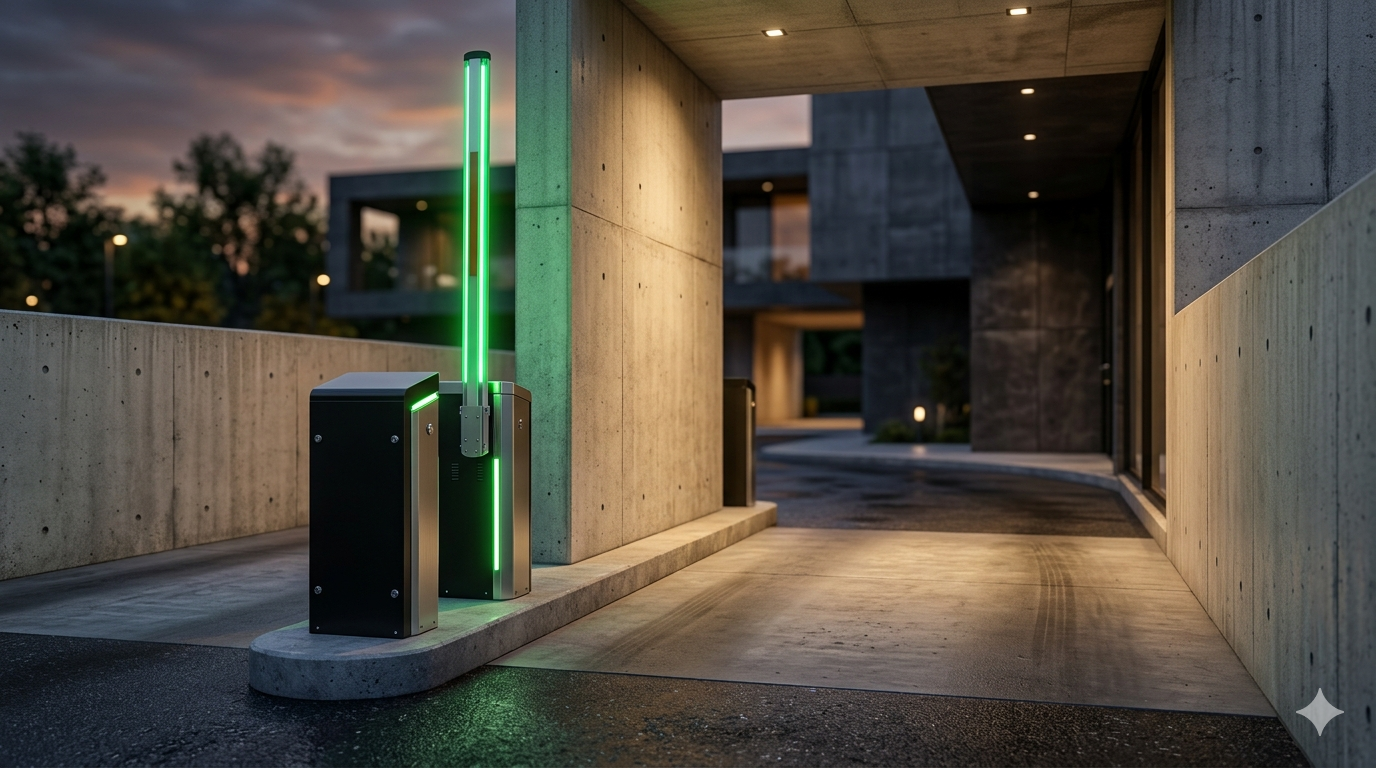
Barrier Arm Gates
Barrier arm gates remain the most common access control mechanism at campgrounds that control vehicular entry. For RV and campground applications, these gates require:
Extended arm length. Arms of 16 to 20 feet or longer to span wider lanes. Longer arms create more stress on the gate mechanism, requiring heavier-duty motors and mounting hardware than standard parking gates.
Breakaway arms. In an environment where drivers are navigating large, unfamiliar vehicles through narrow spaces, accidental gate contact is inevitable. Breakaway arms that detach on impact — rather than damaging the vehicle or the gate mechanism — significantly reduce maintenance costs and customer incidents.
Slow cycle speeds. Standard parking gates cycle in two to four seconds. Gates serving RVs should cycle more slowly — four to eight seconds — to accommodate vehicles that accelerate and pass through more slowly than passenger cars. A gate that closes before a 45-foot motorhome has fully cleared is a safety hazard and a liability exposure.
Ground loop sizing. The inductive loops embedded in the pavement that detect vehicles must be sized for large vehicles and positioned to account for the different wheelbase and ground clearance of RVs, which can affect loop detection reliability.
Sliding Gates
For campgrounds that need perimeter security rather than lane control, sliding gates that close across the entire access road provide a more secure barrier than arm gates. These gates are common at campgrounds in areas where security is a concern or where the property boundary needs to be clearly defined.
Sliding gates are slower than arm gates, making them more appropriate for facilities with lower traffic volume. They also require more maintenance — track cleaning, motor servicing, and weather protection — than arm gates.
Swing Gates
Swing gates are the simplest option and common at smaller campgrounds. A single or double gate swings open to allow entry and closed to secure the property. They are less expensive than barrier arm or sliding gates and mechanically simpler, but they require significant clearance area for the swing arc and are vulnerable to wind damage in exposed locations.
After-Hours Access: The Core Challenge
Campground guests arrive at all hours. A family driving through the night to maximize vacation time pulls up to the gate at 2 AM. A guest steps out for a late dinner and returns at midnight. An early riser leaves before dawn for a fishing trip and returns midmorning.
Managing 24/7 access without 24/7 staffing is the central operational challenge of campground access control. The solutions balance security, guest convenience, and cost:
Keypad and Code Entry
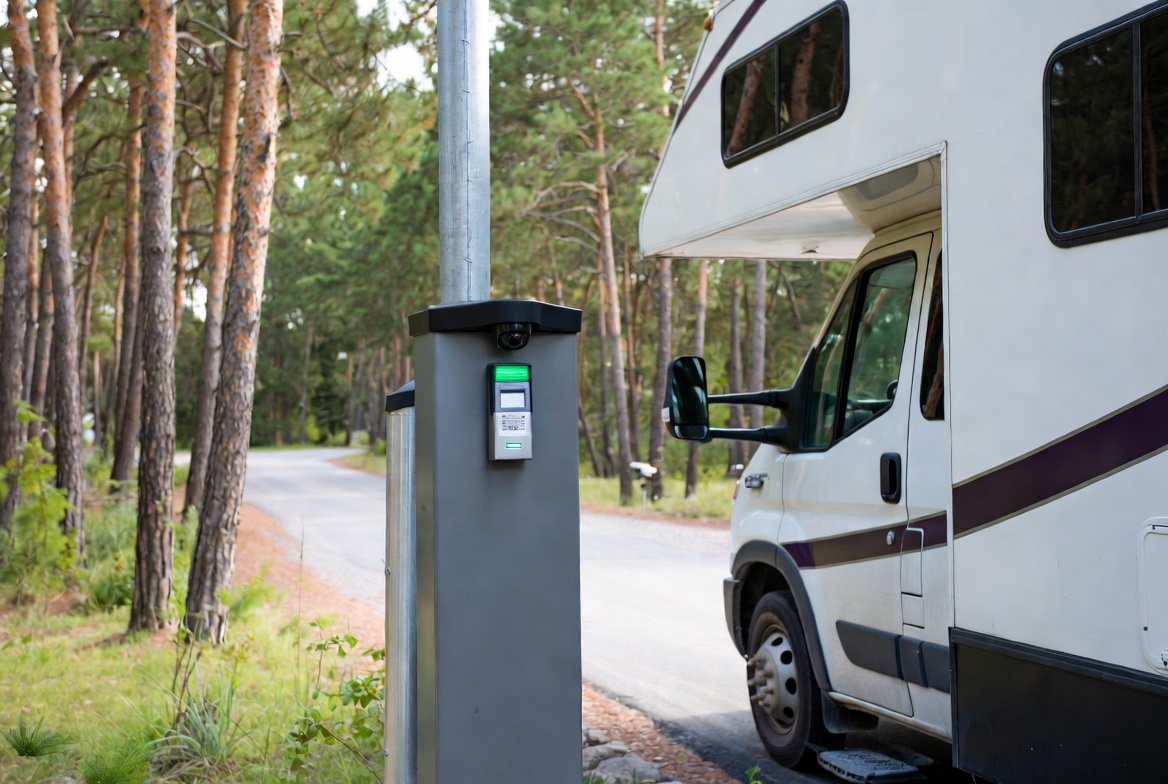
The simplest after-hours access method: guests receive a code at check-in and enter it at a keypad to open the gate. Codes can be unique per reservation, shared among all current guests, or rotated on a daily or weekly basis.
Advantages: Low cost, mechanically simple, no guest technology requirements.
Disadvantages: Codes can be shared with non-guests, keypads are difficult to operate from the driver’s seat of a large vehicle, and code management becomes complicated at scale.
RFID Cards and Fobs
Guests receive an RFID card or fob at check-in that activates the gate reader. The credential is programmed with the reservation dates and deactivated at checkout.
Advantages: More secure than shared codes, easy to use (wave the card near the reader), and credentials can be tracked for entry and exit records.
Disadvantages: Cards must be issued and collected at check-in and checkout, adding to front desk workload. Lost cards create replacement costs and potential security gaps.
Mobile Access
Smartphone-based access using Bluetooth, QR codes, or app-based credentials represents the newest approach. Guests receive a digital credential via email or through a reservation app that activates the gate from their phone.
Advantages: No physical credential to issue or collect. Credentials can be sent before arrival, enabling self-service check-in. Access can be time-limited, restricted to specific gates, and revoked remotely.
Disadvantages: Requires guests to have smartphones and be willing to use them. Cell service at remote campgrounds may be insufficient for app-based solutions. Bluetooth range and reliability vary.
Hybrid Approaches
Most successful campground operations use a combination of methods. Primary access through RFID or mobile credentials for tech-comfortable guests. Keypad backup for guests who prefer simplicity. And a call box or intercom connected to a remote monitoring service or the owner’s phone for edge cases that no automated system handles well.
Campground-specific access control solutions from manufacturers who understand the unique requirements of outdoor recreation facilities can integrate these multiple access methods into a unified system that provides flexibility without complexity.
Seasonal Demand Management
Campground demand is among the most seasonal in any parking-adjacent industry. A campground that is 95 percent occupied on summer weekends may be 10 percent occupied on winter weekdays. This swing creates access control challenges that year-round urban facilities never face.
Peak Season Operations
During peak season, access control must handle:
High arrival volume. Check-in day (typically Friday afternoon) can see dozens or hundreds of arrivals within a few hours, many towing trailers or driving large motorhomes. Entry throughput must handle this volume without creating road-blocking queues.
Guest turnover. Weekend reservations mean a wave of departures on Sunday followed by a wave of arrivals for the next reservation cycle. The access system must process checkouts, deactivate credentials, activate new credentials, and manage the physical flow of large vehicles in and out of the property.
Visitor management. Peak season brings day visitors — guests of campers who are not registered guests themselves. Managing visitor access (separate credentials, time-limited entry, or guest-sponsored access) adds complexity to the access control system.
Off-Season Operations
During off-season or shoulder periods:
Reduced staffing. Many campgrounds operate with minimal or no on-site staff during off-season. Access control must function autonomously, with remote monitoring and management capability.
Seasonal storage. Some campgrounds offer seasonal RV storage, where vehicles remain on-site for months without their owners present. Access control for storage customers requires different credential types and access rules than active campground guests.
Maintenance access. Contractors, utility workers, and maintenance staff need access during off-season when the guest access system may be in a different operating mode. Separate credential categories or temporary access codes manage this without compromising security.
Revenue Collection at the Gate
For campgrounds that collect fees at the point of entry — rather than through advance reservations — the access control system must incorporate payment processing. This is particularly relevant for:
Day-use areas where visitors pay a per-vehicle fee for access to a lake, trailhead, or beach within the campground property.
Overflow camping during peak periods when the campground opens additional areas on a first-come, first-served basis.
Late arrivals who did not make advance reservations but want to check availability and pay on arrival.
Payment kiosks at campground entry points need to handle the same environmental challenges as the gate equipment — weather exposure, limited connectivity, varied user comfort with technology — while accepting credit cards, mobile payments, and in some cases cash.
Integration between the payment system and the reservation system ensures that guests who have already paid online are not charged again at the gate, while walk-up guests can complete a transaction and receive an access credential in a single interaction.
Security and Monitoring
Access control in campgrounds serves a security function beyond revenue collection. Guests are sleeping in their vehicles — their temporary homes — and expect a level of security that justifies the fee they are paying.
Entry logging. Recording every vehicle entry and exit with timestamps and, where LPR is deployed, plate numbers creates a security record that is valuable both for incident investigation and for the general deterrent effect of a monitored access point.
Unauthorized entry detection. Gates and perimeter monitoring that detect vehicles or pedestrians entering outside normal access channels alert operators to potential security concerns.
Emergency access. Fire, medical emergency, and law enforcement vehicles must be able to enter the property without delay, in compliance with ADA accessibility standards and local fire codes. Access control systems need emergency override capability — typically a Knox Box or code known to emergency services — that bypasses normal access procedures.
Remote monitoring. Camera systems at access points, integrated with the access control platform, allow remote operators to visually verify entry attempts, assist guests having difficulty, and monitor the property during unattended hours.
Technology Selection for Campgrounds
Campground operators evaluating access control technology should prioritize:
Environmental durability. Equipment rated for the actual conditions at the site — temperature range, humidity, dust, precipitation, and UV exposure. Indoor-rated equipment in an outdoor application will fail, and the warranty will not cover it.
Offline capability. The system should function — opening gates, validating credentials, processing payments — during internet outages. Connectivity is a convenience for remote monitoring and cloud reporting, not a prerequisite for basic operation.
Ease of maintenance. With limited on-site technical staff and potentially remote locations, equipment should be designed for simple troubleshooting and repair. Modular components that can be swapped without specialized tools or training reduce downtime and support costs.
Scalability. A campground that starts with a single gate and 50 sites may grow to multiple entry points and 200 sites. The access control platform should scale without requiring a complete system replacement.
Integration with reservation systems. The access control system should communicate with the campground’s reservation and property management system, automatically activating and deactivating credentials based on reservation dates and syncing guest information across platforms.
The campground and RV park market represents a growing opportunity for access control providers willing to adapt their products to the specific needs of outdoor recreation. Operators who invest in purpose-built access control — rather than repurposing urban parking equipment — create better guest experiences, improve security, and build the operational foundation for sustainable growth.