Smart city parking programs — municipal initiatives that apply technology, data, and responsive management to improve how parking functions at the city scale — have developed significantly in North American and European cities over the past decade. These programs differ from individual facility technology investments in their scale and coordination: they integrate data from public and private parking sources, coordinate with urban traffic management systems, apply demand-responsive pricing across the curb and garage inventory, and increasingly connect parking to the broader urban mobility ecosystem. Understanding these programs, what they have achieved, and what they require provides context for parking professionals who work in or with municipalities pursuing smart city strategies.
The Smart City Parking Framework
Smart city parking programs typically pursue several integrated goals:
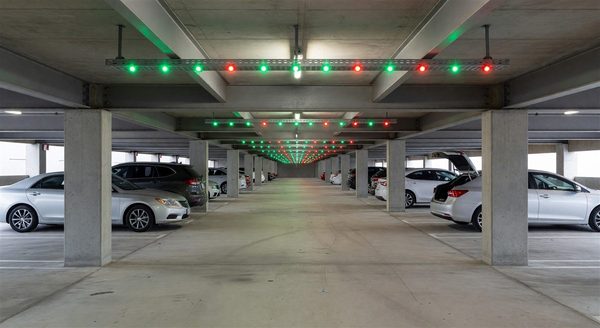
Reducing search-related congestion: Parking search — vehicles circulating to find available spaces — contributes to urban congestion. Real-time availability information that guides drivers to available parking reduces search time and the associated circulation traffic.
Improving curb efficiency: Ensuring that on-street parking spaces serve appropriate demand rather than being occupied by long-term parkers, delivery vehicles blocking parking spaces, or ride-hailing vehicles stopping in no-parking zones.
Generating revenue efficiency: Pricing public parking spaces to reflect demand — higher rates when demand is high, lower rates when demand is low — maximizes the revenue generated from the municipality’s public parking inventory.
Data integration with traffic management: Coordinating parking availability and pricing signals with traffic management tools (variable message signs, signal timing) to smooth traffic flow around high-demand parking areas.
Municipal Smart Parking Programs in Practice
San Francisco SFpark: The prototype for demand-responsive on-street parking in North America. Sensor-based occupancy monitoring of metered spaces, with price adjustments by block and time period to maintain target 80% occupancy. Academic evaluation confirmed reduced vehicle miles traveled in pilot areas. The program expanded citywide as a permanent SFpark program following the pilot.
Los Angeles LA Express Park: Similar architecture to SFpark — real-time occupancy sensors, demand-responsive meter pricing, integration with wayfinding apps. LA Express Park has faced implementation challenges related to sensor reliability and pricing algorithm configuration but represents one of the largest US deployments of demand-responsive metered parking.
Columbus, Ohio: Smart Columbus, funded by a federal Smart Cities Challenge grant, included parking as a component — integrated parking guidance, real-time availability publishing, and connected transportation data sharing as part of a broader urban mobility program.
Seattle: Seattle’s parking program has integrated real-time occupancy monitoring in high-demand neighborhoods, real-time availability through parking guidance apps, and time-of-day parking pricing adjustments.
European programs: Amsterdam, London, Stockholm, and other European cities have more advanced smart parking programs, partially due to denser transit infrastructure and more accepting regulatory environments for dynamic pricing. London’s Congestion Charge, while not parking-specific, demonstrates willingness to apply demand-responsive pricing to urban mobility access at scale.
Data Architecture for Smart City Parking
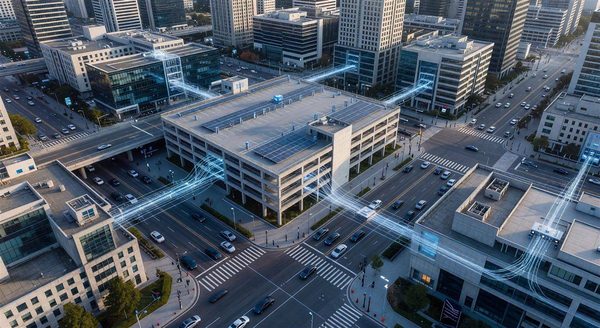
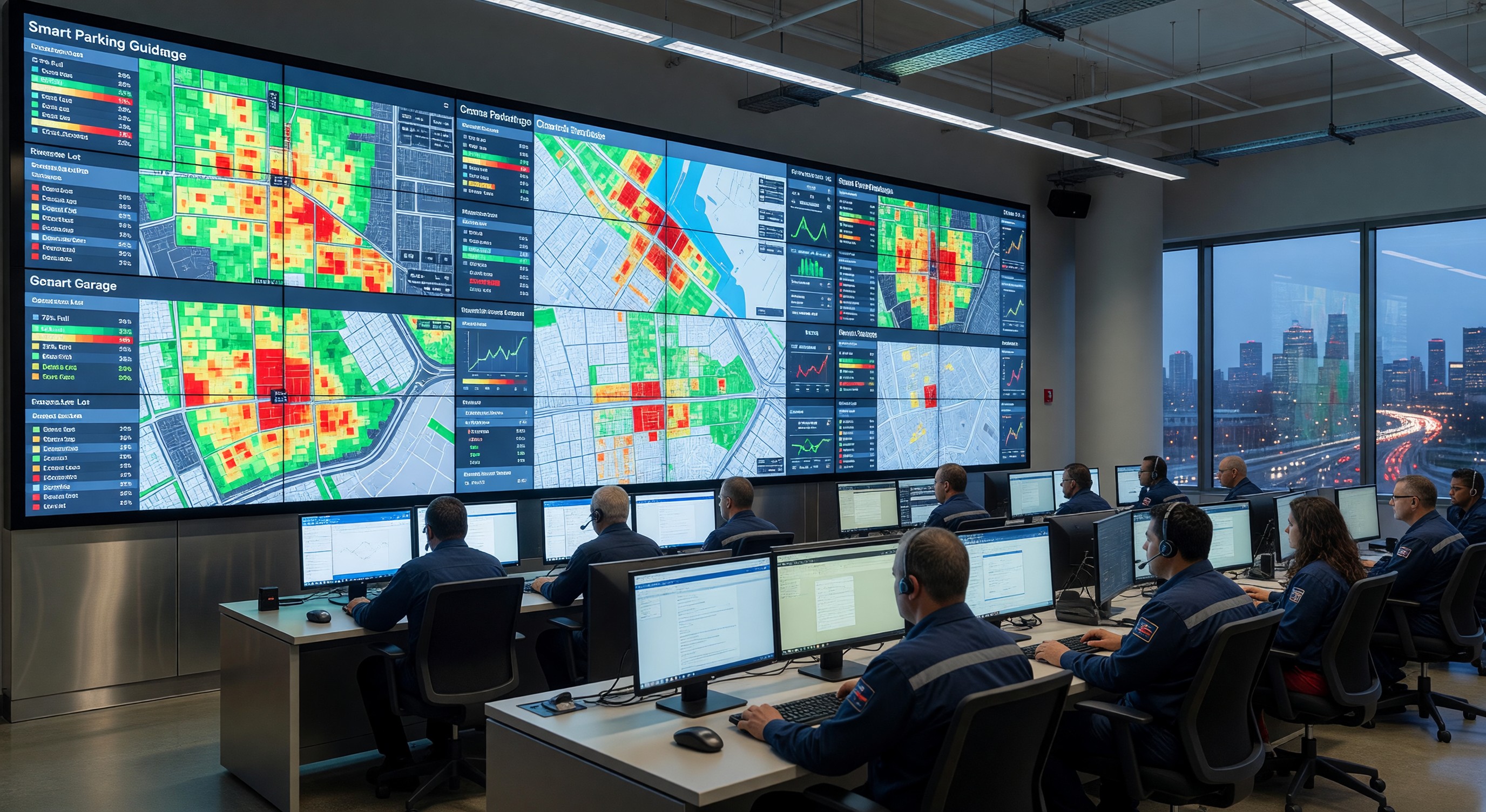
Public data platform: Smart city parking programs require a municipal data platform that aggregates occupancy data from city-owned meters, city-owned garages, and optionally private facilities that participate as data partners.
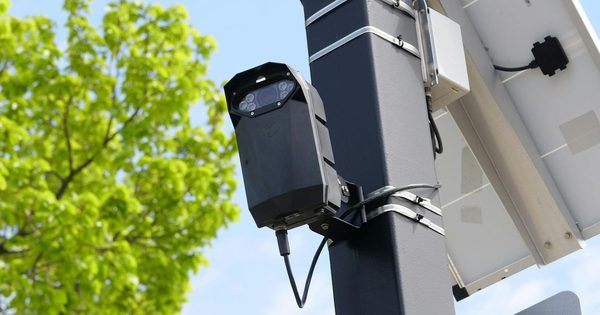
Sensor infrastructure: Real-time occupancy of on-street spaces requires either per-space sensors (in-ground magnetic or wireless above-ground) or camera-based occupancy detection. The cost and maintenance requirements of sensor infrastructure are major factors in municipal budget planning for smart parking.
API publishing: Aggregated real-time occupancy data must be published through APIs accessible to navigation apps, mobility platforms, and third-party developers who build consumer-facing applications using the data.
Traffic management integration: Parking availability data fed to the traffic management center enables variable message sign messages that direct traffic toward available parking before drivers enter congested areas. This integration requires both data and operational coordination between parking management and traffic management departments.
Lessons from Smart City Parking Programs
Data quality is foundational: Programs that launched with sensor networks that had inadequate accuracy have undermined driver trust in availability information. Inaccurate “available” indications that send drivers to full blocks erode adoption faster than any marketing program can rebuild it.
Pricing algorithm complexity: Demand-responsive pricing algorithms require careful calibration to avoid counterproductive results (prices rising too aggressively and reducing occupancy below optimal, or not rising enough to clear excess demand). SFpark’s success was partly attributable to conservative, stepwise pricing adjustments rather than large algorithmic swings.
Public and political acceptance: Demand-responsive pricing on public streets requires political support that is not universal. Several cities have encountered political resistance to “surge pricing” on metered parking, even when the economic rationale is clear. Program design that emphasizes lower prices in off-peak conditions alongside higher prices in peak conditions — framing dynamic pricing as “fair pricing” rather than “price gouging” — improves political sustainability.
Private facility data partnerships: Programs that can incorporate private facility availability alongside public facility data provide more complete guidance to drivers. Negotiating data sharing agreements with private operators involves both commercial and legal complexity but significantly improves the program’s spatial coverage.
Implications for Private Parking Operators
Data sharing as a public contribution: Parking operators whose facilities are adjacent to city-managed parking programs can benefit from being included in city-wide guidance systems while contributing occupancy data to municipal programs. The city’s guidance infrastructure drives visibility to the operator’s facility without requiring independent marketing investment.
Rate coordination: In markets where the city implements demand-responsive pricing on public streets, private operators who coordinate their rates with municipal pricing signals avoid the arbitrage problem (metered spaces near full at high prices, adjacent private facilities underutilized at low prices).
Program participation requirements: Some municipalities building smart parking programs require participating private facilities to provide real-time data and comply with data standards as a condition of operating permits or participating in city parking programs. Operators in cities with active smart city programs should monitor emerging requirements.
Frequently Asked Questions
What is the first step for a municipality considering a smart parking program? A parking utilization study and curb inventory — mapping all parking supply (on-street, off-street, public, and private) and measuring current utilization by location and time of day — provides the baseline data needed to identify where demand management technology would create the most value. This study also identifies where sensor investment is justified by demand variability.
How much do smart city parking programs cost to implement? Costs vary significantly by program scope. Per-space sensor networks cost $300 to $800 per sensor plus installation. Technology platform development or procurement, data infrastructure, and staff training add $500,000 to $2 million+ for a city-scale deployment. Federal smart city grants (USDOT, EDA) and state transportation funding have supported several municipal programs.
Do smart parking programs increase total parking revenue for municipalities? Programs that implement demand-responsive pricing typically increase meter revenue, because prices rise during high-demand periods when occupancy is high and meters are nearly full. SFpark SFMTA estimated revenue improvements in pilot areas. However, the revenue improvement must be evaluated against the infrastructure and operating cost of the program.
Can smart city parking data be used for purposes beyond parking management? Aggregate parking occupancy data provides proxy information about activity patterns in commercial districts — retail vitality, event attendance, work commute patterns. This data has planning value beyond parking management. Individual vehicle data from LPR or parking transaction records is more sensitive and use is governed by DPPA and state privacy law.
Takeaway
Smart city parking programs represent the application of data, connectivity, and demand-responsive management to parking at the urban scale. The most successful programs — SFpark is the benchmark — have demonstrated measurable reductions in search-related congestion, improved utilization of parking supply, and revenue improvement. The requirements for success are demanding: accurate real-time sensor data, calibrated pricing algorithms, strong data infrastructure, political support for dynamic pricing, and coordination between parking management and traffic management departments. Private parking operators in cities with smart parking programs have both opportunity (city-funded infrastructure that drives visibility) and potential obligation (data sharing requirements) to navigate in the evolving urban mobility landscape.
Further Reading from Authoritative Sources
- US DOT ITS program on smart city transportation technology and parking data standards — The US DOT ITS program develops connected transportation technology standards and smart city infrastructure guidance directly applicable to the data architecture, sensor integration, and API publishing requirements described for smart city parking programs in this article.
- NACTO urban street design guide for curb management and parking integration — NACTO’s urban street design guidance addresses curb management and on-street parking integration with multimodal transportation systems, directly relevant to the curb efficiency and traffic management coordination objectives described in smart city parking programs.