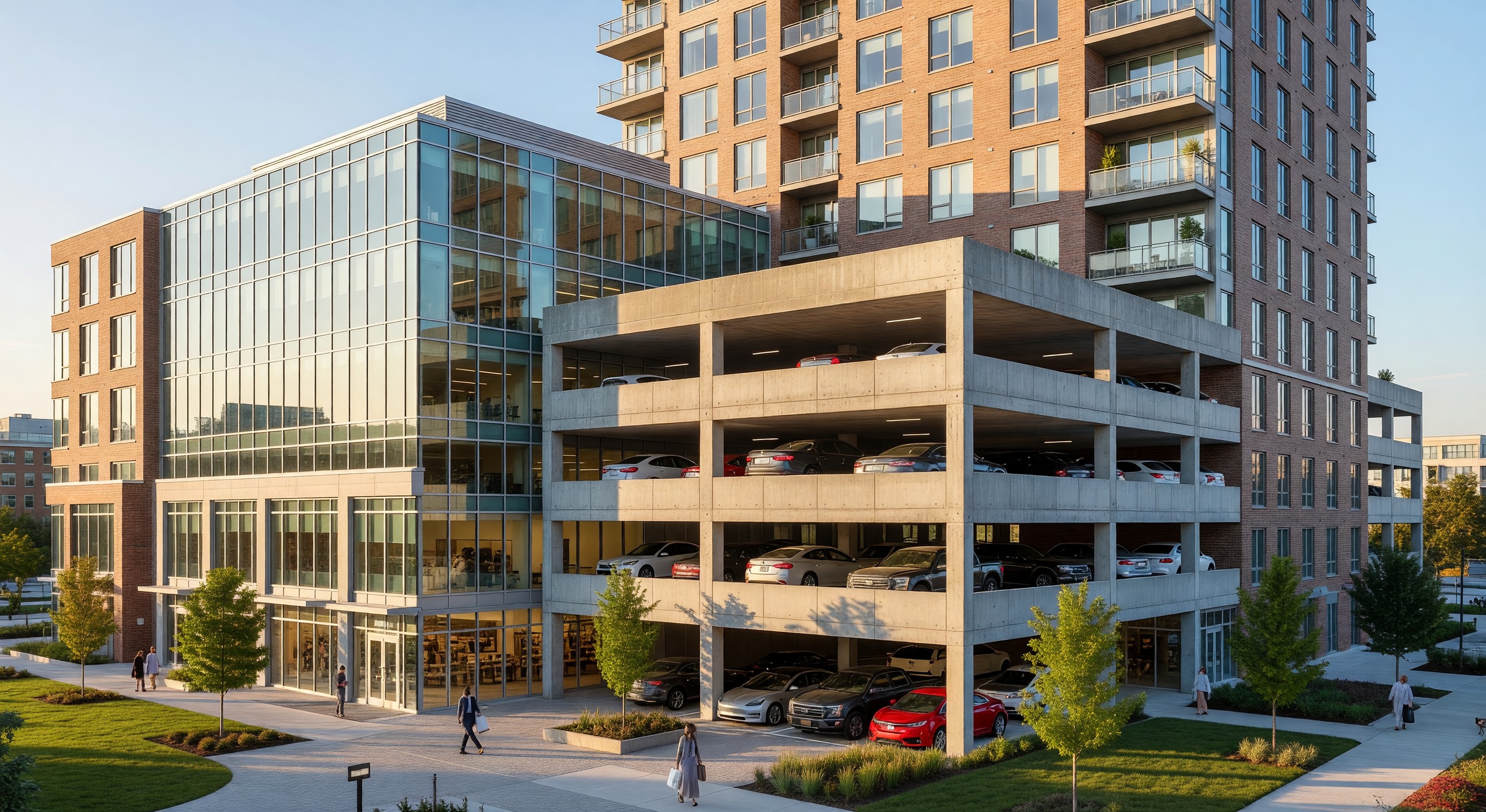
Shared parking — the practice of allowing multiple users or uses to share the same parking supply based on the temporal diversity of their parking demand — is one of the most effective strategies for improving parking efficiency in mixed-use environments. Office workers who leave by 5 PM free up spaces for evening restaurant and theater patrons. Church parking lots that fill on Sunday mornings are empty the rest of the week. Residential parking that is occupied at night is vacant during business hours. Shared parking programs formalize these temporal demand patterns into coordinated arrangements that reduce total parking supply needed while maintaining adequacy for all users.
The Shared Parking Concept
The fundamental insight of shared parking is that different land uses have different peak parking demand times. When these demand patterns are complementary — one use’s peak is another’s valley — the same physical parking spaces can serve both uses without conflict. The Urban Land Institute (ULI) has documented the shared parking methodology in its standard reference publication and provided the analytical framework that planners, developers, and parking operators use to quantify shared parking feasibility.
ULI Shared Parking Methodology: ULI’s shared parking analysis uses time-of-day, day-of-week, and seasonal demand profiles for each land use to estimate total parking demand for a mixed-use project at each hour of each day. The peak demand of the combined uses is the minimum supply required — typically significantly less than the sum of the individual use minimums because the peaks don’t coincide.
For example, a mixed-use development with 200,000 sq ft of office, 50,000 sq ft of retail, and 200 residential units might have an individual use minimum of 450 spaces, but a shared parking analysis that identifies complementary peak times might find that 300 to 350 spaces adequately serve all three uses.
Types of Shared Parking Arrangements
Shared parking by design: Mixed-use developments designed from the outset with a shared parking facility serving all uses. The developer builds or finances a single parking facility with the shared supply rather than individual parking for each use. ULI shared parking analysis is the standard tool for determining adequacy.
Cross-easement agreements: Separate property owners agree to allow each other’s customers, tenants, or employees to use each other’s parking facilities. Common between adjacent retail, office, and restaurant properties where peak demands are complementary.
Off-site parking agreements: A parking facility physically separated from a land use enters a parking agreement to serve that use’s demand. Common for downtown commercial districts where a shared parking structure serves multiple businesses within walking distance.
Church and institutional lot sharing: Religious institution and school parking facilities — heavily used on specific days and times, underused otherwise — are natural candidates for sharing with adjacent businesses or residential uses during non-peak institutional periods.
Employee vs. customer sharing: A single facility designates different sections for employee permit parking (occupied primarily during work hours) and customer transient parking (higher turnover during shopping hours). This design-level sharing optimizes use of the full facility.
Technology Platforms for Dynamic Sharing
Technology platforms have enabled more sophisticated and dynamic sharing arrangements than traditional fixed-agreement models:
ParkHub, Spot, and similar platforms: Platforms that allow facility operators to publish available inventory in real time and allow individuals or businesses to book unused capacity on demand. A stadium parking lot that is empty 90 percent of the year can monetize that unused capacity through these platforms for commuters, events at other venues, and residential overflow parking.
Corporate parking exchanges: Companies have developed internal platforms for sharing employee parking — employees who will be out of the office can release their reserved space for the day, and colleagues with visitors can claim it. This reduces peak demand pressure without requiring additional parking supply.
Municipal shared parking programs: Some cities operate or facilitate cross-property shared parking arrangements through district-level parking programs — managing shared supply across multiple owners in downtown cores to maximize utilization.
Regulatory Considerations
Zoning code recognition: Many zoning codes allow shared parking credits — reducing the minimum parking required for a development if an agreement with an adjacent facility can provide the complementary supply. The zoning code’s shared parking provisions specify what documentation is required, what temporal complementarity must be demonstrated, and what proximity restrictions apply.
Shared parking agreements: Cross-easement and off-site parking agreements require legal documentation that specifies: the spaces available for sharing, the times and conditions of access, the duration of the agreement, how disputes are resolved, and what happens if either property changes use or the agreement is terminated.
Insurance and liability: Shared parking arrangements create questions about liability for incidents (accidents, theft, injury) that occur on each property. Insurance requirements for shared arrangements should be addressed in the shared parking agreement.
ADA compliance: Accessible parking spaces must be provided at each primary building entrance. Shared parking arrangements must ensure that accessible spaces are available at appropriate distances for each use served by the shared facility, even if the total accessible space count is shared.
Economic Benefits of Shared Parking
Reduced construction cost: Fewer total spaces needed means lower construction and land cost for mixed-use development. ULI research has found that shared parking arrangements typically reduce the parking supply required by 20 to 40 percent for complementary mixed uses.
Improved utilization: Shared facilities serving multiple uses have higher average utilization than dedicated single-use facilities — the demand is distributed across more hours of the day.
Revenue for underutilized facilities: Facilities with significant off-peak vacancy can generate additional revenue by sharing capacity with adjacent uses during previously idle periods.
Parking district economics: At the district level, shared parking enables more efficient use of total parking supply, allowing development of more businesses and residences without proportional expansion of parking supply.
Frequently Asked Questions
What is the ULI Shared Parking Standard? The Urban Land Institute publishes “Shared Parking” (3rd edition, 2020) as the standard reference for shared parking analysis. The publication includes demand profiles by land use type and provides the analytical methodology for estimating combined peak demand and minimum shared supply requirements. It is widely referenced by planners, developers, and parking consultants.
What land use pairs are most suitable for shared parking? Highly complementary land use pairs for shared parking include: office + evening restaurant/entertainment (complementary daily peaks), office + residential (complementary morning/evening occupation), retail + office (complementary evening/daytime demand), and church + commercial (complementary weekend/weekday demand). Less complementary pairs (two retail uses with simultaneous peak demand) provide limited sharing benefit.
How do shared parking agreements handle one party’s peak exceeding the shared supply? Shared parking analysis is designed to identify the peak of combined demand, which should be within the shared supply capacity. In practice, agreements specify priority access rights (which use has first claim to spaces during high-demand periods), overflow procedures (what happens when peak demand exceeds supply), and monitoring procedures to identify if usage patterns have shifted from the original analysis assumptions.
Can shared parking arrangements be modified as uses change? Yes, but the original shared parking analysis may no longer be valid if land uses change. Any material change in the type, size, or hours of operation of uses served by a shared parking arrangement should trigger a new shared parking analysis to confirm continued adequacy. Zoning code shared parking credits tied to specific land use assumptions may require re-evaluation if uses change.
Takeaway
Shared parking is one of the most powerful tools available for improving parking efficiency in mixed-use environments — reducing total supply required, improving utilization, and enabling more compact, walkable development. The methodology is well-established through ULI’s shared parking analysis framework; the legal structures (cross-easements, off-site agreements) are documented and routinely implemented; and technology platforms now enable more dynamic sharing than traditional fixed-agreement models. For parking operators, shared parking represents both a demand management strategy (using temporal diversity to serve more users from a fixed supply) and a revenue opportunity (monetizing unused capacity that would otherwise sit idle during off-peak periods).
Further Reading from Authoritative Sources
- TRB shared parking research and mixed-use parking demand methodology — TRB publishes peer-reviewed research on shared parking demand methodology, mixed-use parking analysis, and parking efficiency in urban environments that provides the empirical foundation for the demand complementarity analysis described in this article.
- IPMI shared parking program guidance and mixed-use parking strategy resources — IPMI publishes shared parking program guidance, technology platform assessments, and mixed-use parking strategy resources for parking operators and developers.