The widespread adoption of remote and hybrid work arrangements beginning in 2020 — and their persistence as a permanent feature of knowledge-economy employment — has materially changed parking demand patterns in urban commercial markets. Monthly commuter parking programs that were near-capacity before 2020 have experienced significant account attrition; weekday transient demand patterns have shifted from Monday-Friday consistency to a three-to-four-day core week with lighter Monday and Friday demand. Understanding these demand shifts, their likely permanence, and how parking operators are adapting informs both operational decision-making and longer-term asset investment considerations.
The Magnitude of the Demand Shift
CBRE, JLL, and the National Parking Association have tracked office parking demand since the pandemic period. The findings are consistent across studies:
Monthly permit attrition: Downtown commercial parking facilities serving primarily office commuters experienced 20 to 40 percent monthly permit cancellations between 2020 and 2022. As office buildings reopened and hybrid schedules stabilized, some attrition was recovered — but not fully. Most operators in downtown commercial markets report monthly permit populations at 75 to 90 percent of 2019 levels by 2024-2025 in markets that returned to meaningful office presence.
Day-of-week demand reshaping: Pre-2020, downtown parking occupancy on weekdays was relatively consistent Monday through Friday, with Fridays slightly lower. Post-2020, occupancy has become significantly more variable by day — Tuesday, Wednesday, and Thursday are typically the highest demand days as employers concentrate their in-office expectations in the midweek period. Mondays and Fridays are often 15 to 30 percent lower occupancy than peak midweek.
Peak hour concentration: When employees are in the office, they tend to arrive and depart in more concentrated windows than before — the 9-to-5 structure remains even on hybrid days, creating similar peak demand patterns over fewer total days.
Market heterogeneity: The demand shift has been most significant in markets with high knowledge-economy employment (San Francisco, Seattle, New York, Washington D.C., Austin) and less significant in markets with more service and manufacturing employment. Regional differences are substantial.
Monthly Parker Program Impacts
Monthly parking programs — which provide predictable revenue as a base for commercial parking operations — have been the most directly affected segment:
Account attrition: Employees who shifted to fully remote work cancelled monthly permits that were no longer needed. Employees on hybrid schedules often chose not to maintain a monthly permit when they commute only 2 to 3 days per week, finding that transient parking on in-office days is more economical than a monthly permit they don’t use fully.
Permit type evolution: The demand shift has created interest in flexible permit products that didn’t exist at scale before 2020:
- Shared monthly permits: Two employees share one monthly permit (designated as a “remote-day” shared product), with the understanding that only one will be in the office on a given day
- Day pass products: 10-visit, 20-visit, or calendar-month-with-daily-cap products that accommodate intermittent rather than daily commuting
- Flexible monthly agreements: Monthly permits with the ability to pause during vacation, remote work weeks, or other planned absences
Revenue per account impact: Hybrid commuters who do maintain monthly permits often negotiate or choose lower-tier permit types (farther from the building, without reserved space guarantee) that carry lower rates, reducing revenue per account even when the account is maintained.
Transient Demand Pattern Shifts
Transient parking — pay-per-use without a permit — has partially offset monthly permit attrition in some facilities:
Hybrid employees as transient parkers: Employees who cancelled monthly permits and commute 2 to 3 days per week often become transient parking customers on their in-office days. This shifts revenue from predictable monthly income to variable transient income — lower revenue certainty, potentially higher revenue per transaction (transient rates are often higher than allocated monthly permit rates), and more demand variability.
Midweek transient peaks: In markets with significant hybrid work adoption, Tuesday through Thursday transient parking demand has increased relative to Monday and Friday — tracking the in-office day concentration. Facilities can optimize pricing and staffing around this pattern.
Leisure and hospitality demand resilience: Downtown parking facilities that serve a mix of office commuters, retail, restaurant, and entertainment customers have seen some demand resilience as leisure and hospitality parking has recovered strongly. Facilities with purely office-serving locations have less demand diversification available.
Operational Adaptation Strategies
Flexible permit product development: Facilities most affected by monthly permit attrition have developed hybrid-friendly permit products to reduce the attrition among employees who still commute intermittently. Shared permit programs and day pass products retain customers who would otherwise cancel entirely.
Rate strategy adjustment: Facilities with reduced monthly permit demand that are running higher transient occupancy are experimenting with rate structures that optimize transient revenue. In some markets, reduced monthly permit demand has allowed transient rates to increase (less competition for spaces from permit holders).
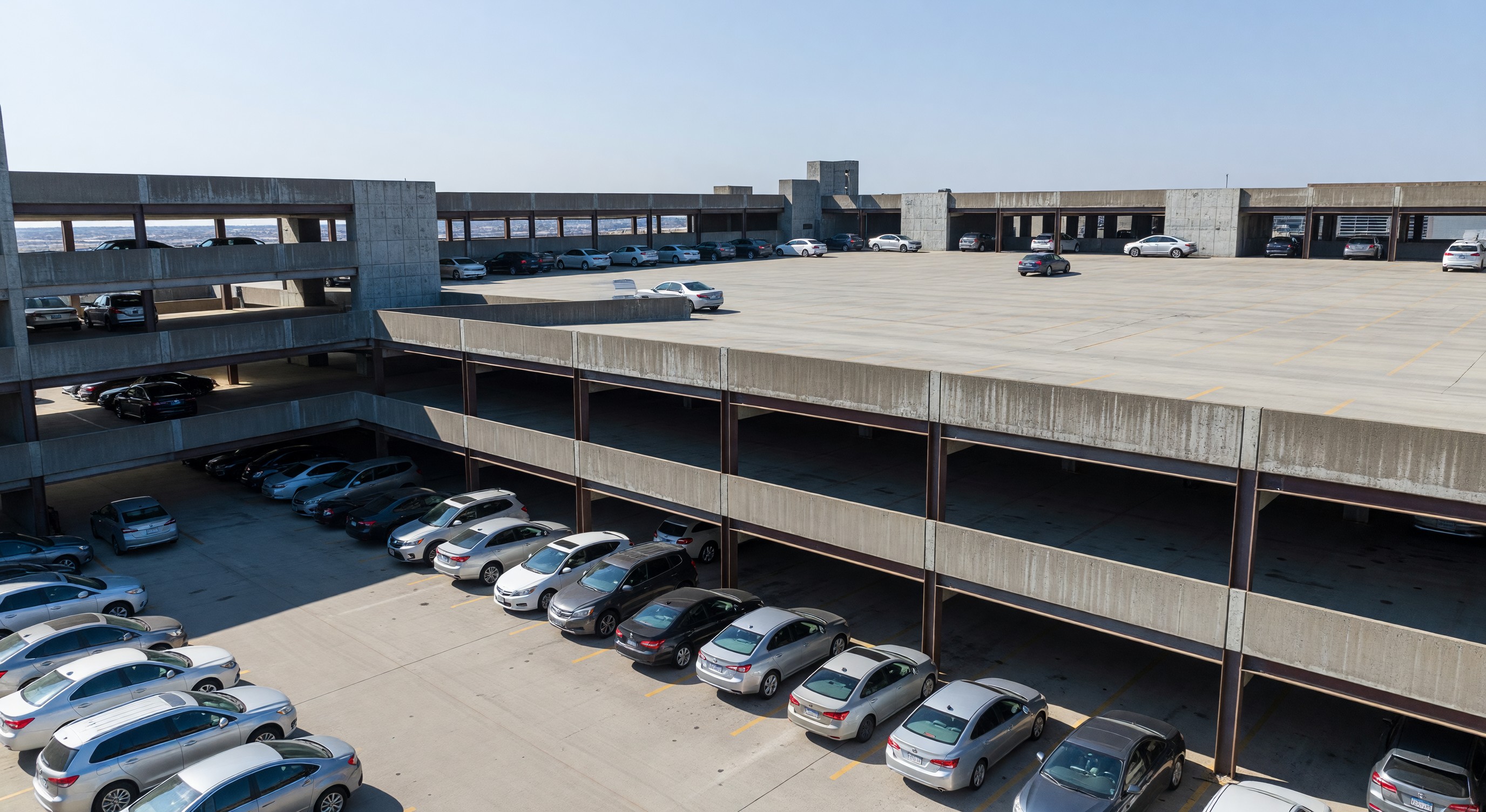
Physical reconfiguration: Some urban parking facilities have reduced their effective parking capacity by repurposing lower-demand floors for storage, micro-fulfillment (urban last-mile delivery), or temporary non-parking uses while maintaining surface-level parking for the reduced demand. This occupancy management approach maintains revenue per space while avoiding the fixed cost of maintaining a fully-open underutilized facility.
Rightsizing staffing models: Attended facilities with reduced Monday and Friday demand can adjust staffing to match actual traffic patterns — reducing staffing on low-demand days and concentrating it on peak midweek periods.
Long-Term Demand Outlook
The critical question for parking asset investment is how permanent the hybrid work-driven demand reduction is:
Hybrid work durability: Employment research from Stanford (Nicholas Bloom), McKinsey, and others consistently finds that hybrid work arrangements are durable — both employees and employers have found value in flexibility, and employer mandates to return to 5-day in-office attendance face significant employee resistance. Most projections see hybrid work as a permanent feature of knowledge-economy employment.
Office leasing implications: Reduced utilization of office space is driving office lease downsizing in many markets — companies occupying less total office space per employee. Less office space reduces total office employment density and therefore the potential parking demand from the adjacent office population.
Recovery limits: Parking demand is unlikely to return to pre-2020 levels in heavily knowledge-economy markets as long as hybrid work remains prevalent. The range of analyst projections for stabilized demand in affected markets centers on 80 to 90 percent of 2019 monthly permit levels, with full return possible only if hybrid work arrangements reverse substantially.
Frequently Asked Questions
How should parking operators reprice monthly permits given reduced demand? The counterintuitive advice is to resist significant price reductions to retain marginal accounts. Monthly permit attrition from hybrid work reflects a structural demand shift, not price sensitivity — employees on hybrid schedules who cancelled permits did so because a monthly permit no longer made economic sense for their commute frequency, not because the price was too high. Price reductions that retain a marginal account at below-market rates reduce revenue without recovering meaningful demand. Instead, develop flexible permit products that match the actual commute behavior of hybrid workers.
What percentage of downtown parking demand decline is attributable to remote work vs. other factors? Isolating remote work as a demand factor is methodologically complex. CBRE research attributes 60 to 70 percent of post-2020 urban parking demand decline to reduced office occupancy from hybrid work, with the balance from transit recovery, rideshare shift, and other factors. The proportions vary significantly by market.
Are there markets where parking demand has fully recovered from 2020 levels? Sun Belt markets with lower knowledge-economy employment concentration (Nashville, Dallas, Miami, Phoenix) have seen stronger parking demand recovery than tech-heavy markets (San Francisco, Seattle) where hybrid work adoption was highest. Some sun belt downtown markets have exceeded 2019 parking revenue levels by 2024-2025 driven by population growth and development activity.
What parking product innovation has emerged to serve hybrid workers? The most significant product innovation is the shared monthly permit — two hybrid employees share one parking space, with the implicit understanding that their in-office schedules do not fully overlap. Some facilities manage shared permits formally (designating sharing partners who coordinate schedules); others sell permits informally at a reduced rate with the expectation of partial usage. Day pass and punch card products have also grown as flexible alternatives.
Takeaway
Remote and hybrid work have permanently altered parking demand patterns in urban commercial markets — a structural shift that differentiates between demand that will return as offices reopen and demand that has structurally declined because fewer daily round-trips are made. Operators in affected markets who adapt through flexible permit product development, transient revenue optimization, and staffing adjustments matched to actual demand patterns will outperform those who wait for a full return to pre-2020 demand levels that may not occur in the same form. The parking operators best positioned for this environment are those with demand diversification beyond office commuters — retail, entertainment, medical, and residential parking demand provides the buffer that pure office parking operations lack in a hybrid work environment.
Further Reading from Authoritative Sources
- IPMI parking demand adaptation resources for hybrid work market conditions — IPMI provides parking operations guidance and market intelligence that helps operators adapt their permit programs and revenue strategies to structural demand changes from hybrid work — directly supporting the flexible permit product development and demand adaptation strategies described in this article.
- US DOT transportation performance management for parking demand trend analysis — The US DOT transportation performance management framework provides the measurement methodology applicable to parking demand trend analysis and REVPASH tracking that informs operational adaptation to hybrid work demand patterns described in this article.