Residential parking unbundling — separating the cost of parking from the rent or purchase price of a housing unit so that residents who don’t need parking can opt out — is a transportation demand management strategy with significant implications for vehicle ownership rates, housing affordability, and parking facility revenue models. The practice has expanded from university and transit-rich urban contexts into broader multifamily housing markets as parking minimum reform, rising construction costs, and interest in sustainable transportation have made bundled parking increasingly questioned.
What Is Parking Unbundling
In most conventional residential development, a parking space is bundled into the unit rent or purchase price — the tenant or buyer pays for the parking whether or not they use it. A studio apartment in a building that provides one parking space per unit is priced to cover the parking cost regardless of whether the renter owns a car.
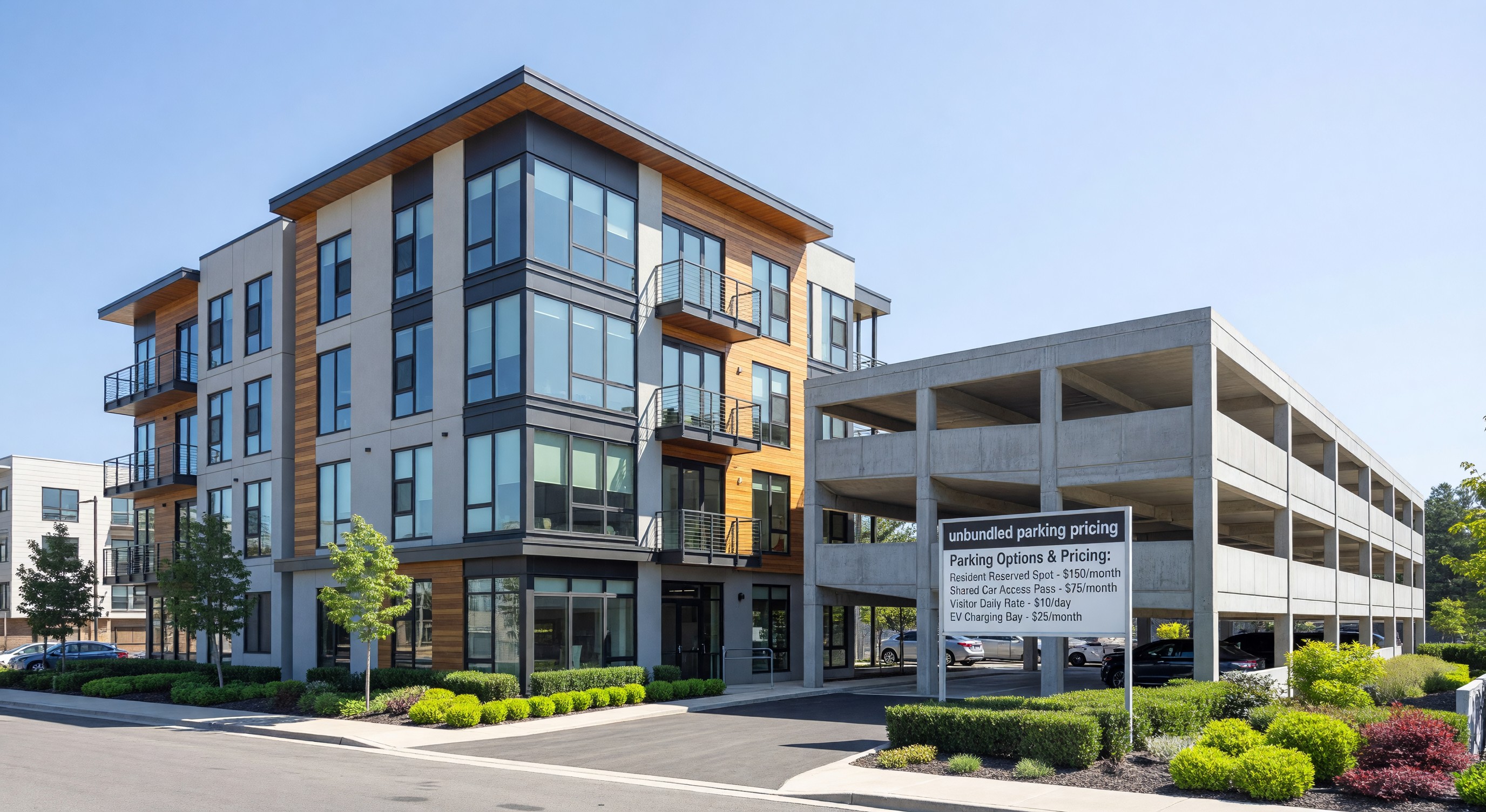
Unbundling separates these costs: the apartment is priced at the cost of the apartment alone; parking is priced and leased separately on an optional basis. A resident without a car pays only for the apartment; a resident with one car pays for the apartment plus one parking space; a resident with two cars pays for two spaces.
This seemingly simple change has significant behavioral and economic effects.
Evidence for Vehicle Ownership Effects
The most-studied effect of parking unbundling is its impact on vehicle ownership rates among residents:
UCLA study (Litman, Chatman): Research in transit-oriented Los Angeles neighborhoods found that residents of buildings with unbundled parking owned significantly fewer cars than residents of buildings with bundled parking at the same price points. The price signal of optional parking (versus free bundled parking) changes the calculus of vehicle ownership.
Portland research: Studies of Portland multifamily buildings near transit found that unbundled parking is associated with reduced vehicle ownership and higher transit use compared to otherwise-similar buildings with bundled parking.
Berkeley study: Research in Berkeley transit-accessible neighborhoods found that unbundled parking was associated with lower vehicle ownership rates (approximately 0.2 fewer vehicles per household) compared to bundled parking buildings.
The mechanism is straightforward: bundled parking makes the marginal cost of owning a vehicle lower by hiding the parking cost in the rent. Unbundled parking makes parking cost visible, creating a real financial incentive to not own a vehicle (or to own fewer vehicles) for residents who don’t need them.
Housing Affordability Implications
Parking unbundling affects housing affordability through several mechanisms:
Direct rent reduction: When parking is unbundled, the base unit rent reflects only the housing cost — not the parking cost. For residents without vehicles, this is a direct cost reduction. The magnitude depends on the market parking rate; at $150 to $300/month for structured parking, unbundling produces meaningful rent reductions for car-free residents.
Enabling lower-cost parking-free housing: Building developers who are not required to provide parking (in markets with parking minimum reform) can build housing without parking and price units lower than if parking were included. The housing is lower cost because a large capital expense (structured parking) has been eliminated.
Equity implications: Lower-income households are more likely to be car-free or single-car households. Bundled parking effectively requires them to subsidize parking for car-owning neighbors through higher shared rents. Unbundling eliminates this cross-subsidy.
Affordability housing development: Affordable housing developers face constraints that make required parking one of the most significant cost barriers to project feasibility. Parking minimum reform and/or unbundling programs that allow developers to provide less parking on affordable projects have been associated with more affordable housing development in constrained markets.
Parking Operator and Revenue Model Implications
New third-party parking demand: Residents in unbundled buildings who own vehicles need parking. Where buildings are near third-party parking facilities, this creates demand for nearby commercial parking that previously would have been captured by the building’s bundled program.
Revenue from optional parking programs: Buildings with unbundled parking that manage their own parking facility earn revenue from optional parking sales — a cleaner revenue model than subsidized bundled parking whose cost is obscured in base rent.
Utilization improvement: Bundled parking programs often have low utilization because some bundled units are occupied by car-free residents whose space sits empty. Unbundled programs where only car-owning residents rent spaces have higher utilization of each space provided.
Pricing sophistication: Unbundled parking programs can price spaces at market rates by type (surface vs. structured, reserved vs. unreserved, EV charging included) — creating a revenue optimization opportunity that bundled programs where every unit gets the same space cannot achieve.
Implementation Challenges
Existing tenants with bundled expectations: Converting a bundled program to unbundled for existing tenants who moved in expecting bundled parking at the bundled price requires careful transition management — and in some jurisdictions, may be constrained by lease terms or rent control provisions.
Perception and marketing: Some prospective tenants view unbundled parking as a “fee” rather than an optional cost reduction. Marketing unbundled parking as an option to pay less if you don’t own a car rather than as an additional charge for parking reframes the value proposition accurately.
Parking access rights in HOA documents: For condominium developments, parking rights are often embedded in governing documents that establish bundled parking as a right of ownership. Converting these structures to unbundled programs requires legal work and owner approval.
Financing implications: Some lenders underwrite multifamily loans based on assumptions that include parking in the unit count or NOI calculation. Unbundled parking requires clear financial modeling that shows parking revenue as a distinct income stream.
Frequently Asked Questions
Is residential parking unbundling required anywhere by law? Several cities have enacted policies that encourage or require parking unbundling in new development, particularly near transit. California’s AB 2097 encourages unbundling in transit-adjacent development. Some transit agencies require unbundling as a condition of transit-oriented development subsidies or land sales. Mandatory statewide unbundling is not widespread, but policy interest is growing.
Does parking unbundling work in car-dependent suburbs? The evidence for vehicle ownership effects of unbundling is strongest in transit-accessible urban neighborhoods where car-free living is a viable choice. In car-dependent suburban environments where transit is inadequate and destinations are not walkable or bikeable, vehicle ownership rates may be less responsive to parking pricing because residents have no realistic alternative. Unbundling in car-dependent environments may reduce vehicle ownership at the margin while being less transformative than in transit-rich locations.
How does unbundling affect the net operating income of an apartment building? For buildings with excess parking capacity, unbundling that converts bundled cost to optional parking revenue may reduce effective parking revenue if some residents opt out. For buildings where parking demand is close to supply, optional parking at market rates may produce similar total revenue with cleaner attribution. The net financial effect depends on the specific building’s parking utilization and the market rate for optional parking vs. the embedded parking cost in bundled rents.
What is the relationship between parking unbundling and parking minimum reform? They are complementary policies. Parking minimum reform allows developers to provide less parking when demand doesn’t justify it. Parking unbundling changes the pricing and incentive structure for whatever parking is provided, making parking costs visible and optional rather than hidden in rent. Together, they reduce the total cost burden of parking on housing development and on individual households.
Takeaway
Parking unbundling is a market-based policy tool that makes parking cost visible and optional, changing the vehicle ownership calculus for households who don’t need a car while maintaining access for those who do. The evidence from deployed programs consistently shows reduced vehicle ownership among residents of unbundled buildings compared to otherwise similar bundled buildings — a meaningful transportation demand management outcome achieved through pricing transparency rather than prohibition. For parking operators, unbundled residential programs near their facilities create new third-party demand; for developers and municipalities interested in housing affordability and sustainable transportation, unbundling is increasingly recognized as part of the policy toolkit alongside transit investment and parking minimum reform.
Further Reading from Authoritative Sources
- Transportation Research Board residential parking unbundling research — The Transportation Research Board has published research synthesizing the UCLA, Portland, and Berkeley unbundling studies and broader evidence on unbundling effects, providing the primary evidence base for the claims in the article.
- NACTO residential parking policy and urban housing transportation guidance — NACTO publishes urban transportation and housing policy guidance that supports residential parking reform as part of a broader transit-oriented development and vehicle ownership reduction strategy relevant to the article.