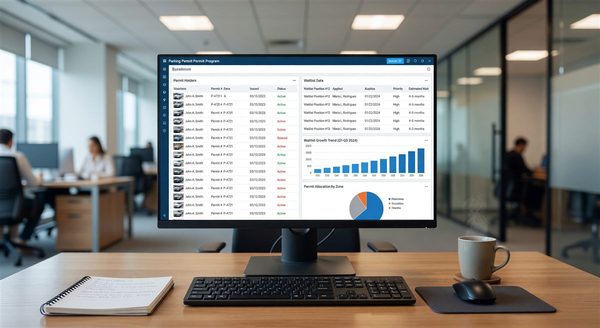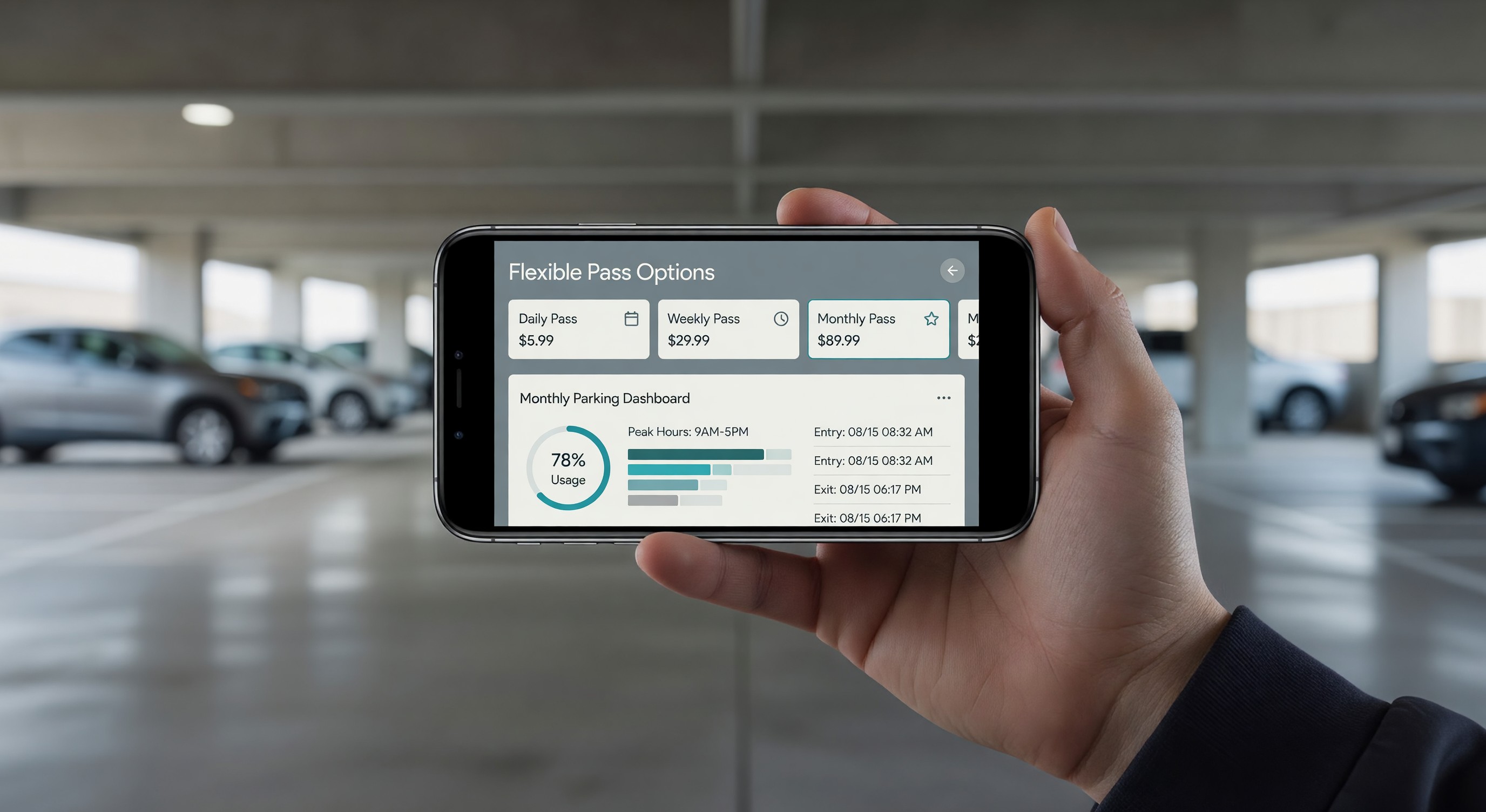
Monthly parking permits — a fixed monthly fee for a dedicated or guaranteed space — have been the foundational recurring revenue product in commercial parking for decades. The hybrid work environment and changing commuter patterns that emerged from the 2020 pandemic disrupted the traditional monthly permit model: parkers who visit downtown offices two or three days per week can no longer justify a full monthly permit designed for daily commuting. In response, parking operators have developed flexible subscription products — flex passes, day bundles, partial-week subscriptions — that match parking access to actual usage patterns. Understanding the economics, design, and management of parking subscription models is increasingly important as operator revenue mixes shift away from the traditional daily-commuter monthly permit.
The Traditional Monthly Permit Model
Monthly permits in their traditional form offer a fixed fee for unlimited access during a defined period (calendar month), typically at a significant discount to the equivalent number of daily transient visits. The economics work for both sides when usage is high:
Operator economics: Monthly permits provide predictable, pre-paid revenue. A 500-space garage with 60% monthly permit occupancy generates $300 per space per month × 300 permits = $90,000 monthly before variable revenue — revenue that is locked in at the start of each month regardless of daily demand fluctuations.
Parker economics: A full-time commuter who visits 20 days per month at $20 daily would pay $400 transient but pays $150 to $250 monthly — a significant savings that makes the monthly permit economically rational for daily use.
Occupancy risk for operator: If monthly permit holders do not show up on a given day, the reserved space sits empty with no revenue upside. Operators who oversell monthly permits (selling more permits than spaces, banking on no-shows) can face capacity conflicts on days when occupancy is higher than expected.
The Hybrid Work Disruption
The shift to hybrid work patterns — widespread among knowledge workers in the professional services, technology, and financial sectors that historically dominated downtown monthly parking — fractured the traditional monthly permit value proposition:
Usage pattern change: A parker who commutes Monday, Tuesday, and Thursday generates approximately 12 to 13 visits per month. At $20 daily, their transient cost is $240 to $260. A monthly permit at $200 remains economically rational, but marginally — a price increase or a change in work schedule can tip the calculation.
Monthly permit churn: Monthly permit programs saw significant churn as hybrid work became normalized. SP+ and other national operators reported 15 to 30 percent declines in monthly permit occupancy in heavily office-dependent downtown facilities in 2021 and 2022, with partial recovery since.
Demand for flexible products: Parkers who commute irregularly need a product that is cheaper than daily transient but doesn’t require the monthly commitment that their usage pattern can’t justify. Operators who created flexible products captured some of this demand; those who only offered full monthly permits lost it to daily transient (lower margin) or to competing facilities.
Flexible Subscription Product Designs
Several flexible subscription designs have emerged to address hybrid work patterns:
Day bundle packs: A pre-purchased package of parking days (10-day pack, 20-day pack) at a discount to single-day rates. The parker pays upfront for a block of visits and uses them over a defined period (30 or 60 days). The operator receives upfront revenue and discounts the rate for volume commitment.
Partial-week monthly passes: A monthly subscription for access on specific days (Monday/Wednesday/Friday pass, two-day-per-week pass) priced proportionally to the monthly full-access rate. This retains the monthly commitment structure while matching the price to actual use frequency.
Flex point subscriptions: A monthly subscription that provides a number of “parking points” usable on any visit during the month, with points deducted per visit. Unused points may or may not roll over. This model resembles cell phone minute plans and creates a floor on revenue (subscription fee) with optional incremental usage.
Reserved vs. unreserved subscription tiers: Reserved parking subscriptions guarantee a specific space or guaranteed availability in a specific section; unreserved subscriptions provide access at a lower price but with no availability guarantee during peak periods. Tiered subscription products capture parker willingness to pay for reliability.
Subscription Economics and Margin Analysis
Revenue per effective use: Flexible subscription products typically generate lower revenue per actual visit than transient pricing but higher margin than traditional monthly permits if churn is reduced. The key metric is lifetime value (LTV) of a subscription customer compared to a transient customer — a subscription customer with 24-month retention at $150/month generates $3,600 LTV; a transient customer at $20/visit over the same period (assuming same visit frequency) generates similar nominal revenue but with higher administrative cost per transaction.
Churn economics: Monthly permit programs historically had low churn because the cost of changing (selecting a new facility, updating access credentials) was meaningful. Digital subscription platforms with easy sign-up and cancellation have lower switching costs — operators must actively manage churn through pricing, service quality, and retention programs.
Margin impact of flex products: Flex products that reduce utilization predictability can complicate capacity management. If a monthly permit holder predictably arrives at 8:15 AM, their space can be managed in the aggregate with confidence. If 200 flex pass holders each have uncertain visit days, capacity planning is more complex — the operator may need a larger buffer of unsold inventory to guarantee availability for flex pass holders.
Managing Subscription Programs Digitally
CRM and subscription management: Digital subscription programs require CRM infrastructure — customer accounts, payment automation, renewal management, usage tracking, churn analytics. Operators without this infrastructure either cannot offer subscription products effectively or rely on operator platforms (ParkWhiz/Arrive, SpotHero for Business, Parking.com) that provide the subscription infrastructure in exchange for revenue share.
Mobile app integration: Subscription programs are most effective when integrated with a mobile application that provides seamless access (mobile credentialing, LPR-based entry) without requiring physical permits. The mobile experience — particularly reliable access at entry and exit — is a primary driver of subscription satisfaction and retention.
Analytics: Subscription programs generate data that enables demand forecasting, churn prediction, and capacity optimization. Operators who analyze usage patterns across their subscription customer base can optimize pricing, identify at-risk churners for retention intervention, and calibrate oversell ratios for unreserved subscription products.
Frequently Asked Questions
What is the appropriate discount from transient rates for monthly parking subscriptions? Industry practice varies by market, but monthly permits typically provide a 30 to 50 percent discount relative to the equivalent number of daily transient visits. Partial-week and day-bundle products typically offer 15 to 30 percent discounts — less than full monthly discounts because the commitment is shorter and the operator assumes more demand uncertainty. The appropriate discount reflects the value of the revenue certainty the subscription provides to the operator.
Should operators build their own subscription platform or use third-party platforms? Operators with scale — multiple facilities, thousands of monthly customers — can justify building proprietary subscription management platforms that capture customer data, avoid revenue share, and enable tighter CRM integration. Smaller operators typically benefit from using third-party platforms (SpotHero for Business, Ace Parking’s digital programs, or PARCS-integrated subscription modules) that provide the infrastructure without capital investment. The platform decision should consider the strategic value of customer data ownership against the cost and complexity of proprietary platform development.
How do subscription programs affect transient revenue? Subscription programs and transient revenue are partially in competition — a subscription customer who would otherwise park transient is captured revenue that previously would have been generated through transient pricing. If subscription pricing is calibrated correctly (not so discounted that it erodes revenue relative to the transient alternative), the predictability and retention value of subscription revenue offsets any transient displacement. Operators in competitive markets may find that subscription programs are necessary for customer retention even if they produce slightly lower revenue per effective visit than transient pricing.
What churn rate is acceptable for parking subscription programs? Monthly churn of 3 to 6 percent (implying average customer life of 14 to 33 months) is typical for parking subscription programs. Programs with higher churn typically have either pricing problems (customers are not getting sufficient value at current pricing), access reliability problems (failed entries or exits creating negative experiences), or customer service problems. Monitoring churn monthly by customer segment identifies whether churn is driven by price sensitivity, service failure, or external factors (job changes, commute pattern changes) that are outside operator control.
Takeaway
Parking subscription models are evolving from the traditional monthly permit toward flexible products that match hybrid work and variable commute patterns, requiring operators to develop new product designs, digital infrastructure, and churn management capabilities. The operators who navigate this transition successfully will maintain recurring revenue bases that would otherwise fragment into lower-margin transient demand — capturing the predictability benefit of subscription revenue while accommodating the flexibility that contemporary commuter patterns require. The fundamental economics of subscription parking remain favorable when designed correctly: predictable revenue, reduced acquisition cost per retained customer, and data assets that support intelligent capacity management.
Further Reading from Authoritative Sources
- IPMI parking subscription models and permit program innovation guidance — The International Parking and Mobility Institute is the primary professional authority for parking permit and subscription program design, directly relevant to the hybrid work adaptation and subscription model innovation described in the article.
- Transportation Research Board parking demand management and commuter behavior research — The Transportation Research Board publishes research on commuter parking demand and behavioral responses to flexible scheduling that provides the evidence base for the subscription model design and demand pattern analysis in the article.