The “mobility hub” framing for parking facilities has moved from conceptual renderings to operating reality. A growing share of new and renovated parking structures now include EV charging at scale, dedicated micromobility parking, ride-share staging zones, and in some cases transit connections or car-share pods in a single integrated facility.
The operational questions that emerge once a facility actually operates as a mobility hub are not well covered in the aspirational literature. What follows draws on lessons from operators running these facilities at scale.
EV Charging: The Hardest Part
EV charging is now table stakes for new parking development, but the design decisions are more consequential than most operators anticipate.
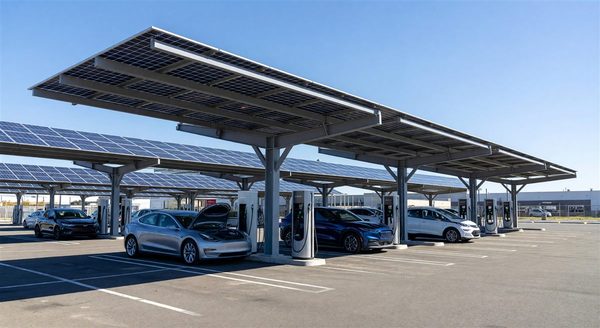
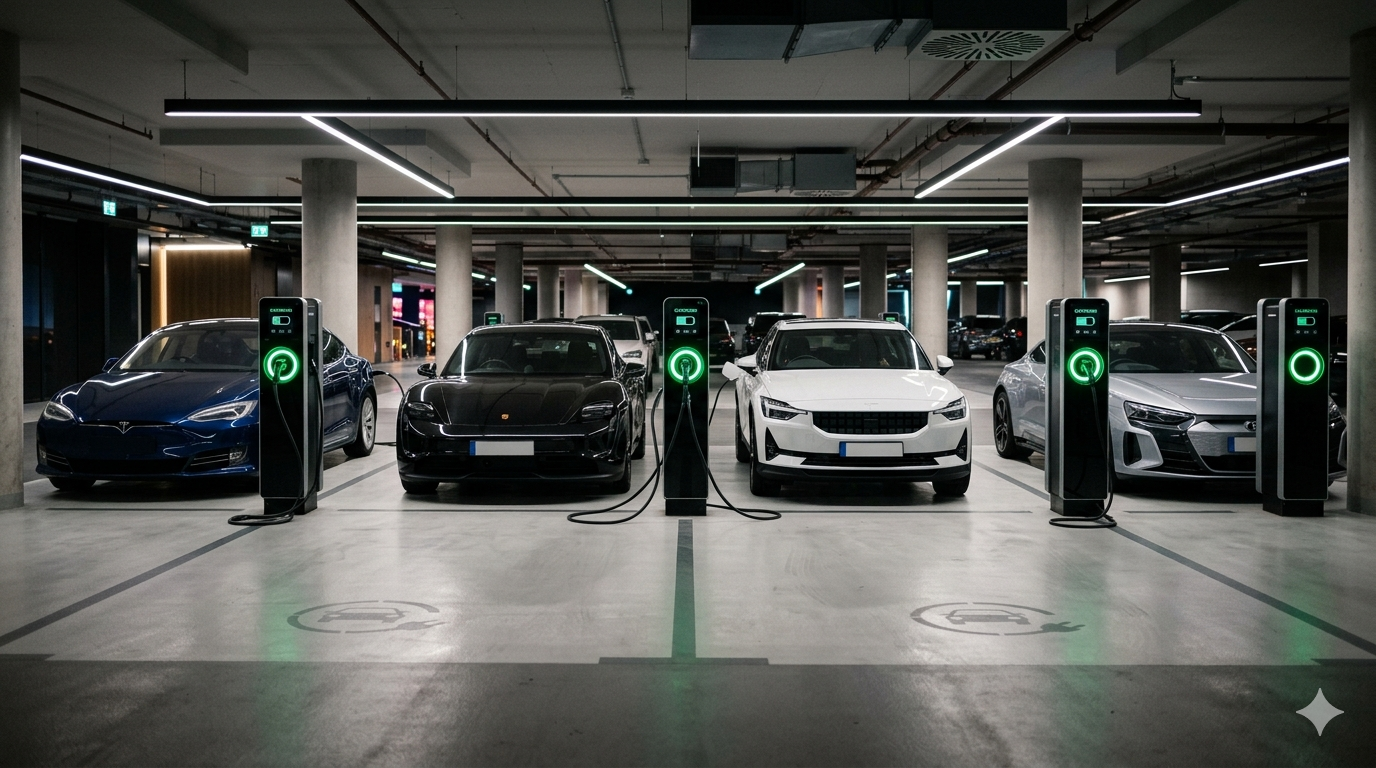
Stall ratio. The share of stalls with Level 2 charging in new builds has risen from single digits to 20 percent and higher in leading jurisdictions. Conduit roughed in for additional future capacity is now near-universal in new construction. The question is no longer whether to provide charging but how fast to scale it.
Make-ready versus active stalls. Make-ready infrastructure — conduit, panel capacity, stub-outs — costs a small fraction of fully activated charging but preserves flexibility. Operators who built out fully activated charging years ago often find themselves with the wrong hardware; operators who built make-ready have been able to scale as demand emerged.
Power capacity planning. The step change in electrical service required to support fleet-scale charging is nontrivial. Conversations with utilities should begin at the schematic design stage, not during commissioning. EPRI and the Department of Energy’s Alternative Fuels Data Center publish load-planning guidance that is useful during early design.
Session management and revenue. Charging pricing, session-length limits, and ICE-vehicle enforcement in EV spaces are operational decisions that substantially affect charging station utilization. Facilities that do not manage these thoughtfully see their EV stalls blocked by non-charging vehicles, long-stay sessions that deny access to subsequent users, and revenue leakage.
Micromobility Parking: Underweighted but Critical
Dedicated, secure, weather-protected bike and scooter parking is the mobility-hub component most commonly underbuilt.
Observed patterns from early mobility-hub projects:
- Exterior, uncovered rack parking has low utilization for commute-hour storage in most climates
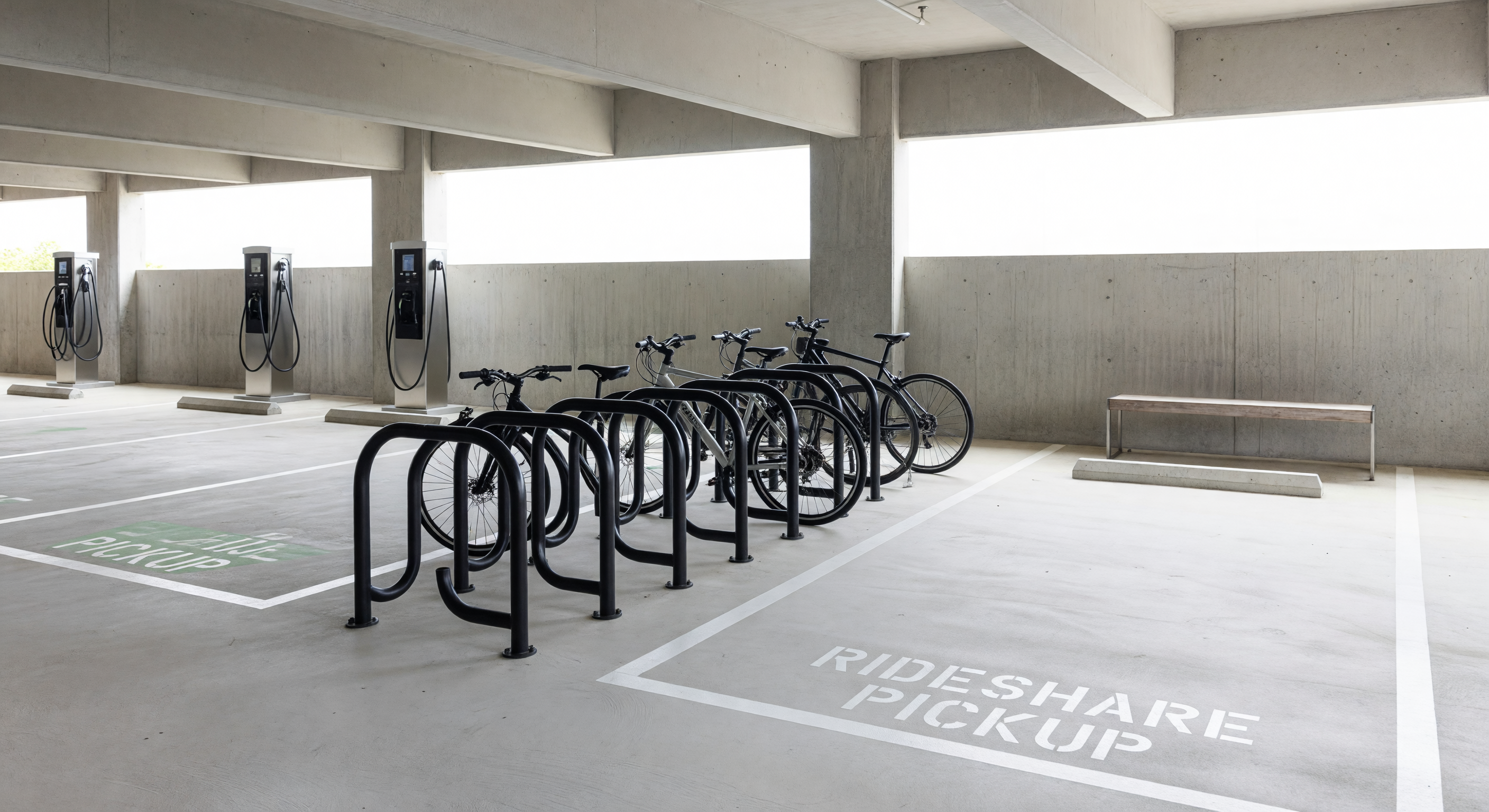
- Interior, secured rooms or cages with keyed or card access show dramatically higher utilization
- Capacity projections based on existing bike/scooter mode share consistently underestimate post-construction demand, because good parking induces use
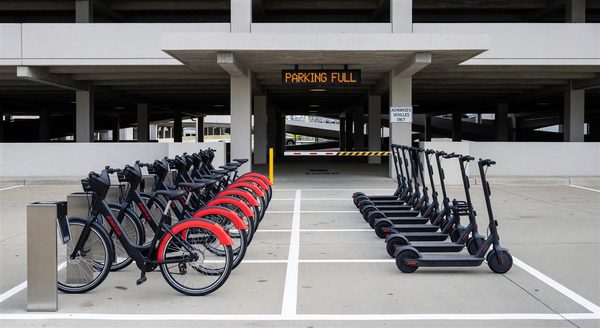
- Shared micromobility (docked bike-share, dockless scooter corrals) benefits from dedicated ground-floor zones with direct street access rather than interior parking deck placement
Integration with the parking facility’s access control system — so monthly or permit customers can access both car and bike parking with the same credential — produces materially better utilization than separate systems.
Ride-Share Staging and Pickup Zones
The integration of ride-hail into parking facilities has lagged the other modes, partly because platforms optimize geofencing around their own operations rather than integrating with facility operators.
Lessons from facilities that have gotten this right:
- Dedicated pickup zones with clear signage and short-duration enforcement outperform general curb use
- Geofencing coordination with the major platforms — shared location data, designated pickup points — reduces driver circulation inside the facility
- Airports and event venues have moved furthest on this; commercial office and retail garages are earlier in the curve
Car-Share and Transit Connections
Car-share pod integration — dedicated stalls for Zipcar, Getaround, or operator-branded fleets — has steadier but modest utilization in most contexts. It works best where the facility serves residential customers whose car ownership is already marginal.
Direct transit integration is rare in North America but growing. Parking facilities adjacent to rail stations that provide covered walkways, transit fare integration, and coordinated signage tend to outperform equivalent facilities without those features. The American Public Transportation Association has documented several US case studies.
What Mobility-Hub Integration Costs
The incremental cost of meaningful mobility-hub integration over a conventional parking structure is typically 5 to 15 percent of total project cost, concentrated in electrical infrastructure, secured bike rooms, and access control upgrades. That premium is usually recovered through longer operational relevance and, in many jurisdictions, through zoning bonuses, utility incentives, or federal tax credits for EV infrastructure.
FAQ
What share of stalls should have EV charging in a new facility?
Current best practice in most urban markets is 15 to 25 percent actively charging, with make-ready infrastructure (conduit and panel capacity) for most remaining stalls. The make-ready fraction is the more important investment — it preserves flexibility as demand scales.
Do mobility hubs actually reduce car parking demand?
Modestly, in most cases. The primary value is not demand reduction but operational relevance — facilities serving current and future mobility patterns rather than only the legacy single-occupancy-vehicle use case.
What’s the cost premium for mobility-hub integration?
Typically 5 to 15 percent of base parking construction cost, concentrated in electrical infrastructure, secured micromobility parking, and access control upgrades. Utility and tax incentives recover part of this in most jurisdictions.
Should bike and scooter parking be interior or exterior?
Interior, secured, weather-protected parking consistently outperforms exterior rack parking in utilization. The investment delta is small relative to total facility cost.