Parking operations have been labor-intensive since the earliest commercial parking facilities — attendants to collect fees, direct traffic, enforce rules, and maintain security. The technology available for parking operations in the 2020s has fundamentally changed the labor calculus: PARCS systems that handle transactions automatically, LPR cameras that identify vehicles without human input, remote monitoring platforms that allow a single person to supervise multiple facilities simultaneously, and intercoms with two-way video that provide customer service without on-site presence. The transition from labor-intensive to technology-enabled parking operations is reshaping staffing models across the industry — creating both operational efficiencies and workforce evolution challenges.
The Traditional Parking Labor Model
Conventional parking facility staffing included:
Cashiers and toll booth attendants: The core labor role in parking — staff stationed at entry and exit lanes to process transactions, handle cash, make change, validate tickets, and resolve customer issues. A facility with four lanes (two entry, two exit) might staff two to four cashiers per shift.
Parking attendants: In staffed lots and garages, attendants direct traffic, assist customers finding spaces, monitor for violations, and handle customer service at the ground level. Valet operations require dedicated attendant pools for vehicle receipt and delivery.
Supervisors and managers: On-site supervisors coordinate shift operations, handle escalated customer issues, manage cash deposits, and ensure policy compliance.
Maintenance and security: Cleaning, minor repairs, and security monitoring may be handled by dedicated staff or shared across facility functions.
At a mid-sized urban garage with three-shift operations and four lanes, the labor cost for attendant and cashier positions alone could represent $400,000 to $700,000 annually — the largest single operating expense category.
Technology Substitution for Labor
Several technologies directly substitute for labor-intensive functions:
PARCS automation: Modern PARCS with automated pay stations, credit card acceptance, and gate management handle the complete parking transaction without attendant involvement. A cashierless garage can operate pay-on-foot kiosks that parkers use before returning to their vehicles, eliminating cashier positions at individual lanes while concentrating customer interaction at central kiosk locations.
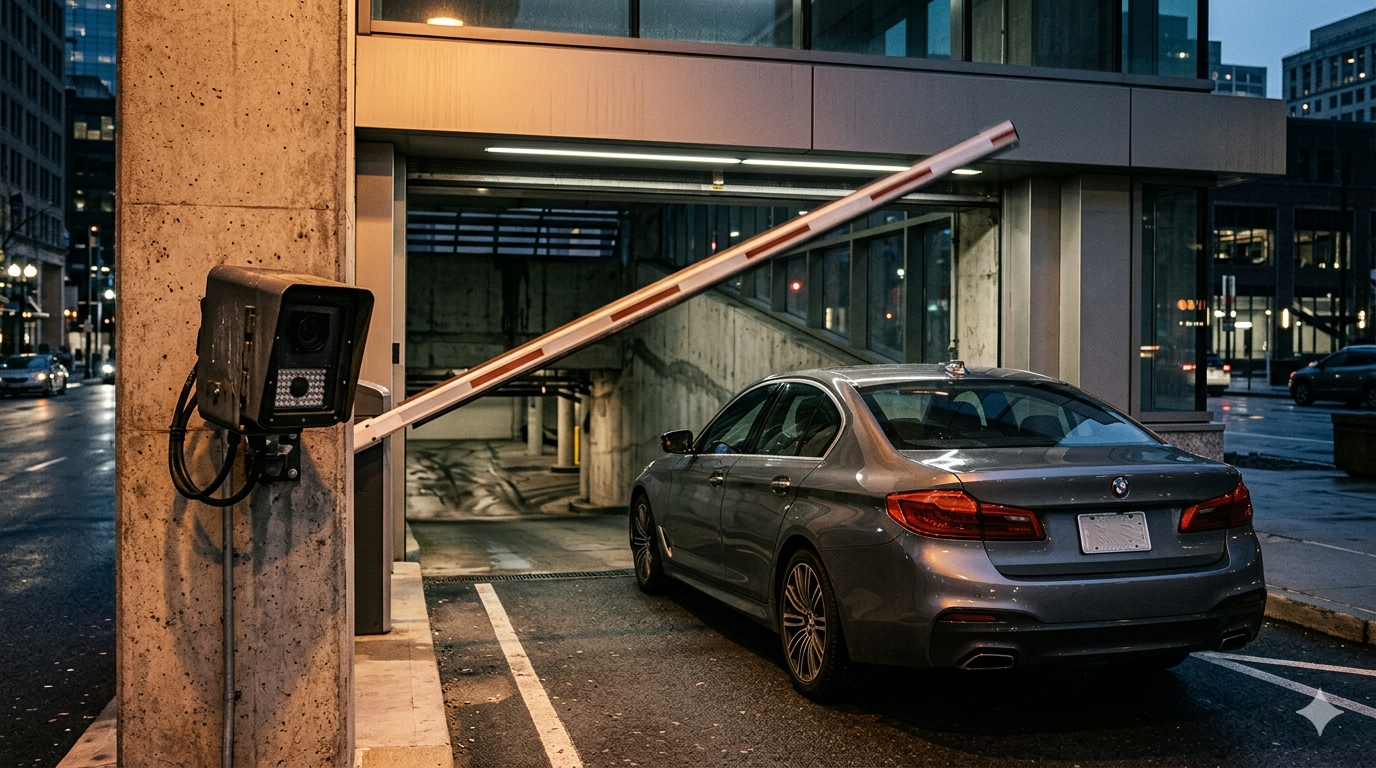
LPR-based gateless systems: License plate recognition systems can eliminate physical gate arms entirely — vehicles enter and exit by having their plate read, with billing handled automatically through a payment method on file. No transaction, no gate, no cashier. A fully LPR-based operation eliminates the entry and exit bottlenecks that require staffing.
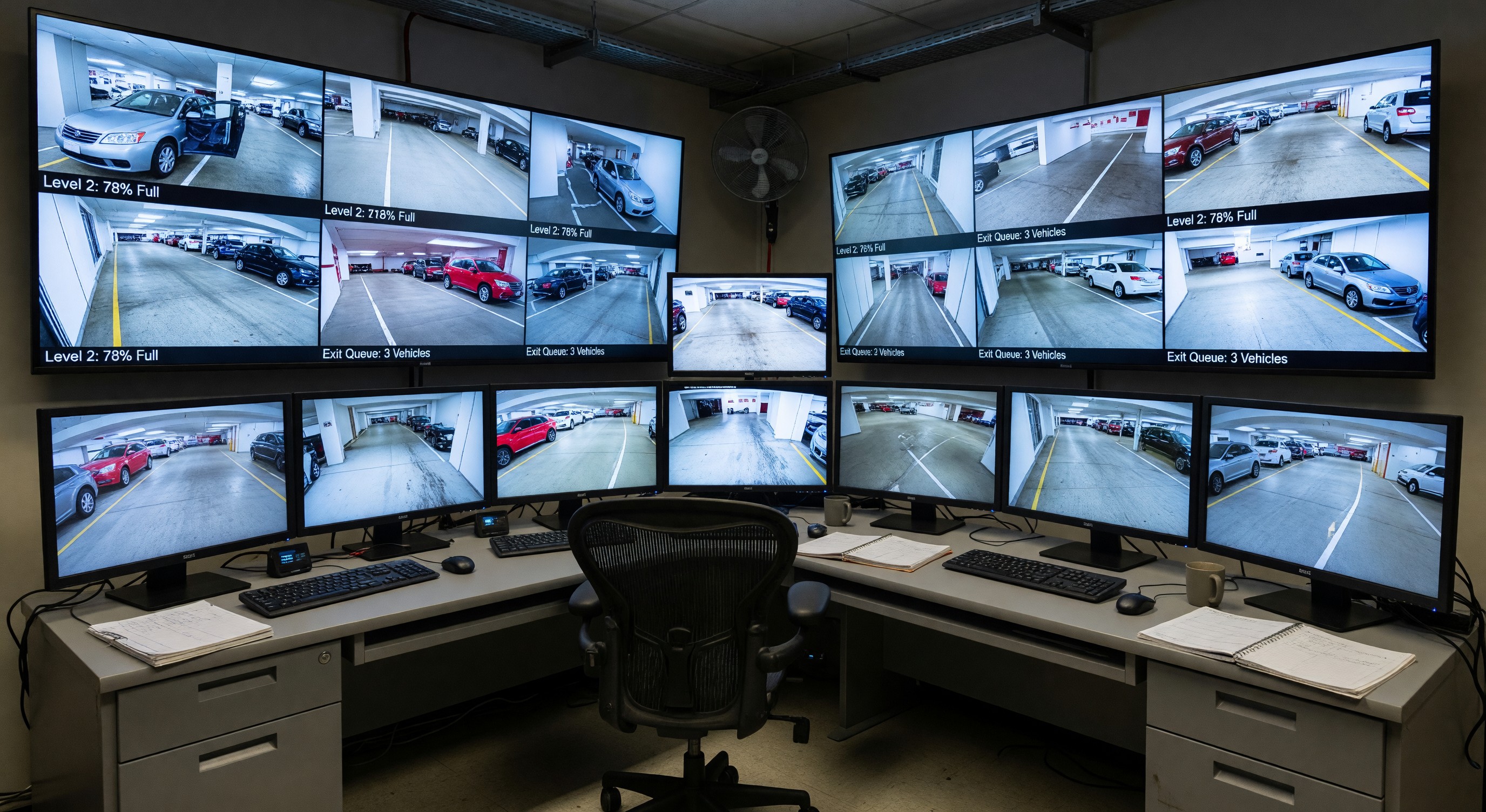
Remote monitoring centers: A single monitoring center operator can supervise ten to twenty facilities simultaneously through camera feeds, occupancy sensors, and facility telemetry. When a customer needs assistance, the monitoring operator connects via intercom with two-way video — providing a “virtual attendant” who is present without being physically at the location.
Automated enforcement: LPR-based enforcement cameras can monitor parking lots and structures for unauthorized vehicles without officer patrol — alerting remote staff or automatically issuing violations when vehicles exceed permitted durations or occupy restricted areas.
Remote Monitoring: Capabilities and Limitations
Remote monitoring capabilities have expanded significantly with improvements in camera resolution, network reliability, and incident response protocols:
Camera coverage: High-definition IP cameras covering entry lanes, exit lanes, cashier stations, stairwells, elevator lobbies, and open floor areas provide the remote monitoring operator with comprehensive visual access to the facility.
Intercom integration: IP-based intercoms with two-way video allow the remote operator to see and speak with customers who press the call button at any location in the facility. The interaction quality can closely approximate an on-site attendant interaction for standard customer service needs.
Alarm and sensor integration: Access control systems, environmental sensors (carbon monoxide, fire), gate status monitoring, and PARCS fault alerts are consolidated in the remote monitoring interface — allowing the operator to see and respond to facility events without on-site presence.
Limitations: Remote monitoring cannot physically assist a customer in distress, retrieve a jammed ticket, manually override a gate that won’t operate remotely, or respond to a physical confrontation that requires on-site presence. Facilities that serve populations with higher rates of in-person assistance needs (hospitals, airports, venues with event traffic) may require more on-site staffing supplementation than commercial office facilities.
Response protocols: Effective remote monitoring requires clear protocols for when to dispatch on-site response — when to call security, when to contact maintenance, when to escalate to a supervisor — and reliable on-call response capacity. Remote monitoring that cannot escalate effectively degrades into monitoring without the ability to act.
Labor Cost Strategy and Transition Management
Phased automation: Most facilities transition from fully staffed to partially automated to primarily remote-monitored operations over time rather than immediately. Phased implementation allows staff reduction through attrition rather than termination — addressing workforce transition concerns while achieving the target operating model.
Hybrid staffing models: The target state for many facilities is not zero staff but a reduced, differently-skilled staff complement — a smaller number of more technically skilled employees who manage the technology systems, handle exceptions, perform maintenance, and provide customer service that remote monitoring cannot. The labor model shifts from many low-skill positions to fewer higher-skill positions.
Worker retraining: Parking attendants and cashiers whose traditional roles are being automated face the choice of retraining for new technical roles (system operator, maintenance technician, customer service specialist) or displacement. IPMI and parking industry workforce development programs provide training resources for industry workers transitioning to technology-enabled roles.
Union considerations: In markets where parking workers are represented by unions (SEIU locals represent parking workers in Chicago, New York, and other major markets), automation and staffing reductions require negotiation and compliance with collective bargaining agreement provisions governing technological displacement. Legal counsel familiar with labor relations should be engaged before implementing significant staffing reductions at unionized facilities.
New Skills in the Automated Parking Workforce
Technology operation and troubleshooting: Parking system operators in automated facilities need basic technical proficiency — understanding PARCS system operation, troubleshooting common PARCS faults, resetting gates and pay stations, and escalating complex technical issues to vendor support.
Remote monitoring operation: Remote monitoring requires different skills than on-site attendant work — the ability to manage multiple video feeds simultaneously, communicate effectively via intercom without visual presence cues, prioritize alerts across multiple facilities, and exercise judgment about when on-site escalation is needed.
Customer service escalation: When automated systems fail or create customer issues, the human contact point needs to be more skilled at resolving complex situations than the traditional cashier role required. De-escalation skills, knowledge of facility policies and exceptions, and the ability to resolve unusual situations without supervisor involvement are more important in a low-staffing environment.
Frequently Asked Questions
How much can automation reduce parking operating labor costs? Significant reductions are achievable: fully automated facilities with remote monitoring may require 20 to 40 percent of the labor of equivalent fully staffed operations. The reduction magnitude depends on facility type (transient-heavy facilities automate more fully than permit-heavy or valet facilities), volume (lower-volume facilities benefit more proportionally from automation), and customer service requirements (hospitals and complex campuses may require more on-site presence than commercial parking).
Does automation reduce parking quality or safety? The evidence from deployed automated facilities does not support a systematic quality or safety reduction. Customer satisfaction scores at automated facilities — when the technology functions reliably and remote customer service is responsive — are comparable to staffed facilities. Safety in automated facilities depends on camera coverage, lighting, and response protocol quality rather than physical staff presence. Facilities with adequate camera coverage and reliable remote monitoring response can maintain security without on-site staffing in many commercial applications.
What is the customer experience impact of removing on-site parking staff? The impact is most significant for customers who need non-standard assistance — directions, accessibility help, payment issues with cash or unfamiliar technology. Automated facilities should ensure that remote customer service is reliably accessible (functioning intercoms, responsive monitoring center staff) and that physical accessibility needs (ADA assistance) can be addressed through protocols that include on-site response when needed.
Are there limits to how far automation can go in parking operations? Valet operations, facilities serving very high proportions of elderly or mobility-impaired customers, high-volume event facilities, and complex multi-use campuses are likely to maintain more human staffing than commercial office or retail facilities. The appropriate staffing model is driven by the specific customer service needs of the facility and customer population rather than by what is technically possible.
Takeaway
Parking operations are in sustained transition toward lower labor intensity through technology automation — PARCS automation, LPR-based gateless systems, and remote monitoring platforms are collectively enabling staffing models that require a fraction of the labor of traditional parking operations. The transition is not without complexity — phased implementation, workforce retraining, union considerations, and maintaining service quality for diverse customer needs all require careful management. But the direction of the industry is clear: technology-enabled parking operations with fewer but more skilled workers, supervised remotely, providing customer service through digital channels supplemented by on-site escalation when needed. Operators who manage this transition thoughtfully are achieving significant cost efficiency while maintaining or improving customer experience outcomes.
Further Reading from Authoritative Sources
- IPMI workforce development and parking automation standards — The International Parking and Mobility Institute is explicitly referenced in the article for workforce training programs and is the primary professional authority for parking labor and automation standards.
- Transportation Research Board parking operations automation and labor impact research — The Transportation Research Board publishes research on parking operations automation that provides the evidence base for the labor reduction claims and workforce transition patterns described in the article.