Parking facilities — surface lots and structured garages — represent some of the largest available solar installation surfaces in the built environment. A surface lot occupies horizontal area that receives full solar exposure; a parking structure’s rooftop deck is structurally designed to support significant loads and provides an unobstructed solar collection surface. The combination of large solar-appropriate areas, EV charging demand for electricity generation, and increasingly favorable solar economics has made parking solar one of the most compelling renewable energy applications for commercial real estate owners. Understanding the economics, design considerations, and financing structures for parking solar helps operators and facility owners evaluate whether solar is appropriate for their assets.
Surface Lot Solar Canopies
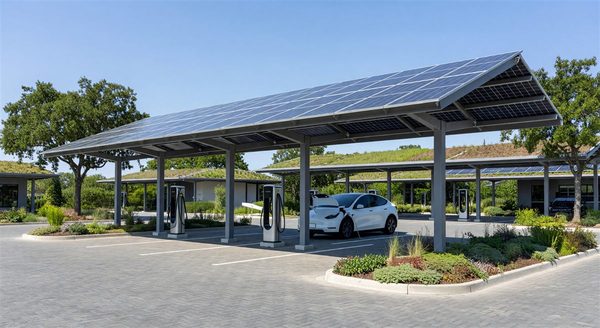
Solar carport canopies — structures that shade parking spaces while supporting elevated photovoltaic (PV) panels — are the most common parking solar installation type in surface lots:
Coverage and generation: A typical solar carport canopy covers one to two rows of parking spaces with a panel array mounted above. A full coverage installation on a 200-space surface lot (approximately 2 acres of impervious surface) can generate 600 kW to 1.2 MW DC of installed solar capacity, producing 800,000 to 1,800,000 kWh annually depending on solar resource availability and system design.
Shade benefit: Solar canopies provide weather protection for parked vehicles — shade from sun that reduces interior temperature and UV exposure, and coverage from rain that keeps vehicles dry during owner access. This benefit supports parking rate premiums or improved customer satisfaction, depending on the market.
Structural requirements: Carport canopy structures must be engineered for wind, snow, and seismic loads appropriate to the site location. Canopy column spacing must accommodate parking stall dimensions. Foundation design varies based on soil conditions. The structural engineering cost is typically 10 to 20 percent of total project cost.
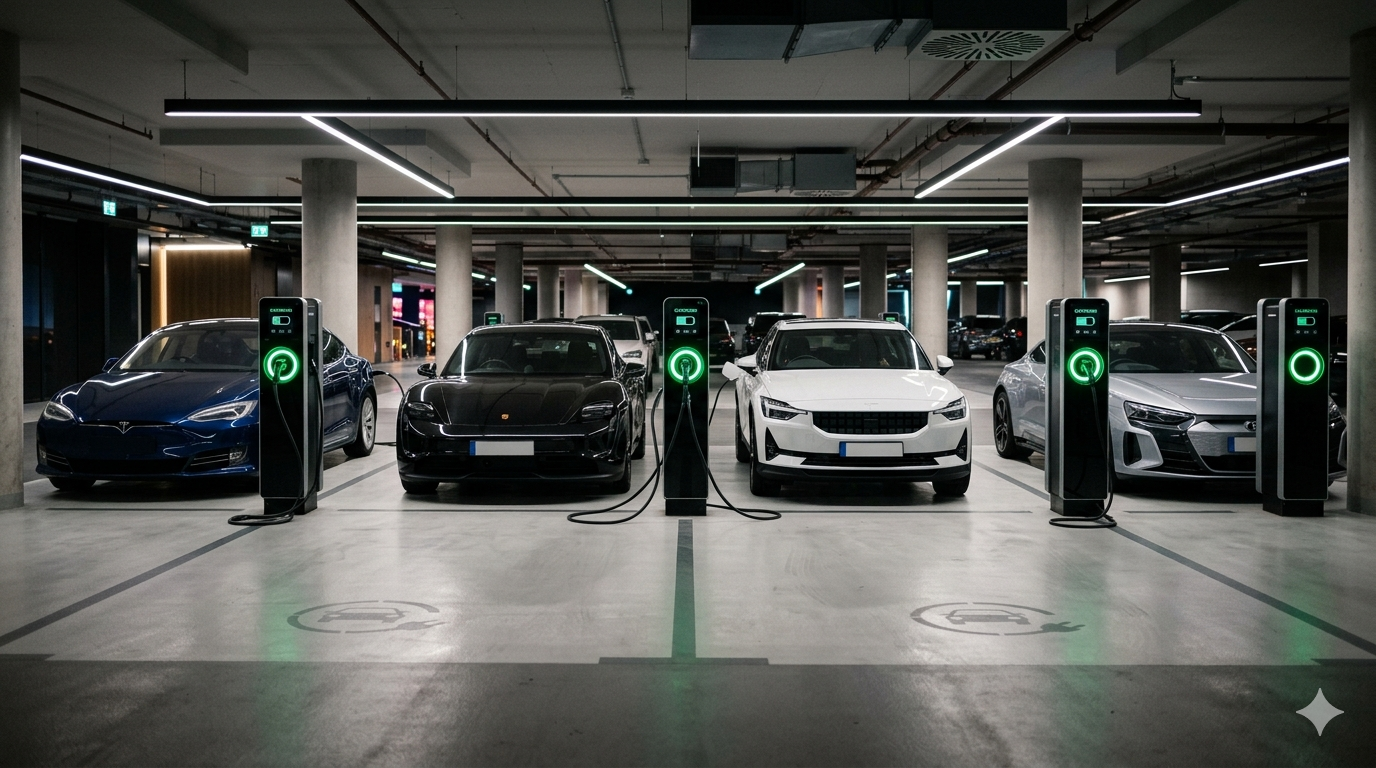
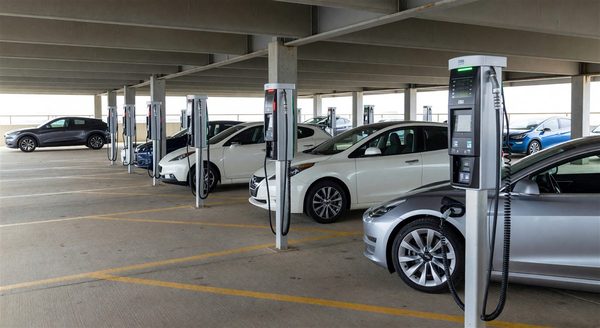
EV charging integration: Solar carports paired with EV charging infrastructure provide an integrated renewable energy and EV fueling solution. The solar generation can supply EV charging load during daylight hours (reducing the grid electricity purchased for charging) and feed back to the grid when EV demand is low. Battery storage can extend the solar-to-EV charging match.
Structured Parking Rooftop Solar
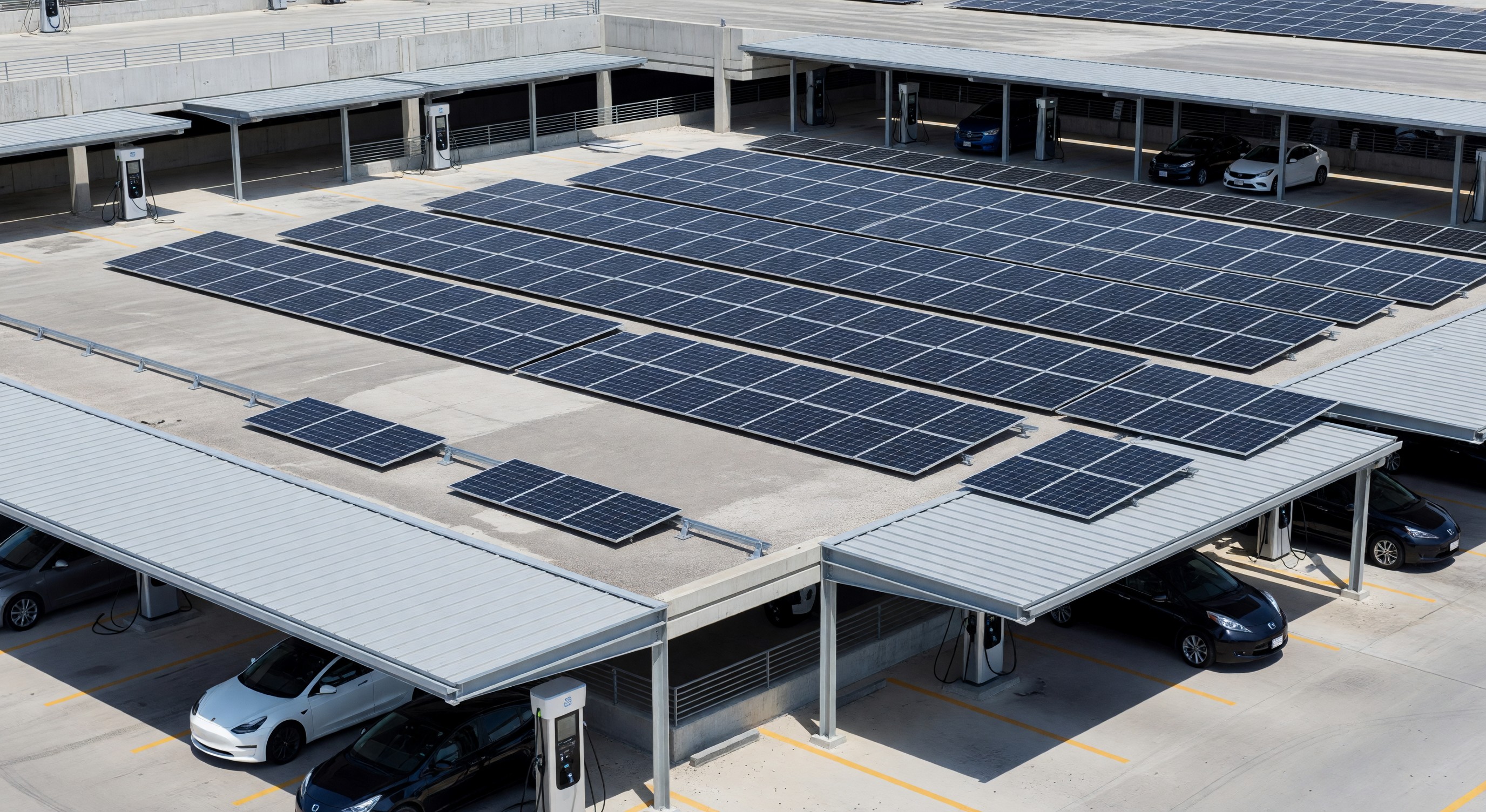
Parking garage rooftop decks provide excellent solar installation surfaces:
Load capacity: Parking structure roof decks are typically designed for 50 pounds per square foot of live load for parked vehicles. Standard solar panel arrays weigh 3 to 5 pounds per square foot — well within the capacity of most parking structure decks without additional structural reinforcement.
Ballasted systems: Most parking garage rooftop solar installations use ballasted racking systems — heavy concrete or rubber base pads that hold the panel array in place without roof penetrations. Ballasted systems are preferred over penetrating systems because they preserve the waterproofing membrane of the roof deck.
Waterproof membrane integration: Parking structure roof decks typically have waterproof membrane systems (usually an elastomeric coating or membrane sheet) that protect the deck below from water infiltration. Solar installation must be coordinated with membrane maintenance and repair access; ballasted systems that are movable for membrane work are preferred over fixed systems.
Generation capacity: A 5-story parking structure with a 50,000 square foot rooftop deck can accommodate approximately 500 kW to 750 kW of rooftop solar — generating 650,000 to 1,000,000 kWh annually. This generation may cover 30 to 60 percent of the facility’s total electricity consumption, depending on operational load.
Solar Economics for Parking Facilities
Electricity cost reduction: The primary economic benefit of parking solar is offsetting purchased electricity at retail rates. Parking facilities are significant electricity consumers (lighting, PARCS equipment, elevators, EV charging, ventilation). Solar generation that displaces grid electricity at $0.12 to $0.25/kWh provides direct cost savings proportional to generation volume.
Net metering: In most states, parking facility solar installations can net meter — export excess generation to the grid when solar production exceeds on-site consumption, receiving a credit against future electricity consumption. Net metering availability and credit rates vary significantly by state and utility; some utilities have modified net metering terms in ways that reduce the value of solar exports.
Federal investment tax credit (ITC): The Inflation Reduction Act extended and increased the federal solar investment tax credit to 30 percent of project cost (with potential bonus credits for domestic content, energy community locations, and low-income community programs). For a $1 million solar installation, the 30% ITC reduces the net investment to $700,000. Tax-exempt facility owners (municipalities, nonprofits) may access the ITC through direct pay provisions under the IRA.
Solar-as-a-service (PPA) financing: Power purchase agreements (PPAs) and solar leases allow parking facility owners to host solar installations without capital investment. The solar developer owns the system, finances the installation, and sells electricity to the facility at a contracted rate below current retail rates. The facility benefits from day-one electricity savings without capital outlay; the developer captures the tax benefits and long-term energy revenue. PPA terms typically run 20 to 25 years with defined escalation rates.
MACRS depreciation: For taxable parking facility owners who invest directly, federal Modified Accelerated Cost Recovery System (MACRS) depreciation allows solar assets to be depreciated over 5 years (with bonus depreciation accelerations under current law), providing significant tax benefit to taxable investors in the first years of operation.
Permitting and Utility Interconnection
Building permits: Solar carport and rooftop installations require building permits in most jurisdictions. Permit requirements vary by locality but typically include engineered structural drawings, electrical plans, and solar-specific documentation. Solar installation on historic structures may face additional review.
Utility interconnection: Grid-connected solar installations require interconnection agreements with the local utility. Interconnection review timelines have extended significantly in many markets as grid connection requests have grown — utilities have 60 to 180 day review timelines in many states, and some systems require utility distribution upgrades that extend timelines further.
HOA and CC&R review: For parking facilities within commercial real estate developments with HOA governance or CC&R restrictions, solar installation may require review and approval from the governing body. State solar access laws in California, Arizona, and other states limit the ability of HOAs to unreasonably restrict solar installations.
Frequently Asked Questions
What is the typical payback period for parking solar installations? Payback period depends on system cost, electricity rate, solar resource, and financing structure. For direct ownership installations with the federal ITC and strong solar resource (Southwest, Southeast), simple payback periods of 6 to 10 years are common. With MACRS depreciation acceleration, effective payback periods for taxable investors can be 4 to 7 years. PPA-financed installations have no payback period because there is no capital investment — savings are day-one.
Does solar installation affect parking capacity? Rooftop solar installations on parking garage decks do not affect parking capacity on lower levels. Surface lot carport canopies are designed to fit within existing stall and drive aisle dimensions without reducing space count. Some large canopy column foundations may require elimination of one or two spaces for column placement, but this impact is minimal relative to the covered area.
How does solar affect parking facility insurance? Solar installations should be disclosed to commercial property insurers and added to coverage schedules. Most commercial property policies can accommodate solar additions with modest premium impact. PPA-financed systems where the solar developer owns the equipment require coordination between the facility owner’s and solar developer’s insurance programs.
What solar resources are best for parking facilities? Parking facilities with high electricity costs (large commercial customers in states with rates above $0.15/kWh), significant solar resource (southwestern and southeastern US), available roof or canopy area (surface lots, garage rooftops), and taxable status that can use the ITC and MACRS depreciation benefit most from direct solar ownership. Facilities with lower electricity rates, limited solar resource (northern US in winter), or non-taxable ownership may still benefit from PPA financing if savings are positive from day one.
Takeaway
Parking facilities are well-suited solar hosts — large areas, structural capacity, electricity consumption that solar can offset, and EV charging demand that solar can supply. The economics of parking solar have improved substantially with the 30% federal ITC, accelerated MACRS depreciation, and declining solar installation costs, making positive ROI achievable across a wide range of parking facility types. Operators and facility owners who have not evaluated solar for their specific assets should commission a solar feasibility study that accounts for their electricity rate, solar resource, available area, tax position, and financing options — the combination of factors that determines whether solar provides compelling economics at a specific location.
Further Reading from Authoritative Sources
- US DOE Alternative Fuels Data Center EV and solar infrastructure guidance for parking facilities — The US DOE Alternative Fuels Data Center provides infrastructure planning resources for solar and EV charging integration in parking facilities, directly supporting the solar-EV pairing economics and technical design considerations described in this article.
- US DOE solar investment tax credit and renewable energy incentive guidance — The US DOE solar tax credit guidance provides the authoritative federal resource on ITC eligibility and IRA provisions described in this article, making it the appropriate reference for operators evaluating parking solar investment economics.