Parking policy decisions — where parking is required, how it is priced, what accessibility accommodations are provided, and who can afford to use it — have equity implications that are receiving increasing attention from policymakers, researchers, and transportation advocates. The parking field has historically focused on supply adequacy and revenue, with equity considerations often secondary. That balance is shifting as cities, transit agencies, and parking operators recognize that parking access and affordability are transportation justice issues that affect real people’s ability to access employment, healthcare, and daily services. Understanding these equity dimensions — and the operational and policy responses that address them — is increasingly important for parking professionals.
ADA Accessibility: The Legal Baseline
The Americans with Disabilities Act (ADA) and its implementing standards (2010 ADA Standards for Accessible Design) establish the legal minimum for accessible parking — the baseline that all facilities must meet:
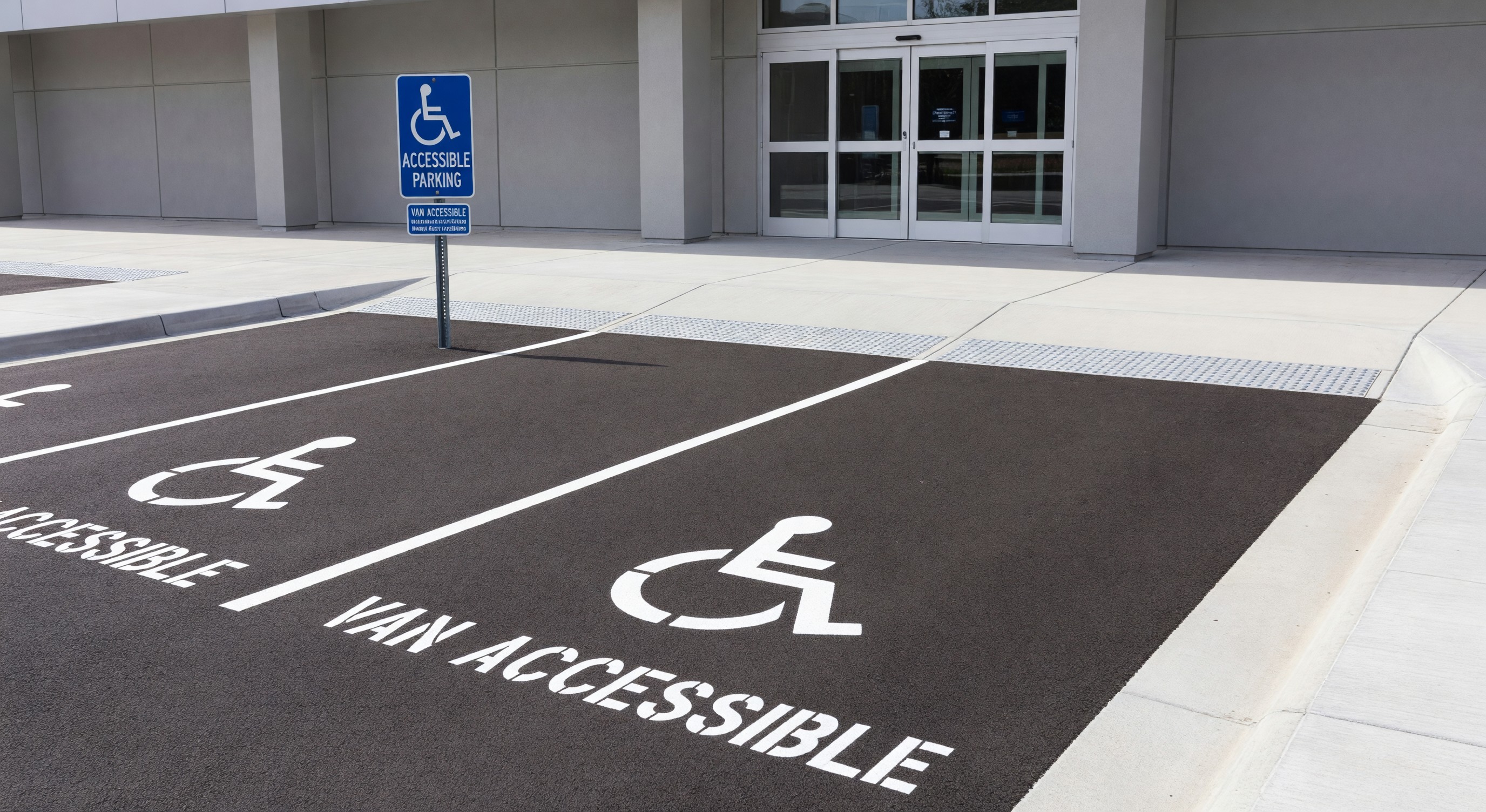
Required accessible stall count: The number of required accessible spaces scales with total facility size. For the first 25 spaces: 1 accessible space required; 26 to 50: 2; 51 to 75: 3; up to 1,000+: 2% of total plus 20 accessible spaces for very large facilities. At least 1 in 6 accessible spaces must be van-accessible.
Stall dimensions: Standard accessible spaces: 8 feet wide with a 5-foot-wide access aisle (or 8-foot-wide shared aisle between two stalls). Van-accessible spaces: 8 feet wide with an 8-foot access aisle on one side.
Location requirements: Accessible spaces must be on the shortest accessible route from parking to the building entrance served. Closer to the building than non-accessible spaces.
Surface and signage: Accessible spaces must be on stable, firm, and slip-resistant surfaces. Vertical signs with the International Symbol of Accessibility mounted at 60 to 66 inches above the ground surface.
Accessible route: A continuous, firm, stable, slip-resistant accessible route from the accessible space to the building entrance, with curb cuts where grade changes occur.
ADA compliance is both a legal obligation and an ethical minimum. Facilities that meet ADA minimums while making accessible parking as difficult to use as possible — through poor maintenance, signage, lighting, or route design — may be technically compliant but are not equitably accessible.
Equity Issues in Parking Pricing
Affordability of urban commercial parking: Commercial parking costs in major urban centers — $20 to $60+ per day in high-demand areas — are a significant expense for lower-income workers who need to commute by car because transit is inadequate for their commute. Workers in lower-wage service and retail jobs who commute by necessity rather than preference face a higher proportion of their income going to parking than higher-wage professional workers.
Dynamic pricing and low-income access: Demand-responsive pricing that increases rates during peak periods disproportionately affects parkers who cannot adjust their schedule to use lower-priced off-peak times — shift workers, service sector employees, and caregivers whose schedules are set by their employer or care responsibilities.
Cashless parking and the unbanked: Cashless parking programs exclude individuals without bank accounts or payment cards — a population that skews lower-income, is more likely to be elderly, and is disproportionately represented in communities of color.
Permit waitlist equity: Monthly parking permit programs with long waitlists may give preference to long-tenured employees or those with higher job classifications — perpetuating access disparities within the employee population.
Approaches to Equitable Parking Program Design
Income-based parking pricing: Some municipalities and employers have developed income-scaled parking pricing programs that charge lower rates to lower-income parkers. Seattle’s Downtown Seattle Association has piloted reduced-rate parking programs for essential workers. Implementation requires income verification mechanisms that protect privacy while enabling eligibility determination.
Cash payment accessibility: Maintaining cash payment options (or cash-to-card kiosk alternatives) in cashless or card-primary parking programs ensures access for unbanked customers. This is both an equity measure and, in several jurisdictions, a legal requirement.
Accessible transportation alternatives: Framing parking equity as part of a broader transportation access issue — improving transit service and pedestrian infrastructure so that not every essential journey requires a car — addresses the root cause rather than just the symptom.
Parking benefit districts: Some cities have directed parking revenue from specific districts toward neighborhood services — transit improvements, streetscape, and community programs — giving the neighborhoods that generate parking revenue a direct community benefit. This doesn’t directly reduce parking cost but improves the equity of how parking revenue is used.
Employer transportation subsidies: Pre-tax commuter benefits (Section 132 of the tax code) allow employees to use pre-tax dollars for transit and parking expenses, effectively reducing cost. Ensuring that lower-wage employees understand and can access these benefits reduces the effective cost burden.
Disability Access Beyond the ADA Minimum
Meeting ADA minimums is necessary but not sufficient for genuinely inclusive parking operations:
Accessibility maintenance: ADA-compliant accessible spaces and routes that are maintained in accessible condition are more important than technically meeting the standard on day one. Snow removal, pothole repair, and surface maintenance in accessible spaces and routes directly affect usability.
Effective accessible space availability: Meeting the required accessible space count is meaningless if available accessible spaces are occupied by permit holders without disability placards, if enforcement is inadequate, or if the spaces are so far from the building entrance that the accessible route advantage is negated.
Signage and wayfinding: Clear, visible wayfinding to accessible spaces and accessible routes — including accessible height signage and contrasting colors for visibility — improves the experience for people with visual or cognitive disabilities beyond the minimum sign requirement.
Intercom and assistance accessibility: Call stations and intercom systems that provide customer assistance should be usable by people with hearing disabilities (visual indicators, TTY compatibility) and mounted at accessible heights.
EV charging accessibility: As EV charging becomes a standard facility amenity, accessible EV charging spaces (with appropriate van-accessible dimensions and reach range for the charger controls) are required by ADA. EVSE manufacturers vary in the accessibility of their equipment design; evaluate accessibility during equipment selection.
The Parking and Transportation Justice Conversation
Transportation advocacy organizations, urban planners, and policy researchers have developed a broad conversation about parking as a transportation justice issue:
Parking minimums and affordable housing: The cost burden of parking minimums on affordable housing development is now well-established in the policy literature. Cities that have eliminated parking minimums near transit have specifically cited affordable housing as a primary motivation.
Parking subsidy disparities: Employer-provided free parking is a significant fringe benefit that disproportionately benefits employees who can afford cars and live in car-dependent situations, while transit benefit programs (which would benefit transit-using employees) may not be provided equally.
Geographic inequity of parking enforcement: Research has found that parking enforcement activity in some cities is concentrated in lower-income neighborhoods — generating fine revenue from a population least able to pay, while parking violations in wealthier neighborhoods receive less enforcement attention.
Frequently Asked Questions
What is the minimum accessible parking count required under ADA for a 200-space facility? For a 201 to 300 space facility: 6 accessible spaces required (2% of total), with at least 1 of those being van-accessible. Spaces must be located on the shortest accessible route from parking to the building entrance served.
How should parking operators approach pricing equity concerns? At minimum: maintain cash payment alternatives (or accessible cash-to-card alternatives) and ensure ADA-required accessible spaces are enforced and maintained. Beyond the minimum: consider tiered pricing structures that reduce the peak-hour premium for low-income demonstrated-need parkers, and evaluate the equity impacts of any dynamic pricing program that significantly increases prices during times when schedule flexibility is lowest for lower-income workers.
Is there a federal standard for income-based parking pricing for municipalities? No federal standard exists for income-based parking pricing. Programs that have been implemented (Seattle, various university campuses) have been locally designed. Federal guidance on Congestion Pricing programs (for tolling) has addressed income equity concerns and may provide a policy model for parking pricing equity programs.
What is the relationship between parking policy and transportation justice? Transportation justice advocates argue that auto-centric transportation systems — of which parking policy is a component — create structural disadvantages for people who cannot afford vehicle ownership or who, due to disability or age, cannot drive. Parking policy that makes driving the only viable transportation option for many destinations, and that prices that driving option unaffordably high for lower-income workers, reinforces existing inequities. The transportation justice framework calls for parking policy to be evaluated alongside transit investment, pedestrian infrastructure, and housing location as interconnected components of equitable urban mobility.
Takeaway
Parking equity encompasses both the legal minimum of ADA accessibility and the broader policy question of whether parking programs, pricing, and design serve people of all incomes, abilities, and transportation circumstances fairly. Operators who address ADA compliance rigorously (not just technically but functionally, through maintenance and enforcement) and who consider the equity implications of pricing and payment policy decisions will better serve the full range of their customer population. The broader policy conversation about parking, transportation equity, and housing affordability is increasingly shaping the regulatory and political environment in which parking operators function — understanding these dynamics is part of operating in the modern urban transportation context.
Further Reading from Authoritative Sources
- US Access Board ADA parking facility design guide for accessible space requirements — The US Access Board ADA parking guide directly establishes the legal accessible space count requirements, dimensional standards, and route requirements described in this article, making it the primary authoritative reference for ADA compliance requirements in parking equity discussions.
- ADA.gov parking accessibility resources for facility compliance and enforcement — ADA.gov provides the federal guidance on ADA parking accessibility requirements and enforcement applicable to parking facility operators, directly supporting the accessibility compliance and equitable access considerations described in this article.