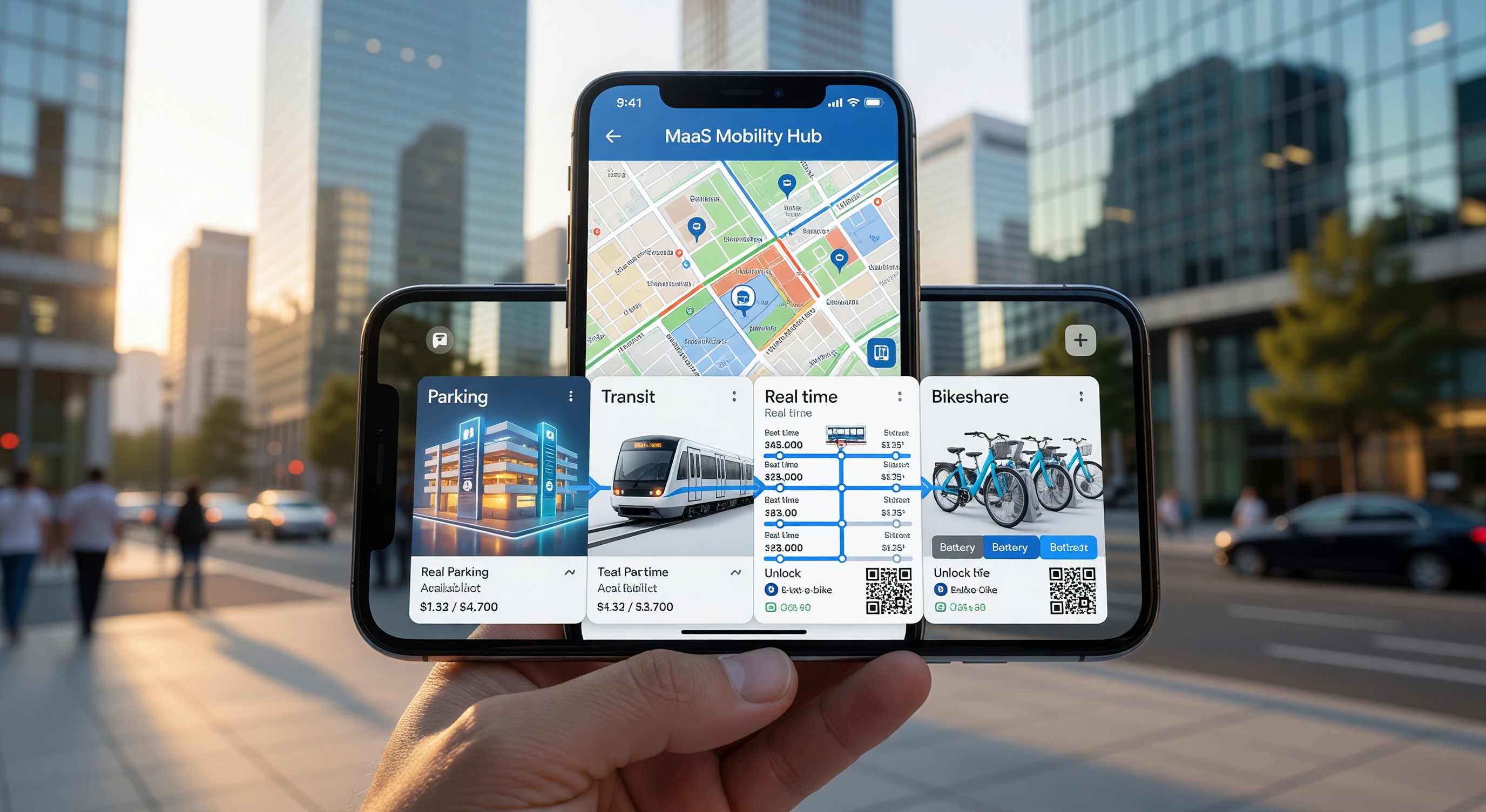
Mobility as a Service (MaaS) refers to integrated digital platforms that combine multiple transportation modes — transit, rideshare, bikeshare, scooter share, and parking — into a single user interface, enabling travelers to plan, book, and pay for multimodal trips without managing separate apps and accounts for each mode. MaaS platforms are active in cities across Europe and are developing in North American markets. The parking industry interest in MaaS is significant: if MaaS platforms successfully reduce personal vehicle dependence by making multimodal alternatives more accessible, parking demand in urban markets could decline over time.
What MaaS Platforms Offer
MaaS platforms differ from individual mobility apps by integrating across modes:
Single trip planning: MaaS apps show the user all available options for a trip — drive alone, park and take transit, take an Uber or Lyft directly, use a scooter for first/last mile to transit — with estimated time and cost for each option. Users can compare options without accessing multiple apps.
Integrated payment: A single MaaS account covers payment across all included modes — transit fare, rideshare fee, parking payment, bikeshare time. Monthly subscriptions that bundle access to multiple modes are a common MaaS business model.
Parking as a MaaS component: Parking is included as a mode in MaaS platforms — users can search for parking, see real-time availability and pricing, and complete payment through the MaaS interface. MaaS aggregates parking inventory from multiple operators, similar to how Google Maps aggregates parking across providers.
Evidence for MaaS Impact on Driving and Parking
The most extensive MaaS pilot and deployment data comes from Europe:
Whim (Helsinki): The Whim MaaS platform in Helsinki, developed by MaaS Global, offered unlimited public transit, bikeshare, and taxi/rideshare through a monthly subscription. Academic research on Whim subscribers found that a significant fraction of users reduced personal vehicle use, and some sold their personal vehicles after subscribing.
Transit use increase: Several European MaaS pilots have found that integrated platforms increase transit ridership among subscribers by making transit planning and payment frictionless relative to driving.
Caution on transferability: European MaaS pilots operate in high-transit-density cities with existing robust transit networks. The impact on car-dependent North American markets, where transit is less competitive with driving for most trips, may be substantially lower.
MaaS Development in North American Markets
North American MaaS development has proceeded more slowly than in Europe:
Transit agency involvement: Several large transit agencies have developed or partnered on MaaS pilots — LA Metro, Dallas DART, and others have explored multimodal integration platforms. Transit agency willingness to share trip data and fare revenue through third-party MaaS platforms has been a barrier in some markets.
Rideshare as a de facto MaaS component: The widespread adoption of Uber and Lyft has already moved a significant share of urban trips from personal vehicle ownership to on-demand rideshare — a form of MaaS-like behavior even without a formal MaaS integration. This substitution has contributed to some measurable decline in young adult vehicle ownership in major metros.
Parking aggregation platforms: The parking reservation market (SpotHero, ParkWhiz/Arrive, Google Maps parking) functions as partial MaaS in providing parking search and booking across multiple operators. The next integration layer is trip planning that presents parking as one of several modal options.
Implications for Parking Demand
MaaS platforms could reduce parking demand in urban markets through several mechanisms:
Reducing vehicle ownership: If MaaS subscriptions reduce the perceived need for personal vehicle ownership (by making alternative modes more accessible and affordable), total vehicle fleet size decreases, and with it total parking demand.
Shifting mode for urban trips: Commuters who previously drove to downtown destinations and parked may shift to transit or rideshare when the MaaS platform makes the comparison explicit, reducing daily parking demand.
Park-and-ride optimization: MaaS platforms can optimize park-and-ride behavior — directing drivers to park at optimal transit access points and continue by transit, reducing vehicle travel in congested urban cores and parking demand near urban destinations.
Offset by induced demand: If MaaS makes transportation generally cheaper and more accessible, total trips (including driving trips) may increase as people take more trips than they would have otherwise.
Parking as a MaaS Revenue Opportunity
Rather than viewing MaaS purely as a demand risk, parking operators can engage with MaaS platforms as a distribution channel:
Inventory listing on MaaS platforms: Parking facilities listed in MaaS apps have visibility to users who are planning multimodal trips and need parking at a transit connection or destination. This represents incremental distribution beyond the operator’s own channels.
Park-and-ride partnerships: Transit agencies developing MaaS platforms may seek formal park-and-ride partnerships with private parking operators whose facilities provide appropriate transit connectivity. These partnerships can produce reliable demand at favorable rates.
Subscription program integration: MaaS monthly subscriptions that bundle transportation costs could include parking access as a component. Operators who negotiate inclusion in MaaS subscription packages gain guaranteed demand.
Frequently Asked Questions
How soon will MaaS platforms materially reduce parking demand in North American cities? The timeline is uncertain and market-dependent. In cities with strong transit infrastructure and high transit mode share (New York, Chicago, San Francisco, Toronto), MaaS adoption is more likely and potential demand impact is higher. In car-dependent suburban and sunbelt markets with weak transit infrastructure, MaaS platforms will have limited impact on personal vehicle dependence for the foreseeable future.
Should parking operators be on MaaS platforms? For operators in urban markets where MaaS platforms are active or developing, listing inventory on MaaS platforms provides distribution exposure to a growing user segment that actively manages transportation spending across modes. The incremental revenue from MaaS-sourced parkers typically outweighs the commission cost.
Does MaaS competition affect parking pricing strategy? In markets where MaaS platforms present parking alongside rideshare and transit costs transparently, parking pricing has more competitive visibility than in markets where each mode is planned and priced separately. This competitive transparency may constrain pricing power in some scenarios — when driving and parking is the obvious cheapest option, it drives parking demand; when it is obviously the most expensive option, some demand shifts.
What is the relationship between TNC rideshare growth and parking demand? Uber and Lyft have functioned as partial MaaS since their widespread adoption, and their growth has contributed to measurable reductions in young adult vehicle ownership in major metros. Some parking demand has been reduced by rideshare substitution, particularly for airport terminal curbside drop-off vs. driving and parking. The magnitude of this effect on total urban parking demand remains debated in transportation research literature.
Takeaway
MaaS platforms represent a long-term trend toward modal integration that could reduce parking demand at the margin in transit-strong urban markets — particularly as personal vehicle ownership becomes less necessary for users with reliable multimodal alternatives. For most North American markets, the timeline for significant MaaS-driven parking demand reduction is a decade or more. In the near term, MaaS platforms represent an additional distribution channel for parking operators in urban markets, and a signal to monitor for early indicators of vehicle ownership and demand pattern shifts. Parking operators who engage with MaaS as a distribution opportunity rather than solely a threat will be better positioned for the long-term shifts this trend represents.
Further Reading from Authoritative Sources
- US DOT transportation performance management framework for multimodal demand analysis — The US DOT transportation performance management framework provides the federal-level methodology for analyzing multimodal transportation demand and mobility integration that directly supports the MaaS impact analysis on parking demand described in this article.
- NACTO urban transportation design guidance for multimodal curb and parking integration — NACTO’s urban street and curb design guidance addresses the multimodal transportation planning context that MaaS platforms are reshaping, relevant to the urban parking demand implications and park-and-ride integration opportunities described in this article.