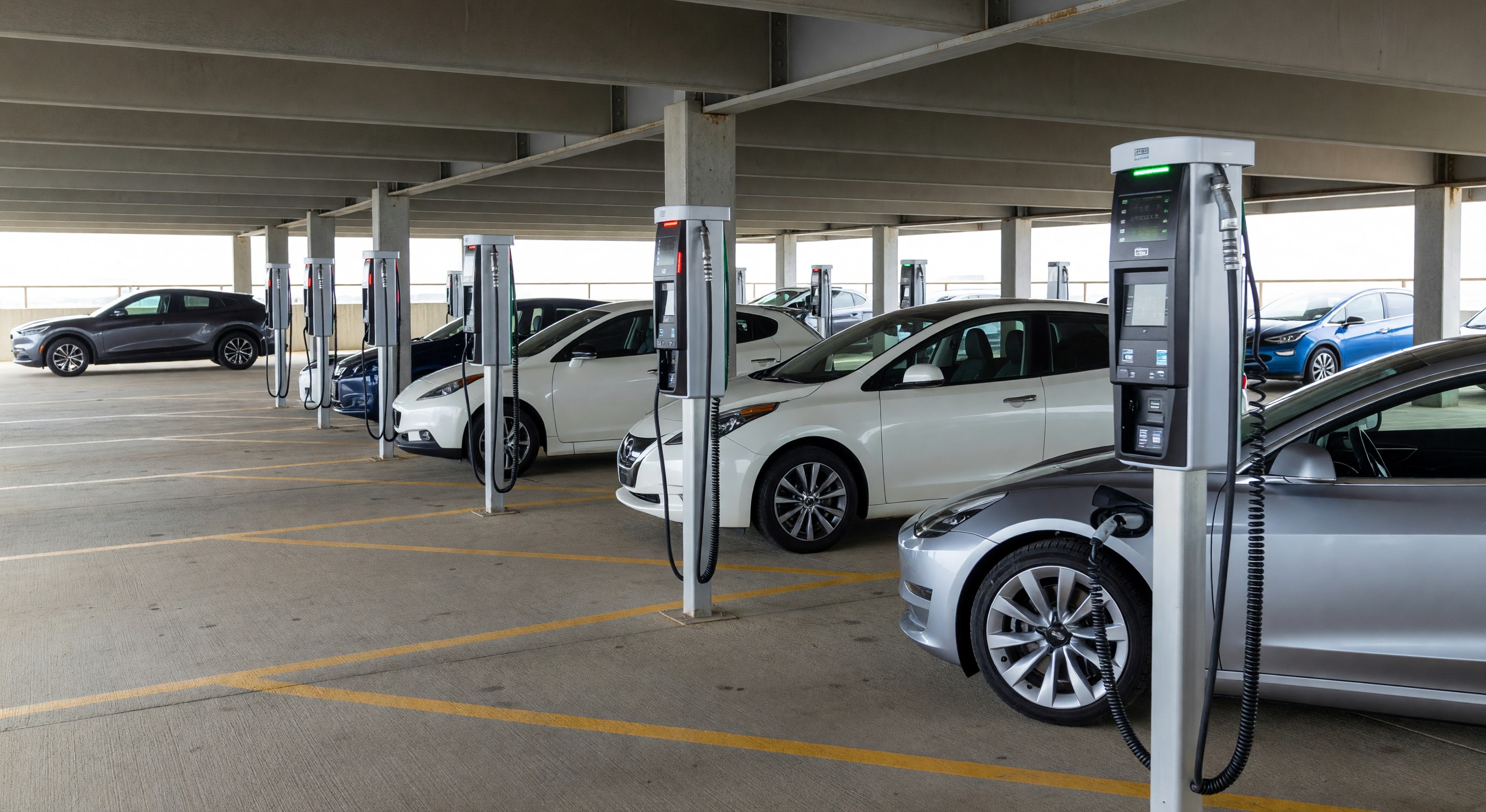
Electric vehicle adoption is growing across North America — federal and state incentive programs, expanding vehicle model availability across price points, and declining battery costs are accelerating the transition. For parking facility operators, EV charging integration is no longer a speculative future concern: parking facilities that lack adequate charging infrastructure face growing competitive disadvantage as the share of EV owners in the driver population increases. Understanding how to plan, design, and operate EV charging as a managed parking facility service is an operational competency that commercial parking operators need now.
Demand Assessment
The starting point for EV charging planning is understanding the current and projected EV share of the parking facility’s customer base:
Current demand audit: Occupancy data combined with direct observation or customer survey can estimate the current fraction of EVs in the facility’s customer mix. In markets with high EV penetration (California, Pacific Northwest, major Northeast cities), 10 to 20 percent EV share in commercial parking is not uncommon in 2025-2026. In lower-penetration markets, 2 to 5 percent is more typical.
Demand projection: EV adoption projections by market are available from the Edison Electric Institute, NREL (National Renewable Energy Laboratory), and state energy agencies. Combine market-level adoption projections with the specific demographics of the facility’s customer base (newer vehicles, tech-forward markets, and higher-income demographics have higher EV adoption rates) to project facility-specific demand through a 5 to 10 year horizon.
Dwell time consideration: Level 2 EV charging (7 to 11 kW) adds roughly 25 to 45 miles of range per hour. For customers parking 8+ hours (office parkers, airport long-term), Level 2 is adequate to provide a meaningful charge. For shorter stays (1 to 3 hours), DCFC (50 to 150 kW) is required for significant range delivery. Match charging power to the typical dwell time of the facility’s customer mix.
Electrical Infrastructure Requirements
EV charging is a significant electrical load. Planning the electrical infrastructure before committing to EVSE equipment count is essential:
Service panel capacity: Assess the facility’s existing electrical service capacity against current demand plus projected EV charging load. A 100-stall facility with 20 Level 2 chargers at 7.2 kW each adds up to 144 kW of potential load — which may exceed the remaining capacity of a typical commercial electrical service if the facility has significant existing electrical loads (ventilation, lighting, PARCS equipment).
Load management: Smart EV charging management systems can manage total charging load within available service capacity by dynamically allocating amperage among active chargers. Load management allows more charging stalls to be installed on a given service panel than would be possible if each charger operated at full rated power simultaneously.
Electrical upgrade planning: If demand projections indicate that EV charging load will exceed current service capacity, electrical service upgrades (transformer upgrades, new service entrance, utility coordination) must be planned and budgeted. Utility lead times for service upgrades can be 12 to 24 months; begin coordination early.
Conduit and wiring: For phased deployment, running conduit and wiring to future charging stall locations during initial construction or renovation is significantly cheaper than retrofitting conduit through existing construction later. Pre-install conduit to all planned future charging locations even if chargers are not immediately deployed.
EVSE Equipment Selection
Level 2 (AC) EVSE: The workhorse of commercial parking EV charging. Level 2 chargers operate at 208-240V AC and deliver 7 to 19 kW (depending on circuit size and vehicle onboard charger capacity). Typical cost: $1,500 to $6,000 per unit for commercial-grade equipment. Appropriate for parking sessions of 2+ hours.
DCFC (DC Fast Charge): Direct-current fast chargers bypass the vehicle’s onboard AC charger and deliver DC power directly to the battery. Power levels from 50 kW to 350+ kW can charge most EVs to 80% in 20 to 45 minutes. Much higher per-unit cost ($40,000 to $200,000+ depending on power level), and significantly higher electrical infrastructure cost. Appropriate for high-turnover facilities, convenience stops, and premium customer amenity positions.
OCPP compliance: Require OCPP 2.0.1 compliance for all purchased EVSE. OCPP compliance ensures that the charging equipment can be managed by any OCPP-compliant network management software — protecting against vendor lock-in in the charging network market.
SAE J1772 and CCS connectors: SAE J1772 is the standard Level 2 connector for North American EVs. CCS (Combined Charging System) is the dominant DCFC connector standard for non-Tesla vehicles. NACS (Tesla’s connector, now adopted as SAE J3400) is becoming a required connector as Tesla Supercharger access has expanded and major automakers are adopting NACS in new models. New DCFC deployments should support both CCS and NACS.
Network and Software Management
Charging network selection: The charging management software layer (OCPP-connected to the EVSE) handles session management, driver authentication, billing, and reporting. Options range from national charging network operators (ChargePoint, Blink, EVgo) to white-label OCPP management software for operators who want direct brand control.
Driver payment options: Parking facility EV charging can be provided at: no charge (tenant amenity, employee benefit); cost-recovery pricing (energy cost passthrough at kWh or time-based rates); or profit-generating rates (markup above energy cost). Pricing should be simple, transparent, and visible on the charger before session initiation.
Utilization monitoring: Charging network software provides session utilization data — daily session counts, energy delivered, revenue, and charger uptime. This data enables ROI tracking and informs expansion decisions.
Utility Rate Optimization
Demand charges: Facilities charged on demand-based utility rates face potential demand charge spikes from EV charging. Smart charging load management can reduce peak demand by staggering charge rates during demand charge measurement windows, potentially significantly reducing utility cost.
Time-of-use rates: Utility time-of-use (TOU) rates offer lower energy cost during off-peak hours. Smart charging systems that shift load toward off-peak hours reduce facility electricity cost.
Utility incentive programs: Federal and state utility incentive programs for EV charging infrastructure installation include NEVI (National Electric Vehicle Infrastructure) program funding for certain facility types, utility rebate programs, and tax credits. The IRS Section 30C Alternative Fuel Vehicle Refueling Property Credit covers 30% of installation cost (up to $100,000 per property) for commercial EV charging. Consult a tax advisor and local utility program representative for specific incentive availability.
Frequently Asked Questions
How many EV charging stalls should a parking facility deploy? A starting point for commercial facilities: 5 to 10 percent of total capacity as EV-capable charging stalls (Level 2), with expansion conduit installed to support 20 to 25 percent capacity. Adjust based on the facility’s specific customer EV adoption rate and local market penetration. Facilities in high-EV markets should plan for 20+ percent eventual capacity.
Who pays for EV charging in a commercial parking facility? The most common commercial models are: property owner funds the installation as a tenant amenity (no session charge); parking operator installs and prices charging at cost-recovery rates; or third-party charging network installs equipment under a revenue-sharing arrangement with the facility owner. The appropriate model depends on the facility ownership structure, customer expectations, and the competitive environment.
What is the expected ROI for EV charging in a parking facility? ROI depends heavily on the pricing model, utilization rate, and incentive programs accessed. Cost-recovery pricing with high utilization (>50% of installed capacity) in a high-EV market typically achieves payback within 3 to 5 years on Level 2 installation cost after incentives. DCFC payback periods are longer (5 to 10 years) due to higher equipment cost but may be justified by customer experience positioning and premium pricing potential.
What maintenance is required for EV charging equipment? Level 2 EVSE requires minimal maintenance — annual cleaning, cable inspection, and connector wear assessment. DCFC equipment has more complex power electronics that may require firmware updates and occasional component replacement. All EVSE benefits from remote monitoring through the network management software to identify offline units and schedule maintenance before extended downtime.
Takeaway
EV charging integration in parking facilities is a present operational requirement, not a future planning exercise. Facilities that assess their current EV customer fraction, plan electrical infrastructure for scaled deployment, install OCPP-compliant equipment, and manage charging as a monitored operational service are well-positioned for the continued growth in EV adoption. The operators who will struggle are those who install a token number of chargers as a marketing gesture without the electrical infrastructure, management software, or pricing model to support meaningful charging capacity as EV demand grows. A phased, infrastructure-first approach — conduit and service capacity planned for full build-out, equipment deployed in tranches as demand develops — is the most capital-efficient path to a competitive EV charging program.
Further Reading from Authoritative Sources
- DOE EV charging infrastructure guidance and Alternative Fuel Vehicle incentive programs — The US Department of Energy publishes EV charging infrastructure guidance, EVSE technology specifications, and administers incentive programs including the NEVI program and Section 30C credit information directly referenced in this article.
- IPMI EV charging integration standards and parking facility electrification resources — IPMI publishes EV charging integration guidance, electrification planning resources, and technology implementation standards for parking operators.