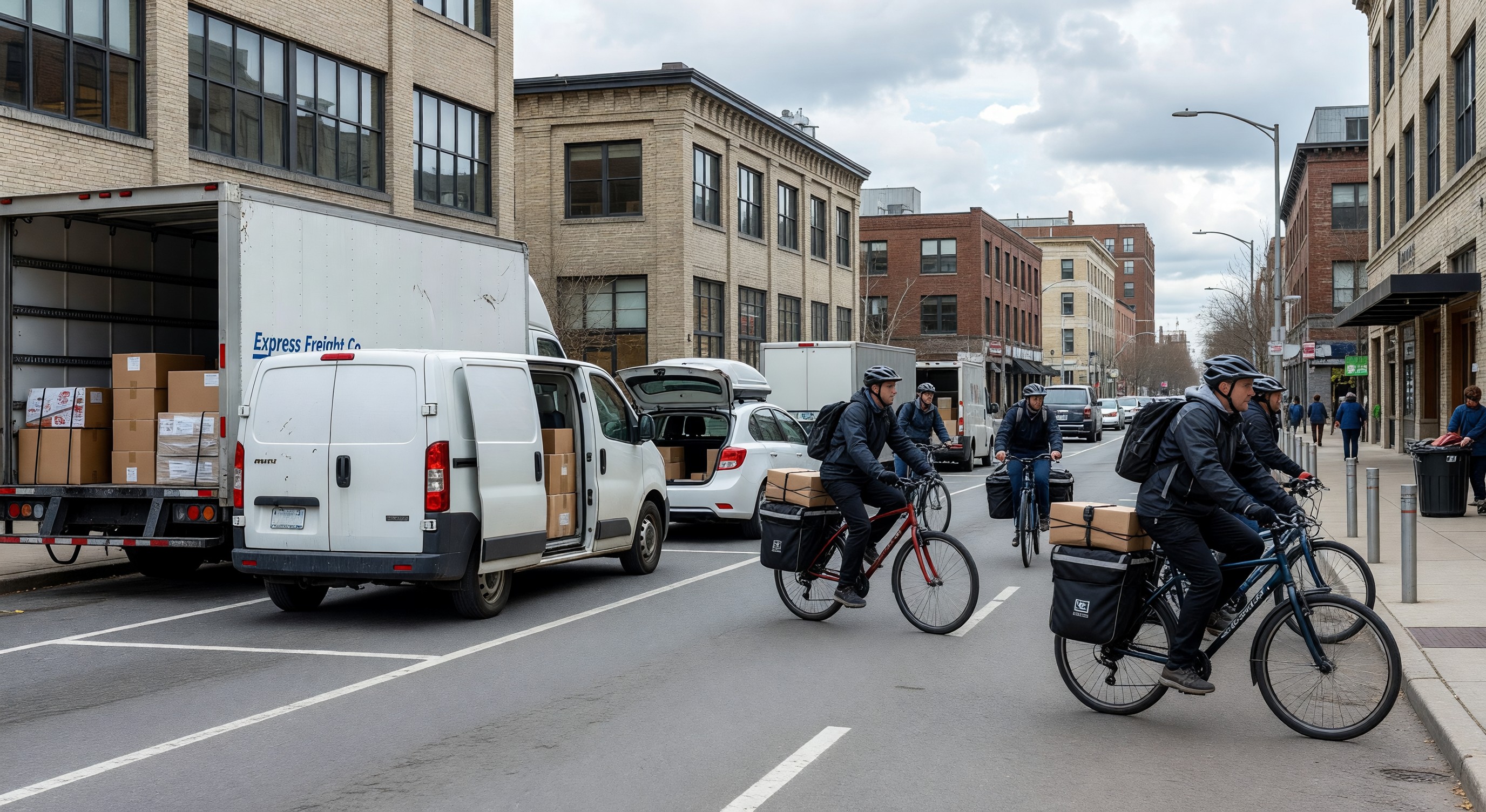
E-commerce growth has transformed last-mile delivery demand in American cities. The volume of packages delivered to homes and businesses has grown dramatically, particularly since 2020, and the vehicles carrying those packages compete with personal vehicles for curb space that was not designed for contemporary freight volumes. Double-parking delivery vehicles block traffic, displace metered parking revenue, and create safety hazards. Managing curbside delivery activity — through loading zone design, delivery vehicle regulation, off-hours delivery incentives, and urban freight consolidation — has become a priority for municipal transportation departments and an operational concern for parking operators whose facilities and revenue are affected.
The Scale of Urban Delivery Demand
Quantifying the delivery problem requires understanding its scale:
Package volume growth: U.S. parcel delivery volume exceeded 20 billion packages annually by 2023, up from approximately 12 billion in 2019. Urban density means that per-curb-mile delivery demand in major city centers has grown proportionally. Amazon, UPS, FedEx, and USPS collectively maintain thousands of delivery vehicles operating in major metropolitan areas at any given time.
Dwell time and displacement: A delivery vehicle double-parked during a delivery occupies approximately 12 to 15 minutes of road and curb capacity per stop. In dense urban environments with limited loading zones, multiple delivery vehicles servicing the same block simultaneously create traffic disruptions that have significant economic cost. NYC DOT studies have found that delivery-related traffic contributes substantially to commercial district congestion.
Parking revenue displacement: When delivery vehicles occupy metered parking spaces — either legitimately or through double-parking that blocks space access — metered parking revenue is displaced. Cities that have analyzed delivery double-parking events have found significant revenue loss attributable to delivery vehicle use of revenue-generating curb space.
Loading Zone Design and Allocation
The primary infrastructure response to delivery demand is loading zone designation and design:
Commercial loading zone placement: Loading zones must be placed where delivery vehicles actually need to stop — in front of or adjacent to delivery destinations, not in locations that are convenient for traffic flow but distant from delivery addresses. Analysis of actual delivery patterns (using delivery vehicle GPS data, available through programs like NYC’s Commercial Vehicle Restriction Database) identifies high-demand loading locations where zone placement is most effective.
Loading zone dimensions: A standard loading zone typically accommodates one commercial vehicle. High-demand blocks may require multiple consecutive loading zones or extended zones that accommodate two vehicles simultaneously. NACTO (National Association of City Transportation Officials) guidelines recommend loading zones of at least 50 feet to accommodate full-sized delivery trucks.
Time-of-day loading restrictions: Converting parking spaces to time-limited loading zones during peak delivery hours (typically 7 AM to 6 PM weekdays) while returning them to metered parking in evenings and weekends maximizes curb space utility. Smart signs that display current curb use and enforcement cameras that verify compliance support effective time-variable loading zone management.
Loading zone pricing: Some cities have piloted charged loading zones — commercial vehicles pay a per-minute or per-stop fee for designated loading space. Pricing creates an economic incentive for efficient loading operations and generates revenue that partially offsets lost parking revenue. San Francisco, Seattle, and NYC have piloted or implemented commercial loading zone pricing programs.
Double-Parking Economics and Enforcement
Double-parking delivery vehicles present an enforcement challenge:
Citation economics: The cost of a double-parking citation (typically $65 to $175 in major cities) is often lower than the cost of driving to a loading zone that may require a circuitous route and additional walking distance. For high-volume urban delivery routes, absorbing citation costs as a cost of doing business is economically rational for carriers who cannot find legal loading space.
Escalating citations: Some cities have moved toward escalating citation schemes — higher fines for repeat double-parking events within a defined period — to change the economic calculation for carriers who routinely double-park.
Commercial vehicle metering: Requiring commercial vehicles to pay for any occupied curb space (parking or loading) through commercial vehicle meters or digital payment creates revenue while establishing a pricing signal that reflects the true cost of curb occupation.
Camera enforcement: Fixed or mobile cameras that automatically identify and cite commercial vehicles occupying restricted spaces without payment reduce the labor cost of delivery enforcement compared to officer-based enforcement, allowing more consistent citation issuance at scale.
Urban Freight Consolidation Strategies
Off-street consolidation approaches reduce on-street delivery demand:
Micro-fulfillment centers: Small urban warehouses or retail spaces in dense neighborhoods store packages for same-day last-mile delivery by cargo bike, electric cargo vehicle, or foot courier — reducing the footprint of delivery vehicles on urban streets. Retailers and logistics companies have established micro-fulfillment centers in converted storefronts and parking facilities in high-density areas.
Parking facility as freight depot: Underutilized parking garages can serve as urban freight consolidation points — receiving full truck deliveries during off-peak hours and dispatching small-vehicle delivery during business hours. Parking operators with excess daytime capacity can lease space for this function, converting empty spaces to revenue-generating freight use.
Off-hours delivery programs: New York City’s Off-Hour Delivery (OHD) program, which incentivizes nighttime and early morning deliveries when streets are less congested, has been shown to reduce daytime commercial vehicle traffic in participating corridors. Off-hours delivery requires receiver (business) participation and operational adjustments; financial incentives and regulatory relief accelerate adoption.
Cargo bike programs: Several European cities have demonstrated that cargo bikes — electric-assist cargo bicycles capable of carrying 200 to 500 pounds of packages — can handle significant urban last-mile delivery volume. DHL, UPS, and Amazon have piloted cargo bike programs in U.S. cities including Seattle, NYC, and Austin. Cargo bike delivery requires secure, convenient parking/charging infrastructure that parking operators are positioned to provide.
Implications for Parking Operators
Loading zone as revenue replacement: When cities convert metered parking spaces to commercial loading zones, parking operators lose metered revenue. Advocacy for paid loading zones (rather than free loading zones) converts the lost parking revenue to loading zone revenue, maintaining curb revenue generation while accommodating delivery demand appropriately.
Parking facilities as freight nodes: The urban freight consolidation opportunity — parking facilities serving as freight depots or cargo bike hubs — represents a new revenue source for operators with excess capacity and urban locations. Structuring these agreements requires understanding the operational requirements of freight consolidation (loading dock access, ceiling height for freight handling, security for package storage).
Permit structures for delivery: Monthly permit programs for delivery vehicle operators — providing designated spaces during business hours at a monthly fee — create predictable revenue and reduce double-parking conflicts. Several operators in dense urban markets offer commercial vehicle monthly permits as a distinct product category.
Frequently Asked Questions
How much curb space do urban areas need to allocate to loading zones? Research from NACTO and urban freight studies suggests that one loading zone per block face in high-activity commercial districts is insufficient in most major cities under current delivery volumes. Studies in NYC, San Francisco, and Seattle suggest that two to three loading spaces per 250 linear feet of commercial curb is closer to peak demand requirements. The appropriate ratio depends heavily on the specific commercial density and delivery destination concentration.
Are cities required to accommodate commercial loading by federal law? The ADA requires that accessible loading and passenger drop-off zones be provided; federal law does not mandate commercial freight loading zones. Delivery vehicle operators have no federal right to curb access for loading. City management of commercial loading — including zone allocation, pricing, and enforcement — is a local regulatory matter.
How should parking operators approach cities about converting loading zones to paid zones? Operators whose revenue is affected by free loading zone conversion should engage through local parking and transportation advisory processes, presenting data on revenue displacement. The argument that paid loading zones recover public revenue from commercial use of public space — rather than providing a free subsidy to delivery carriers — aligns with fiscal management principles that are persuasive to budget-aware municipal officials.
What technology helps manage loading zone compliance? Curb management platforms from vendors like Coord, Remix (now part of Via), and Conduent provide tools for municipalities to inventory, allocate, and manage curb space including loading zones. Sensor-based occupancy monitoring in loading zones (radar, video analytics) enables real-time compliance monitoring and automated enforcement without continuous officer presence.
Takeaway
Curbside delivery management is a growing operational challenge for parking operators and municipalities as e-commerce delivery volumes continue to increase in urban environments. The competition between delivery vehicles and metered parking for curb space is a structural conflict without a simple solution — but strategies including appropriately sized and located loading zones, paid commercial loading programs, off-hours delivery incentives, and urban freight consolidation facilities can collectively reduce double-parking conflicts and associated revenue loss. Parking operators who engage constructively in local curb management planning are better positioned to protect their revenue interests and potentially capture new income streams from urban freight consolidation uses of excess parking capacity.
Further Reading from Authoritative Sources
- NACTO loading zone design guidelines and urban curb management standards — NACTO is explicitly cited in the article for its loading zone dimension recommendations and curb allocation guidance.
- FHWA urban freight and curbside management research and guidance — FHWA publishes urban freight management research, curbside management guidance, and last-mile delivery policy frameworks that directly inform how cities and parking operators address delivery vehicle conflicts with metered parking.