Autonomous vehicles (AVs) are among the most frequently discussed trends in parking industry discourse — and among the most uncertain in their timeline and ultimate scale of impact. The genuine question for parking operators and facility developers is not whether AVs will eventually change parking, but which specific changes are meaningful enough to influence decisions being made today, and which are too speculative to act on before adoption patterns become clearer.
How AV Adoption Could Change Parking Demand
Reduction in parked vehicle time: A fully autonomous vehicle can drop a passenger at the destination and proceed to a remote location (lower-cost parking, fleet depot, or the next passenger pickup) rather than parking near the destination. This would reduce parking demand in high-cost urban locations where remote parking is significantly cheaper.
Shared AV fleets: Transportation network companies operating autonomous fleets (no driver cost) could make on-demand shared transportation significantly cheaper than personal vehicle ownership, potentially reducing the personal vehicle ownership rate and therefore the pool of vehicles requiring parking.
Circulating vs. parking: AVs waiting for a passenger pickup may circulate on street rather than parking — substituting traffic for parked vehicles. This would reduce parking demand while potentially increasing traffic congestion.
Total vehicle miles traveled: If AV convenience encourages more total trips (including non-driver members of households, elderly, and disabled who currently cannot drive), total vehicle miles traveled and parking demand per trip could increase even as per-vehicle parking time decreases.
Timeline Reality
As of 2026, Level 4 autonomous vehicles (capable of operating without human intervention in defined geographic areas) are in limited commercial deployment — primarily in robotaxi services in a handful of cities. Widespread Level 4/5 autonomy in personally owned vehicles remains years away from the penetration rates that would materially affect aggregate parking demand.
The IHS Markit, RAND Corporation, and transportation research literature have repeatedly revised autonomous vehicle timeline projections toward longer horizons as technical and regulatory challenges prove more durable than early optimists anticipated. Parking operators should treat AV as a medium-to-long-term planning variable (5 to 20+ years for material demand impact in most markets) rather than an immediate operational concern.
What is clearer in the nearer term: Specific urban markets with active robotaxi deployments may see localized demand changes at affected facilities before national-level impact. Airport, hospital, and downtown commercial facilities in cities with active AV programs should monitor facility utilization data for early demand signals.
Facility Design Implications
For parking facilities being designed and built today for 30 to 50 year lifespans, AV-related design flexibility is worth incorporating even if AV demand impact is uncertain:
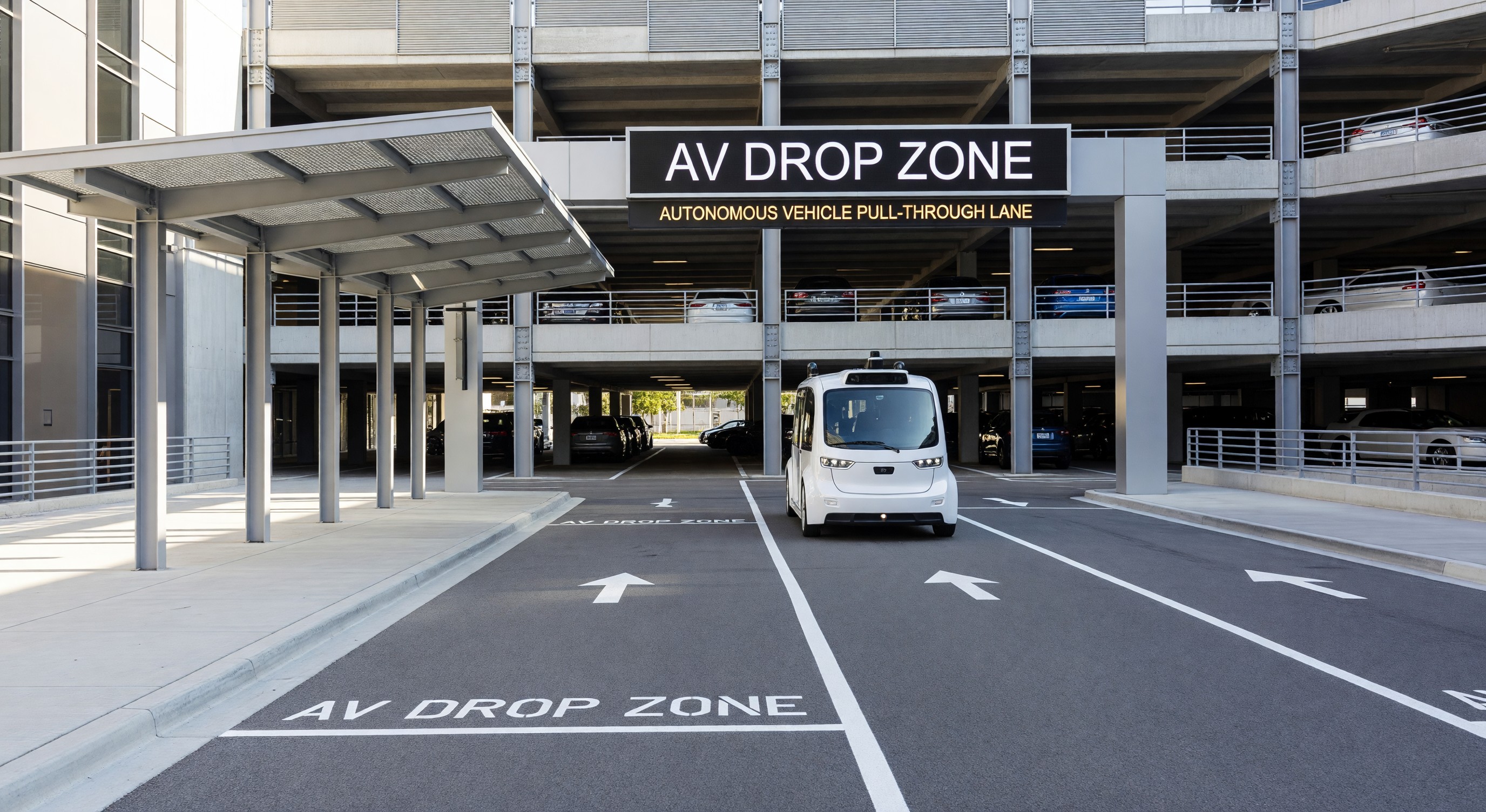
Drop zone capacity: Facilities designed for AV use need capacity at the entry to accommodate vehicles dropping passengers and departing without parking. A wider entry drive or designated pull-through drop-off zone prevents queuing conflicts between AVs dropping passengers and conventional vehicles seeking parking.
Wider aisles for AV navigation: AV-navigated vehicles in parking structures benefit from wider aisles (10 feet per lane) to accommodate the navigation algorithms’ lane-centering behavior. Narrower aisles that conventional drivers navigate manually may create navigation challenges for early AV guidance systems.
Minimal human-occupancy infrastructure in storage areas: If a facility is eventually converted to automated AV self-parking (the vehicle parks itself with no human occupants inside the structure), the life safety infrastructure for human occupants (stairwells, elevators, lighting levels, CO monitoring) could be reduced. Including structural system flexibility that doesn’t permanently require this infrastructure is a low-cost future option to preserve.
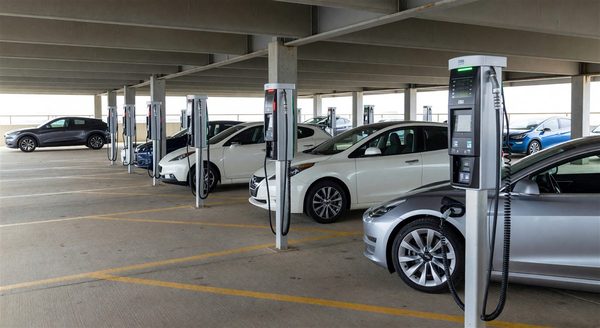
Electrical infrastructure: AVs are predominantly electric. Substantial EV charging infrastructure is appropriate regardless of AV timeline assumptions.
Adaptive reuse flexibility: The most durable design recommendation for AV uncertainty is to design parking structures with adaptive reuse potential — structural systems and floor-to-floor heights that allow conversion to office, residential, or retail uses if long-term parking demand declines significantly. This is sound investment advice under any demand scenario.
Facility Demand Scenarios
Parking demand modeling for facilities with long investment horizons should include scenario analysis:
Optimistic AV adoption (high demand impact): 30 to 40 percent reduction in urban core parking demand by 2040 as personal AV and shared AV fleet adoption reduces per-trip parking needs. Primarily affects downtown commercial facilities in major metros.
Moderate AV adoption: 10 to 15 percent urban parking demand reduction by 2040, concentrated in specific market types. Most facilities see minimal impact through 2035.
Slow AV adoption: AV deployment progresses more slowly than projected; meaningful demand impact pushed to 2040 and beyond. The majority of parking facilities designed today are retired or repurposed before AV adoption reaches material demand-impacting levels.
Most transportation research literature supports the moderate or slow adoption scenario as more likely than the optimistic scenario over a 15-year horizon, due to regulatory, technical, and consumer adoption factors.
Operational Opportunities with AV Integration
Valet-less self-parking: Even before full Level 5 autonomy, facilities could offer AV-assisted self-parking for AV-capable vehicles — the driver deposits the vehicle at the facility entrance and the vehicle proceeds to park itself under facility direction. This reduces valet staffing cost and provides a premium customer experience for AV owners.
Remote monitoring without staff: Facilities serving primarily AV vehicles (hypothetical future scenario) could potentially operate with remote management rather than on-site staff, reducing labor cost significantly.
Integration with fleet management systems: Parking facilities can serve as operational hubs for AV fleet operators — charging, cleaning, maintenance, and storage between dispatch cycles. This commercial opportunity could grow as AV fleet deployment expands.
Frequently Asked Questions
Should parking facilities being built today be designed differently because of autonomous vehicles? New facilities with expected lifespans of 30+ years should incorporate AV-related design flexibility at low incremental cost: adaptable structural systems, wider aisles, AV drop zone capacity, and abundant electrical infrastructure. These features have low or zero cost penalty in new construction and preserve future flexibility. Specific AV-only features (no pedestrian infrastructure, automated vehicle routing systems) are premature investments given timeline uncertainty.
Will autonomous vehicles make parking garages obsolete? Not within a planning-relevant timeframe for facilities built today. Even optimistic AV adoption scenarios involve decades of transition, and significant parking demand from non-AV vehicles continues through any plausible adoption curve. Facilities built today will reach the end of their useful lives before AV adoption reaches levels that would make them obsolete.
What is the best data indicator that AV adoption is affecting parking demand at a specific facility? Declining occupancy during periods where no operational or competitive explanation exists — combined with rising AV deployment data for the facility’s market — would be an early demand signal. Tracking vehicle type data (through PARCS or observation) to monitor the AV fraction of the customer base provides the most direct measure of AV adoption at the facility level.
How are parking industry organizations approaching AV planning? The International Parking and Mobility Institute (IPMI) has published guidance on AV facility design considerations. The Urban Land Institute (ULI) has addressed adaptive reuse design flexibility in parking structure guidance. Both organizations recommend design flexibility over speculative AV-specific investment at current adoption levels.
Takeaway
Autonomous vehicles will change parking — the questions are when, how much, and in which markets. For parking operators and designers working with today’s investment timelines, the practical response is design flexibility (adaptive structures, wider aisles, drop zone capacity, electrical infrastructure) rather than speculative AV-specific investment. The facilities being designed and built today will serve their primary parking function for decades before AV adoption reaches levels that create material operational change; the goal is to design them to adapt gracefully when that change arrives rather than to optimize for an AV future that remains uncertain in its timing and form.
Further Reading from Authoritative Sources
- IPMI autonomous vehicle planning guidance for parking professionals — The International Parking and Mobility Institute is explicitly cited in the article as a source of AV planning guidance for parking professionals, making IPMI the primary authority link for this article.
- Transportation Research Board autonomous vehicle and parking demand research — The Transportation Research Board publishes research on autonomous vehicle impacts on transportation demand, including parking demand modeling, that provides the evidence base for the adoption timeline and demand reduction projections in the article.