Artificial intelligence is the most overused term in parking technology marketing right now. Open any vendor’s website, attend any industry conference — from the International Parking & Mobility Institute expo to regional events — or read any trade publication, and you will encounter AI positioned as the solution to virtually every operational challenge. Occupancy prediction, dynamic pricing, enforcement optimization, customer service automation, predictive maintenance, fraud detection — all powered by AI, all promising transformative results.
Some of these claims are legitimate. Others are conventional software relabeled to ride the AI wave. And a few are genuine vaporware — capabilities that exist in a demo environment but not in production. This article draws the line between them, based on what is actually deployed and delivering measurable results in parking operations in early 2025, not what might be possible in theory.
The AI Spectrum in Parking
Before evaluating specific applications, it helps to understand what AI actually means in the context of parking technology. The term encompasses a wide range of capabilities:
Rule-based automation is the simplest form — if occupancy exceeds 90 percent, change the sign to “Full.” This is not AI in any meaningful sense, but vendors sometimes market it as such.
Statistical analysis uses historical data to identify patterns and correlations. Reporting that Tuesday afternoons average 73 percent occupancy is statistical analysis. Useful, but not AI.
Machine learning trains models on data to make predictions or classifications that improve over time. A model that predicts tomorrow’s peak occupancy based on day of week, weather, events, and historical patterns, and gets more accurate as it processes more data, is genuine machine learning.
Deep learning uses neural networks for complex pattern recognition — the technology behind modern computer vision, natural language processing, and some advanced prediction systems. License plate recognition using deep learning to read plates in varying conditions (angle, lighting, speed, dirt) is a real-world parking application of deep learning.
Generative AI — large language models like those powering ChatGPT and similar systems — is the newest addition to vendor marketing materials. Its practical applications in parking are still emerging and more limited than the marketing suggests.
With this framework in mind, here is where AI actually stands across key parking applications.
Occupancy Prediction: Real and Valuable
Verdict: Genuinely useful AI that delivers measurable operational value.
Occupancy prediction is the most mature and most proven AI application in parking. Machine learning models trained on historical occupancy data, combined with external variables (weather, events, holidays, day of week), produce forecasts that are substantially more accurate than human estimation or simple historical averages.
The best production systems predict daily peak occupancy within five to eight percent for routine days. They identify demand anomalies — an unexpected surge caused by a concert that was not in the events database, or a weather-related depression in demand — faster than human operators, often within the first hour of deviation from the predicted pattern.
Where prediction delivers operational value:
Staffing optimization. Aligning staffing levels with predicted demand reduces labor costs during low-demand periods and prevents understaffing during peaks. Operators report labor savings of 10 to 15 percent after implementing prediction-driven scheduling.
Proactive communication. Alerting customers, tenants, and stakeholders about expected capacity constraints before they materialize improves customer experience and enables demand shaping (encouraging early arrival, suggesting alternative facilities).
Maintenance scheduling. Predicting low-demand windows allows maintenance — lane closures, equipment servicing, cleaning — to be scheduled when it has the least operational impact.
Where prediction falls short:
Unprecedented events. Models trained on historical data struggle with genuinely novel situations — a pandemic, a major infrastructure closure, or a sudden change in commuting patterns. This is a fundamental limitation of any data-driven prediction system, not a flaw in the specific implementations.
Granular space-level prediction. Predicting overall facility occupancy is reliable. Predicting that space B-247 will be available at 10:15 AM is not. Vendors who claim space-level prediction with actionable accuracy are overreaching.
Dynamic Pricing: Real but Requires Discipline
Verdict: The AI works. The organizational readiness is usually the limiting factor.
AI-driven dynamic pricing algorithms can optimize rates in real time based on current occupancy, predicted demand, price elasticity (learned from historical response to rate changes), and competitive conditions. The mathematical models work. Several operators have demonstrated revenue improvements of five to fifteen percent after implementing AI-driven pricing.
But dynamic pricing in parking is as much an organizational challenge as a technical one. Operators need:
Clear pricing authority. Who approves rate changes? If every AI-recommended price adjustment must be reviewed by a committee, the real-time benefit evaporates.
Customer communication. Rates that fluctuate unpredictably erode trust. Effective implementations communicate pricing logic transparently — “rates are higher today because of the downtown festival” — rather than letting customers discover price changes at the pay station.
Constraint boundaries. AI optimization will find the revenue-maximizing price, which may not be the operationally or politically appropriate price. Rate caps, change frequency limits, and segment protections (never charge a hospital patient more than $X) must be defined as constraints the AI operates within.
Sufficient data. Dynamic pricing algorithms need months of data to learn price elasticity in a specific market. Operators who expect immediate optimization from day one will be disappointed.
The vendors who market dynamic pricing as a turnkey solution are oversimplifying. The technology is ready. Deploying it effectively requires operational planning and organizational alignment that the software cannot provide.
Computer Vision for Enforcement: Real and Improving Rapidly
Verdict: Genuine deep learning application with proven production deployments.
Computer vision — the AI’s ability to interpret visual information — has reached a level of maturity in parking that makes it genuinely transformative for enforcement and monitoring.
License plate recognition — a technology tracked by the Intelligent Transportation Systems Joint Program Office — using deep learning achieves accuracy rates above 98 percent in controlled environments and above 95 percent in challenging conditions (rain, darkness, extreme angles). This is substantially better than earlier OCR-based approaches and has made LPR-based enforcement practical and reliable at scale.
Vehicle classification — distinguishing between cars, trucks, motorcycles, and oversized vehicles — enables automated enforcement of vehicle-type restrictions. Systems can identify vehicles that violate height restrictions, park in compact-only spaces with oversized vehicles, or use motorcycle spaces with full-size vehicles.
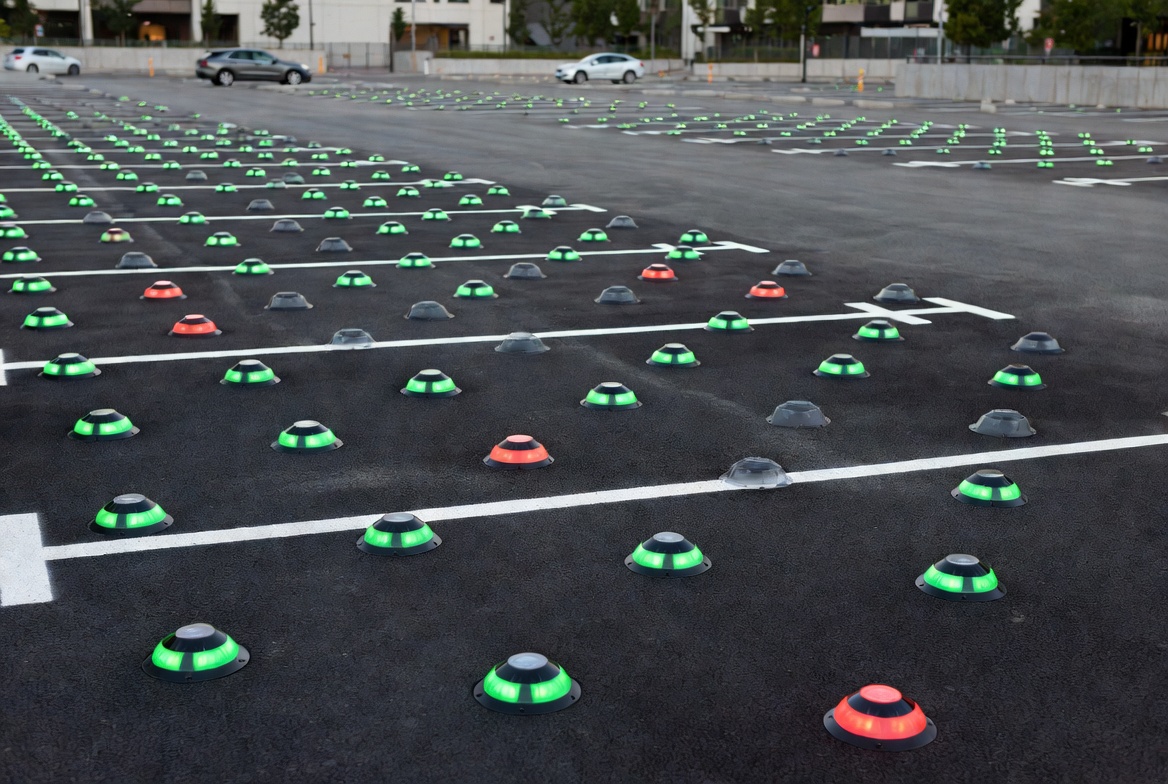
Occupancy detection using cameras and computer vision eliminates the need for per-space sensors. A single camera can monitor 20 to 50 spaces, dramatically reducing the per-space cost of occupancy sensing. Accuracy has improved to the point where camera-based detection matches or exceeds ultrasonic sensor accuracy in most lighting conditions.
Behavioral detection is an emerging capability where computer vision identifies concerning behaviors: vehicles circling repeatedly, pedestrians in vehicle-only areas, or unusual activity patterns that might indicate security concerns. Integrated parking monitoring systems combine these detection capabilities with alert management and operational response tools, giving operators actionable intelligence from their camera infrastructure.
What to watch for: Vendors who claim 99.9 percent accuracy in all conditions are overstating. Real-world performance varies with lighting, weather, camera positioning, and the quality of the training data the model was built on. Ask for accuracy metrics from production deployments in conditions similar to yours, not from controlled test environments.
Predictive Maintenance: Promising but Early
Verdict: Genuine AI application, but limited production deployments in parking specifically.
Predictive maintenance uses machine learning to analyze equipment performance data — motor current draws, cycle times, error frequencies, sensor readings — and predict failures before they occur. The concept is well-proven in industries like manufacturing and aviation. Its application to parking equipment is logical but still maturing.
The challenge is data volume. A parking gate cycles perhaps 500 to 2,000 times per day. A manufacturing motor might cycle 10,000 to 100,000 times. The statistical signal that precedes a failure is harder to detect with fewer data points. Parking equipment also operates in harsh environments — temperature extremes, moisture, vehicle impacts — where failure modes are less predictable than in controlled industrial settings.
Current production implementations in parking focus on:
Trend monitoring that flags degrading performance — a gate that is taking progressively longer to cycle, a payment station with increasing error rates, or a network device with growing packet loss. These trends often precede failures by days or weeks, providing a maintenance planning window.
Consumable management that predicts when receipt paper, ticket stock, or cash canisters need replenishment based on transaction volume rather than fixed schedules. This is useful but not especially sophisticated AI — it is closer to statistical forecasting.
True predictive maintenance — “this gate motor will fail in approximately 72 hours” — remains aspirational for most parking equipment. The data infrastructure and failure history needed to train reliable models are still being built.
Customer Service Automation: Mixed Results
Verdict: Useful for simple interactions. Limited for complex situations.
Chatbots and virtual assistants powered by large language models have appeared in parking customer service channels. They handle common inquiries: rates, hours, directions, payment options, and lost ticket procedures. For these routine questions, AI customer service works reasonably well and reduces the volume of calls that human agents must handle.
Where AI customer service struggles:
Dispute resolution. A customer challenging a citation or disputing a charge requires nuanced judgment, policy interpretation, and often a de-escalation capability that current AI systems lack. Routing these interactions to human agents remains essential.
Complex transactions. Modifying a monthly permit, resolving a payment system error, or coordinating a special event arrangement involves multiple system interactions and judgment calls that AI cannot reliably handle in production.
Emotional situations. Parking interactions can be emotionally charged. A stressed hospital visitor who cannot find their car, a traveler who missed a flight and is being charged for extra parking days, or a tenant frustrated by ongoing construction disruptions — these situations require empathy and flexibility that AI does not genuinely possess, despite marketing claims to the contrary.
The most effective implementations use AI for first-contact triage and simple resolution, with seamless escalation to human agents for anything beyond routine inquiries. Vendors who position AI as a replacement for customer service staff rather than a tool that augments them are setting expectations that the technology cannot meet.
Fraud and Revenue Leakage Detection: Real and Underappreciated
Verdict: One of the most valuable AI applications in parking, but rarely marketed as aggressively as flashier capabilities.
Machine learning excels at finding anomalies in large datasets — exactly the capability needed to detect revenue leakage and fraud in parking operations. Production systems flag:
Unusual transaction patterns that suggest credential sharing, payment system manipulation, or employee misconduct. A monthly permit used for entry at 7 AM and again at 9 AM without an intervening exit triggers investigation. A pay station that processes significantly fewer cash transactions than its peers suggests a hardware issue or something worse.
Validation abuse where electronic validation credits are applied in patterns that do not match the validating business’s customer traffic. A restaurant that validates 200 tickets on a day it served 80 customers warrants a conversation.
Systematic revenue gaps between expected revenue (based on occupancy and rate structure) and actual collections. These gaps may indicate equipment errors, process failures, or theft, and AI-driven analysis can quantify and localize them faster than manual auditing.
Operators who have deployed these analytics consistently report recovering two to five percent of revenue that was previously leaking undetected. For a facility generating $2 million annually, that is $40,000 to $100,000 — a return that more than justifies the analytics investment.
The Honest Assessment
AI is neither the revolution that vendor marketing promises nor the empty buzzword that skeptics dismiss. In parking, the technology is genuinely useful for:
- Predicting demand based on historical patterns and external variables
- Optimizing prices within well-defined operational constraints
- Reading license plates and interpreting visual information
- Detecting anomalies in transaction data that indicate fraud or leakage
- Handling routine customer service inquiries
It is not yet reliably useful for:
- Predicting individual space availability at specific times
- Fully automating complex customer service interactions
- Predicting specific equipment failures with high confidence
- Replacing human judgment in operational decision-making
The operators who get the most from AI invest in the data infrastructure that AI requires. Research from McKinsey on smart city technologies supports this measured approach, emphasizing that successful AI deployment depends on (accurate, continuous, well-structured data), set realistic expectations about what the technology can deliver, and treat AI as a tool that augments human decision-making rather than replacing it.
The vendors who earn trust are those who are honest about what their AI can and cannot do. In an industry where the hype cycle is running hot, that honesty is both rare and valuable.
For a grounded look at AI and LPR camera technology in parking — what the technology actually does versus marketing claims — the Parking BOXX blog provides manufacturer-level perspective on AI LPR deployment and real-world accuracy.