Artificial intelligence has become one of the most heavily marketed technology categories in parking — vendors apply the “AI” label broadly to everything from simple rule-based systems to genuine machine learning models. Separating practically useful AI applications from marketing hyperbole requires understanding what AI can actually do in parking contexts, what data and infrastructure it requires, and what realistic benefits to expect. For parking operators navigating AI vendor claims and evaluating specific applications, a grounded assessment of near-term practical applications versus longer-horizon emerging capabilities provides a better framework than either blanket skepticism or blanket enthusiasm.
What AI Actually Means in Parking Context
“AI” in parking software typically refers to one or more of these specific technical capabilities:
Machine learning (ML): Statistical models trained on historical data to make predictions or classifications. Demand forecasting models that predict occupancy based on historical patterns and external variables are ML models. Equipment failure prediction models are ML models. These are genuinely useful and well-established in parking applications.
Computer vision / image processing: AI that analyzes images or video frames — used in camera-based occupancy detection, LPR plate recognition, and video analytics for security monitoring. This is mature technology with established accuracy and performance characteristics.
Natural language processing (NLP): AI that understands and generates human language. Used in parking customer service chatbots, natural language query interfaces for operational data, and automated communication classification.
Large language models (LLMs): Advanced NLP systems (GPT-4, Claude, Gemini) capable of sophisticated text generation, instruction following, and multi-step reasoning. Beginning to appear in parking operations through customer service applications, automated report generation, and natural language query of operational data.
Rule-based systems marketed as AI: Systems that follow predefined if-then logic rules are often marketed as AI, particularly for rate adjustment and exception detection. These are not AI in the ML sense — they are algorithmic logic — but they can be useful.
Practical Near-Term AI Applications
Demand forecasting: Machine learning models trained on historical parking occupancy data, with external variables (day of week, weather, event calendar, holidays), produce demand forecasts significantly more accurate than manual estimation or simple historical averaging. This is the most established and proven AI application in parking, enabling better staffing decisions, advance rate optimization, and maintenance scheduling.
Revenue anomaly detection: ML models that learn the normal pattern of daily revenue, transaction counts, and payment mix can flag anomalies — unusual revenue dips, unexpected payment method shifts, or transaction count variations — that may indicate equipment failure, revenue leakage, or data errors. This application requires minimal special infrastructure beyond access to PARCS transaction data.
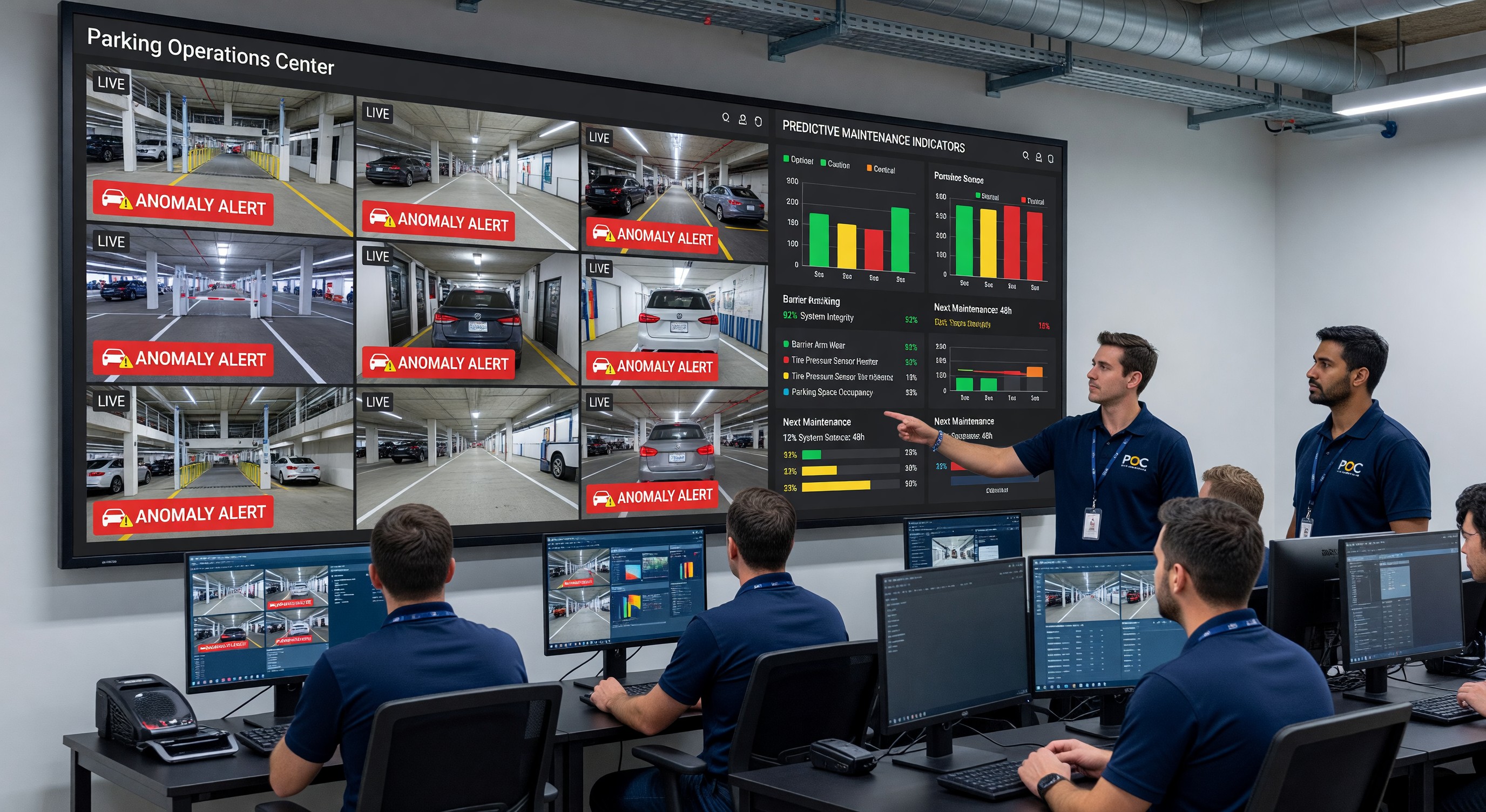
Equipment failure prediction: Models trained on equipment sensor data (motor current, error code frequency, transaction failure rates) can identify equipment that is trending toward failure before it actually fails. This application requires sensor data that must be structured for model training — a data infrastructure requirement before the ML model can function.
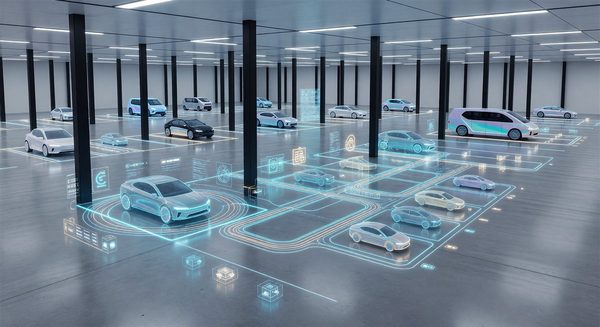
Camera-based occupancy detection: Computer vision applied to security camera video to detect vehicle occupancy in individual parking spaces — providing parking guidance data without per-space sensor installation. The AI is the video analysis; the underlying infrastructure is standard IP cameras.
Customer service chatbots with NLP: Natural language chatbots that handle customer service queries without human involvement. Modern LLM-based chatbots handle more varied language and multi-step conversations than earlier rule-based chatbots. PARCS integration enables account-specific responses.
Emerging AI Capabilities
Natural language operational queries: Interfaces that allow operators to query their operational data in plain English — “Show me last Tuesday’s occupancy compared to the same Tuesday last year” — rather than navigating report menus. LLM-based query interfaces are beginning to appear in parking management software.
Automated rate management recommendations: AI systems that analyze real-time and forecast occupancy and generate rate adjustment recommendations (or make adjustments automatically within defined bounds) go beyond rule-based dynamic pricing by learning from actual demand-rate relationships rather than following fixed rules.
Automated exception investigation: AI systems that receive exception alerts (revenue variance, equipment anomaly) and automatically gather the relevant data to facilitate investigation — pulling the PARCS transaction records, camera footage timestamp, and equipment event logs relevant to the exception — reducing the manual work of investigation.
Computer vision for safety monitoring: Video analytics that detect safety incidents — vehicles entering the wrong way, accidents, slips and falls in pedestrian areas — and trigger immediate alert to remote monitoring staff. More sophisticated than simple motion detection but requiring well-designed alert thresholds to avoid alert fatigue.
Evaluating AI Claims from Vendors
Ask for the specific algorithm: “AI-powered” without specificity is marketing language. Ask vendors to describe the specific algorithm (ML model type, training data, performance metrics) behind any AI claim. Rule-based systems presented as AI should be recognized as such.
Request performance data: Machine learning models should have documented accuracy metrics — demand forecasting models have mean absolute error; equipment failure prediction has precision/recall; occupancy detection has accuracy percentage. Vendors who cannot provide performance metrics for claimed AI features have not measured their system’s actual performance.
Understand data requirements: ML models require training data. Ask vendors what data their models were trained on, how frequently models are updated, and whether the model is personalized to the specific facility’s data or uses a generic model.
Evaluate the operational workflow: AI that generates predictions or recommendations without a clear operational workflow for acting on those outputs creates information without action. The best AI implementations have clear connections between the model output and the operational decision it informs.
Data Infrastructure as AI Prerequisite
AI in parking requires data, and the quality of that data directly determines AI system performance:
Historical depth: Demand forecasting models need 12 to 24+ months of daily data to capture seasonal patterns. Equipment failure prediction needs failure event data across multiple equipment units over time.
Data completeness: Gaps in data (from equipment failures, system changes, missing reconciliation) degrade model accuracy. Data cleaning and gap-filling is prerequisite to model development.
Feature data: External signals that improve model accuracy (weather, events, economic indicators) must be available in formats joinable to parking operational data. This data engineering work precedes model development.
Structured access: AI models need data in structured, queryable form. PARCS transaction data exported to a spreadsheet is less useful for ML than data accessible through a database API.
Frequently Asked Questions
What is the most impactful near-term AI application for a parking operator? Revenue anomaly detection applied to daily transaction data provides the fastest path to measurable value for most operators — it requires data already available in the PARCS, has a clear operational response (investigate anomalies), and addresses revenue protection, which is a high-priority concern. Demand forecasting is a close second, particularly for operators with dynamic pricing programs.
Do parking operators need data scientists to use AI? For off-the-shelf AI applications built into PARCS or analytics platforms, data science expertise is not required — the vendor provides the model. For custom ML model development or integration of general-purpose AI tools, some technical expertise is needed for data preparation and model configuration, though not necessarily a full data scientist.
How does generative AI (like ChatGPT) apply to parking operations? LLM-based tools are most immediately useful for: natural language query of operational data (connecting to the PARCS database and answering questions in plain language), automated report generation (producing written summaries of performance data), and customer service chatbots (handling varied natural language customer queries). Direct integration of LLM APIs into parking operations tools is an emerging capability in 2025-2026.
Is AI investment worth it for a single-facility operator? For single facilities, off-the-shelf AI features in PARCS platforms (anomaly detection, demand forecast dashboards) are worth using when available at no additional cost. Custom ML model development for a single facility rarely justifies the investment — the data volume is limited and the model investment cannot be amortized across a portfolio. AI value scales with data volume.
Takeaway
AI in parking operations has moved from speculative to practical for specific high-value applications — demand forecasting, revenue anomaly detection, camera-based occupancy detection, and LLM-based customer service are all deployable now with established performance. The key to productive AI adoption is grounding evaluation in specific use cases with measurable outcomes rather than responding to generic AI marketing claims. Data infrastructure investment — clean, complete, structured operational data — is the prerequisite for any AI application; operators who build that foundation position themselves for AI capability adoption as tools continue to mature. The risk to avoid is over-investment in speculative AI capabilities that require data or infrastructure that isn’t in place, or that address problems of lower priority than the foundational operational improvements that are also available.
Further Reading from Authoritative Sources
- TRB parking demand forecasting and transportation AI research — TRB publishes transportation demand modeling research, AI and machine learning applications in transportation operations, and parking-specific demand forecasting studies including research building on the SFpark pilot findings.
- IPMI AI and machine learning applications in parking operations — IPMI publishes technology guidance, vendor evaluation frameworks, and emerging technology roadmaps for parking operators including AI and machine learning adoption resources.