The parking ticket has been a remarkably durable piece of technology. A small card with a magnetic stripe or barcode, dispensed at entry, presented at payment, and inserted at exit — it has served as the transactional backbone of paid parking for decades, as documented in historical surveys by the National Parking Association. Despite wave after wave of technological change in the broader parking industry, the basic ticket-in, ticket-out model remains the most widely deployed access and revenue control method in North America.
But the ticket’s dominance is being challenged. License plate recognition technology has matured to the point where a camera can reliably identify a vehicle at entry, track its duration, and process payment at exit — all without the driver touching a physical token. Ticketless systems promise lower maintenance, faster throughput, and a smoother customer experience.
So which approach is right for your facility? The answer depends on factors that go well beyond the technology itself: your customer profile, your rate structure, your existing infrastructure, your tolerance for capital investment, and your operational philosophy. This article lays out the case for each — and for the hybrid approaches that many operators are finding most practical.
How Ticket-Based Systems Work
The traditional ticket-based parking access and revenue control system (PARCS) follows a well-established sequence.
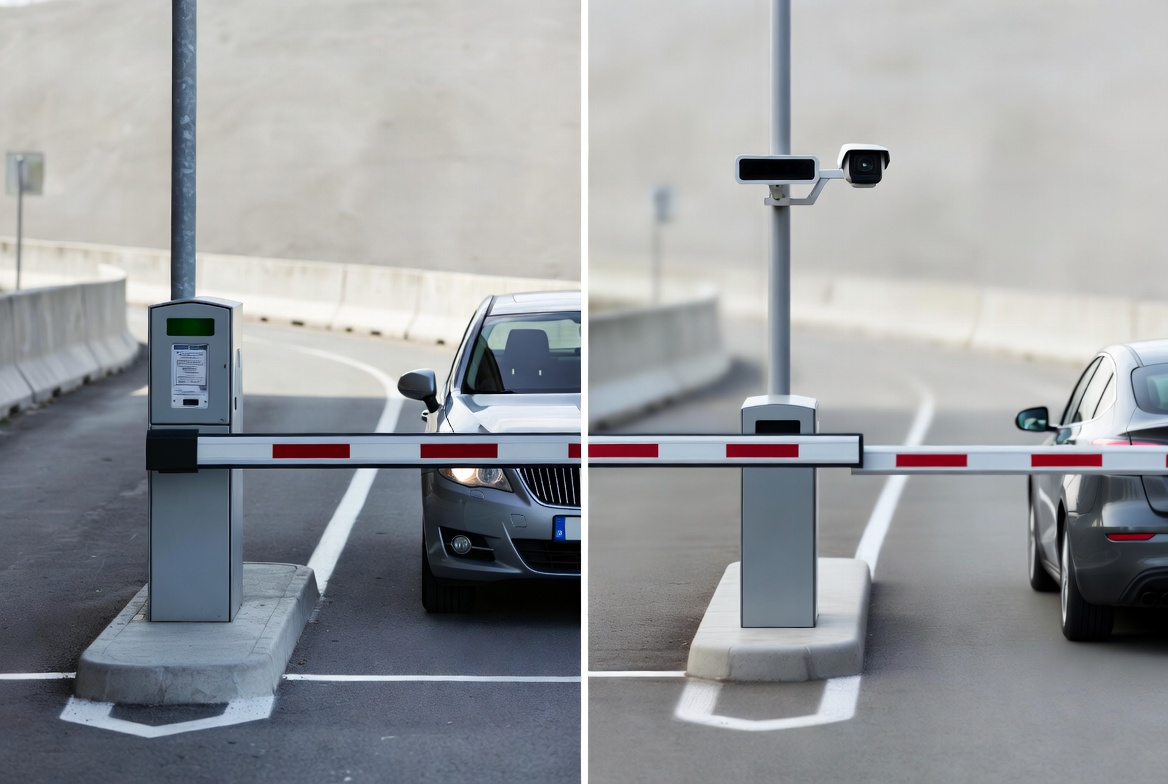
Entry: The driver approaches the entry lane and activates a sensor (typically a vehicle detection loop or infrared beam). A ticket dispenser issues a paper or plastic ticket encoded with the entry time. The barrier gate rises, and the driver proceeds.
Duration: The vehicle parks. The clock runs.
Payment: Before returning to the vehicle (in a pay-on-foot model) or at the exit lane (in a pay-at-exit model), the driver inserts the ticket into a pay station or hands it to an attendant. The system calculates the fee based on elapsed time and the applicable rate schedule. The driver pays and receives a validated ticket.
Exit: The driver inserts the validated ticket at the exit verifier. The gate rises. The ticket is retained or collected for reconciliation.
It is a proven workflow. Millions of parking transactions follow this exact sequence every day. The equipment is well-understood, widely available, and supported by a deep bench of service technicians.
Strengths of Ticket-Based Systems
Universality. Every driver understands how to take a ticket and pay for parking. There is no learning curve, no app to download, no plate registration to complete. The physical ticket is a tangible reminder that a transaction is in progress.
Reliability. Ticket dispensers are mechanically straightforward devices. Modern units from established manufacturers like Parking BOXX feature robust ticket transport mechanisms, multiple ticket stock sensors, and diagnostic capabilities that alert operators to jams or low stock before they become service-affecting.
Rate flexibility. Ticket-based systems handle complex rate structures with ease. Time-of-day pricing, early-bird specials, event surcharges, lost-ticket fees, and validation discounts are all standard features in modern PARCS software. The ticket carries the entry timestamp, and the payment calculation happens at the pay station, giving operators broad flexibility in how they structure pricing.
Fallback capability. When network connectivity drops or software encounters an error, the physical ticket provides a fallback. The entry timestamp is encoded on the ticket itself, so payment can be calculated even if the system is temporarily offline.
Weaknesses of Ticket-Based Systems
Consumables. Tickets cost money. Standard magnetic-stripe tickets run between $0.02 and $0.05 each, which adds up in high-volume facilities. Stock management, reordering, and loading are ongoing operational tasks.
Mechanical maintenance. Ticket dispensers have moving parts — feed rollers, print heads, cutting mechanisms — that wear out and require servicing. Paper jams, while less frequent than they once were, still occur and require on-site intervention.
Throughput limitations. The ticket-taking process adds seconds to each entry transaction. In a high-volume garage during morning rush, those seconds translate to queues. A driver who fumbles a ticket or whose window is too far from the dispenser creates a bottleneck.
Lost tickets. Every operator’s least favorite topic. Lost tickets generate customer frustration, revenue disputes, and administrative overhead. Standard practice is to charge a maximum daily rate for lost tickets, but this policy produces complaints and, in some cases, genuine hardship for the occasional parker who simply misplaced a slip of paper.
How Ticketless Systems Work
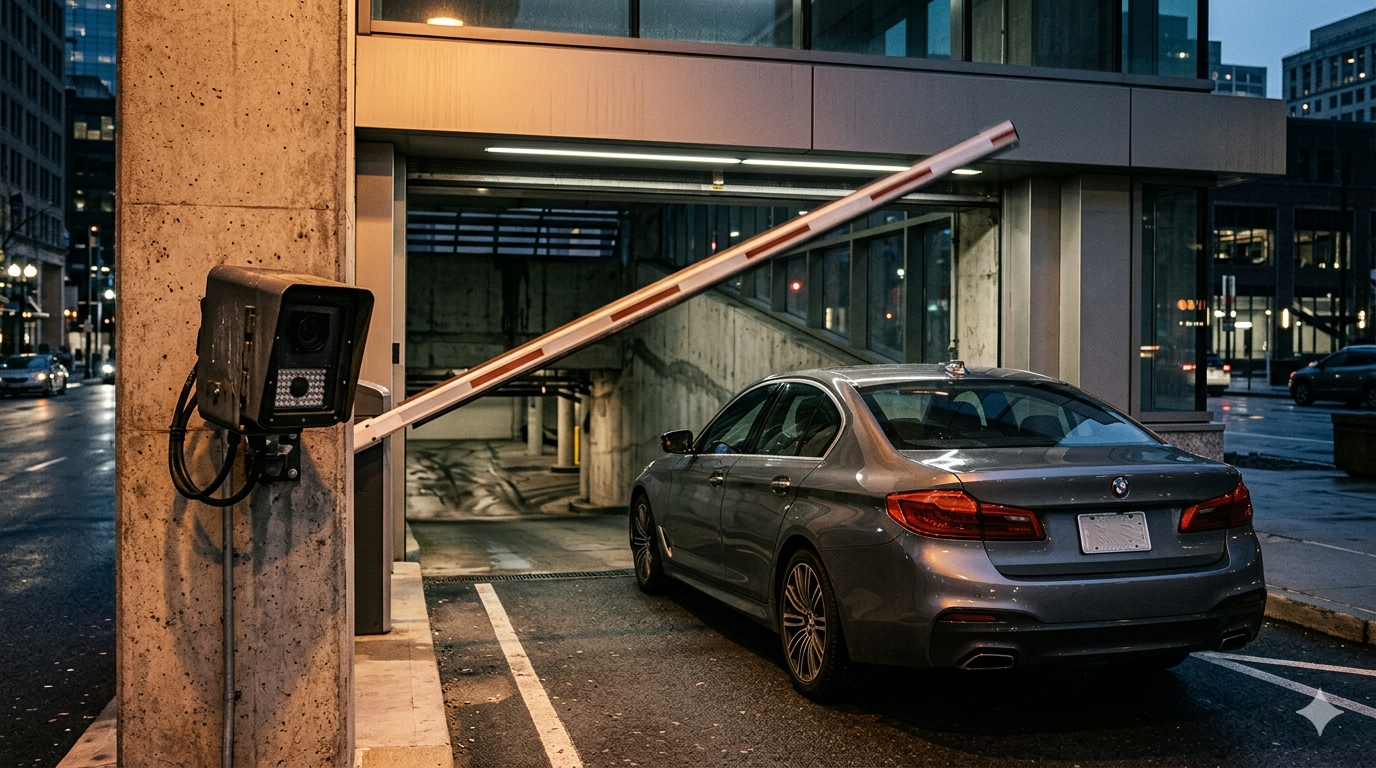
A ticketless system replaces the physical ticket with a digital record keyed to the vehicle’s license plate.
Entry: The driver approaches the entry lane. An LPR camera captures the license plate and records the entry time. The barrier gate rises automatically (or after a brief confirmation on a display). No ticket is dispensed. No physical interaction occurs.
Duration: Identical to the ticket-based model. The vehicle parks. The clock runs.
Payment: The driver pays at a pay station by entering their plate number (or having it read by an integrated camera at the pay station). The system looks up the entry record, calculates the fee, and processes payment. Alternatively, the driver pays via a mobile app linked to their plate.
Exit: The driver approaches the exit lane. The LPR camera reads the plate, confirms that payment has been made, and the gate rises. If payment has not been made, the system either directs the driver to a pay station or processes payment at the exit lane.
Strengths of Ticketless Systems
No consumables. No tickets to purchase, store, load, or dispose of. This is a meaningful operational simplification and a modest but real cost savings.
Faster throughput. Removing the ticket-taking step shaves several seconds off each entry transaction. In a 500-space garage processing 800 daily entries, those seconds add up to meaningful queue reduction during peak periods.
No lost tickets. The single most compelling operational argument for ticketless. The entire category of lost-ticket disputes, lost-ticket fees, and lost-ticket customer frustration disappears.
Data richness. Every LPR read generates a data point — not just entry and exit times, but plate-level information that enables customer analytics, repeat-visitor identification, and occupancy pattern analysis. This data is significantly richer than what a ticket-based system provides.
Seamless integration with monthly/permit accounts. Vehicles with active accounts are recognized automatically at entry and exit. There is no separate credential — no proximity card, no transponder, no hang tag. The plate is the credential.
Weaknesses of Ticketless Systems
LPR accuracy. No LPR system reads 100 percent of plates correctly 100 percent of the time. Dirty plates, temporary tags, obscured characters, unusual plate formats, and challenging lighting conditions all reduce read rates. A system that achieves 97 percent accuracy in controlled testing might perform at 93 to 95 percent in real-world conditions, depending on the environment.
Every misread creates a customer service event. The driver whose plate was not captured at entry has no record in the system and cannot pay through the normal process. Handling these exceptions — via intercom, manual entry, or default rate assessment — is the operational overhead that ticketless systems trade for the elimination of physical tickets.
Customer familiarity. Not every parker immediately understands a ticketless system. The first-time visitor who expects a ticket and does not receive one may feel uncertain about whether their entry was recorded. Clear signage and confirmation displays mitigate this, but there is a learning curve that does not exist with tickets.
Rate limitations in some configurations. Ticketless systems that rely on plate entry at pay stations require the driver to remember (or look up) their plate number. This is a minor friction point but a real one. Pay stations with integrated LPR cameras that read the plate automatically eliminate this issue but add hardware cost.
Rental vehicles and temporary plates. Drivers in rental cars may not know the plate number. Temporary paper tags are notoriously difficult for LPR cameras to read. These scenarios require fallback procedures that add operational complexity.
The Hybrid Approach
Increasingly, operators are deploying hybrid systems that combine ticketless LPR with a ticket-dispensing backup. In normal operation, the LPR camera captures the plate and the gate rises without a ticket. If the camera fails to read the plate — due to obstruction, an unreadable temporary tag, or a system error — the dispenser issues a ticket as a fallback.
This hybrid model captures most of the throughput and convenience benefits of ticketless operation while providing a safety net for the edge cases that would otherwise require manual intervention.
The hybrid approach is particularly common in facilities that serve a mix of regular and transient parkers. Regulars — monthly permit holders, employees, frequent visitors — experience seamless LPR-based access. Transients, some of whom may be uncomfortable with a purely ticketless interaction, have the reassurance of a physical ticket if the system determines one is needed.
Decision Factors
Volume and Throughput Needs
High-volume facilities with peak-hour congestion benefit most from ticketless operation. If your entry lanes regularly queue during morning rush, eliminating the ticket-taking step can provide meaningful relief without adding a second lane.
Customer Profile
Facilities serving a tech-savvy urban commuter population will encounter less friction with ticketless than those serving an older or less technology-comfortable demographic. Hospital parking, for example, serves patients who may be distracted, stressed, or unfamiliar with the facility — a population where the tangible simplicity of a ticket has value.
Rate Structure Complexity
Simple rate structures (flat rate, hourly, daily max) are well-suited to ticketless operation. Highly complex structures with multiple validation types, split-rate calculations, or negotiated corporate rates may be easier to manage in a ticket-based or hybrid configuration, at least until the PARCS software can handle all scenarios seamlessly through plate-based lookup.
Existing Infrastructure
Operators with recently installed ticket-based systems may find that adding LPR cameras to their existing lanes — creating a hybrid configuration — delivers most of the benefits of ticketless at a fraction of the cost of a full system replacement. Most modern PARCS platforms support this kind of incremental upgrade.
Climate and Environmental Conditions
LPR performance is affected by environmental factors. Facilities in regions with heavy snow, frequent rain, or extreme temperature swings should evaluate LPR accuracy under worst-case conditions, not just optimal ones. Ticket-based backup capability becomes more important in challenging climates.
Cost Comparison
Direct cost comparisons between ticket-based and ticketless systems are complicated by the wide range of configurations, feature sets, and vendor pricing models in the market. However, some general observations hold:
Capital cost. A ticketless entry lane (LPR camera, controller, barrier gate) typically costs less than a ticket-dispensing entry lane (dispenser, controller, barrier gate) because the LPR camera is less mechanically complex than a ticket dispenser. However, the difference narrows when you add LPR cameras at pay stations and exit lanes.
Operating cost. Ticketless systems have lower ongoing costs — no ticket stock, fewer mechanical components to maintain. The savings are modest on a per-lane basis but accumulate across multi-lane, multi-facility operations.
Total cost of ownership. Over a seven- to ten-year equipment lifecycle, ticketless systems generally deliver a lower total cost, assuming LPR accuracy is sufficient to keep exception-handling costs manageable.
Where the Industry Is Heading
The trend is clearly toward ticketless, with ticket-based backup available as a safety net. New facility installations increasingly default to ticketless or hybrid configurations. Existing facilities are adding LPR to their ticket-based lanes as budgets allow.
The pace of adoption is being driven by two converging forces. First, LPR technology continues to improve — higher-resolution cameras, better algorithms for handling difficult plate types, and machine learning models that adapt to site-specific conditions, as reported by Parking Today. Second, customer expectations are shifting. Parkers who use toll roads with automatic plate-based billing, who unlock their cars with their phones, and who check out of hotels without stopping at the front desk increasingly expect parking to be equally frictionless.
The ticket is not going to disappear overnight. Too much installed infrastructure depends on it, and the edge cases that challenge ticketless systems are real. But for operators planning new installations or major renovations, the question has shifted from “should we go ticketless?” to “how do we manage the transition?”
The answer, for most, starts with a clear-eyed assessment of their specific facility, their specific customers, and their specific operational capabilities — not with a technology choice made in the abstract. The best system is the one that works reliably for your operation, not the one that sounds most impressive in a product brochure.