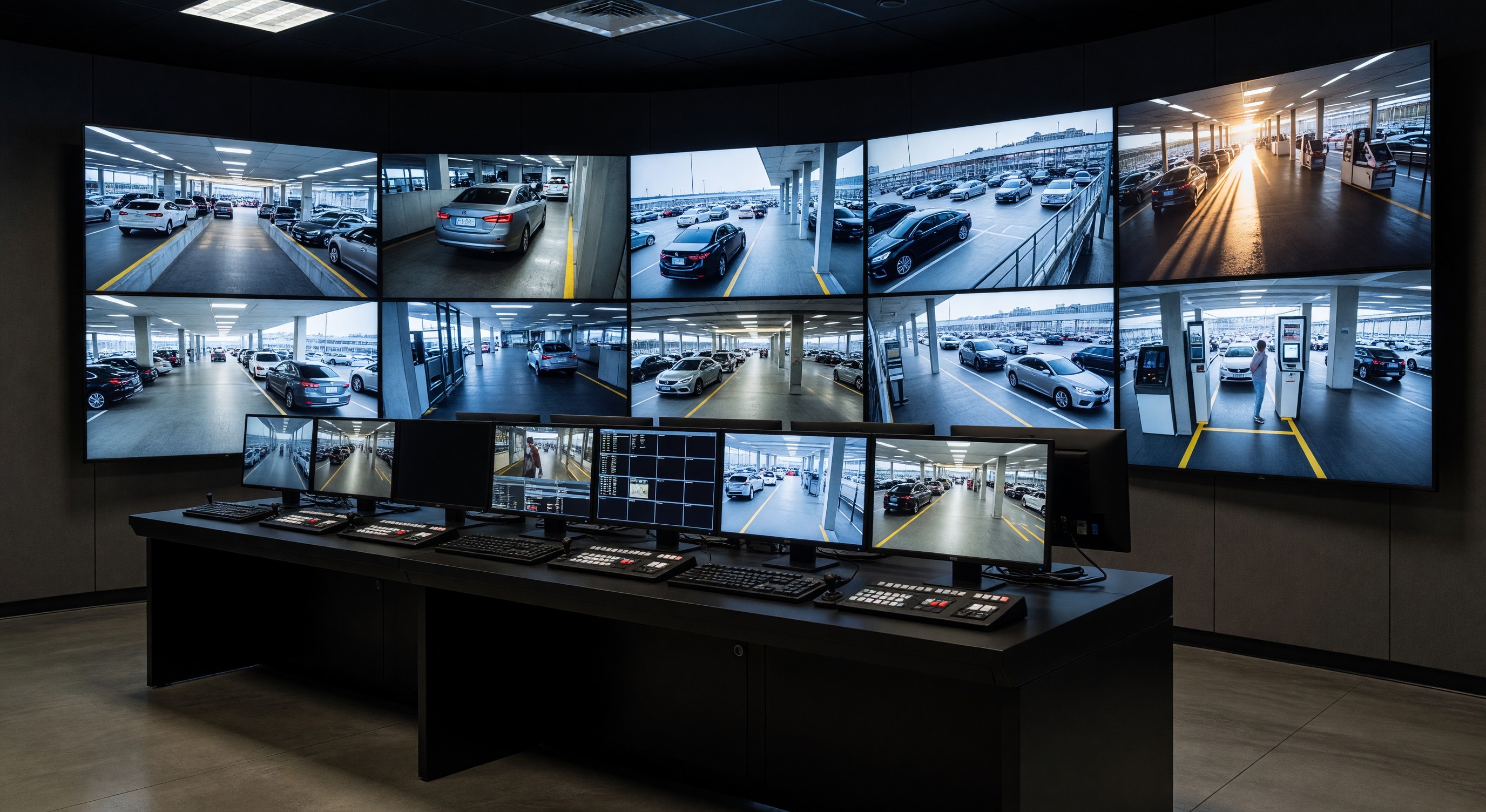
Video surveillance in parking facilities serves two distinct operational functions: security monitoring (deterrence and response to criminal activity, incident documentation, liability protection) and operational intelligence (occupancy detection, traffic flow analysis, equipment monitoring). Video management systems (VMS) are the software platforms that aggregate camera feeds, manage storage, enable live and recorded video review, and increasingly apply AI analytics to extract operational data from video streams. A well-designed parking VMS serves both security and operational functions from a unified platform.
Parking Facility Camera Network Design
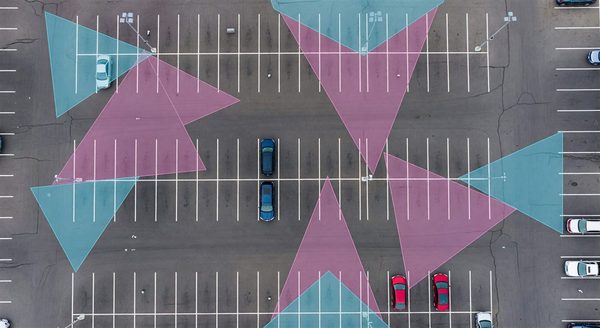
Camera placement priorities: Effective parking surveillance requires coverage at specific areas where the density of events (incidents, enforcement needs, equipment interaction) justifies camera investment. Priority locations in most parking facilities: all entry and exit lanes, all pedestrian access points (elevators, stairwells), cashier booths and pay station faces, each parking level at aisle ends and full-level coverage for large floors, and any areas with documented security incident history.
IP cameras vs. analog: IP (network) cameras have largely replaced analog CCTV in parking facilities built or renovated in the past decade. IP cameras transmit video over standard Ethernet networks, support higher resolution (2MP to 12MP and above), and connect to VMS platforms via standard ONVIF or RTSP protocols. Existing analog installations can be extended with IP cameras on a hybrid system, but new installations should be fully IP.
Resolution selection: Entry/exit lane cameras used for LPR capture need sufficient resolution to read license plates — typically at least 2MP for narrow lane coverage. General area surveillance cameras can use lower resolution (2MP to 4MP) for coverage without needing plate-level detail. Specific areas requiring facial or detailed recognition (cashier booths, elevator lobbies) benefit from 4MP to 8MP cameras at close range.
Lens selection and field of view: Parking structure levels with long aisles require long focal length lenses or wide-angle lenses at the aisle end to cover the full aisle length. Elevator lobbies and entry vestibules need wide-angle coverage of a small area. Fisheye (360-degree) cameras can cover an entire level from a ceiling-mounted position but with reduced detail at the periphery. Match lens selection to the specific coverage requirement.
Environmental considerations: Parking structures expose cameras to extremes of temperature, moisture, and dust. Cameras in outdoor-exposed areas require weatherproof housings rated IP67 or higher. Underground structure cameras face humidity and exhaust deposit buildup that requires regular cleaning.
Video Management System Architecture
On-premise VMS: VMS software installed on servers at the facility manages camera streams, records video to local NAS or direct-attached storage, and provides access to live and recorded video through desktop clients or web interfaces. On-premise VMS provides full control over storage, network traffic, and system configuration. Requires server hardware investment, IT management, and dedicated network bandwidth.
Cloud VMS: Camera video streams are processed or recorded in the cloud. Cloud VMS reduces or eliminates on-site server hardware and enables remote access without VPN. Video transmission to the cloud requires significant upload bandwidth (a 24-camera system recording at 1080p continuously requires substantial upload capacity). Cloud VMS has growing adoption in commercial parking.
Hybrid VMS: Edge recording at the camera or a local network video recorder (NVR) handles continuous recording; cloud provides remote access, AI analytics processing, and long-term archiving. Hybrid VMS is a common architecture for facilities with limited upload bandwidth or specific data locality requirements.
NVR vs. NAS storage: Network video recorders (NVR) are dedicated appliances that manage camera connections and local storage. NAS (network-attached storage) provides storage capacity that VMS software on a server accesses. NVR is simpler to configure; NAS provides more flexibility in storage scaling and management.
Video Retention and Storage Calculation
Retention requirements: Parking facility video retention periods should be defined based on: operational need (how long after an incident is video review requested?), legal requirements (some jurisdictions have minimum retention periods for parking facility CCTV), and insurance requirements (some insurers require minimum retention for coverage). Most commercial parking operations retain video for 30 to 90 days.
Storage estimation: Storage required depends on camera count, resolution, frame rate, and compression codec. A rough estimate for H.265-compressed 2MP cameras recording continuously: approximately 1.5 to 2 GB per camera per day. A 30-camera system at 30 days retention requires approximately 1.4 to 1.8 TB of storage. Higher resolution, higher frame rate, or less efficient compression (H.264 vs. H.265) increases storage requirements proportionally.
Motion-triggered recording: Reducing recording to periods of detected motion reduces storage requirements by 50 to 80 percent in areas with intermittent activity. Motion-triggered recording is appropriate for interior facility areas; always-on recording is appropriate for entry/exit lanes and high-activity areas.
Video Analytics for Parking Operations
Occupancy detection: Camera-based AI can detect vehicle presence in individual parking spaces, providing occupancy data without per-space sensor hardware. The same cameras that serve security functions can serve parking guidance functions if video analytics are applied. Accuracy in parking structures is affected by lighting variability and shadow conditions.
People counting: Pedestrian counting using video analytics at elevator lobbies and stairwell entrances provides data on pedestrian traffic patterns, useful for staffing and safety planning.
License plate recognition: LPR cameras integrated with VMS provide plate data alongside video for incident investigation — when a vehicle is involved in an incident, the plate can be retrieved from the LPR log associated with the camera position.
Intrusion detection: Video analytics can detect vehicles or people in restricted areas outside operating hours, generating alerts for remote monitoring response. Zone-based intrusion detection can trigger alerts for specific areas (reserved parking zones, employee-only areas) without full-facility motion detection.
Wrong-way detection: In one-way aisles and entry/exit lanes, video analytics can detect vehicles moving in the wrong direction, generating alerts for staff response.
VMS Platform Evaluation
ONVIF compliance: Confirm that the VMS platform supports ONVIF (Open Network Video Interface Forum) protocol for camera connectivity. ONVIF compliance enables integration with cameras from multiple manufacturers, avoiding a single-vendor camera ecosystem requirement.
Scalability: The VMS should scale to the facility’s current camera count and foreseeable expansion. Request performance benchmarks for the expected camera count and resolution.
Mobile access: Modern VMS platforms provide mobile apps for live and recorded video access on smartphones and tablets. Evaluate the mobile client for the specific iOS and Android use cases relevant to the facility’s management team.
Integration APIs: VMS platforms with REST APIs or SDK-based integration enable connection with access control systems (correlating camera events with access control events), PARCS (associating video with transaction records), and third-party analytics platforms.
Video export and evidence handling: Confirm the process for exporting video clips for law enforcement, insurance claims, or legal proceedings. Video should be exportable in standard formats (MP4, AVI) with metadata intact.
Frequently Asked Questions
How long should parking facility video be retained? The minimum is typically 30 days; 60 to 90 days is recommended to cover the latency between an incident and a claim or investigation request. For facilities with significant liability history or specific insurance requirements, longer retention may be warranted. Review applicable state laws for any minimum retention requirements.
What is the difference between a VMS and an NVR? A network video recorder (NVR) is a hardware appliance with dedicated software for recording and managing IP cameras. A video management system (VMS) is software that runs on general-purpose server hardware (or in the cloud) and provides more advanced features — analytics, multi-site management, access control integration, and advanced search. Most serious commercial parking deployments use VMS software rather than NVR appliances for the additional feature and integration capability.
Can parking facility cameras serve dual purposes for both security and parking guidance? Yes. Camera-based occupancy detection using video analytics can serve parking guidance functions (detecting whether spaces are occupied) using the same camera hardware deployed for security. This dual-use eliminates the need for separate per-space sensors in new installations. The trade-off: dedicated occupancy sensors (ultrasonic, magnetic) typically achieve higher accuracy than video analytics occupancy detection in varying lighting conditions.
What cybersecurity measures are required for IP camera networks? IP cameras are internet-connected devices that have been exploited in numerous large-scale attacks. Required measures: change all default passwords before deployment, segment camera networks on dedicated VLANs separate from office networks, apply vendor firmware updates promptly, disable unused camera features (FTP access, cloud connectivity if not needed), and monitor camera network traffic for anomalies.
Takeaway
Video management systems are the operational backbone of parking facility security and increasingly a source of operational intelligence through AI-powered video analytics. A well-designed VMS — with appropriate camera coverage, adequate storage, IP camera standards compliance, and integration with access control and PARCS — provides security documentation, incident response capability, and operational data that improves facility management. The shift from analog CCTV to IP camera networks and cloud-capable VMS platforms has made high-quality video management accessible to facilities of all sizes; the design and implementation decisions that matter most are camera placement, retention policy, analytics integration, and cybersecurity configuration.
Further Reading from Authoritative Sources
- IPMI parking facility security and video management standards — IPMI publishes parking facility security standards, VMS technology guidance, and camera network design best practices for parking operators.
- NIST cybersecurity guidance for IoT devices and IP camera networks — NIST publishes cybersecurity guidance for IoT devices, network security standards, and IP camera security best practices directly relevant to the VMS cybersecurity requirements in this article.