Parking technology is in a period of accelerating change — AI capabilities are expanding from specialized applications to general operational tools; EV charging is transitioning from amenity to utility infrastructure; autonomous vehicle preparation is moving from speculative planning to practical design decisions; and the PARCS market is consolidating toward cloud-native platforms with broader ecosystem integration. Understanding which emerging technologies represent actionable near-term investments versus longer-horizon possibilities helps operators build technology roadmaps that improve current operations without over-investing in speculative capabilities.
The Current State of Parking Technology
Before mapping the road ahead, understanding where the industry stands as of 2026:
Cloud PARCS is the market standard: The majority of new PARCS deployments are cloud-native or cloud-hybrid. On-premise PARCS deployments are increasingly limited to facilities with specific connectivity or security requirements. Operators still on legacy on-premise systems face growing pressure — shrinking vendor support, limited integration capability, and increasing total cost of maintaining aging server infrastructure.
LPR is mainstream access control: License plate recognition for monthly permit access control has moved from differentiated feature to mainstream PARCS capability. Facilities that have not transitioned to LPR-enabled access for at least their monthly parker population are behind the operational standard.
Mobile payment is table stakes: Contactless payment (NFC tap-to-pay, mobile wallets) is now a baseline consumer expectation. Facilities without contactless payment capability face customer satisfaction gaps relative to the market.
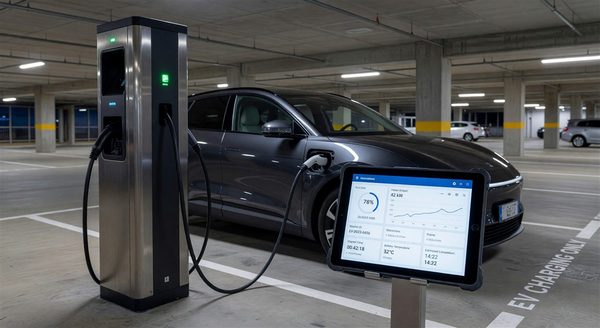
EV charging is an infrastructure requirement: EV adoption has crossed the threshold at which EV charging availability is a requirement for competitive commercial facilities, not an optional amenity. The planning question is no longer whether to deploy EV charging, but how many stalls, at what power level, and with what management infrastructure.
Near-Term Investment Priorities (2026-2027)
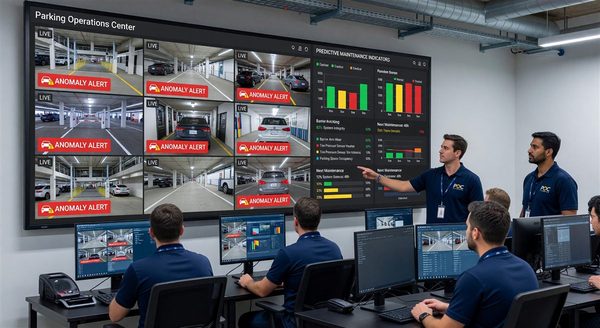
AI-powered operational management: Practical AI tools — large language models and multimodal AI — are becoming viable for parking operational tasks previously requiring specialized software: natural language queries of operational data (“Show me occupancy last Tuesday compared to the same day last year”), automated anomaly detection in revenue streams, and predictive maintenance alerts from equipment sensor data. These capabilities are becoming available through PARCS platform AI features and through integration of general-purpose AI APIs with existing operational data.
Actionable for most operators: ensure PARCS platform data is accessible via API for AI tool integration; evaluate PARCS vendor AI feature roadmaps during renewal negotiations; and pilot AI-based anomaly detection in revenue reporting workflows where the operational value is immediate.
EV charging infrastructure expansion: Facilities in higher-EV-adoption markets (California, Pacific Northwest, major Northeast cities) that have not yet deployed significant EV charging are at competitive risk. Near-term investment priorities: Level 2 charging for commuter parkers with all-day dwell times; DCFC for transient facilities where rapid charge is the customer need; OCPP 2.0.1 compliant equipment for interoperability future-proofing; and smart charging management systems for load management as charging density increases.
Virtual permitting completion: Facilities that still rely on physical hang tags or stickers for monthly permit programs should complete the transition to LPR-based virtual permitting. The operational efficiency advantage (immediate activation, no physical permit management, superior enforcement) is well-established, and the technology is mature.
Data integration and analytics: Facilities that have not yet built analytical workflow infrastructure — connecting PARCS data to dashboards, enabling KPI tracking without manual report compilation — should prioritize this as a foundational operational improvement. The investment is modest relative to the ongoing operational value.
Medium-Term Considerations (2027-2030)
Autonomous vehicle preparation: Fully autonomous vehicles (SAE Level 4/5) are beginning to appear in limited commercial deployment contexts as of 2026, but their impact on mainstream commercial parking is a 5 to 10 year horizon for most markets. Near-term practical steps that don’t require speculative investment: ensure new construction projects include electrical conduit and communication infrastructure for future AV technology without committing to specific equipment; avoid permanent structural designs that would be difficult to adapt for AV-specific functions (drop zones, narrow-aisle storage, zero-clearance parking); and monitor AV deployment in the specific markets where your facilities operate.
V2G and grid services: Vehicle-to-grid technology — bi-directional EV charging that allows parked EVs to provide grid services — is advancing from pilot to early commercial deployment. Parking facilities with large EV charging capacity and appropriate utility relationships may have opportunities to participate in demand response programs that generate revenue from grid services. This is a medium-term opportunity that requires utility program availability, appropriate EVSE equipment, and V2G management software — none of which are yet ubiquitous.
Biometric and alternative authentication: Facial recognition and other biometric authentication technologies are being piloted for parking access control. Biometric parking access offers the lowest-friction entry experience (no card, no plate lookup, no app interaction), but faces regulatory headwinds (several states have restricted commercial biometric data collection) and significant consumer adoption barriers. A monitoring stance — tracking regulatory and adoption developments without deployment investment — is appropriate for most operators over the medium term.
Platform consolidation: The parking technology vendor market has been consolidating — larger PARCS platforms acquiring permit management, enforcement, and analytics competitors to offer broader integrated suites. This consolidation simplifies integration overhead for operators using single-vendor platforms, but concentrates vendor dependency risk. Operators should evaluate contract terms that protect data portability and exit rights as vendor consolidation continues.
Longer-Term Horizon (2030+)
Autonomous parking facilities: Fully autonomous parking — where the vehicle parks itself without a human driver from a drop-off zone — requires both AV-capable vehicles at sufficient market penetration and facility infrastructure designed for autonomous operation. This scenario is beyond the near-term planning horizon for most current facilities, but relevant for facilities being designed for 30+ year lifecycles.
Dynamic shared parking ecosystems: Technology platforms that enable real-time sharing of parking inventory across multiple operators in a market — with dynamic pricing, unified payment, and centralized demand management — are conceptually attractive for urban parking markets. Several pilot programs exist; widespread adoption depends on operator collaboration, interoperability standards, and regulatory frameworks that don’t yet exist at scale.
Quantum-optimized routing and parking: Theoretical applications of quantum computing to urban mobility optimization, including parking demand routing, represent a very long horizon that is not actionable for current parking technology planning.
Building a Technology Roadmap
A practical 3-year technology roadmap for a commercial parking operation should include:
Year 1: Address foundational gaps — cloud PARCS migration if still on legacy on-premise, contactless payment completion, LPR access control deployment, EV charging initial deployment, data analytics infrastructure.
Year 2: Optimize operational performance — virtual permit conversion completion, AI-powered anomaly detection in revenue management, EV charging expansion and smart management integration, occupancy API publication for navigation platform integration.
Year 3: Prepare for next-horizon capabilities — evaluate AV accommodation design requirements for new construction, assess V2G opportunity in your utility markets, evaluate PARCS platform AI features for operational workflow automation, conduct review of data privacy compliance against evolving state laws.
Frequently Asked Questions
What is the single highest-priority technology investment for a parking facility in 2026? For facilities still on legacy on-premise PARCS without LPR access control: PARCS migration to a cloud-native platform with LPR. For facilities on modern PARCS platforms: EV charging infrastructure at meaningful capacity (not just 1 or 2 stations), with OCPP-compliant management software. For facilities with adequate EV charging: analytical infrastructure connecting PARCS data to operational dashboards.
How should parking operators prepare for autonomous vehicles without knowing exactly when they’ll arrive? Design new construction with AV-adaptable features (wider aisles, taller clearances, electrical and communication infrastructure in place, drop zone capacity at entry/exit) without committing to AV-specific fixed infrastructure. For existing facilities, focus on the digital infrastructure (API-based PARCS, occupancy data publishing, reservation capability) that will be required regardless of AV timeline.
Is AI in parking a near-term operational tool or a longer-term possibility? AI for specific operational tasks is actionable now: natural language queries of operational data, anomaly detection in revenue streams, and predictive maintenance signal processing are all achievable with current technology by integrating general-purpose AI APIs with existing PARCS and sensor data. AI that autonomously manages rate strategy, staffing, and customer communication without human review is closer to medium-term capability.
How does the parking technology vendor consolidation affect long-term technology strategy? Vendor consolidation favors operators with well-documented API integrations and strong data portability contractual provisions. As vendors consolidate, the risk of acquiring a system that is then discontinued or degraded as part of a portfolio rationalization increases. Contracts should include data export rights, API access continuity provisions, and termination for cause rights that protect operators from being stranded by vendor strategic decisions.
Takeaway
The parking technology roadmap for 2026 and beyond is navigable with a disciplined priority framework: address foundational gaps first (cloud PARCS, contactless payment, LPR, EV charging), optimize operational performance second (analytics, virtual permits, data integration), and prepare for next-horizon capabilities without over-investing ahead of demonstrated adoption. The technologies most likely to transform parking operations — AI operational tools, widespread EV infrastructure, and eventually AV accommodation — are either actionable now (AI, EV) or appropriately addressed through design flexibility rather than capital deployment (AV). Operators who build strong foundational technology infrastructure today — open APIs, cloud platforms, comprehensive occupancy and transaction data — will be positioned to adopt emerging capabilities as they mature without major infrastructure replacement.
Further Reading from Authoritative Sources
- IPMI parking technology investment planning and roadmap development resources — IPMI provides parking technology investment guidance and market intelligence that helps operators evaluate which technology categories are mature enough for capital investment versus which require further market development — directly supporting the roadmap prioritization framework described in this article.
- US DOE Alternative Fuels Data Center EV charging infrastructure planning for parking facilities — The US DOE AFDC provides EV charging infrastructure planning resources specifically applicable to parking facility operators evaluating EVSE deployment, utility requirements, and network protocol decisions described in the 2026 technology roadmap article.