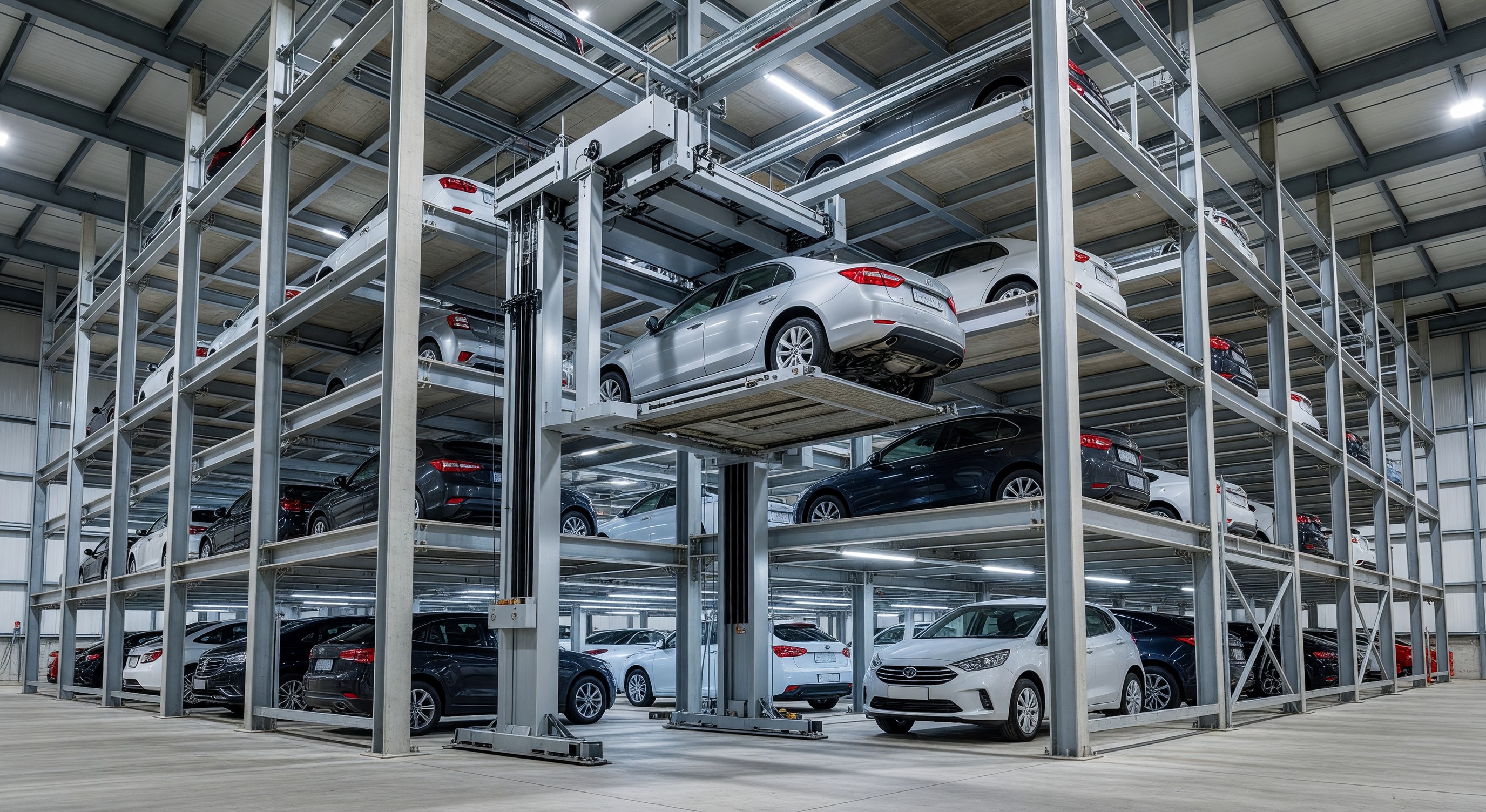
Automated parking systems (APS) — mechanical systems that store vehicles without human drivers operating within the structure — offer significant density advantages over conventional parking when land costs justify the premium infrastructure investment. The technology ranges from simple two-level pit lifts to fully computer-controlled robotic systems that store hundreds of vehicles in the footprint of a conventional multi-level garage. Understanding the categories, throughput characteristics, maintenance requirements, and appropriate applications of automated parking systems helps developers and operators evaluate whether APS is appropriate for a specific project.
Categories of Automated Parking Systems
Semi-automated systems: Systems where the driver participates in part of the parking process, typically by driving the vehicle onto a platform or pallet, and the mechanical system handles storage and retrieval.
Mechanical parking lifts: Single or double-level lifts that raise one vehicle above another, effectively doubling the storage capacity of a single ground-level stall footprint. The simplest form of automated parking; the driver parks the vehicle on the platform manually, and the lift raises it to make room for a vehicle in the lower position. Common for residential garages, small urban lots, and facilities with height clearance.
Puzzle parking: Interlocking platform systems where vehicles are parked on movable platforms, and platforms shift horizontally and vertically (like a sliding puzzle) to create access to any specific vehicle without driver operation within the system. Requires a vacant space for movement; retrieval involves computer-directed platform movements to bring the target vehicle to the entry/exit position.
Pallet systems: Drivers park on a pallet at the entry vestibule; the pallet is transported by mechanical conveyor to an automated storage position within the structure. Retrieval is the reverse. The driver never enters the storage area. Pallet systems can be stacked multiple levels high and extend in a rectangular array.
Fully automated systems: Robotic or mechanical systems where the driver deposits the vehicle in an entry vestibule and exits entirely; the vehicle is stored and retrieved without any driver involvement in the storage area.
Cart-based systems: Wheel-gripping carts carry vehicles horizontally on rails within the storage structure. The cart system can move vehicles both horizontally and vertically (in combination with lifts) to any storage position within a two-dimensional or three-dimensional array.
Robotic systems: Computer-controlled robots navigate the storage structure floor to retrieve and store vehicles. Some systems use multiple robots simultaneously. Robotic systems offer flexibility in storage density and retrieval sequencing.
Rotary tower systems: Vehicles are stored in a rotating vertical carousel — similar to a Ferris wheel for cars. The carousel rotates to bring the requested vehicle to the entry level. Compact footprint; limited horizontal scalability.
Density Advantages and Limitations
The primary justification for APS investment is density — more vehicles stored in less horizontal footprint, which has value when land cost is high:
Density improvement: APS systems typically achieve 50 to 80 percent more vehicles stored per horizontal square foot than conventional self-parking structures, because they eliminate: driving aisles (no aisles needed within the storage area), turning radii clearances, pedestrian circulation paths, and the clearance height required for doors to open. A 10,000 sq ft footprint that accommodates 40 vehicles in a conventional surface configuration may accommodate 70 to 90 vehicles in a fully automated system.
Height utilization: APS systems can stack vehicles to greater heights than conventional structures (since no driver head clearance or elevator lobby space is required per level), further improving density per footprint.
Limitations on density: APS density advantages are most pronounced in small footprint, high-land-cost urban contexts. For large suburban facilities where land cost is lower, the capital cost premium of APS typically does not pencil against conventional construction.
Throughput Capacity
Retrieval time: APS retrieval time depends on system type, storage utilization, and sequencing algorithm. Typical retrieval times: puzzle systems 2 to 5 minutes per vehicle; pallet systems 2 to 4 minutes; cart/robotic systems 1 to 4 minutes. Tower/carousel systems: 30 seconds to 2 minutes for well-positioned vehicles.
Peak throughput constraint: APS systems have a maximum throughput capacity — the number of vehicles that can be deposited or retrieved per hour — that is determined by the number of entry/exit vestibules and the speed of the mechanical system. A system with two entry/exit vestibules and 3-minute average retrieval time has a theoretical maximum throughput of 40 vehicles per hour. Peak demand events that exceed this capacity create wait times that are unacceptable for many applications.
Appropriate applications: APS is most appropriate for facilities with predictable, distributed departure demand (residential, office) rather than highly concentrated peak departures (event venues, airports). A concert venue with 1,500 spaces in an APS system would create hours-long retrieval queues as all attendees attempt to exit simultaneously.
Structural and Mechanical Requirements
Foundation requirements: APS systems with deep pits or multi-level underground storage have significant foundation engineering requirements. Groundwater, soil conditions, and proximity to adjacent structures all affect foundation design. Geotechnical investigation is an early design requirement for APS projects.
Clear span structure: The storage array requires a clear span structure without interior columns that would obstruct the mechanical system’s movement. This typically results in higher structural steel costs than conventional parking with smaller column spacing.
Electrical and control systems: APS systems are electrically intensive — motors, conveyors, elevators, sensors, and control computers all require power. Redundant power supply (UPS for control systems, generator backup) is typically required for reliable operation.
Fire suppression: Enclosed automated parking structures are subject to fire protection requirements that differ from open parking structures. NFPA 88A addresses automated parking garages; fire suppression system design must accommodate the absence of vehicle access paths for manual firefighting.
Maintenance and Lifecycle Considerations
Maintenance intensity: APS systems have more mechanical components than conventional parking — motors, chains, bearings, sensors, pneumatics — and require more intensive preventive maintenance than a conventional garage. Maintenance contracts with the system manufacturer or a qualified third party are typically required. Budget 3 to 5 percent of system replacement cost annually for maintenance.
Downtime risk: When an APS system has a mechanical failure, vehicles stored within the system may be inaccessible until the failure is repaired. Redundant mechanical systems and 24/7 maintenance support contracts are essential for any APS serving regular commuter or residential parkers who need vehicle access at unpredictable times.
System lifecycle: APS mechanical systems have lifespans of 25 to 40 years with appropriate maintenance. Control system software and electronic components may require earlier replacement. Planning for mid-lifecycle control system upgrades should be part of the initial project pro forma.
Frequently Asked Questions
When does automated parking pencil economically? APS investment is typically justified when: land cost exceeds $300 to $500 per square foot (highly variable by market), the density premium of APS provides sufficient additional units to justify the capital premium, and the use case has distributed rather than concentrated peak demand. Residential towers in dense urban markets, hotel parking in central cities, and small urban commercial sites with premium land cost are the most common successful APS applications.
How does automated parking compare to conventional multi-story parking for airport applications? Airport parking demands high peak throughput (simultaneous departure and arrival surges) that APS systems struggle to handle efficiently. Conventional multi-story parking with high aisle count and pay-on-exit lanes is better suited to airport peak demand patterns. APS has found application in airport employee parking (more distributed demand) but less often in traveler parking.
What certifications are required for automated parking systems? APS systems are subject to building code requirements for mechanical equipment, including elevator codes (ASME A17.1 for mechanical parking equipment), fire suppression requirements (NFPA 88A), and structural requirements. Local building departments review and permit APS installations. The APS manufacturer should provide documentation of compliance with applicable codes.
What is the typical cost premium of automated parking over conventional construction? APS construction costs vary significantly by system type, site conditions, and local construction market. As a rough range, fully automated systems cost $35,000 to $75,000+ per space to construct, compared to $20,000 to $45,000 per space for conventional structured parking. The premium is most easily justified in markets where the additional spaces enabled by higher density generate proportionally higher revenue.
Takeaway
Automated parking systems occupy a specific niche in parking development — high land cost, density-constrained sites where the capital premium for mechanical storage is offset by the additional vehicles that can be stored in the limited footprint. For applications with distributed demand patterns (residential, office), appropriate mechanical throughput, and maintenance infrastructure, APS provides a technically viable solution to urban parking density constraints. For applications with concentrated peak demand, large footprints, or less expensive land alternatives, conventional parking construction remains the more appropriate and lower-risk choice. The fundamental APS feasibility question is always density value per dollar against the capital and operational premium of mechanical systems.
Further Reading from Authoritative Sources
- IPMI automated parking systems technology guidance and evaluation resources — The International Parking and Mobility Institute publishes technology evaluation guidance for parking operators, including automated parking systems, that is directly relevant to the article’s content.
- Transportation Research Board automated parking technology and urban parking research — The Transportation Research Board publishes research on automated parking technologies that provides the technical evidence base for the density improvement claims and system performance data discussed in the article.