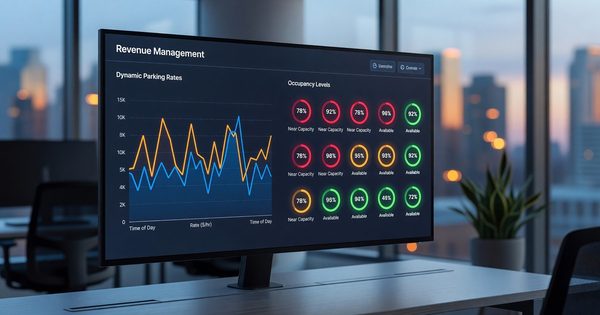
Revenue management — the practice of optimizing pricing to maximize revenue given capacity constraints and variable demand — has long been established in airlines, hotels, and rental cars. The same principles apply directly to parking: a fixed inventory of spaces available over time, demand that varies by time of day and week, and customers with varying price sensitivities. Revenue management software translates these principles into automated rate decisions that maximize parking revenue beyond what static pricing can achieve.
What Parking Revenue Management Software Does
Parking revenue management software automates or supports the rate decisions that operators would otherwise make manually. The core functions:
Demand forecasting: The software analyzes historical occupancy and revenue data, incorporating external signals (events, weather, day of week, holidays), to generate demand forecasts for future periods. These forecasts are the primary input to rate decisions.
Rate optimization: Based on demand forecasts and defined rate boundaries (minimum and maximum rates), the software recommends or automatically sets rates that optimize for a target outcome — typically maximum revenue at or near a target occupancy level.
Rate publishing: Recommended or approved rates are pushed to the PARCS, digital signage, and consumer-facing platforms (mobile apps, reservation platforms) through API integrations.
Performance monitoring: The software tracks actual occupancy and revenue against forecast and prior period, enabling operators to assess rate strategy effectiveness and identify periods where forecasts were inaccurate.
Implementation Approaches
Parking revenue management can be implemented at different levels of automation and sophistication:
Operator-guided rate changes: The simplest implementation — operators use demand forecasting and historical analysis to inform manual rate decisions. A rate management calendar (planned rate schedule by day and period) is updated periodically based on known demand signals. No automation; the software informs rather than executes rate decisions.
Rule-based dynamic pricing: Rates change automatically based on defined rules: “If occupancy exceeds 85% at 9 AM, increase hourly rate to $X for the following 2 hours.” Rule-based systems are transparent and predictable but require operators to define the rules explicitly — the software executes the rules, not a learned optimization.
Algorithmic optimization: Machine learning-based revenue management systems develop demand models from historical data and continuously optimize rate recommendations to maximize total revenue. Algorithmic systems can identify non-obvious patterns (e.g., specific combinations of weather and day-of-week that correlate with high demand) that rule-based systems miss. Require more historical data for model training and more operator sophistication to interpret and override recommendations.
PARCS Integration Requirements
Revenue management software is only operationally effective if recommended rates can be published automatically to the systems where customers encounter them:
PARCS rate management API: The PARCS must expose an API that allows authorized external systems to update rate schedules. Rate changes recommended by the revenue management software are pushed to the PARCS API, eliminating the need for manual rate entry each time a rate adjustment is made.
Digital signage integration: If rate information is displayed on physical or digital signage at the facility entrance, signage content must update when rates change. The revenue management platform should integrate with the signage management system via API or direct control.
Mobile and reservation platform integration: If transient rates are published to mobile apps or reservation platforms (SpotHero, operator-branded apps), those rates must also be updated when the rate management system changes them. Multi-channel rate consistency is essential — customers who see a rate on Google Maps and arrive to find a different rate at the pay station have a negative experience that damages trust.
Dynamic Pricing Ethics and Customer Communication
Dynamic pricing in parking is legal and widespread, but the customer experience is better when pricing variability is communicated transparently:
Advance rate visibility: Publishing expected peak rates in advance (event day rates, holiday rates) allows customers to make informed decisions. Surprise rate increases at the pay station after parking is committed create frustration regardless of their legality.
Maximum rate posting: Many cities and facility types post maximum rates that cannot be exceeded. Revenue management systems must be configured to respect rate ceiling constraints.
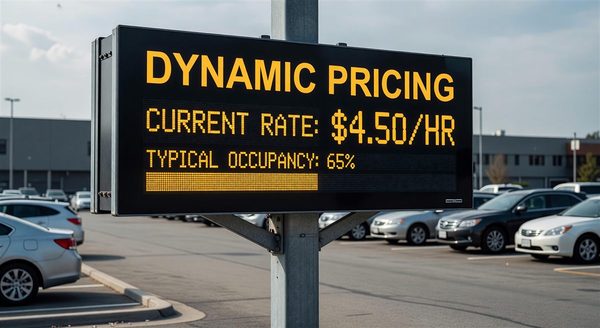
Consumer-facing rate change display: When digital signage can display current dynamic rates, customers have real-time information before committing to the facility.
Specific Platform Categories
Standalone parking yield management software: Purpose-built platforms like FLASH Parking (which includes yield management features) and T2 Systems have developed revenue management modules that integrate with their PARCS infrastructure.
Hospitality revenue management adapted for parking: Some parking operators have adapted hotel revenue management platforms (IDeaS, Duetto) for parking applications where the demand patterns and data structures are compatible. This approach benefits from mature hospitality revenue management science but requires integration work not native to parking operations.
Operator-built analytical workflows: Many operators build revenue management workflows using general-purpose tools (Excel-based models fed from PARCS data exports, Power BI dashboards with rate recommendation logic) rather than purpose-built software. This approach is more labor-intensive but may be appropriate for operations where the volume of rate decisions does not justify dedicated software subscription cost.
Measuring Revenue Management Performance
Revenue per available space-hour (REVPASH): The primary revenue management performance metric. Tracks total revenue relative to capacity and operating hours, enabling comparison across periods with different occupancy levels.
Occupancy vs. rate correlation: Plotting occupancy rates against the rate in effect for each period reveals whether demand is sensitive to rate changes — the fundamental input to elasticity modeling.
Forecast accuracy: How closely demand forecasts matched actual occupancy. Improving forecast accuracy is the highest-leverage improvement in revenue management performance.
Capture rate: What percentage of maximum possible revenue (if every space were filled at the highest achievable rate) was actually captured. Revenue management exists to improve capture rate.
Frequently Asked Questions
What size operation justifies dedicated parking revenue management software? Operations with significant demand variability — event-driven facilities, downtown commercial facilities with peak periods that approach capacity — typically see the most benefit from revenue management software. Facilities with consistent demand at well below capacity have less opportunity for yield optimization. A rough threshold: facilities that regularly exceed 80% occupancy during peak periods and have significant off-peak underutilization are the best candidates.
How much revenue improvement does dynamic parking pricing typically generate? Academic and industry studies of dynamic parking pricing programs have reported revenue improvements of 5 to 15 percent compared to static rate structures in facilities with significant demand variability. The range reflects differences in prior pricing efficiency, demand elasticity, and rate adjustment frequency.
What data is required for parking revenue management software to function? Minimum: hourly occupancy data and revenue data for 12 to 24 months, plus a rate history covering the same period (so the system can assess demand response to past rate changes). Richer data — transaction-level records, event calendar data, weather data — improves forecast accuracy and optimization quality.
How does revenue management software handle special events? Event handling is typically managed through manual event calendar input — the operator enters upcoming events with estimated demand impact. The revenue management system adjusts rate recommendations for event periods based on this input, either automatically or as recommendations for operator approval. Event-period performance should be reviewed post-event to improve future event demand estimates.
Takeaway
Parking revenue management software applies the same yield optimization principles that have driven revenue improvement in airlines and hotels to parking operations — using demand forecasting and rate optimization to maximize revenue from a fixed capacity. The implementation path ranges from operator-guided rate calendars to fully automated algorithmic rate setting; the appropriate level of automation depends on facility complexity, demand variability, and operational analytical capability. For parking operations with significant peak demand and meaningful off-peak underutilization, revenue management investment — even at the simplest analytical level — consistently outperforms static rate structures in total revenue generation.
Further Reading from Authoritative Sources
- IPMI parking revenue management technology and yield optimization resources — IPMI documents revenue management technology adoption in parking operations and provides guidance on yield optimization implementation that directly supports the rate strategy and occupancy-based pricing framework described in this article.
- US DOT performance management framework for transportation revenue optimization — The US DOT transportation performance management framework provides the methodological basis for REVPASH and data-driven operational performance measurement that underpins the revenue management evaluation criteria described in this article.