Parking payment technology has changed more rapidly in the past five years than in the prior two decades. The introduction of EMV chip payment mandates, the growth of contactless tap-to-pay, the proliferation of mobile payment apps, and the emergence of license plate-based payment have given operators an expanding set of payment methods to support — and customers an increasing expectation that any payment method they use elsewhere will work in a parking facility. Understanding where each technology stands, what it costs to implement, and how transaction economics compare helps operators prioritize payment technology investments.
EMV Chip Payment: The Baseline Standard
EMV (Europay, Mastercard, Visa) chip payment became the baseline requirement for parking pay stations following the liability shift implemented by the card networks in 2015. Facilities using non-EMV terminals bear the liability for card-present counterfeit fraud on those transactions — a meaningful financial risk as EMV compliance has become universal at other retail points of purchase.
Most parking pay stations procured since 2016 include EMV chip readers as standard. Older magnetic stripe-only equipment should be flagged for replacement in the capital plan. EMV compliance is a prerequisite for the contactless and tap-to-pay capabilities that drive the current payment technology conversation.
Implementation note: EMV certification is separate from contactless certification. A terminal can be EMV chip compliant without supporting NFC contactless payment. Operators purchasing new equipment should confirm both certifications.
Contactless / NFC Tap-to-Pay
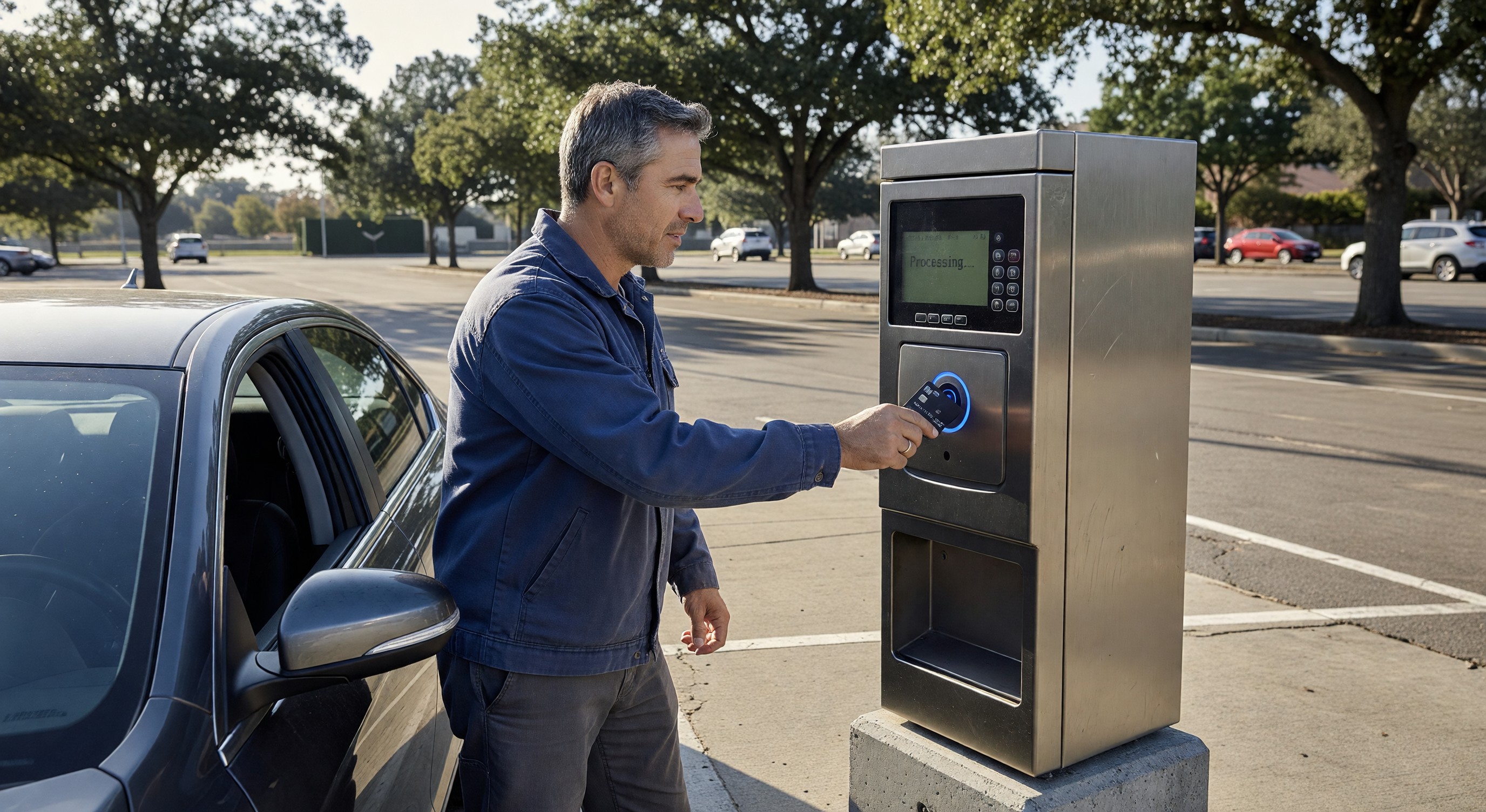
Contactless payment — using near-field communication (NFC) to process transactions by tapping a card, phone, or wearable to the terminal — has grown dramatically since 2019. Apple Pay, Google Pay, Samsung Pay, and NFC-enabled credit cards all use the same terminal technology. Contactless transactions in North American retail increased significantly during the COVID-19 pandemic and have remained elevated as consumer behavior shifted.
For parking operations, contactless payment reduces transaction time (tap vs. insert + PIN or signature), reduces physical contact with shared equipment, and supports the same payment credential customers use at grocery stores and transit systems. Consumer expectation for contactless capability at parking pay stations has risen substantially in urban markets.
Implementation: Contactless payment requires an NFC-enabled terminal certified by the card networks. Many EMV terminals sold in the 2016-2019 period include NFC hardware that was not initially certified; operators should check with their equipment vendor whether a certification upgrade is available for existing terminals.
Transaction economics: Contactless transactions typically carry slightly higher interchange fees than standard card-present transactions, but the network fees are not materially different from chip transactions for most parking operators. The volume benefit (faster transaction throughput at pay stations) can offset the marginal fee difference.
QR Code Payment
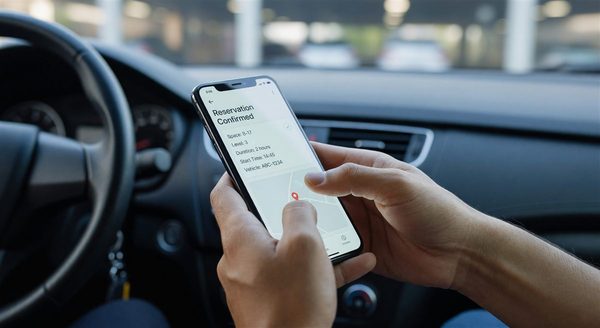
QR code-based payment has grown significantly in North American markets, particularly for contactless parking meter payment. The parker scans a posted QR code (at the space, meter, or pay station) with a smartphone camera, which launches a mobile payment web page or app. Payment is completed on the phone, eliminating the need to interact with a physical terminal.
Operational advantages: QR codes can be added to existing metered spaces and lots without full equipment replacement. A printed QR code sticker on an existing meter allows mobile payment capability at minimal equipment cost. This makes QR code payment particularly attractive for municipal parking programs and operators seeking to add contactless capability to aging pay stations.
Consumer experience considerations: QR code payment requires smartphone proficiency and may create friction for customers unfamiliar with the workflow. Operators deploying QR-only or QR-primary payment should maintain alternative payment methods (card or cash) to avoid excluding customers who cannot use smartphone-based payment.
License Plate-Based Payment
License plate-based payment combines LPR technology with a pre-registered payment account to enable frictionless exit payment — the vehicle’s plate is the payment credential. At entry, the plate is captured; at exit, the fee is calculated and charged automatically to the account associated with the registered plate.
How it works in practice: Monthly parkers and frequent transient customers register their plate and a payment method (credit card) in an operator portal or app. On each visit, the plate is recognized at entry, and the fee is charged at exit without any terminal interaction.
Consumer experience: License plate-based payment provides the lowest-friction parking experience currently available — no ticket, no card tap, no app interaction required. It is the closest equivalent to the seamless experience of bridge toll E-ZPass in parking operations.
Implementation requirements: LPR cameras at entry and exit, PARCS integration for account management and payment processing, and a customer self-service portal for account registration and plate management.
In-Car and Embedded Vehicle Payment
Several automakers have introduced in-vehicle payment capabilities that allow drivers to pay for parking directly through the vehicle’s infotainment system. General Motors’ Marketplace, Honda’s Skill for Amazon Alexa, and similar systems have enabled parking payment from the dashboard, integrated with navigation.
The market for in-vehicle parking payment is developing slowly — consumer adoption has been limited by the fragmentation of automaker payment platforms and the friction of configuring in-vehicle payment accounts. Operators in major urban markets should monitor this space without making significant infrastructure investments until consumer adoption is more established.
Evaluating Payment Technology Investments
Consumer demographics: Payment technology adoption varies significantly by demographic. A facility serving daily commuters in a tech-forward urban market will see higher contactless and mobile payment adoption than a rural hospital lot. Understanding the actual payment behavior of the customer base (through transaction data analysis) should drive prioritization.
Transaction time impact: Contactless and plate-based payment reduce transaction time at pay stations and exit lanes. In high-volume facilities, the throughput improvement from faster payment methods can reduce exit queue length and improve customer experience even if the fee difference is minimal.
Equipment replacement economics: Evaluate whether existing pay station hardware supports newer payment methods through firmware or certification upgrades, versus requiring full equipment replacement. Replacement economics are more favorable when equipment is near the end of its useful life.
PCI DSS compliance: All payment methods that involve card data must comply with Payment Card Industry Data Security Standard (PCI DSS) requirements. Mobile, QR code, and license plate-based payment platforms that process card data are subject to PCI DSS; operators should confirm compliance in any new payment technology vendor’s agreement.
Frequently Asked Questions
Is contactless payment now expected at parking pay stations? In urban commercial and municipal markets, consumer expectation for contactless payment has grown substantially. A 2023 survey by the National Parking Association found that contactless payment availability significantly influences customer satisfaction ratings. Operators serving tech-forward demographics should treat contactless capability as a baseline rather than a premium feature.
What is the difference between Apple Pay/Google Pay and a contactless credit card for parking? Both use NFC at the terminal and process as contactless card transactions. The functional difference is the device presenting the credential — a contactless card vs. a smartphone or smartwatch. From a terminal perspective, both process identically. From a consumer perspective, Apple Pay and Google Pay add tokenization security (the actual card number is not transmitted) and biometric authentication.
How does license plate-based payment handle rental vehicles and vehicle changes? Account holders can update their registered plate through a self-service portal. For rental vehicles, the renter’s plate is not registered unless they explicitly add it; rental scenarios typically require a standard payment method. Operators should provide clear signage directing rental vehicle drivers to standard payment lanes.
What PCI compliance is required for parking operators accepting credit cards? Parking operators accepting card payments must comply with PCI DSS requirements appropriate to their processing method (SAQ D for merchants with direct card data handling, SAQ A or A-EP for operators using certified third-party payment processors that keep card data off-facility systems). Most modern pay station and PARCS payment integrations are designed to minimize operator PCI scope by routing card data through certified payment processors.
Takeaway
Parking payment technology is converging toward touchless, account-based models — contactless card, mobile wallet, QR code, and license plate-based payment all move in this direction. Operators who sequence their payment technology investments by actual consumer behavior in their market, equipment replacement cycles, and PCI compliance requirements will make more defensible investments than those who chase any individual trend. The baseline requirements — EMV chip compliance and NFC contactless capability — are well-established; the emerging technologies (license plate payment, in-vehicle) will develop more gradually. A payment technology roadmap that addresses the baseline now and monitors emerging channels for the next equipment procurement cycle is the appropriate framework for most operations.
Further Reading from Authoritative Sources
- IPMI parking payment technology trends and contactless deployment guidance — IPMI publishes parking payment technology resources and contactless deployment guidance that directly address the EMV, NFC, LPR, and cashless transition topics covered in this article from an industry-standards perspective.
- NIST cybersecurity framework for payment system security in parking operations — NIST’s cybersecurity framework provides the security standard foundation that underpins PCI DSS compliance requirements for parking payment systems, particularly relevant to encryption, access control, and incident response practices described in this article.