The Internet of Things (IoT) refers to physical devices embedded with sensors that collect and transmit data over network connections. In parking facilities, IoT sensor deployment has expanded from occupancy detection to include environmental monitoring, structural health assessment, equipment diagnostics, and pedestrian safety systems. Understanding the available sensor categories, their operational value, and the data infrastructure required to use them helps operators make informed decisions about sensor investment.
Occupancy Sensors
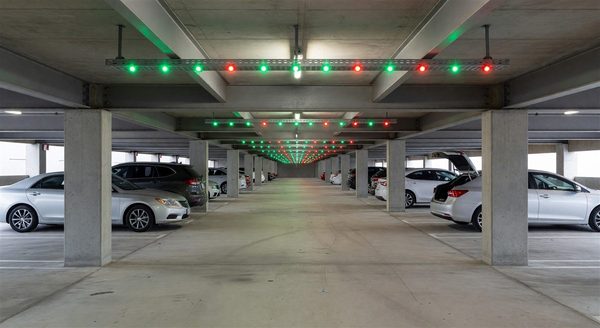
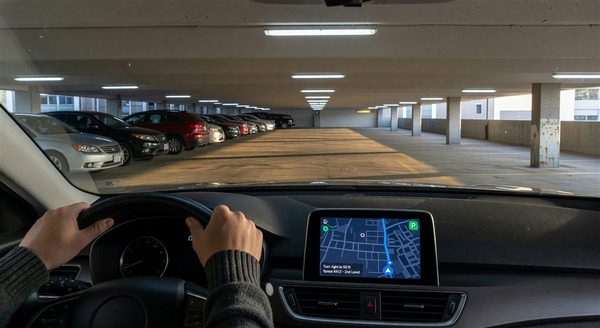
Occupancy sensors are the most widely deployed IoT sensor category in parking, providing the real-time space availability data that powers parking guidance systems, mobile apps, and operational dashboards.
Ultrasonic sensors: Ceiling-mounted sensors emit sound pulses and measure reflection time to detect vehicle presence in the space below. The most common per-space sensor technology in North American parking structures. Typical accuracy: 95 to 98 percent in stable environments. Sensitivity adjustments required for ceiling heights, column positions, and unusual vehicle profiles.
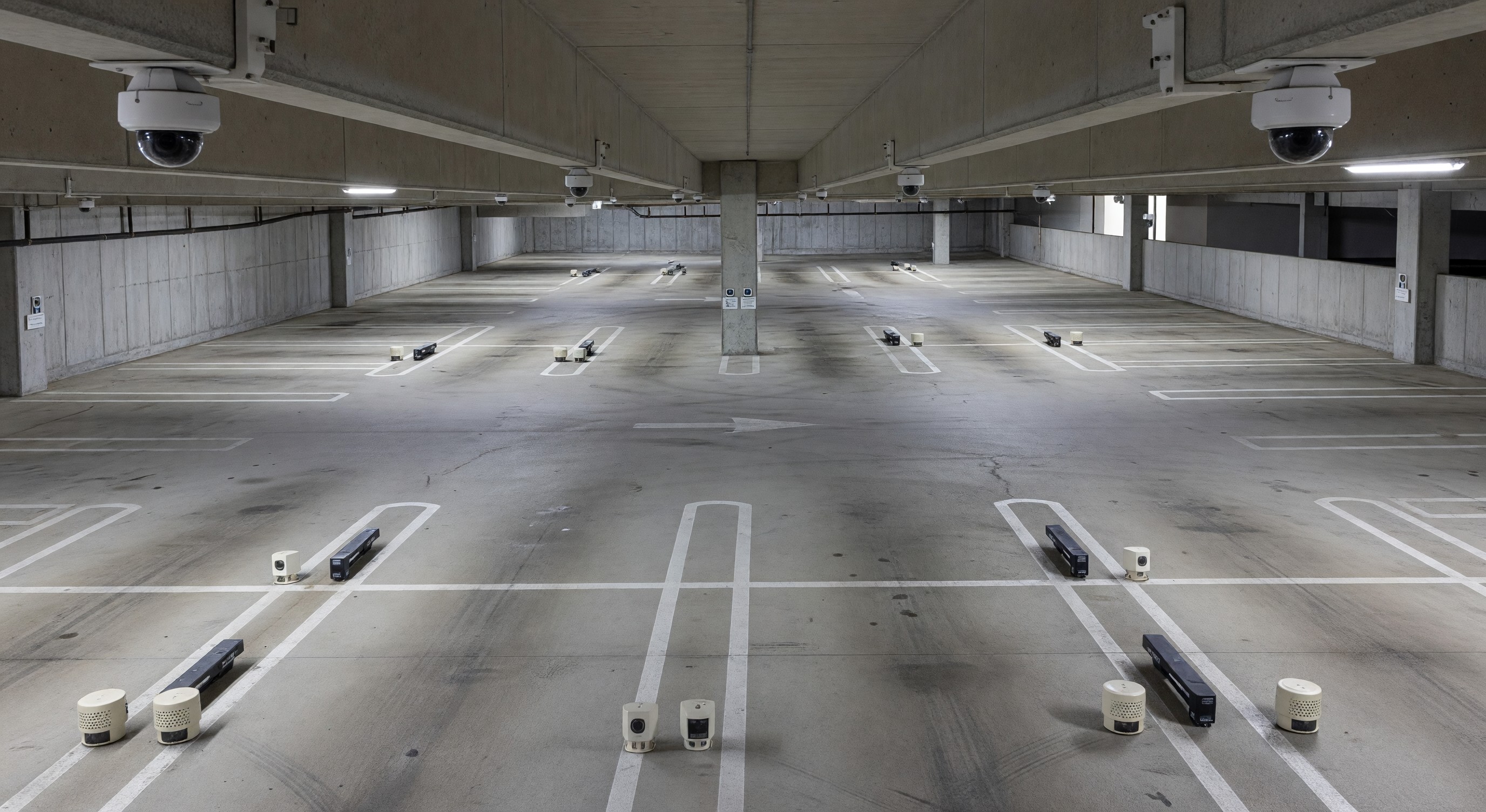
Magnetic field sensors: In-ground sensors detect disruption in the Earth’s magnetic field caused by vehicle metal mass above. Very accurate and stable, but require pavement core drilling for installation and battery replacement over a 3 to 5 year lifecycle. Better suited for surface lot deployment than structured concrete installation.
Camera-based occupancy sensors: Machine vision cameras analyze video frames to detect vehicle presence across multiple spaces simultaneously. Increasingly cost-competitive as processing hardware costs decline. Provides richer data than binary occupancy sensors (vehicle classification, dwell time, space change detection) at the cost of image data management requirements.
Infrared active sensors: Active infrared sensors detect vehicle presence through beam interruption or reflection. Common in single-lane detection (entry/exit counting) and some per-space applications. Less common than ultrasonic for large-scale per-space deployment.
Environmental Sensors
Parking structures — particularly underground and enclosed structures — present specific environmental monitoring needs:
Carbon monoxide (CO) sensors: Required by IMC Section 404 in enclosed garages. CO sensors trigger ventilation system activation when CO concentrations approach hazardous levels (25 ppm OSHA action level, 35 ppm ceiling). Modern CO sensors transmit real-time readings to building management systems and can trigger remote alerts when thresholds are exceeded.
Nitrogen oxide (NOx) sensors: Modern gasoline vehicles produce NOx in addition to CO. Some enclosed garage ventilation codes now reference NOx thresholds alongside CO. NOx sensors are increasingly included in integrated air quality monitoring packages for parking structures.
Temperature and humidity sensors: Temperature and humidity monitoring in parking structures supports HVAC management (maintaining appropriate ventilation in hot weather) and concrete structural management (humidity levels affect corrosion rates in reinforced concrete). Temperature extremes also affect PARCS equipment performance.
Flood and water intrusion sensors: Parking facilities with below-grade levels or inadequate drainage infrastructure are at risk of water intrusion events. Moisture sensors at low points in below-grade sections detect water accumulation and trigger alerts before water levels reach dangerous or equipment-damaging thresholds.
Structural Health Monitoring Sensors
Parking structures have significant structural lifespans but face specific deterioration risks — freeze-thaw cycling in northern climates, chloride penetration from deicing chemicals, corrosion of post-tensioned cables, and dynamic loading from heavy vehicle traffic. Structural health monitoring sensors detect early-stage deterioration:
Crack monitoring sensors: Vibrating wire gauges and displacement sensors installed across known crack locations monitor crack width changes over time. Progressive crack widening indicates active structural deterioration requiring engineering assessment.
Corrosion monitoring sensors: Electrochemical sensors embedded in concrete measure the potential difference indicative of active rebar corrosion. Early detection enables targeted repair before structural capacity is compromised.
Vibration and load sensors: Accelerometers and load cells monitor dynamic loading from vehicles, particularly in facilities with express ramp design or exposed to significant wind loads. Unusual vibration signatures can indicate loosening connections or progressive structural fatigue.
Post-tension cable monitoring: High-value parking structures with post-tensioned concrete slabs may deploy acoustic emission sensors that detect the distinctive acoustic signature of post-tension cable fracture — a safety-critical event that warrants immediate inspection.
Equipment Monitoring Sensors
IoT sensors on parking equipment reduce reactive maintenance by enabling predictive maintenance programs:
Gate arm position sensors: Sensors that confirm gate arm position (fully raised, fully lowered, intermediate) in real time detect gate failures, obstructions, and mechanical drift that indicates maintenance need before full failure.
Pay station diagnostic sensors: Modern pay stations include embedded sensors that monitor cash vault capacity, paper ticket inventory, card reader head wear, and thermal printer status. Integration with a remote monitoring system enables preventive maintenance dispatch before equipment-caused transaction failures.
Motor and actuator health sensors: Current draw monitoring on gate motors and barrier actuators detects abnormal current patterns that indicate bearing wear, obstruction resistance, or motor degradation — predictive indicators of imminent failure.
Pedestrian and Safety Sensors
Pedestrian detection at exit lanes: Thermal or camera-based pedestrian detection sensors at vehicle exit lanes detect pedestrians in the path of exiting vehicles, triggering audible alerts and gate hold. These systems address a genuine safety risk in facilities where pedestrian and vehicle paths cross at exit lanes.
Speed monitoring: Radar-based vehicle speed sensors in parking structures alert when vehicles exceed safe internal speeds. Combined with variable message signs, speed monitoring supports speed management programs in high-traffic facilities.
Emergency call stations: IoT-connected emergency call stations (blue light stations) provide location data and connection status monitoring to security management systems, ensuring operational status of safety equipment.
Data Infrastructure for IoT Sensor Networks
A sensor network generates value only when its data is collected, processed, and acted upon:
Gateway devices: Individual sensors typically communicate via low-power wireless protocols (Zigbee, Z-Wave, LoRa, or cellular) to a local gateway device that aggregates data and transmits it to a cloud platform over standard internet connectivity.
Cloud platform aggregation: Sensor data platforms (AWS IoT, Azure IoT Hub, or parking-specific platforms) aggregate data streams from multiple gateways, apply processing logic (threshold alerts, trend analysis, anomaly detection), and provide the API interface through which other systems (PARCS, parking guidance, building management) consume sensor data.
Alert routing and escalation: IoT deployments require defined alert routing — which sensor conditions trigger what alerts, delivered to whom, through what channel. CO sensor threshold alerts should reach maintenance staff immediately; crack sensor trend reports may be appropriate for monthly engineering review.
Frequently Asked Questions
What IoT sensors provide the fastest ROI in parking facilities? Occupancy sensors (when connected to a guidance system that reduces search time and improves utilization) and equipment diagnostic sensors (when connected to a predictive maintenance program that reduces emergency repair costs) typically provide the fastest payback. Environmental sensors (CO monitoring) address regulatory compliance requirements that make their value less ROI-dependent.
How are IoT sensor networks typically powered in parking structures? Per-space occupancy sensors typically use battery power (3 to 7 year battery life depending on sensor type and transmission frequency). Equipment-mounted sensors may use wired power from the equipment they monitor. Environmental sensors in equipment rooms are typically wired. Power sourcing should be addressed in the sensor selection and installation planning process.
What network connectivity is required for parking IoT sensors? Most modern sensor networks use low-power wireless protocols (Zigbee, LoRaWAN) for sensor-to-gateway communication, requiring only internet connectivity at the gateway level. Facilities without reliable WiFi coverage in all areas may need cellular-connected gateways or wired gateway placement near internet-connected infrastructure.
How does IoT data integrate with PARCS systems? Integration occurs at the platform level — the IoT data platform exposes APIs that PARCS systems (or parking operations dashboards) call to retrieve current sensor status, occupancy counts, and alert conditions. Well-documented REST APIs with webhook support for real-time alerts are the appropriate integration standard.
Takeaway
IoT sensors in parking facilities have moved well beyond simple occupancy detection into a broad platform of connected monitoring that supports structural health, equipment reliability, environmental compliance, and pedestrian safety. The operational value of IoT investment scales with the quality of data infrastructure — sensors that feed well-designed alert systems and analytics platforms deliver measurable operational improvement, while sensors deployed without data infrastructure investment produce data that is never acted upon. A phased sensor deployment strategy that starts with the highest-ROI applications (occupancy for guidance, equipment diagnostics for maintenance) and builds data infrastructure progressively is more sustainable than attempting comprehensive sensor coverage before the operational workflow to use the data is established.
Further Reading from Authoritative Sources
- IPMI parking guidance system and sensor technology standards — The International Parking and Mobility Institute is the primary professional authority for parking technology standards, including sensor selection and implementation guidance directly relevant to the IoT sensors discussed in the article.
- NIST IoT device security and sensor network standards — NIST’s IoT cybersecurity guidance (NIST SP 800-213 and related publications) provides authoritative standards for the sensor network security and device management requirements for parking IoT deployments discussed in the article.