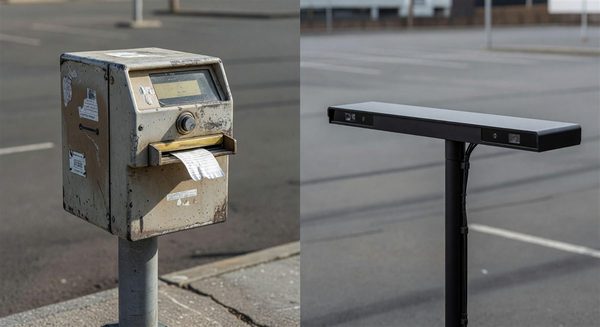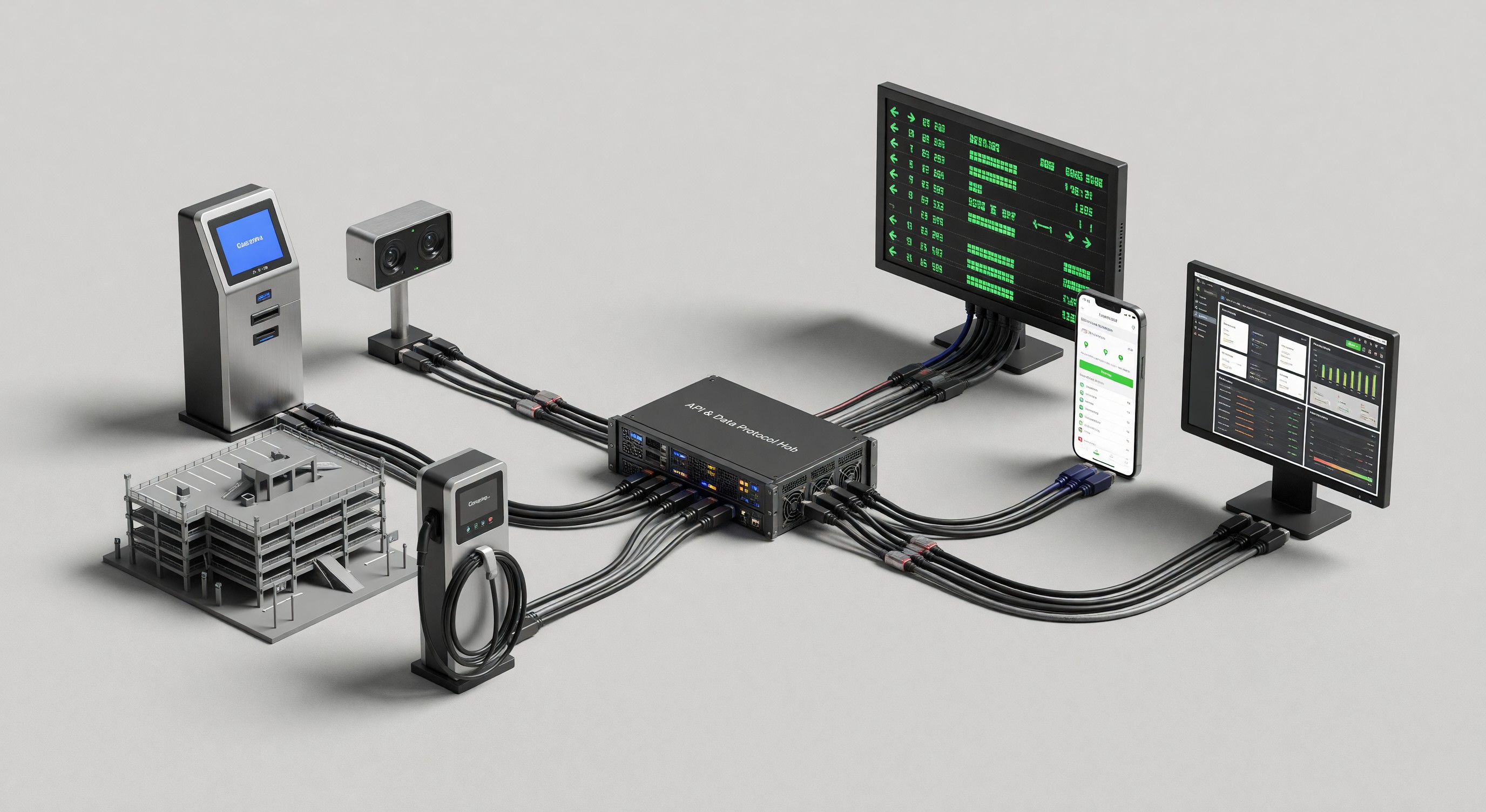
Parking technology investments are long-term commitments — PARCS equipment lifecycles of 10 to 15 years are common, and software platform migrations are costly and disruptive. Interoperability standards determine whether parking technology components from different vendors can communicate and work together, or whether operators are locked into a single vendor ecosystem for the life of each system. Understanding which interoperability standards exist, where they are mature, and where gaps remain helps operators make investments that preserve future flexibility.
Why Interoperability Matters
The parking technology market includes hundreds of vendors across equipment manufacturing, software platforms, payment processing, enforcement, guidance, and mobile applications. Without interoperability standards, each combination of equipment and software from different vendors requires custom integration — expensive, time-consuming, and fragile. Operators who inadvertently purchase from incompatible vendor combinations face integration costs that can rival the equipment cost.
Interoperability standards solve this through pre-defined, documented protocols that any vendor can implement. When two products both support the same standard, integration is predictable and often immediate. The parking industry has made meaningful progress in some areas (payment network interoperability is now mature) and remains fragmented in others (PARCS-to-PARCS data exchange, enforcement platform integration).
Payment Network Interoperability
Payment network interoperability is the most mature area of parking technology standardization. EMV chip payment, NFC contactless, and major card network (Visa, Mastercard, Amex, Discover) acceptance are standardized through card network certification requirements. Any EMV-certified parking pay station can process any EMV-compatible card — this interoperability is complete and contractually enforced by the card networks.
The major gap in payment interoperability is between parking-specific payment platforms (ParkMobile, SpotHero, PayByPhone) and PARCS systems. Each of these integrations is custom — there is no universal parking payment API standard that allows any mobile payment app to integrate with any PARCS without custom development. Industry organizations including the International Parking and Mobility Institute (IPMI) have discussed standardization in this area, but as of the mid-2020s, these integrations remain vendor-specific.
EV Charging Interoperability: OCPP
The Open Charge Point Protocol (OCPP) is the most significant parking-adjacent interoperability standard to emerge in recent years. OCPP defines the communication protocol between EV charging equipment (EVSE) and charging network management software. OCPP 1.6 and 2.0.1 are the current deployed versions.
OCPP compliance means that an OCPP-compliant charger can be managed by any OCPP-compliant network management software — operators are not locked into a single charging network. This is practically important: parking operators adding EV charging should require OCPP compliance from charging equipment vendors to preserve flexibility in choosing or changing network management software.
OCPP 2.0.1 adds capabilities relevant to parking operations: Plug and Charge (ISO 15118) authentication, smart charging for load management, and more granular session data reporting. Facilities adding EV charging should evaluate OCPP 2.0.1 compatible equipment even if OCPP 1.6 is adequate for current requirements, to avoid near-term equipment obsolescence.
LPR Data Standards
License plate recognition data exchange lacks a universal interoperability standard, creating integration challenges when LPR systems from one vendor must communicate with PARCS or enforcement platforms from another:
Plate data format: License plate data is typically transmitted as plain text strings with associated confidence scores and image references. Most platforms accept this format, but field names, confidence thresholds, and image delivery mechanisms vary by vendor.
Database access: The absence of a standard API for permit and violation database queries means that each LPR-PARCS integration is custom. An LPR camera from Vendor A checking plates against a PARCS permit database from Vendor B requires custom API integration that both vendors must develop and maintain.
The practical implication: when selecting LPR equipment and PARCS software, confirm existing integration support before purchasing. Most major LPR and PARCS vendors have developed bilateral integrations with common partner vendors; these established integrations are more reliable than custom integration projects.
PARCS Equipment Communication Standards
Within PARCS systems, communication between field equipment (gates, pay stations, ticket dispensers) and management software has historically used proprietary protocols. This created PARCS ecosystems where equipment from one manufacturer could only be managed by that manufacturer’s software.
More recently, IP-based communication over standard TCP/IP networks has replaced proprietary bus protocols in most modern PARCS equipment. This does not by itself create interoperability — the application-layer protocol (what commands and data are exchanged) is still typically proprietary — but it does mean that physical network connectivity is no longer a barrier to future integration work.
Several industry initiatives have attempted to define PARCS equipment communication standards, including work through IPMI and the National Parking Association (NPA). These efforts have produced draft specifications but have not achieved the market adoption necessary to drive widespread vendor implementation.
Parking Data Exchange Standards
The parking data sharing ecosystem — enabling real-time availability data to flow from facility operators to navigation apps, mapping platforms, and smart city systems — has developed several competing approaches:
APDS (Alliance for Parking Data Standards): A consortium effort including IPMI, NPA, and European parking associations to define standard data models for parking facility information, real-time availability, and rate data. APDS has published specifications for static data (facility location, capacity, amenities) and is working on real-time data exchange standards.
GTFS-Flex and similar transit data formats: General Transit Feed Specification extensions have been proposed to include parking as part of multimodal trip planning data. Adoption has been limited in the parking sector.
Google and TomTom proprietary formats: Navigation platforms have developed their own data ingestion formats for parking availability. Operators who want to appear in Google Maps with real-time parking availability must use Google’s specific data feed format.
The practical result: there is no single parking data exchange standard with universal adoption. Operators who want real-time availability in multiple platforms face multiple integration formats.
Open Standards Evaluation Criteria
When evaluating parking technology vendors, apply these interoperability criteria:
Documented, open APIs: API documentation should be publicly available (or accessible under NDA to integration partners). Undocumented or proprietary APIs that require the vendor’s custom development services for each integration create ongoing cost and dependency.
Stated interoperability support: Ask vendors specifically which PARCS, payment, LPR, and mobile app platforms their system has documented integrations with. Request a reference for each claimed integration.
Standards compliance claims: Verify specific standards compliance (OCPP, EMV, ADA payment terminal accessibility) rather than accepting generic “standards-compliant” marketing language. Request the specific standard version and certification evidence.
Data export without restriction: All stored data should be exportable in standard formats (CSV, JSON, XML) at the operator’s request and at contract termination without fees. This is a minimum interoperability requirement regardless of other standard support.
Frequently Asked Questions
What is the most important interoperability standard for parking operators to understand? OCPP for EV charging and EMV/NFC for payment are the most mature and consequential interoperability standards. For operators adding EV charging, OCPP compliance protects against charging network vendor lock-in — likely the most significant interoperability risk in the current market.
Is there a universal standard for PARCS data exchange? No. PARCS-to-PARCS and PARCS-to-third-party data exchange lacks a universal standard with broad market adoption. Custom API integrations are the norm. The practical implication is that PARCS selection should consider existing integration relationships between specific vendor combinations, rather than assuming any two standards-claiming platforms will integrate without custom work.
How does OCPP 2.0.1 differ from OCPP 1.6 for parking operators? OCPP 2.0.1 adds Plug and Charge (ISO 15118) for automated vehicle-to-station authentication (the vehicle credentials itself without a card or app), smart charging for load management (important for facilities adding significant EV charging capacity alongside other electrical loads), and improved security features. For most current deployments, OCPP 1.6 is functional; future-proofing arguments favor 2.0.1 compliant equipment.
What is APDS and should operators care about it? The Alliance for Parking Data Standards (APDS) is an industry initiative to standardize parking data exchange formats. Its practical impact is currently limited — major navigation platforms use proprietary formats, not APDS. Operators should monitor APDS adoption without making investment decisions contingent on it.
Takeaway
Parking technology interoperability is a spectrum from mature (payment network standards) to fragmented (PARCS data exchange). Operators who understand where standards are established and where gaps remain can make purchasing decisions that minimize vendor lock-in risk: requiring OCPP compliance for EV charging, confirming specific documented integrations between selected PARCS and partner platforms, and contractually requiring open data export. The absence of universal PARCS interoperability standards means that vendor selection is more consequential in parking than in industries with mature open standards — the integration ecosystem of any PARCS platform is a meaningful part of its total value.
Further Reading from Authoritative Sources
- IPMI parking technology interoperability resources and open standards guidance — IPMI actively promotes open interoperability standards in parking technology procurement and has published guidance on APDS adoption and API requirements that directly support the interoperability evaluation criteria described in this article.
- US DOT ITS program on transportation system interoperability and connected infrastructure standards — The US DOT ITS program develops connected transportation interoperability standards including data exchange protocols relevant to parking integration with transit, navigation, and smart city platforms described in this article.