EV charging has become a standard amenity expectation at commercial parking facilities as electric vehicle adoption grows across North America. The equipment — electric vehicle supply equipment (EVSE) — is familiar from consumer experience, but the management software layer that controls, monitors, prices, and reports on charging sessions is less understood by parking operators who are new to charging deployment. EV charging management software is the bridge between the physical charger and the operator’s operational and financial systems, and selecting and implementing it correctly determines whether a charging program runs profitably and efficiently or becomes an operational burden.
OCPP: The Foundation of Charging Management
The Open Charge Point Protocol (OCPP) is the communication protocol between EV charging equipment and charging management software. OCPP defines the messages that equipment and software exchange: session start and stop commands, energy meter readings, fault notifications, firmware update transfers, and configuration changes.
OCPP compliance means that any OCPP-compliant charger can communicate with any OCPP-compliant management software — operators are not locked into the equipment manufacturer’s specific network management platform. This interoperability is practically important: the EV charging network market is dynamic, and an operator who can switch network management software without replacing hardware has significantly more flexibility over a 10-year equipment lifecycle.
OCPP versions in deployment: OCPP 1.6 is the most widely deployed version as of the mid-2020s. OCPP 2.0.1 adds important capabilities including Plug and Charge (ISO 15118 vehicle-to-station automatic authentication), improved smart charging (dynamic load management signals), and enhanced security features. New installations should favor OCPP 2.0.1-capable equipment even if the management platform initially uses OCPP 1.6.
Charging Network Selection
The charging management software layer is typically provided by a charging network operator (CNO) or a standalone software vendor. Options:
National charging networks: ChargePoint, Blink, EVgo, Electrify America, and others offer end-to-end charging programs including equipment, management software, driver authentication, billing, and support. National networks provide an established driver community, smartphone app experience, and network operations center support. Equipment purchased through a national network is typically locked to that network’s management software unless the equipment is OCPP-compliant and the contract permits software migration.
Fleet-focused networks: Networks like Greenlots (now acquired by Shell) and ChargePoint for Fleets focus on managed fleet charging with detailed session reporting, cost allocation by vehicle, and integration with fleet telematics.
White-label and open-source platforms: Operators who want to control the charging experience and economics without dependence on a national network brand can deploy OCPP-compliant chargers with white-label or open-source management software. This approach requires more technical management but provides the most flexibility in pricing, driver experience, and data ownership.
Core Software Functions
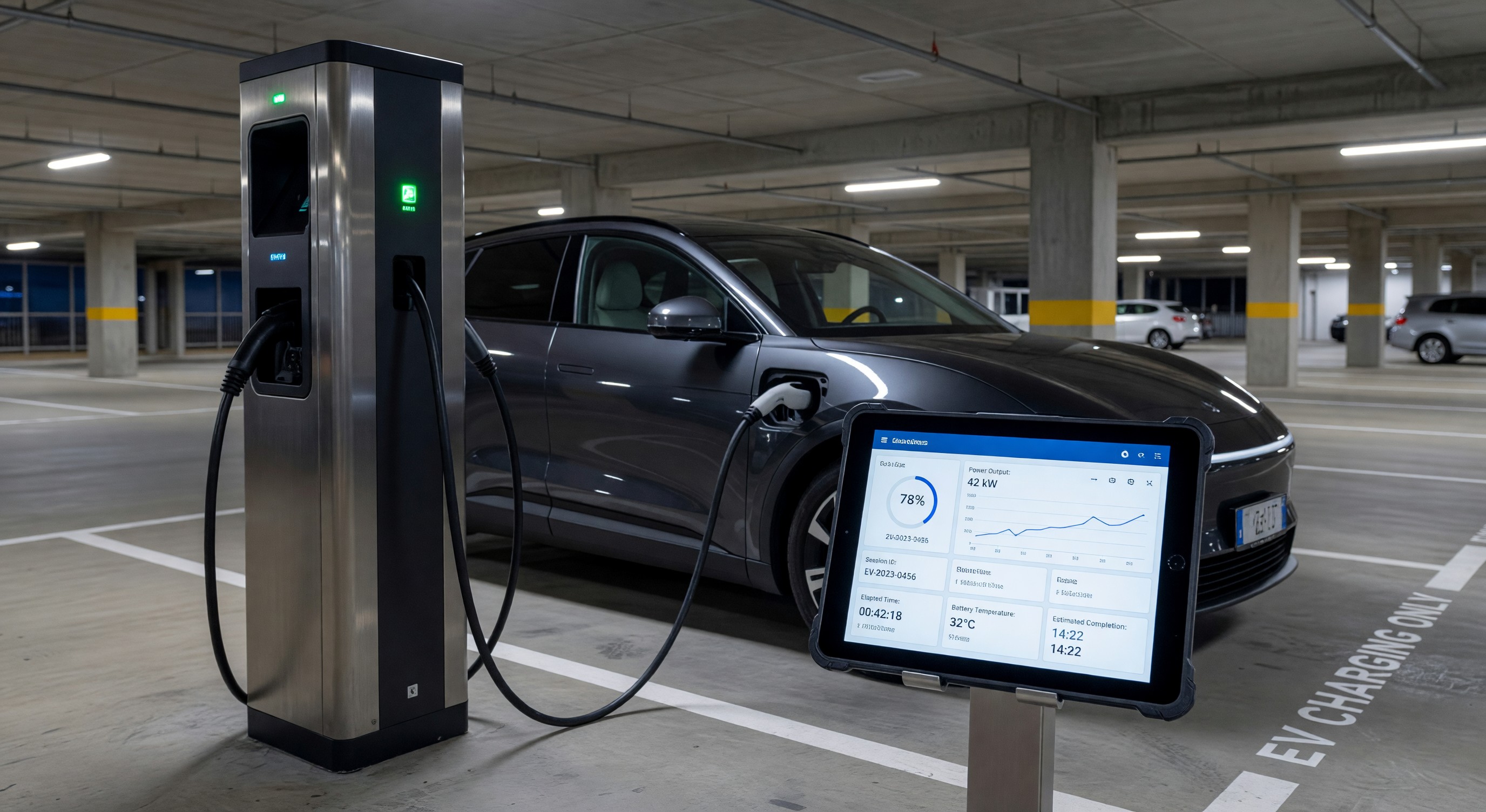
Session management: Starting, monitoring, and stopping charging sessions. The software tracks session start time, energy delivered, session duration, and session end state (completed, interrupted, fault).
Driver authentication: Verifying that a driver is authorized to charge and recording session-level billing information. Authentication methods include:
- RFID card/fob: Driver taps a registered RFID credential to the charger reader. Simple, reliable, but requires credential issuance.
- Mobile app: Driver initiates session through the network’s smartphone app. Convenient; requires app download and account setup.
- Credit card direct payment: Driver pays at the charger with a tap-to-pay or chip card. No account required; higher per-transaction processing cost.
- Plug and Charge (ISO 15118): The vehicle and charger authenticate each other automatically when the cable is plugged in, without driver interaction. Requires OCPP 2.0.1 and ISO 15118-compatible vehicle.
Energy metering and billing: The charger includes a calibrated energy meter that records kWh delivered per session. The management software converts energy delivery to a billing amount using the operator-configured pricing structure (per kWh, per session, per time, or combination). For parking facility EV charging, time-based fees are sometimes added to encourage turnover in high-demand charging spaces.
Load management: Multiple chargers connected to a shared electrical service compete for available capacity. The management software’s load management function allocates available amperage among active sessions to prevent service panel overload while maximizing charging throughput. Dynamic load management (OCPP 2.0.1 smart charging profiles) adjusts allocation in real time based on grid demand signals.
Remote monitoring and diagnostics: The management software monitors charger status in real time — fault codes, connectivity, utilization — and enables remote troubleshooting and restart. Remote diagnostics reduce the need for on-site service visits for software-resolvable issues.
Revenue and Reporting
Revenue models: EV charging revenue in parking facilities may include:
- Pass-through energy billing: Drivers pay for the exact energy delivered at a markup over the facility’s electricity cost
- Session fee: Flat fee per charging session regardless of energy delivered
- Time-based fee: Fee per minute of charging (and potentially additional fee for time connected after charging completes, encouraging turnover)
- Subscription access: Monthly subscriber access to charging for a flat fee
Reporting: Charging management platforms provide session-level reports that detail energy delivered, session duration, revenue, authentication method, and charger utilization. These reports should be exportable in formats compatible with accounting systems, and should be comparable to PARCS revenue reports for unified financial reporting.
Utility incentive programs: Many utility programs provide rebates, incentive payments, or demand response revenue for EV charging infrastructure. Charging management software that participates in utility smart charging or demand response programs may generate revenue credits that offset operating cost.
Integration with PARCS
For parking operators who want unified facility management, EV charging management integration with the PARCS system is desirable:
Combined session management: A parking session and a charging session that begin simultaneously should ideally be linked — the charging session is associated with the vehicle’s PARCS entry record, enabling combined parking-plus-charging billing and reporting.
Shared authentication: PARCS monthly parker accounts that include charging access should be able to present a single credential (LPR, proximity card, or mobile) that authorizes both parking access and charging session initiation.
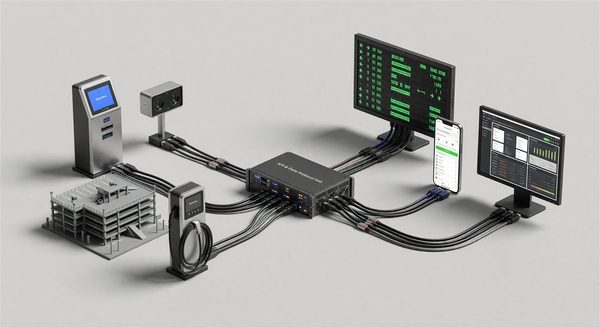
Unified operational dashboard: Facility managers benefit from viewing PARCS occupancy, revenue, and equipment status alongside EV charging session status, charger utilization, and energy revenue in a single dashboard rather than two separate platforms.
Most current PARCS platforms do not natively integrate with EV charging management software — this remains an active area of development, and integration depth varies significantly across PARCS vendors and charging network providers.
Frequently Asked Questions
Should a parking operator choose a national charging network or an independent platform? National charging networks offer faster deployment, established driver communities, and network operations support. Independent platforms offer more control over economics, branding, and data. For facilities seeking initial simplicity and driver reach, a national network is typically the faster path. For facilities with large EV charging programs or specific revenue model requirements, evaluating independent platforms alongside national networks is worthwhile.
What is Level 2 vs. DCFC charging, and which is appropriate for parking facilities? Level 2 (AC) charging at 208-240V delivers 7 to 19 kW, adding 25 to 60+ miles of range per hour of charging. Appropriate for parking sessions of 2+ hours — overnight parking, workday parking, extended shopping. DCFC (DC Fast Charge) at 50 to 350 kW can charge most EVs to 80% in 20 to 45 minutes. Appropriate for high-turnover facilities where parkers need significant range quickly. Most commercial parking deployments lead with Level 2 and add DCFC selectively.
How does demand management work for multi-charger installations? When multiple chargers share a single electrical service panel, the total simultaneous draw can exceed the panel’s capacity if all chargers operate at full power simultaneously. Demand management software monitors total draw and throttles individual charger output to keep total draw within the panel’s capacity. This allows more chargers to be installed on an existing electrical service than would be possible if each charger operated at full rated power independently.
What data should a parking operator receive from charging management software? At minimum: session count, total energy delivered (kWh), revenue by session and in total, charger uptime percentage, fault events and duration, and peak utilization periods. This data enables ROI tracking and informs decisions about charging program expansion or pricing adjustments.
Takeaway
EV charging management software is the operational and financial control layer for parking facility charging programs — managing sessions, authenticating drivers, tracking revenue, and providing the data needed to run charging as a managed facility service rather than an unmonitored amenity. OCPP compliance is the foundational requirement that preserves operator flexibility across a charging program’s lifecycle. Revenue model selection, load management configuration, and integration with PARCS systems determine whether charging generates meaningful revenue and operates within the operator’s management capacity. Facilities approaching EV charging as an operational program — with appropriate software infrastructure, clear revenue tracking, and load management — will extract far more value from their charging investment than those deploying chargers as standalone equipment without management integration.
Further Reading from Authoritative Sources
- U.S. Department of Energy EV charging infrastructure and EVSE standards — The U.S.
- IPMI EV charging integration guidance for parking facilities — The International Parking and Mobility Institute publishes guidance on EV charging integration for parking facilities that covers the management software, PARCS integration, and operational standards discussed in the article.