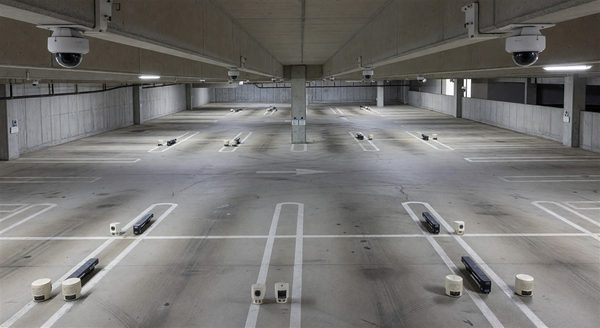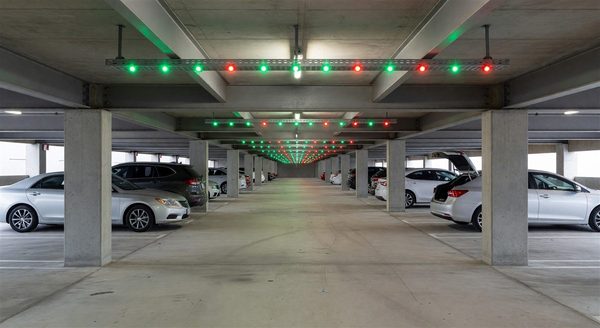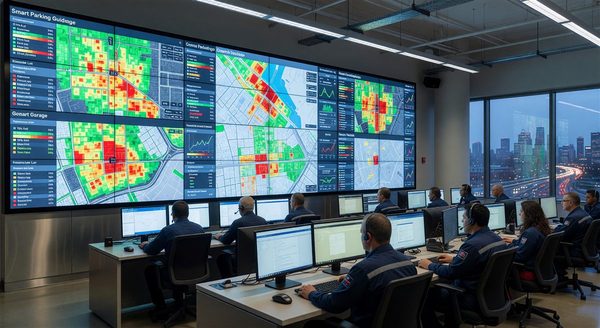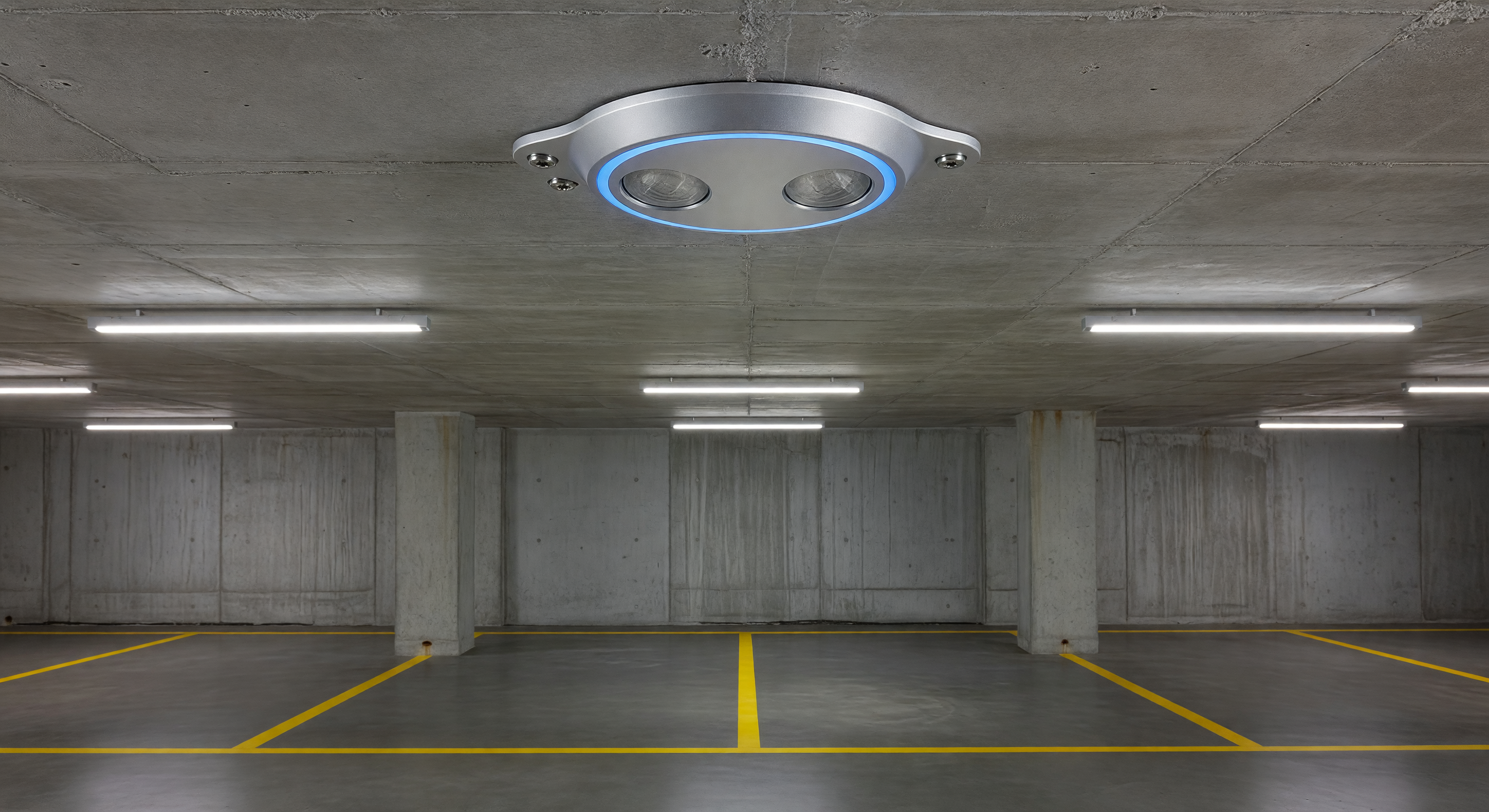
Parking occupancy sensors are a commodity product on paper and anything but in practice. Four technology families dominate the market — ultrasonic, magnetometer, camera-based, and LiDAR — and each has a distinct profile of strengths, failure modes, and total cost of ownership that product literature tends to obscure.
This review draws on publicly available deployment data and published independent studies; it is not a vendor comparison. The goal is to clarify when each technology makes sense, not which specific vendor leads in each category.
Ultrasonic
The dominant technology in indoor garage deployments for the last fifteen years. A ceiling-mounted sensor emits an ultrasonic pulse toward the parking space floor and measures the return time. A vehicle in the space returns the pulse earlier than an empty space would.
Strengths: Mature technology, typically the lowest unit cost ($30-80 per sensor at fleet scale), well-understood failure modes. Excellent accuracy when properly calibrated (98-99% in controlled indoor environments).
Weaknesses: Accuracy degrades with ceiling height variance (>4m becomes problematic), with vehicles of unusual form factor (motorcycles, convertibles with tops down), and with temperature extremes that affect air density. Sensors require line-of-sight, meaning anything mounted below the sensor (air ducts, sprinkler heads) must be designed around.
Best for: Indoor structured parking with uniform ceiling heights and conventional passenger vehicle mix.
Magnetometer
A puck-shaped sensor embedded in the pavement of the parking space detects the magnetic distortion caused by a vehicle’s body. Wireless communication (typically LoRaWAN or similar low-power WAN) transmits state changes to a gateway.
Strengths: Works outdoors and indoors equally well. No ceiling infrastructure required. Battery life of 5-7 years is achievable with conservative transmit schedules. Well-suited to surface lots where overhead mounting is impractical.
Weaknesses: Installation requires core-drilling each space, which is disruptive and creates pavement integrity concerns over time. The core-drill + epoxy seal is a long-term failure point in freeze-thaw climates. False positives from nearby moving vehicles or adjacent metal infrastructure (light poles, shopping carts) are common and require careful commissioning.
Best for: Surface lots, on-street parking, outdoor environments where ceiling mounting is impossible.
Camera-Based
A single camera can monitor 4-20 parking spaces depending on mounting height and viewing angle, with machine vision determining occupancy. This category has changed rapidly since 2020 as computer vision reliability has improved.
Strengths: Lowest per-space cost at high density (camera + processing can run $8-25 per space in dense deployments). Same hardware supports license plate recognition, space-level guidance, and security monitoring, allowing functional amortization. Incremental features (EV-charger occupancy, accessibility-space abuse detection) require software updates, not hardware changes.
Weaknesses: Lighting sensitivity remains significant. Glare, shadow patterns, and headlight bloom can each degrade reliability. Outdoor deployments typically require camera-per-space density approaching other technologies once lighting-robust configurations are specified. Privacy concerns (especially combined with LPR) trigger legal review in several jurisdictions and have killed some municipal deployments.
Best for: Indoor garages with controlled lighting; multi-function deployments where LPR or guidance is also desired; jurisdictions without strict anti-surveillance policies.
LiDAR
A relatively recent entry to the parking occupancy market. Solid-state LiDAR sensors measure distance to multiple points in the parking space, building a partial 3D representation that reliably distinguishes vehicle from empty space regardless of lighting.
Strengths: Essentially immune to lighting conditions. Very high accuracy (99%+) across a wider range of vehicle types than ultrasonic. One sensor can cover 8-15 spaces from suitable mounting positions.
Weaknesses: Unit cost remains high ($200-500 per sensor), so per-space cost is competitive only at favorable coverage geometries. Dust, snow accumulation on the sensor itself, and direct sunlight at certain angles can degrade accuracy. The installed base is small enough that long-term reliability data is not yet available.
Best for: High-end installations where accuracy is critical and lighting is uncontrolled; airport parking, premium garages, accessibility-compliance monitoring.
The Comparison That Actually Matters
The sensor choice rarely determines project success. Commissioning quality, calibration discipline, and the back-end software’s handling of ambiguous sensor states matter more than the underlying technology.
An ultrasonic deployment with careful commissioning outperforms a LiDAR deployment with default settings. A magnetometer deployment with quarterly recalibration outperforms a camera deployment with no maintenance plan. Procurement decisions that weight hardware cost heavily while treating commissioning as an afterthought are the reliable predictor of post-deployment disappointment, regardless of the chosen technology.
Frequently Asked Questions
How accurate is “99% accurate” in real deployments?
Vendor-claimed accuracy is typically measured in controlled commissioning conditions. Real deployment accuracy, measured over a month of actual operation including edge cases, typically runs 3-8 percentage points lower. A 99% claim usually translates to 92-96% in the field. A 95% claim often drops below 90%.
Is battery life a concern for magnetometer sensors?
Yes, but less than it was. Current-generation sensors with conservative transmit schedules (state-change only, hourly heartbeat) achieve 5-7 year battery life. The operational risk is less about average battery life and more about the distribution — some sensors fail early and create a rolling replacement burden if the fleet was deployed in one cohort.
Can these sensors detect EV charging?
Indirectly. An occupancy sensor reports whether a space is occupied, not whether a charging cable is connected. True EV-charging monitoring requires either integration with the charger’s own telemetry or camera-based systems trained to detect the cable connection. Several vendors now offer the latter; the former is generally more reliable where available.
How do sensors integrate with parking guidance signage?
Through a back-end aggregator that consumes sensor state and drives the guidance system. Industry has standardized on MQTT and REST APIs for this integration. Vendor-specific protocols still exist but are declining. Operators specifying new systems should insist on open protocols to preserve future flexibility.
Further Reading from Authoritative Sources
- NIST IoT sensor standards and measurement technology guidance — NIST publishes standards for IoT sensor performance, measurement accuracy, and calibration protocols that directly inform the accuracy benchmarking and commissioning quality discussion in this article.
- IPMI parking guidance system and occupancy sensor technology resources — IPMI publishes technology evaluation guidance, deployment case studies, and operational best practices for parking occupancy sensing and guidance systems.