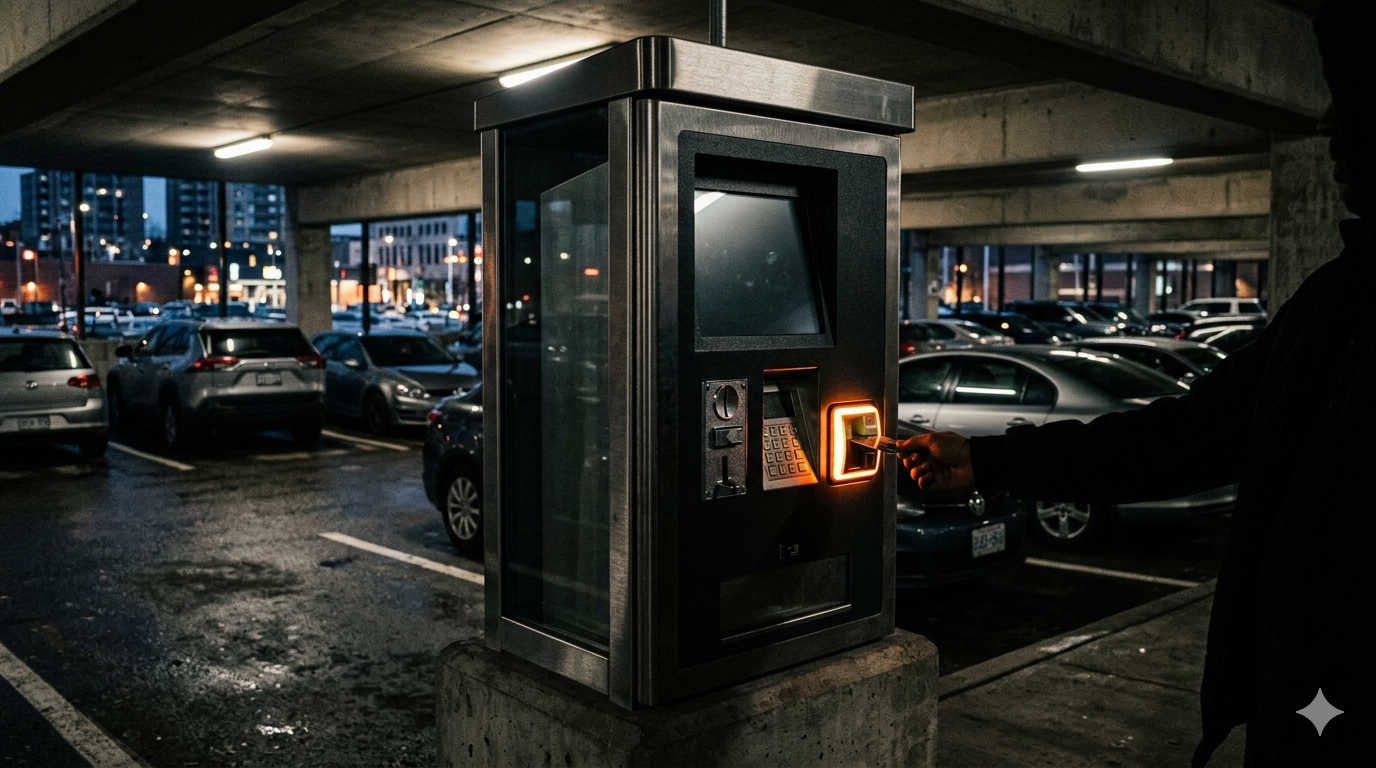
The EMV migration in the United States has been dominated by discussion of retail point-of-sale terminals — the chip readers at grocery stores, restaurants, and pharmacies. But a quieter revolution is happening in unattended payment environments, and parking is leading the way.
In March 2015, Parking BOXX became the first parking system in the United States to receive Moneris certification for EMV unattended solutions — a milestone that signals the industry’s shift toward chip card security in self-service environments.
This matters more than it might seem.
Why Unattended EMV Is Harder
Implementing EMV at a staffed checkout counter is relatively straightforward. A cashier can help customers navigate the chip card process, handle errors, and call a manager if something goes wrong. In an unattended parking environment, the technology has to handle everything autonomously.
The challenges include:
Error recovery — When a chip card transaction fails (card not read properly, communication timeout, PIN entry error), the system must guide the customer through recovery without human assistance. In a parking exit lane, this must happen quickly to prevent traffic queuing.
PIN pad security — Unattended PIN pads must meet stricter physical security requirements than attended terminals. They need tamper-resistant housings, encrypted PIN entry, and detection mechanisms for skimming devices — all while being mounted outdoors in weather-exposed locations.
Certification complexity — Each combination of card reader hardware, payment application software, and payment processor must be certified together. Unattended environments require separate certification from attended environments, and the testing requirements are more rigorous.
Network reliability — EMV transactions require real-time communication with the card issuer for authorization. Unlike magnetic stripe transactions that can sometimes be batched, chip card transactions need consistent network connectivity at every payment point in the facility.
What the Moneris Certification Means
Moneris Solutions is one of North America’s largest payment processors. Their certification of an EMV unattended parking solution validates several things:
- Technical feasibility — EMV chip-and-PIN works reliably in unattended parking environments
- Security compliance — The hardware and software meet PCI and EMV security standards for self-service
- Processing readiness — The payment processing infrastructure can handle EMV transactions from parking equipment
- Industry readiness — Parking operators now have a certified, commercially available EMV solution
This certification opens the door for parking operators across the United States to begin deploying EMV-capable payment machines ahead of the October 2015 liability shift deadline.
The Liability Shift Countdown
With the major card networks’ October 2015 liability shift approaching, parking operators face a clear decision point. After the shift:
- Facilities with EMV-capable payment systems are protected from counterfeit card fraud liability
- Facilities still using magnetic stripe only will absorb counterfeit fraud losses
For high-volume parking operations processing thousands of credit card transactions daily, the fraud liability exposure is significant. A single large-scale card counterfeiting attack targeting a facility without EMV protection could cost tens of thousands of dollars.
What This Means for Parking Operators
Immediate Opportunity
Parking operators can now specify EMV-certified equipment with confidence. The certification proves the technology works in real-world unattended conditions, not just in a lab.
Procurement Considerations
When evaluating parking payment equipment, operators should ask:
- Is the system certified for EMV in unattended environments? (Not just attended — the certifications are different)
- Which payment processors are supported?
- What’s the chip card transaction time? (Critical for exit lane applications)
- Does the system support both chip-and-PIN and chip-and-signature?
- Can the system fall back to magnetic stripe for cards without chips?
Future-Proofing
EMV certification is a critical step in modernizing parking payment infrastructure. Systems certified for EMV chip today are built on a platform that can accommodate future payment innovations as they emerge.
Beyond Parking: The Unattended Payment Trend
Parking is just one segment of the broader unattended payment market that includes transit, vending, and self-service fuel. The National Parking Association has highlighted unattended payment as a key technology trend for the industry. The parking industry’s early EMV adoption positions it as a proof point for other unattended sectors.
The fact that parking — with its challenging outdoor environments, diverse user populations, and high transaction volumes — can successfully implement EMV demonstrates that virtually any unattended payment environment can make the transition.
Key Takeaways
- The first US EMV certification for unattended parking represents a genuine industry milestone
- Unattended EMV implementation is significantly more complex than attended retail deployment
- The October 2015 liability shift creates financial urgency for parking operators to adopt EMV
- Certified solutions now exist for parking operators to deploy with confidence
- EMV capability is the foundation for future payment technology upgrades
- Parking’s early adoption of unattended EMV positions the industry as a leader in payment security