The parking barrier gate is one of the most visible and most misunderstood pieces of parking technology, as noted by the International Parking & Mobility Institute in their technology guides. To casual observers, it’s a simple mechanical arm that goes up and down. To parking professionals, it’s the primary control point for facility access, revenue integrity, and customer experience.
And it’s gotten remarkably sophisticated.
A Brief History
Generation 1: Mechanical Gates (1960s-1980s)
The earliest parking barrier gates were purely mechanical devices. A motor drove a gearbox that raised and lowered a wooden or aluminum arm. Control was simple: a signal from a ticket dispenser or loop detector triggered the motor. These gates were reliable but slow, noisy, and offered no intelligence.
Generation 2: Electromechanical Gates (1990s-2000s)
The addition of electronic controllers brought programmable logic to barrier gates. Operators could configure arm speed, auto-close timing, and basic safety features (auto-reverse on obstruction). Communication with central management systems became possible, enabling remote monitoring and basic statistics.
Generation 3: Smart Gates (2010s-Present)
Today’s barrier gate systems are networked, intelligent devices that integrate with access control, payment systems, LPR cameras, and management software. They’re no longer just barriers — they’re data collection points and customer interaction touchpoints.
Modern Gate Architecture
A contemporary parking barrier gate installation includes:
The Gate Mechanism
The mechanical arm assembly and motor. Key specifications:
| Specification | Standard | High-Performance |
|---|---|---|
| Arm length | Up to 12 ft | Up to 18 ft |
| Cycle time | 3-6 seconds | 1-1.5 seconds |
| Duty cycle | 50% | 100% (continuous) |
| Operating temp | -20°C to +50°C | -40°C to +60°C |
| Motor type | AC gear motor | DC brushless servo |
| Arm type | Aluminum, round | Articulating, LED-lit |
Cycle time is critical for high-volume facilities. A gate that takes 6 seconds to open and close can process a maximum of 600 vehicles per hour per lane. A 1.5-second gate handles over 2,000 vehicles per hour — a significant difference during peak periods.
Articulating arms fold upward rather than swinging in a full arc. This allows installation under low ceilings (common in parking garages) and reduces the clearance required.
The Controller
The electronic brain of the gate. Modern controllers:
- Accept inputs from multiple credential readers (proximity cards, key fobs, LPR cameras, mobile credentials)
- Communicate with management software via TCP/IP network
- Log every open/close event with timestamp and credential used
- Support programmable access schedules
- Provide diagnostic information for predictive maintenance
- Interface with payment systems for revenue-controlled access
Safety Systems
Gate safety has evolved significantly. Current requirements include:
- Vehicle detection loops — Inductive loops embedded in the pavement detect vehicle presence and prevent the arm from closing on a vehicle
- Infrared safety beams — Photo-eye sensors across the lane opening detect objects the loops might miss (motorcycles, pedestrians, shopping carts)
- Arm breakaway — The arm is designed to break free or flex rather than damage a vehicle if contact occurs
- Auto-reverse — The arm automatically reverses direction if it contacts an obstruction
- Soft-start/soft-stop — Gradual acceleration and deceleration reduce mechanical stress and noise
Integration Points
The barrier gate’s value increases with each system it connects to:
Access Control
The gate works with the access control system to verify credentials before opening:
- Proximity cards and key fobs (HID, MIFARE)
- License plate recognition (automatic identification, no credential needed)
- Mobile credentials (Bluetooth, NFC via smartphone)
- Ticket validation (barcode, QR code, magnetic stripe)
- Intercom-based manual override (visitor assistance)
Payment Systems
In revenue-controlled facilities, the gate won’t open until payment is confirmed:
- Pay-on-foot validation at the exit lane
- Credit card payment at the exit lane reader
- Pre-paid mobile payment validated via LPR or QR code
- Monthly permit verified via access credential
Management Software
The gate feeds operational data to the management platform:
- Vehicle counts (entry and exit by lane, by hour)
- Peak period identification
- Average transaction times
- Equipment utilization rates
- Fault and maintenance alerts
Choosing the Right Gate
Selecting the right barrier gate involves balancing cycle speed, arm length, environmental ratings, and integration capabilities — a decision complex enough that a complete buyer’s guide to barrier gate systems is worth reviewing before committing to a specification.
Traffic Volume
Match the gate specification to your facility’s peak traffic:
| Peak Vehicles/Hour/Lane | Recommended Cycle Time | Gate Class |
|---|---|---|
| Under 200 | 4-6 seconds | Standard |
| 200-500 | 2-3 seconds | Commercial |
| 500-1000 | 1-1.5 seconds | High-speed |
| Over 1000 | Consider free-flow (no gate) | LPR-based |
Arm Length
The arm must span the full lane width with margin for safety:
- Single lane (8-10 ft): Standard arm, most economical
- Wide lane (10-14 ft): Extended arm, may need counterbalance
- Double lane (14-18 ft): Extra-long arm with heavy-duty motor
- Over 18 ft: Consider dual-arm installation from both sides
Environment
- Cold climates: Specify extended temperature range and heated cabinets for controllers
- Coastal locations: Specify marine-grade corrosion protection
- High wind areas: Consider aerodynamic arm profiles and wind loading calculations
- Heavy use: Specify 100% duty cycle motors designed for continuous operation
Aesthetics
Parking gates are increasingly visible architectural elements. Options include:
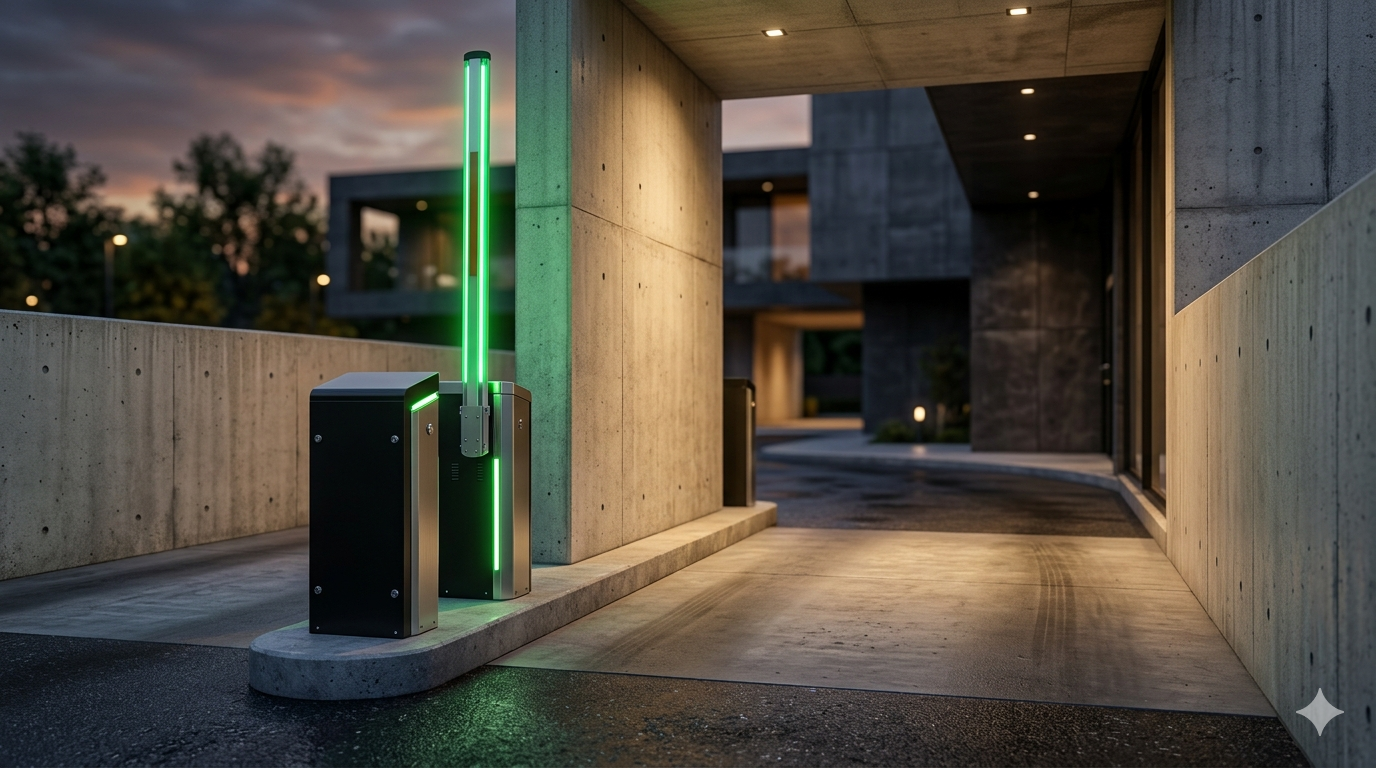
- LED-illuminated arms (red when closed, green when open)
- Custom housing colors to match facility design
- Integrated signage and branding
- Low-profile designs for premium facilities
Maintenance Considerations
Barrier gates are mechanical devices that require regular maintenance:
Monthly: Visual inspection, arm alignment check, safety system test Quarterly: Lubrication, belt/chain tension, electrical connections Annually: Full mechanical inspection, controller firmware update, calibration
The most common failure points:
- Loop detectors — Wire breaks from pavement movement
- Photo-eyes — Misalignment from vibration or impact
- Arm pivot points — Wear from continuous cycling
- Motor gearbox — Gear wear in high-cycle installations
- Controller boards — Environmental damage (moisture, temperature extremes)
Newer gates with brushless DC motors and belt drives have significantly longer maintenance intervals than older AC motor/gearbox designs.
The Future of Gate Technology
Several trends are shaping the next generation of barrier gates:
Gateless facilities — LPR-based access control that eliminates physical barriers entirely, using license plate identification for both access and payment
Predictive maintenance — IoT sensors monitoring motor temperature, cycle counts, and vibration patterns to predict failures before they occur
Vehicle-to-infrastructure communication — Connected vehicles communicating credentials directly to the gate without any driver action, a concept actively researched by the Intelligent Transportation Systems Joint Program Office
Energy harvesting — Solar and kinetic energy systems that power gates independently of facility electrical infrastructure, with research supported by the U.S. Department of Energy
Key Takeaways
- Modern barrier gates are integrated access control and data collection points, not just mechanical barriers
- Cycle time and duty cycle are the critical specifications for high-volume facilities
- Safety systems (loops, photo-eyes, breakaway arms) are essential and increasingly sophisticated
- Integration with access control, payment, LPR, and management software multiplies the gate’s value
- Maintenance requirements have decreased with modern brushless motors and belt drives
- Gateless LPR-based facilities may reduce the need for physical barriers in the future
Frequently Asked Questions
What cycle time is required to handle 500 to 1,000 vehicles per hour per lane? High-speed gates with 1 to 1.5-second cycle times are required for 500 to 1,000 vehicles per hour per lane. A standard gate at 6 seconds can process a maximum of 600 vehicles per hour per lane; a 1.5-second gate handles over 2,000 vehicles per hour—a critical difference during peak ingress or egress periods.
What are the primary safety systems required in modern parking barrier gates? Current safety requirements include vehicle detection loops (inductive loops embedded in pavement that prevent the arm from closing on a vehicle), infrared safety beams (photo-eye sensors that detect motorcycles, pedestrians, and shopping carts the loops might miss), arm breakaway design (arm flexes rather than damages a vehicle on contact), auto-reverse on obstruction, and soft-start/soft-stop gradual acceleration.
What is an articulating arm and why is it used in parking garages? Articulating arms fold upward rather than swinging in a full arc. This allows installation under low ceilings common in parking garages and reduces the clearance required compared to standard arms. For facilities with overhead obstructions, articulating arm designs are often the only practical option.
What maintenance intervals are recommended for parking barrier gates? Monthly maintenance includes visual inspection, arm alignment check, and safety system test. Quarterly maintenance covers lubrication, belt/chain tension, and electrical connections. Annual maintenance includes full mechanical inspection, controller firmware update, and calibration. Newer gates with brushless DC motors and belt drives have significantly longer maintenance intervals than older AC motor/gearbox designs.
What credential types can modern barrier gate controllers accept? Modern controllers accept proximity cards and key fobs (HID, MIFARE), license plate recognition (automatic identification with no credential needed), mobile credentials via Bluetooth or NFC smartphone, barcode and QR code ticket validation, and intercom-based manual override. The gate works with the access control system to verify credentials before opening and logs every event with timestamp.