The parking barrier gate is one of the most visible and most misunderstood pieces of parking technology, as noted by the International Parking & Mobility Institute in their technology guides. To casual observers, it’s a simple mechanical arm that goes up and down. To parking professionals, it’s the primary control point for facility access, revenue integrity, and customer experience.
And it’s gotten remarkably sophisticated.
A Brief History
Generation 1: Mechanical Gates (1960s-1980s)
The earliest parking barrier gates were purely mechanical devices. A motor drove a gearbox that raised and lowered a wooden or aluminum arm. Control was simple: a signal from a ticket dispenser or loop detector triggered the motor. These gates were reliable but slow, noisy, and offered no intelligence.
Generation 2: Electromechanical Gates (1990s-2000s)
The addition of electronic controllers brought programmable logic to barrier gates. Operators could configure arm speed, auto-close timing, and basic safety features (auto-reverse on obstruction). Communication with central management systems became possible, enabling remote monitoring and basic statistics.
Generation 3: Smart Gates (2010s-Present)
Today’s barrier gate systems are networked, intelligent devices that integrate with access control, payment systems, LPR cameras, and management software. They’re no longer just barriers — they’re data collection points and customer interaction touchpoints.
Modern Gate Architecture
A contemporary parking barrier gate installation includes:
The Gate Mechanism
The mechanical arm assembly and motor. Key specifications:
| Specification | Standard | High-Performance |
|---|---|---|
| Arm length | Up to 12 ft | Up to 18 ft |
| Cycle time | 3-6 seconds | 1-1.5 seconds |
| Duty cycle | 50% | 100% (continuous) |
| Operating temp | -20°C to +50°C | -40°C to +60°C |
| Motor type | AC gear motor | DC brushless servo |
| Arm type | Aluminum, round | Articulating, LED-lit |
Cycle time is critical for high-volume facilities. A gate that takes 6 seconds to open and close can process a maximum of 600 vehicles per hour per lane. A 1.5-second gate handles over 2,000 vehicles per hour — a significant difference during peak periods.
Articulating arms fold upward rather than swinging in a full arc. This allows installation under low ceilings (common in parking garages) and reduces the clearance required.
The Controller
The electronic brain of the gate. Modern controllers:
- Accept inputs from multiple credential readers (proximity cards, key fobs, LPR cameras, mobile credentials)
- Communicate with management software via TCP/IP network
- Log every open/close event with timestamp and credential used
- Support programmable access schedules
- Provide diagnostic information for predictive maintenance
- Interface with payment systems for revenue-controlled access
Safety Systems
Gate safety has evolved significantly. Current requirements include:
- Vehicle detection loops — Inductive loops embedded in the pavement detect vehicle presence and prevent the arm from closing on a vehicle
- Infrared safety beams — Photo-eye sensors across the lane opening detect objects the loops might miss (motorcycles, pedestrians, shopping carts)
- Arm breakaway — The arm is designed to break free or flex rather than damage a vehicle if contact occurs
- Auto-reverse — The arm automatically reverses direction if it contacts an obstruction
- Soft-start/soft-stop — Gradual acceleration and deceleration reduce mechanical stress and noise
Integration Points
The barrier gate’s value increases with each system it connects to:
Access Control
The gate works with the access control system to verify credentials before opening:
- Proximity cards and key fobs (HID, MIFARE)
- License plate recognition (automatic identification, no credential needed)
- Mobile credentials (Bluetooth, NFC via smartphone)
- Ticket validation (barcode, QR code, magnetic stripe)
- Intercom-based manual override (visitor assistance)
Payment Systems
In revenue-controlled facilities, the gate won’t open until payment is confirmed:
- Pay-on-foot validation at the exit lane
- Credit card payment at the exit lane reader
- Pre-paid mobile payment validated via LPR or QR code
- Monthly permit verified via access credential
Management Software
The gate feeds operational data to the management platform:
- Vehicle counts (entry and exit by lane, by hour)
- Peak period identification
- Average transaction times
- Equipment utilization rates
- Fault and maintenance alerts
Choosing the Right Gate
Selecting the right barrier gate involves balancing cycle speed, arm length, environmental ratings, and integration capabilities — a decision complex enough that a complete buyer’s guide to barrier gate systems is worth reviewing before committing to a specification.
Traffic Volume
Match the gate specification to your facility’s peak traffic:
| Peak Vehicles/Hour/Lane | Recommended Cycle Time | Gate Class |
|---|---|---|
| Under 200 | 4-6 seconds | Standard |
| 200-500 | 2-3 seconds | Commercial |
| 500-1000 | 1-1.5 seconds | High-speed |
| Over 1000 | Consider free-flow (no gate) | LPR-based |
Arm Length
The arm must span the full lane width with margin for safety:
- Single lane (8-10 ft): Standard arm, most economical
- Wide lane (10-14 ft): Extended arm, may need counterbalance
- Double lane (14-18 ft): Extra-long arm with heavy-duty motor
- Over 18 ft: Consider dual-arm installation from both sides
Environment
- Cold climates: Specify extended temperature range and heated cabinets for controllers
- Coastal locations: Specify marine-grade corrosion protection
- High wind areas: Consider aerodynamic arm profiles and wind loading calculations
- Heavy use: Specify 100% duty cycle motors designed for continuous operation
Aesthetics
Parking gates are increasingly visible architectural elements. Options include:
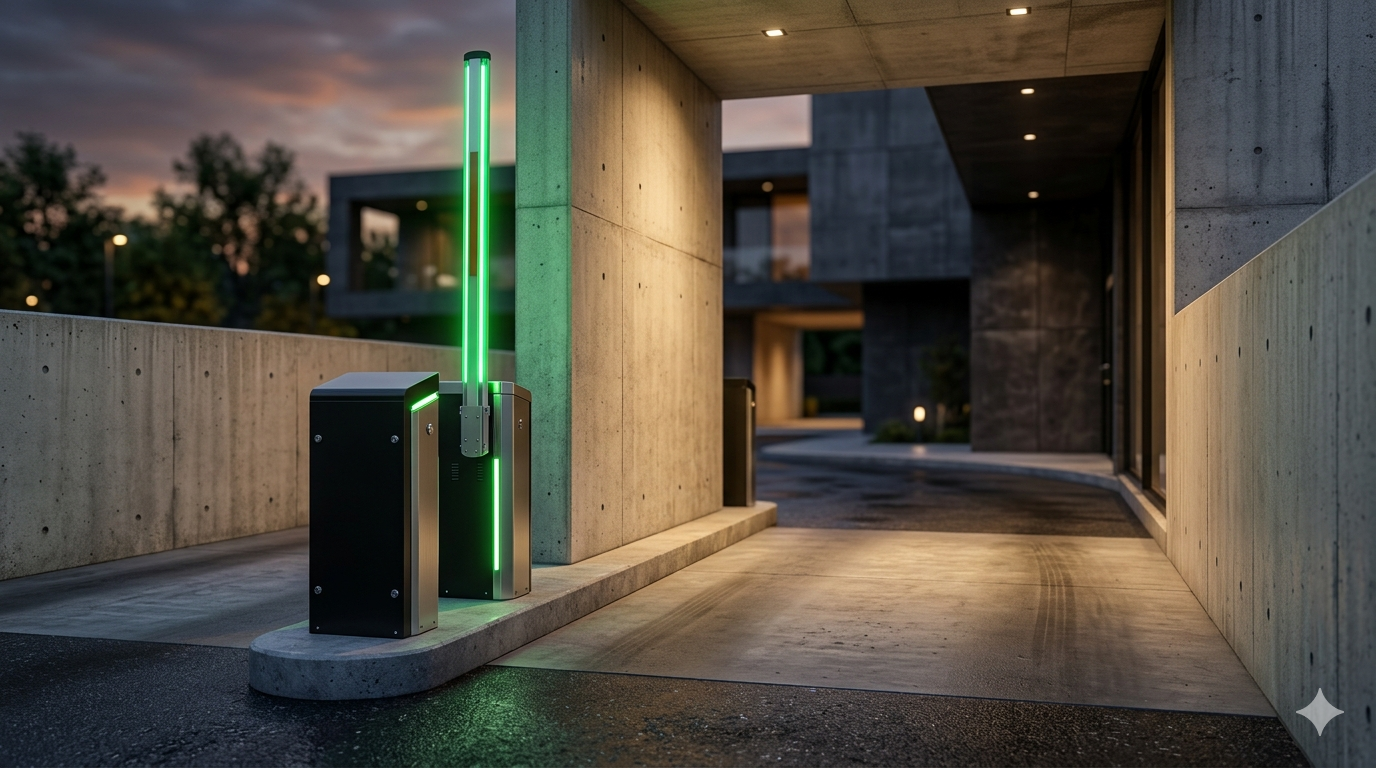
- LED-illuminated arms (red when closed, green when open)
- Custom housing colors to match facility design
- Integrated signage and branding
- Low-profile designs for premium facilities
Maintenance Considerations
Barrier gates are mechanical devices that require regular maintenance:
Monthly: Visual inspection, arm alignment check, safety system test Quarterly: Lubrication, belt/chain tension, electrical connections Annually: Full mechanical inspection, controller firmware update, calibration
The most common failure points:
- Loop detectors — Wire breaks from pavement movement
- Photo-eyes — Misalignment from vibration or impact
- Arm pivot points — Wear from continuous cycling
- Motor gearbox — Gear wear in high-cycle installations
- Controller boards — Environmental damage (moisture, temperature extremes)
Newer gates with brushless DC motors and belt drives have significantly longer maintenance intervals than older AC motor/gearbox designs.
The Future of Gate Technology
Several trends are shaping the next generation of barrier gates:
Gateless facilities — LPR-based access control that eliminates physical barriers entirely, using license plate identification for both access and payment
Predictive maintenance — IoT sensors monitoring motor temperature, cycle counts, and vibration patterns to predict failures before they occur
Vehicle-to-infrastructure communication — Connected vehicles communicating credentials directly to the gate without any driver action, a concept actively researched by the Intelligent Transportation Systems Joint Program Office
Energy harvesting — Solar and kinetic energy systems that power gates independently of facility electrical infrastructure, with research supported by the U.S. Department of Energy
Key Takeaways
- Modern barrier gates are integrated access control and data collection points, not just mechanical barriers
- Cycle time and duty cycle are the critical specifications for high-volume facilities
- Safety systems (loops, photo-eyes, breakaway arms) are essential and increasingly sophisticated
- Integration with access control, payment, LPR, and management software multiplies the gate’s value
- Maintenance requirements have decreased with modern brushless motors and belt drives
- Gateless LPR-based facilities may reduce the need for physical barriers in the future